Fill out New York court forms
with AI.
New York court forms are the essential building blocks for navigating the state's complex legal system, providing the necessary structure for everything from civil litigation to administrative proceedings. These documents, such as a Summons for the Supreme Court, serve as the official method for initiating legal actions and notifying parties of their rights and responsibilities. Because the New York State Unified Court System relies on specific procedural standards, ensuring that every form is completed accurately is vital for maintaining the integrity of a case and avoiding costly procedural delays.
By continuing, you acknowledge Instafill's Privacy Policy and agree to get occasional product update and promotional emails.
About New York court forms
These forms are most commonly utilized by legal professionals, business owners, and individuals representing themselves in court. Whether you are filing a new lawsuit, responding to a claim, or managing ongoing litigation, having access to the correct paperwork is the first step in the judicial process. Since legal matters often involve strict deadlines and precise language, the burden of manual data entry can be both stressful and time-consuming for those already managing high-stakes situations.
To streamline this process, modern tools like Instafill.ai use AI to fill these forms in under 30 seconds, handling sensitive data accurately and securely. This allows users to complete their necessary filings with confidence, reducing the administrative overhead associated with New York legal forms and allowing them to focus on the more substantive aspects of their legal strategy.
Every form on this page can be completed without typing. Instafill is form filling software that reads a PDF and fills it for you — including flat and scanned documents that carry no fillable fields at all.
Forms in This Category
The forms in this category have a median Form Complexity Index of 60/100 (Moderate), measured across 3 forms by field count, input difficulty, length, conditional logic and structure. See how it is calculated.
| Form Name | Pages | FCI | |
|---|---|---|---|
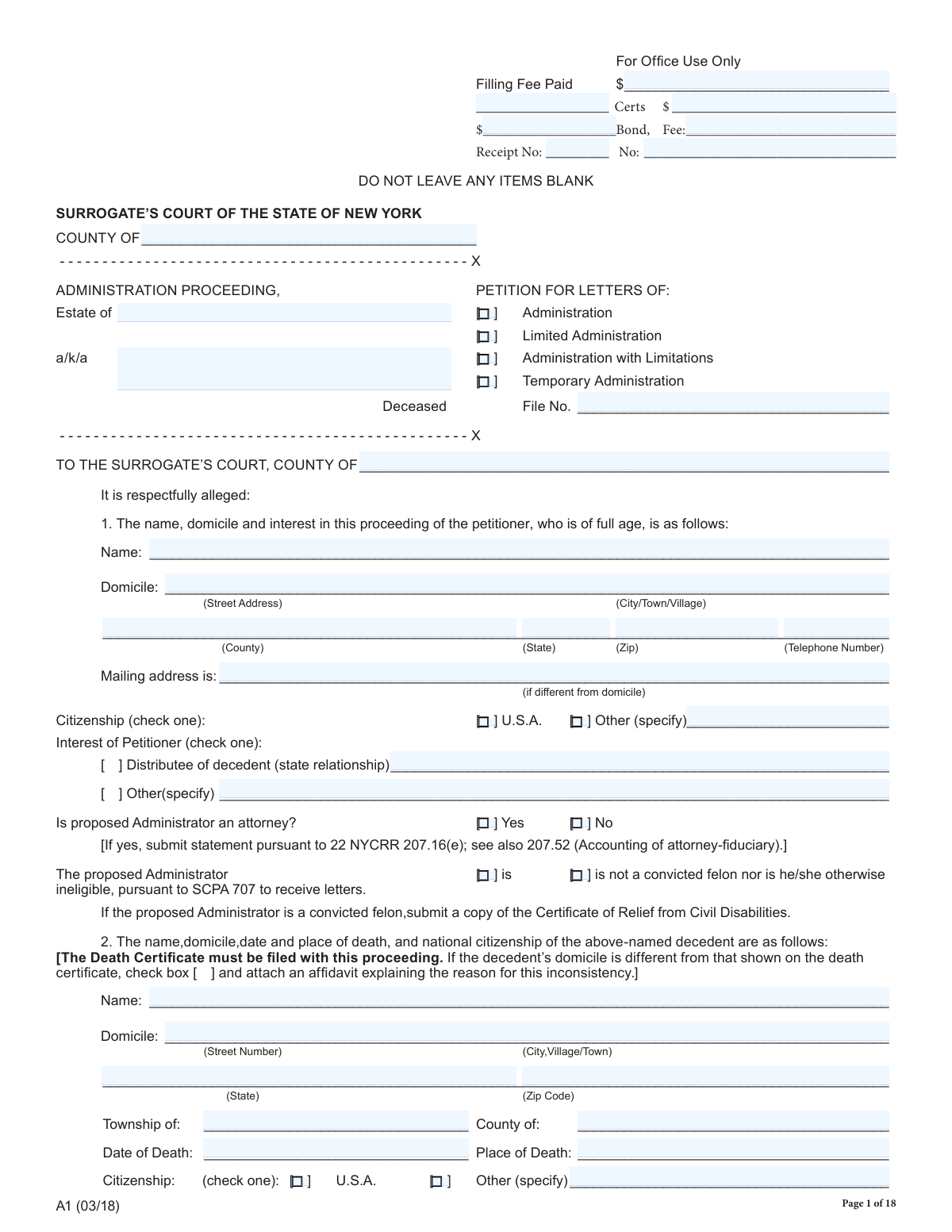
| 1. | Petition for Letters of Administration (New York Surrogate's Court) | 4 | Moderate 60 |
| 2. | Statement of Net Worth, Supreme Court of the State of New York | 24 | Very Complex 91 |
| 3. | Form Summons, Supreme Court of New York | 1 | Basic 31 |
- Enterprise-grade security & data encryption
- 99%+ accuracy powered by AI
- 1,000+ forms from all industries
- Complete forms in under 60 seconds
How to Choose the Right Form
Initiating a Civil Action in New York
Navigating the New York Unified Court System requires precision from the very first filing. If you are starting a lawsuit, the document you choose depends on the court's jurisdiction and the nature of your claim. In this category, the primary tool for starting a case is the Form Summons, Supreme Court of New York.
When to Use the Supreme Court Summons
The New York State Supreme Court is the trial-level court of general jurisdiction. You should select the Form Summons, Supreme Court of New York if your case meets the following criteria:
- High-Value Claims: Your dispute involves monetary damages that exceed the limits of lower courts (generally over $25,000 in New York City or $15,000 in other jurisdictions).
- Equitable Relief: You are seeking a court order other than money, such as a permanent injunction, a declaratory judgment, or a divorce.
- Formal Litigation: You are prepared to proceed with a full civil trial and the formal discovery process.
Summons with Notice vs. Summons and Complaint
When filling out the Form Summons, Supreme Court of New York, you must decide how you will present your claims to the defendant.
1. Summons with Notice: This version includes a brief statement of the nature of the action and the relief sought. It is often used when an attorney needs to start an action quickly to meet a statute of limitations deadline.
2. Summons and Complaint: This is the more common approach where the summons is served alongside a detailed "Verified Complaint" outlining every legal allegation.
Ensuring Proper Jurisdiction
Before finalizing your form, ensure that the Supreme Court is the correct venue. If your dispute involves a landlord-tenant issue or a small claim under $10,000, you may need specific forms for the Civil Court of the City of New York or local Justice Courts instead. However, for significant litigation and general civil matters, the Form Summons, Supreme Court of New York remains the standard requirement for notifying defendants and establishing the court's authority over the case.
Form Comparison
| Form | Purpose | Who Files It | Filing Deadline |
|---|---|---|---|
| Form Summons, Supreme Court of New York | Initiates a lawsuit and officially notifies defendants of legal action against them. | The plaintiff or their legal representative starting a civil case. | Served at the start of litigation; defendant must respond within 20-30 days. |
Tips for New York court forms
In New York Supreme Court, even a minor misspelling of a party's name can lead to motions to dismiss or delays in service. Double-check all legal names against official records or identification to ensure the court's jurisdiction is properly established from the start.
When filling out New York litigation forms, you must specify why the particular county was chosen for the case. Whether it is based on the residence of a party or where the claim arose, ensuring this section is accurate prevents the case from being transferred or challenged.
If you are filing a Summons with Notice without a full complaint, you must provide a brief but clear statement of the nature of the action and the relief sought. Failing to include sufficient detail in this section can result in a jurisdictional defect that may jeopardize the lawsuit.
In the New York Supreme Court, you generally need to file your summons and pay the required fee to obtain an index number before serving the defendant. Ensure this number is clearly written on all copies distributed to avoid administrative rejection by the court clerk.
Filling out repetitive legal details across multiple forms can be tedious and prone to human error. AI-powered tools like Instafill.ai can complete these forms in under 30 seconds with high accuracy, ensuring your data stays secure while significantly speeding up the preparation process.
After the summons is delivered, you must complete and file an Affidavit of Service to prove the defendant was notified. Keep a detailed log of exactly when and how the forms were delivered, as this documentation is required by the court to move forward with the litigation.
While Supreme Court forms are standardized across the state, individual counties in New York may have specific local rules regarding electronic filing through the NYSCEF system. Review the specific requirements for the county where you are filing to ensure your documents are formatted correctly.
Frequently Asked Questions
New York court forms are standardized legal documents used to initiate lawsuits, respond to claims, or request specific actions from a judge. These forms ensure that all parties and the court receive necessary information in a format that complies with the New York Civil Practice Law and Rules (CPLR).
The correct court depends on the nature of your legal matter and the amount of money in dispute. The Supreme Court of New York generally handles civil cases involving higher monetary values and matrimonial actions, while Civil, City, or Small Claims courts handle smaller disputes and landlord-tenant issues.
Yes, AI tools like Instafill.ai can be used to fill out New York court forms efficiently. These tools accurately extract data from your source documents and place it into the correct fields on the PDF, ensuring the information is transposed correctly without manual typing.
Using AI-powered platforms, you can often complete complex New York court forms in under 30 seconds. This process is significantly faster than manual entry and helps reduce the risk of clerical errors when transferring data from personal records to legal documents.
Once a summons is completed and filed with the court clerk, it must be served on the defendant by a person who is at least 18 years old and not a party to the case. Proper service is a legal requirement in New York to ensure the defendant has been officially notified of the litigation.
Filing the incorrect form can lead to your case being delayed, rejected by the clerk, or even dismissed by a judge. It is essential to verify that the form you are using matches the specific legal action you intend to pursue and meets the requirements of the specific New York county where you are filing.
General filing rules are maintained by the New York State Unified Court System, but individual courts often have 'Local Rules.' You should check the official website of the specific court or county clerk's office where you plan to file to ensure you are following their particular procedural requirements.
Many New York court documents, such as affidavits and verified pleadings, require a signature in the presence of a notary public. You should always check the signature section of the form for a notary block to determine if notarization is a mandatory step before submission.
While many Supreme Court forms are standardized for use throughout the state, some counties require additional local forms or specific cover sheets. It is common for different judicial districts to have slight variations in how they process filings, even when the primary document is the same.
A standard Summons is typically filed alongside a detailed Complaint that explains the facts of the case. A Summons with Notice is a shorter document used to start an action by providing a brief summary of the claims and the relief requested, allowing the full Complaint to be served later.
Glossary
- Form Complexity Index
- Instafill’s 0–100 measure of how much effort a form takes to complete, calculated deterministically from the form’s own structure rather than estimated. It combines the number of fillable fields (the largest factor), how difficult those fields are to complete based on their type, the number of pages that contain fields, the amount of conditional “fill-only-if” logic, and how many sections the form is divided into, then adds modifiers for tables and repeating lists, bundled instruction pages, and dense page layouts. A higher score means the form is harder to fill out by hand. The forms in this category have a median Form Complexity Index of 60/100 (Moderate). See exactly how it is calculated.
- Index Number
- A unique identification number assigned by the County Clerk's office that must be listed on all court filings to track your specific case.
- Supreme Court
- In New York, this is the primary trial-level court for civil cases involving significant legal disputes, rather than the state's highest appellate court.
- Venue
- The specific county where a lawsuit is filed and heard, typically determined by where the parties live or where the legal dispute occurred.
- Service of Process
- The formal procedure of delivering legal documents to the defendant to ensure they are legally notified of the lawsuit against them.
- Affidavit of Service
- A sworn document signed by a process server that provides proof to the court that the summons and other legal papers were properly delivered to the defendant.
- Notice of Appearance
- A formal response filed by the defendant or their lawyer stating they are participating in the case and wish to receive all future court notifications.
- Verified Complaint
- A detailed legal document often served with a summons where the plaintiff swears under oath that the allegations against the defendant are true.
- Pro Se
- A legal term meaning 'on one's own behalf,' used to describe an individual who is representing themselves in court without a lawyer.