Yes! You can use AI to fill out Statement of Net Worth, Supreme Court of the State of New York

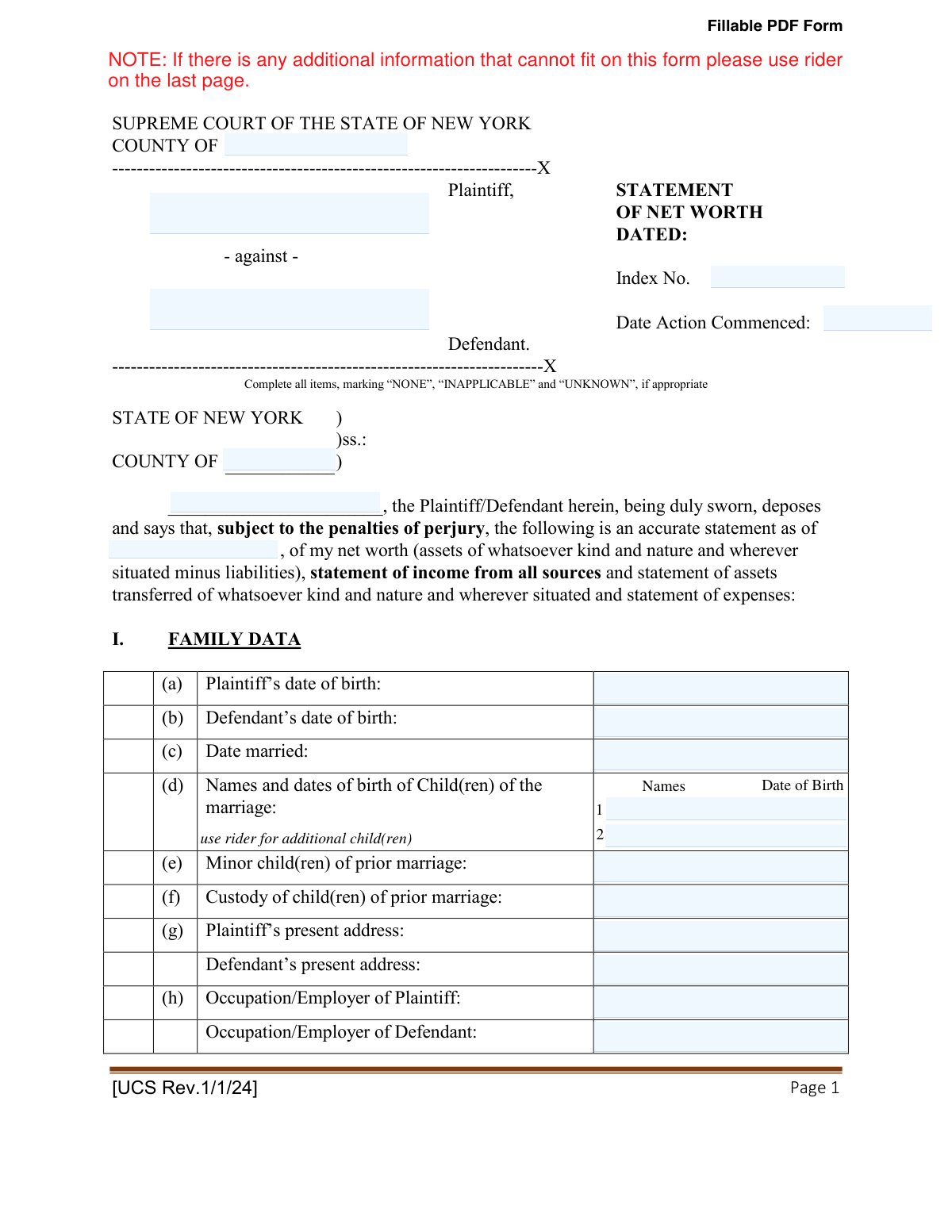
The Statement of Net Worth is a mandatory legal document used in the New York State Supreme Court for matrimonial actions, such as divorce. It provides a detailed, sworn account of an individual's complete financial situation, including all assets, liabilities, income, and expenses. This comprehensive disclosure is crucial for the court to make fair decisions regarding equitable distribution of property, child support, and spousal support. Today, this form can be filled out quickly and accurately using AI-powered services like Instafill.ai, which can also convert non-fillable PDF versions into interactive fillable forms.
UCS Statement of Net Worth is part of the court forms, NJ state forms, New York State forms, New York court forms, New York forms, PA state forms, state ID forms and UK court forms categories on Instafill.
Our AI automatically handles information lookup, data retrieval, formatting, and form filling.
It takes less than a minute to fill out UCS Statement of Net Worth using our AI form filling.
Securely upload your data. Information is encrypted in transit and deleted immediately after the form is filled out.

Form specifications

Form name: Statement of Net Worth, Supreme Court of the State of New York
Number of fields: 496
Number of pages: 24
Language: English
main-image

Instafill Demo: How to fill out PDF forms in seconds with AI

How to Fill Out UCS Statement of Net Worth Online for Free in 2026

Are you looking to fill out a UCS STATEMENT OF NET WORTH form online quickly and accurately? Instafill.ai offers the #1 AI-powered PDF filling software of 2026, allowing you to complete your UCS STATEMENT OF NET WORTH form in just 37 seconds or less.
Follow these steps to fill out your UCS STATEMENT OF NET WORTH form online using Instafill.ai:
  1. 1 Navigate to Instafill.ai and upload or select the New York Statement of Net Worth form.
  2. 2 Use the AI assistant to accurately input your personal and family data, including names, dates of birth, and marriage information.
  3. 3 Systematically list all your monthly expenses across categories like housing, utilities, food, and transportation, allowing the AI to guide you through each section.
  4. 4 Detail all sources of gross income and attach required financial documents like W-2s and tax returns, which the AI can help process and extract data from.
  5. 5 Disclose all assets, including bank accounts, real estate, retirement funds, vehicles, and other valuable property, ensuring all fields are completed.
  6. 6 List all liabilities, such as mortgages, credit card debt, student loans, and other outstanding debts, providing accurate balances and creditor information.
  7. 7 Carefully review the entire completed statement for accuracy, sign it before a notary public as required, and then file it with the court.

Our AI-powered system ensures each field is filled out correctly, reducing errors and saving you time.

Why Choose Instafill.ai for Your Fillable UCS Statement of Net Worth Form?

Speed

Complete your UCS Statement of Net Worth in as little as 37 seconds.

Up-to-Date

Always use the latest 2026 UCS Statement of Net Worth form version.

Cost-effective

No need to hire expensive lawyers.

Accuracy

Our AI performs 10 compliance checks to ensure your form is error-free.

Security

Your personal information is protected with bank-level encryption.

Frequently Asked Questions About Form UCS Statement of Net Worth

This form is a legal document used in New York Supreme Court, primarily in divorce cases, to provide a complete and sworn financial disclosure of your income, expenses, assets, and liabilities to the court and the other party.

Both the Plaintiff and the Defendant in a matrimonial action, such as a divorce, are required to complete and file their own separate Statement of Net Worth.

You are required to attach your attorney's retainer agreement, your most recent W-2, 1099s, K1s, and your income tax returns to support the financial information you provide.

The 'date of commencement' is the official date that the legal action was filed with the court. You must report the value of your assets and liabilities as of that specific date, in addition to their current values.

For variable expenses like utilities, food, or gas, you should calculate a reasonable monthly average based on your spending over the past several months or the last year.

The form includes a 'Rider' section at the end for additional information. Use these pages for any overflow, and make sure to clearly label which section and item number the extra information corresponds to.

Yes, the form must be signed in the presence of a notary public. The form explicitly states this is required to comply with New York law for a sworn Statement of Net Worth.

The form instructions state that you should mark the field with 'NONE', 'INAPPLICABLE', or 'UNKNOWN' as appropriate. Do not leave any fields blank.

For any jointly held asset, you must indicate that it is held jointly in the 'Title owner' field and specify the respective shares or ownership percentages of each person.

This section requires you to list all assets you have transferred to someone else during the preceding three years, or the length of the marriage, whichever is shorter. This is to ensure full transparency of your financial history leading up to the case.

Yes, services like Instafill.ai use AI to accurately auto-fill form fields from your saved information, which can save a significant amount of time and help reduce errors on this lengthy document.

You can use a service like Instafill.ai to complete the form digitally. Simply upload the PDF, and the platform will allow you to type directly into the fields, save your progress, and use AI to help complete the information.

If you have a non-fillable or 'flat' PDF, you can upload it to Instafill.ai. The service's technology can convert it into an interactive, fillable form that you can complete and save online.

Total Assets is the sum of everything you own (Section IV). Your Net Worth, as defined on page 1, is your Total Assets minus your Total Liabilities (Section V).

Compliance UCS Statement of Net Worth
Validation Checks by Instafill.ai

1
Validate Date of Marriage Logic
Checks that the 'Date Married' is after both the Plaintiff's and Defendant's 'Date of Birth' and before the 'Date Action Commenced'. This ensures chronological consistency in the family data, which is fundamental for establishing the marital timeline for legal purposes. A failure would prompt the user to correct the dates as they are logically impossible.
2
Validate Child's Date of Birth
Ensures that the 'Date of Birth' for any child listed under 'Child(ren) of the marriage' is after the 'Date Married'. This check verifies that children listed as being of the marriage were born within the marital period, which is crucial for matters of custody and support. An error would flag the entry for review, as it may indicate a typo or a child from a prior relationship who should be listed elsewhere.
3
Enforce Completeness of Case Caption
Verifies that all mandatory case caption fields, including 'County', 'Plaintiff Name', 'Defendant Name', 'Index No.', and 'Date Action Commenced', are filled. These details are essential for identifying the case and ensuring the document is correctly filed with the court. An incomplete caption would cause the form to be rejected by the court clerk.
4
Verify Expense Section Totals
Automatically calculates and validates the sum of individual expense items against the user-entered total for each category (e.g., 'TOTAL: HOUSING', 'TOTAL: UTILITIES'). It also cross-checks that the 'TOTAL: MONTHLY EXPENSES' on page 7 is the correct sum of all category totals. This prevents mathematical errors that could misrepresent the affiant's financial situation and ensures the statement is arithmetically sound for court review.
5
Verify Asset and Liability Grand Totals
Confirms that the 'TOTAL ASSETS' value on page 16 is the correct sum of all individual asset category totals and that the 'TOTAL LIABILITIES' on page 21 is the sum of all liability category totals. Accurate grand totals are essential for calculating the final net worth. An incorrect total would invalidate the entire financial picture presented to the court.
6
Validate Date Formats and Chronology
Ensures all date fields throughout the form (e.g., 'Date of acquisition', 'Date of incurring debt') are entered in a valid format (e.g., MM/DD/YYYY) and are not future dates. This maintains data integrity and prevents impossible entries, such as acquiring an asset tomorrow. Failure to comply would require the user to correct the date to a valid, past or present entry.
7
Check for Required Attachments Confirmation
Prompts the user to confirm that all required documents, specifically the 'most recent W-2, 1099s, K1s and income tax returns' and the 'Retainer Agreement,' have been attached. While the system cannot see physical papers, this validation acts as a critical reminder and digital confirmation step. Missing these attachments is a common reason for a court to deem the submission incomplete.
8
Validate Asset Value Consistency
Checks that for each asset listed, both the 'Value as of date of commencement' and the 'Current value' fields are filled with valid numeric currency amounts. These two data points are crucial for the court to understand how asset values may have changed during the proceedings. A failure would highlight the incomplete asset entry, ensuring a full financial disclosure.
9
Logical Check for Mortgage and Real Estate
Verifies that if a value is entered for 'Mortgage/Co-op Loan' in the Expenses section, a corresponding property is listed in the 'Real Estate' assets section (IV.B). Similarly, if a property is listed with an 'Amount of mortgage or lien unpaid', a corresponding mortgage payment should be listed in expenses. This cross-references assets and their associated liabilities, ensuring a consistent and logical financial statement.
10
Validate Business Interest Percentage
Ensures the 'Your percentage of interest' field for a business asset (Section F.8.1.c) contains a numeric value between 0 and 100. This prevents nonsensical entries and ensures the ownership stake is clearly and correctly stated. An invalid entry would misrepresent the affiant's ownership and the value of their interest in the business.
11
Validate Asset Transfer Date
Checks that the 'Date of Transfer' for any asset listed in Section VI is within the legally relevant period, defined as 'the preceding three years, or length of the marriage, whichever is shorter.' This requires a logical comparison between the transfer date, the statement date, and the date of marriage. This validation is critical to identify potentially fraudulent or preferential transfers of assets.
12
Ensure 'Other' Fields are Explained
Requires that if a monetary value is entered into an 'Other' expense line item (e.g., II(a)7, II(b)9), a corresponding description is provided, either in a dedicated field or a rider. This prevents ambiguity and ensures all claimed expenses are clearly identified and justified. An unexplained 'Other' expense could be disallowed or questioned by the court or opposing counsel.
13
Validate Affiant Identity
Confirms that the 'Affiant Name' entered in the jurat section matches either the 'Plaintiff Name' or the 'Defendant Name' from the case caption. This simple check ensures the person swearing to the statement's accuracy is a primary party to the case. A mismatch could indicate a serious error and would invalidate the affidavit.
14
Check for Paired Child Information
Verifies that if a child's name is entered in Section I(d), their date of birth is also provided, and vice versa. Leaving one of these fields blank creates an incomplete record for a dependent. This check ensures that all listed children have complete identifying information, which is essential for decisions regarding child support and custody.

Common Mistakes in Completing UCS Statement of Net Worth

Leaving Fields Blank Instead of Using 'NONE' or 'INAPPLICABLE'

The form explicitly instructs users to mark fields as 'NONE', 'INAPPLICABLE', or 'UNKNOWN' if they do not apply. Many people leave these fields blank, which creates ambiguity for the court and opposing counsel, who may assume information is being concealed. This can lead to further inquiries, delays, and a perception of non-cooperation. Always fill in every single line item as instructed to ensure the form is complete and unambiguous.

Miscalculating Monthly Expense Averages

The form requires monthly expense figures, but many costs like insurance, taxes, or vacations are paid quarterly or annually. A common error is to enter a single month's payment or guess, leading to an inaccurate financial picture. To avoid this, review at least 6-12 months of bank and credit card statements to calculate a true monthly average for each category (e.g., total annual grocery cost divided by 12). This provides a more defensible and realistic representation of your lifestyle.

Confusing 'Value as of Date of Commencement' vs. 'Current Value'

The asset and liability sections require two different valuations: one as of the 'date of commencement' of the action and a 'current' one. People often mistakenly use the same value for both or use an incorrect date for commencement. This is a critical error as the difference in these values can determine how assets are divided. It is essential to obtain financial statements and valuations for both specific dates to ensure accuracy.

Forgetting to Attach Mandatory Financial Documents

Page 8 and Page 22 clearly state that recent W-2s, 1099s, K1s, income tax returns, and the attorney's retainer agreement must be attached. Overlooking this requirement is a frequent mistake that renders the submission incomplete. An incomplete filing will be rejected or delayed, stalling legal proceedings and potentially frustrating the court. Create a checklist of all required attachments before finalizing the document.

Failing to Properly Notarize the Statement

A critical instruction on Page 22, often missed, specifies that the form must be sworn before a notary public, despite a general change in civil practice rules. Simply signing the document is not sufficient; it will be considered invalid. This mistake requires the filer to redo the entire process, causing significant delays. Always ensure you sign the document in the physical presence of a Notary Public to comply with the specific requirements for this statement.

Reporting Net Income Instead of Gross Income

Section III of the form asks for 'Gross (total) income,' which is income before any taxes or deductions are taken out. A frequent error is to report net (take-home) pay from a paycheck, which significantly understates one's true earnings and financial capacity. This can negatively impact calculations for support and maintenance. Always refer to your W-2 or the gross pay amount on your pay stub to report the correct figure.

Improperly Disclosing Jointly Held Assets

The form requires filers to state if an asset is held jointly and to specify the respective shares. People often list a joint bank account or property as if it were solely their own, or they fail to detail the ownership structure. This omission can complicate the process of equitable distribution and lead to disputes over whether an asset is marital or separate property. Carefully review titles, deeds, and account statements to accurately report all title holders.

Omitting Contingent, Intangible, or 'Other' Assets

Sections for 'Contingent Interests' (like stock options or prospective inheritances) and 'Other Assets' (like patents, copyrights, or causes of action) are often overlooked. Individuals may not consider these 'assets' or may be unsure how to value them, leading them to omit the information entirely. This is a serious error of disclosure that can have severe legal consequences, including sanctions from the court, if discovered later.

Neglecting to Specify the 'Source of Funds' for Assets

Many asset categories, from bank accounts to real estate, ask for the 'Source of Funds' used for acquisition. This detail is crucial for determining if an asset is marital or separate property, but it is frequently left blank. Failing to provide this information can lead to the presumption that an asset is marital and subject to division. To protect separate property claims, it is vital to trace and document the source of funds for each relevant asset.

Not Utilizing the Rider for Overflow Information

The form provides limited space for listing multiple children, bank accounts, or properties, instructing filers to use a rider for additional entries. A common mistake is to try to cram information into the small fields or margins, which makes the form illegible and appear incomplete. This can cause the court to overlook important details. Always use the provided rider pages to neatly and clearly list all additional information as instructed. AI-powered tools like Instafill.ai can also help by automatically formatting and adding rider pages as needed.
Saved over 80 hours a year

“I was never sure if my IRS forms like W-9 were filled correctly. Now, I can complete the forms accurately without any external help.”

Kevin Martin Green

Your data stays secure with advanced protection from Instafill and our subprocessors

Robust compliance program

Transparent business model

You’re not the product. You always know where your data is and what it is processed for.

ISO 27001, HIPAA, and GDPR

Our subprocesses adhere to multiple compliance standards, including but not limited to ISO 27001, HIPAA, and GDPR.

Security & privacy by design

We consider security and privacy from the initial design phase of any new service or functionality. It’s not an afterthought, it’s built-in, including support for two-factor authentication (2FA) to further protect your account.

Fill out UCS Statement of Net Worth with Instafill.ai

Worried about filling PDFs wrong? Instafill securely fills statement-of-net-worth-supreme-court-of-the-state-of-new-york forms, ensuring each field is accurate.