Yes! You can use AI to fill out Form DOS-2156, New York State Housing Discrimination Disclosure Form

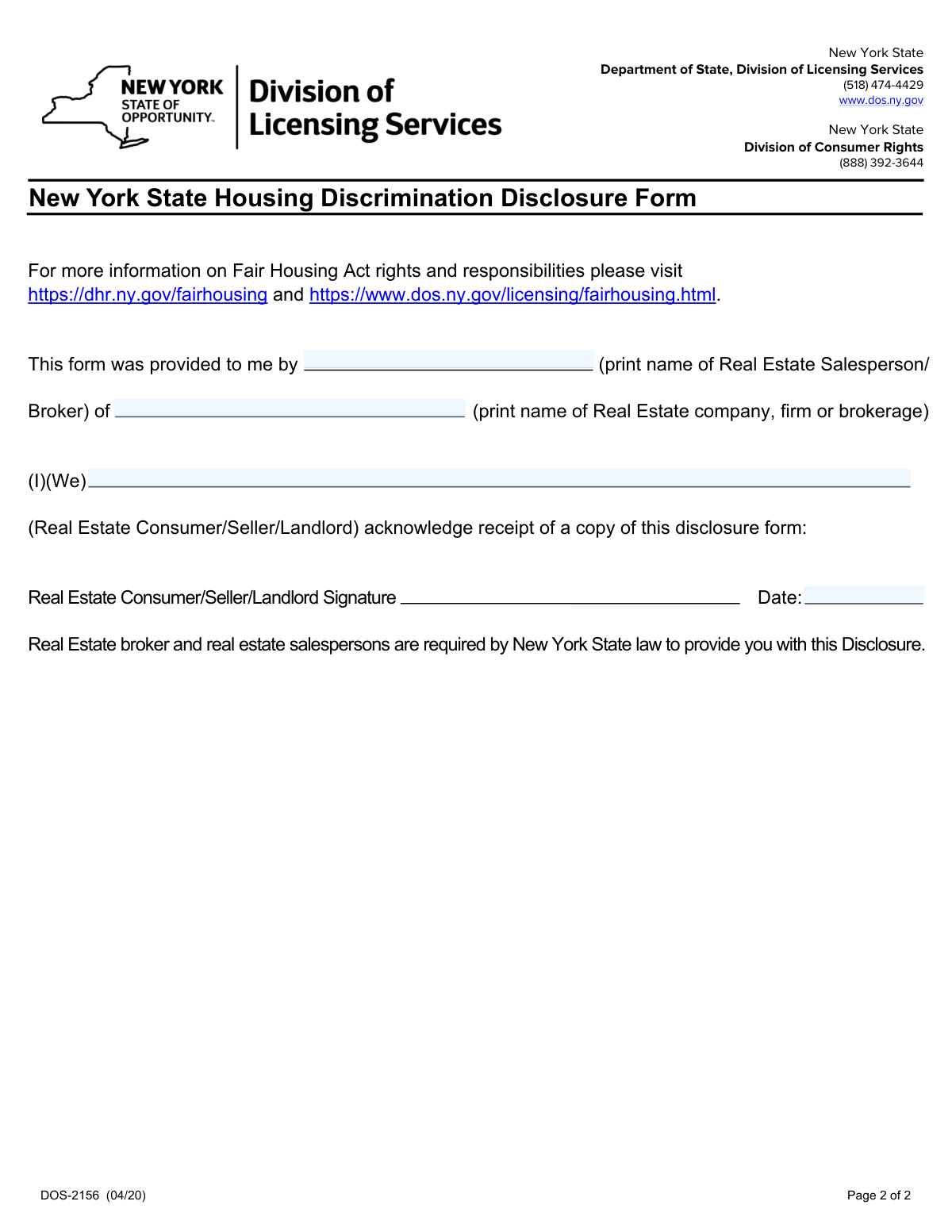
The New York State Housing Discrimination Disclosure Form (DOS-2156) is a mandatory document required by the NYS Department of State for real estate transactions. It ensures that consumers, sellers, and landlords are aware of their protections against discrimination under federal, state, and local fair housing laws, and serves as an acknowledgment that a real estate agent has provided this information. Today, this form can be filled out quickly and accurately using AI-powered services like Instafill.ai, which can also convert non-fillable PDF versions into interactive fillable forms.
Our AI automatically handles information lookup, data retrieval, formatting, and form filling.
It takes less than a minute to fill out DOS-2156 using our AI form filling.
Securely upload your data. Information is encrypted in transit and deleted immediately after the form is filled out.

Form specifications

Form name: Form DOS-2156, New York State Housing Discrimination Disclosure Form
Number of fields: 4
Number of pages: 2
Filled form examples: Form DOS-2156 Examples
Language: English
main-image

Instafill Demo: How to fill out PDF forms in seconds with AI

How to Fill Out DOS-2156 Online for Free in 2026

Are you looking to fill out a DOS-2156 form online quickly and accurately? Instafill.ai offers the #1 AI-powered PDF filling software of 2026, allowing you to complete your DOS-2156 form in just 37 seconds or less.
Follow these steps to fill out your DOS-2156 form online using Instafill.ai:
  1. 1 Navigate to Instafill.ai and upload the New York State Housing Discrimination Disclosure Form or select it from the template library.
  2. 2 Use the AI-powered tool to enter the printed name of the real estate salesperson/broker and their company who provided the form.
  3. 3 In the consumer acknowledgment section, provide the full name(s) of the real estate consumer, seller, or landlord receiving the disclosure.
  4. 4 Carefully read the entire disclosure to understand your rights and the protections afforded by fair housing laws.
  5. 5 Review all entered information for accuracy, then electronically sign and date the form to formally acknowledge receipt of the disclosure.
  6. 6 Download, save, or share the completed and signed DOS-2156 form for your records and to provide to the necessary parties.

Our AI-powered system ensures each field is filled out correctly, reducing errors and saving you time.

Why Choose Instafill.ai for Your Fillable DOS-2156 Form?

Speed

Complete your DOS-2156 in as little as 37 seconds.

Up-to-Date

Always use the latest 2026 DOS-2156 form version.

Cost-effective

No need to hire expensive lawyers.

Accuracy

Our AI performs 10 compliance checks to ensure your form is error-free.

Security

Your personal information is protected with bank-level encryption.

Frequently Asked Questions About Form DOS-2156

This form is designed to inform you of your rights under federal, state, and local Fair Housing Laws. It details illegal discriminatory practices and ensures you are aware of your protections during any housing transaction.

Real estate consumers, sellers, or landlords working with a real estate professional in New York State must sign this form. Your signature simply acknowledges that you have received a copy of this disclosure.

No, this form is not a contract. It is a mandatory disclosure notice required by New York State law to ensure you are informed of your fair housing rights.

You only need to print your name(s), sign, and provide the date. The real estate professional who gives you the form is responsible for filling in their name and brokerage information.

Your signature simply confirms that you have received a copy of the disclosure form from your real estate agent. It does not obligate you to any service or waive any of your legal rights.

You do not need to submit this form anywhere. Your real estate agent is required by law to provide it to you and keep the signed copy for their records.

You should file a complaint with the New York State Division of Human Rights (DHR) or the NYS Department of State (DOS). The form provides contact information and websites for both agencies to help you start the process.

While you are not legally forced to sign, the real estate agent is still required by law to provide you with this information. The agent will likely have to make a note of your refusal for their records.

No, there are no fees for receiving this disclosure form. The form also clearly states that there is no fee charged to you for filing a housing discrimination complaint with state agencies.

Yes, services like Instafill.ai use AI to help you accurately auto-fill form fields, which saves time and reduces errors. This can be particularly helpful for the various documents involved in a real estate transaction.

You can use a service like Instafill.ai to upload the form, which then allows you to fill in your name, date, and add an electronic signature. You can then download the completed document to share with your real estate agent.

You can use a tool like Instafill.ai, which can convert flat, non-fillable PDFs into interactive forms. Simply upload the document, and the platform will make the fields for your name, date, and signature fillable online.

Steering is an illegal practice where a real estate professional guides prospective buyers or renters towards or away from certain neighborhoods based on protected characteristics like race or national origin.

Your real estate broker or salesperson is required by New York State law to provide you with this disclosure form, typically at the beginning of your professional relationship.

Compliance DOS-2156
Validation Checks by Instafill.ai

1
Ensures Salesperson Name is Provided
Checks that the 'Real Estate Salesperson or Broker Name' field is not empty. This is crucial for identifying the individual who provided the disclosure, which is a legal requirement for record-keeping and accountability. If this field is left blank, the submission is rejected and the user is prompted to enter the name.
2
Validates Salesperson Name Format
Verifies that the salesperson's name contains only valid characters, such as letters, spaces, hyphens, and apostrophes, and does not contain numbers or excessive special symbols. This ensures data quality and prevents the submission of garbage or placeholder data. An invalid entry would trigger an error message asking the user to provide a valid name.
3
Ensures Brokerage Name is Provided
Confirms that the 'Real Estate Company, Firm, or Brokerage Name' field is filled out. Identifying the brokerage is as important as identifying the agent for compliance and liability purposes. A missing brokerage name will cause the validation to fail, requiring the user to complete the field before submission.
4
Validates Brokerage Name for Prohibited Characters
Scans the brokerage name for invalid characters while allowing for common business name elements like '&', ',', '.', 'Inc', and 'LLC'. This check prevents script injection or the entry of nonsensical data that is not part of a legitimate company name. If invalid characters are detected, the user will be notified to correct the company name.
5
Ensures Consumer Name is Provided
Checks that the 'Real Estate Consumer/Seller/Landlord' name field is not left blank. The form serves as an acknowledgment of receipt by the consumer, so their name is essential to validate the entire document's purpose. Without a consumer name, the acknowledgment is meaningless and the form submission will be blocked.
6
Validates Consumer Name Format
Ensures the consumer name(s) field contains valid characters appropriate for personal names, such as letters, spaces, and commas. It should also gracefully handle the entry of multiple names, as indicated by the '(I)(We)' text on the form. This validation maintains data integrity and ensures the record accurately reflects all parties who acknowledged the disclosure.
7
Prohibits Placeholder Text in Name Fields
This validation specifically checks all name fields (Salesperson, Brokerage, Consumer) to ensure they do not contain common placeholder text like 'N/A', 'TBD', 'Enter Name', or a single repeating character. This is important to prevent users from bypassing required fields with invalid but non-empty data. A failed check would prompt the user to enter the actual name.
8
Ensures Acknowledgment Date is Provided
Verifies that the 'Acknowledgment Date' field is completed. The date is a critical piece of evidence that establishes when the disclosure was acknowledged by the consumer. A missing date renders the form incomplete for legal and compliance purposes, so the submission will be rejected until a date is entered.
9
Validates Acknowledgment Date Format
Checks that the date entered in the 'Acknowledgment Date' field conforms to a standard format, such as MM/DD/YYYY. This consistency is vital for accurate digital record-keeping, sorting, and auditing. If the date is entered in an unrecognized format, the system will prompt the user to correct it.
10
Verifies Acknowledgment Date is a Valid Calendar Date
Confirms that the provided date is a real, possible date on the calendar (e.g., it rejects entries like '02/30/2023' or '13/01/2023'). This prevents data entry errors and ensures the integrity of the timestamp associated with the acknowledgment. An impossible date will trigger an error message requesting a valid calendar date.
11
Prevents Future Acknowledgment Dates
This logical check ensures the 'Acknowledgment Date' is not set to a date in the future. A disclosure cannot be acknowledged before it is received, so the date must be the current day or a day in the past. This validation prevents accidental or intentional post-dating and maintains the chronological accuracy of the record.
12
Ensures Acknowledgment Date is After Form Revision
This validation compares the 'Acknowledgment Date' to the form's revision date, which is '04/20' (April 2020). The acknowledgment date must be on or after this date, as it's impossible to sign a version of a form before it was created. This check catches significant data entry errors, such as entering the wrong year.
13
Validates Minimum and Maximum Length for Salesperson Name
Checks that the salesperson's name is within a reasonable length, for example, between 3 and 100 characters. This helps to filter out entries that are clearly too short (e.g., a single letter) or excessively long, which could indicate a data entry error or malicious input. Submissions outside this range would be flagged for review or correction.
14
Validates Minimum and Maximum Length for Brokerage Name
Ensures the brokerage name field entry is within a practical character length, such as 3 to 150 characters. This prevents submissions of single-character gibberish or overly long strings that could be part of an attack or simply an error. The system would require the user to enter a name that fits within the specified length constraints.

Common Mistakes in Completing DOS-2156

Incomplete or Incorrect Broker/Agent Name

People often write a nickname or an abbreviated name for the real estate agent, rather than their full licensed name. This can happen due to familiarity or haste, but an incorrect name makes it difficult to identify the agent in case of a future complaint or audit. To avoid this, always use the agent's full name as it appears on their license, which can be verified on the Department of State's website.

Using an Abbreviated Brokerage Name

It is common to write a shortened or brand name for the real estate company (e.g., "Compass" instead of the full legal entity name like "Compass Greater New York, LLC"). This ambiguity can create compliance issues, as the form is a legal record intended to link the disclosure to a specific, licensed entity. Always use the complete, official name of the brokerage to ensure the form is legally sound and verifiable.

Forgetting to Print Consumer Name(s)

The form has a blank space after "(I)(We)" for the consumer's printed name, which is separate from the signature line. Individuals often sign the document but forget to print their name in this area, leaving it blank. This omission makes it unclear who acknowledged the form, potentially invalidating the document for compliance purposes.

Missing Acknowledgment from All Parties

The form includes the text "(I)(We)," indicating that all parties to the transaction (e.g., both spouses in a couple) should acknowledge receipt. Often, only one person will print their name and sign, even when multiple people are the "Real Estate Consumer." This creates a gap in compliance, as not all parties have legally acknowledged the disclosure, so ensure every individual consumer, seller, or landlord signs.

Omitting the Signature Date

The date field is frequently left blank, which is a critical error on a time-sensitive disclosure form. The date serves as proof of when the disclosure was provided and acknowledged, which is essential for regulatory compliance. Forgetting the date can call into question whether the disclosure was provided at the legally required time, so always fill in the current date at the moment of signing.

Illegible Handwriting

Rushing through the form often leads to illegible handwriting for names, dates, and company information. If the information cannot be clearly read, the form may be considered incomplete or invalid during an audit by the Department of State, which can result in penalties. To avoid this, print all information clearly in block letters. AI-powered tools like Instafill.ai can convert non-fillable PDFs into fillable versions to ensure all entries are legible and accurate.

Signing Without Understanding the Document

Consumers may treat this form as just another piece of paperwork to sign without reading the content. They are, however, acknowledging receipt of critical information about their fair housing rights and the legal obligations of real estate professionals. Signing without reading means a person may not be aware of their rights or how to file a complaint if they experience discrimination.

Mismatching Agent and Brokerage Information

An agent might have recently switched companies but accidentally use an old form with their previous brokerage's information, or the consumer might fill in the wrong brokerage for the agent. This creates an inaccurate record and can lead to significant compliance confusion. Verify the agent's current brokerage affiliation before filling out the form. AI form-filling tools like Instafill.ai can help by storing and auto-populating verified agent and brokerage data, preventing such mismatches.

Failure to Retain a Copy

The form's text explicitly states that the consumer is acknowledging "receipt of a copy of this disclosure form." However, in the rush of a transaction, the consumer may sign the agent's copy and forget to receive or ask for their own. Failing to keep a copy leaves the consumer without a record of their rights and the information provided, so always insist on receiving a physical or digital copy of the signed form for your records.

Using an Outdated Form Version

Real estate professionals may inadvertently use an old version of a mandatory form that they have saved on their computer. The footer of this form indicates a version date (e.g., "04/20"), and using an outdated version can lead to non-compliance if the disclosure requirements have changed. Always ensure you are using the most current version of the form as provided by the NYS Department of State.
Saved over 80 hours a year

“I was never sure if my IRS forms like W-9 were filled correctly. Now, I can complete the forms accurately without any external help.”

Kevin Martin Green

Your data stays secure with advanced protection from Instafill and our subprocessors

Robust compliance program

Transparent business model

You’re not the product. You always know where your data is and what it is processed for.

ISO 27001, HIPAA, and GDPR

Our subprocesses adhere to multiple compliance standards, including but not limited to ISO 27001, HIPAA, and GDPR.

Security & privacy by design

We consider security and privacy from the initial design phase of any new service or functionality. It’s not an afterthought, it’s built-in, including support for two-factor authentication (2FA) to further protect your account.

Fill out DOS-2156 with Instafill.ai

Worried about filling PDFs wrong? Instafill securely fills form-dos-2156-new-york-state-housing-discrimination-disclosure-form forms, ensuring each field is accurate.