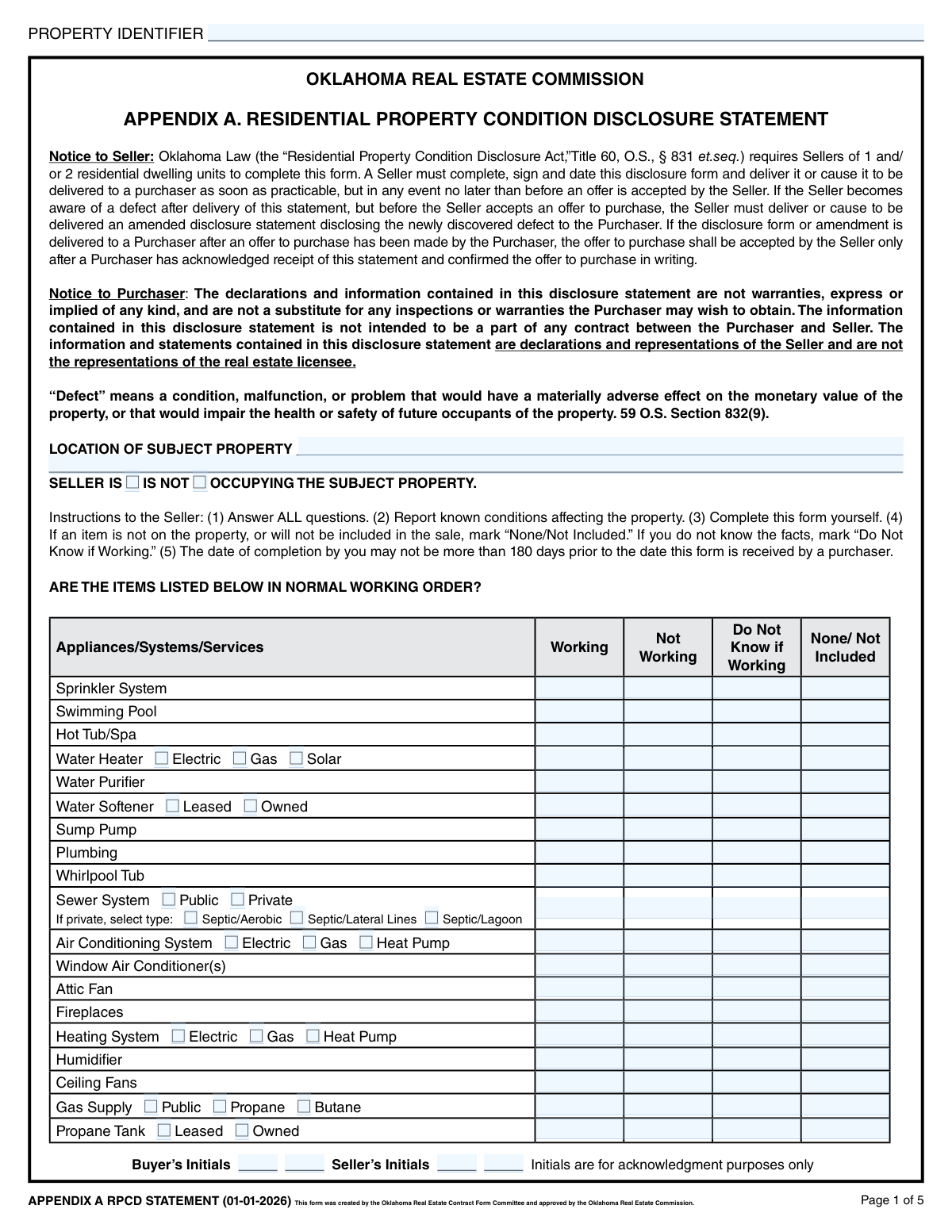
Yes! You can use AI to fill out Oklahoma Appendix A, Residential Property Condition Disclosure Statement

The Oklahoma Residential Property Condition Disclosure Statement (Appendix A) is a legally mandated document under Oklahoma's Residential Property Condition Disclosure Act. Sellers of one or two residential dwelling units must complete this form to inform purchasers of any known defects or conditions affecting the property's value, health, or safety. This disclosure is a representation of the seller's current knowledge and not a warranty. Today, this form can be filled out quickly and accurately using AI-powered services like Instafill.ai, which can also convert non-fillable PDF versions into interactive fillable forms.
Our AI automatically handles information lookup, data retrieval, formatting, and form filling.
It takes less than a minute to fill out Appendix A RPCD Statement using our AI form filling.
Securely upload your data. Information is encrypted in transit and deleted immediately after the form is filled out.

Form specifications

Form name: Oklahoma Appendix A, Residential Property Condition Disclosure Statement
Number of pages: 5
Language: English
Categories: disclosure forms, PA state forms, property forms, NJ state forms
main-image

Instafill Demo: How to fill out PDF forms in seconds with AI

How to Fill Out Appendix A RPCD Statement Online for Free in 2026

Are you looking to fill out a APPENDIX A RPCD STATEMENT form online quickly and accurately? Instafill.ai offers the #1 AI-powered PDF filling software of 2026, allowing you to complete your APPENDIX A RPCD STATEMENT form in just 37 seconds or less.
Follow these steps to fill out your APPENDIX A RPCD STATEMENT form online using Instafill.ai:
  1. 1 Navigate to Instafill.ai and upload or select the Oklahoma Residential Property Condition Disclosure Statement.
  2. 2 Enter the Property Identifier and the full address of the subject property in the initial fields.
  3. 3 Systematically go through the checklist of appliances, systems, and services, marking their status as 'Working,' 'Not Working,' 'Do Not Know,' or 'None/Not Included' with guidance from the AI assistant.
  4. 4 Answer the series of 'Yes/No' questions regarding the property's history, covering topics like flood zones, structural alterations, environmental hazards, and legal encumbrances.
  5. 5 Provide detailed written explanations for any items marked 'Not Working' or any questions answered 'Yes' in the designated sections, attaching additional pages if necessary.
  6. 6 Carefully review the entire completed form for accuracy and completeness before the seller(s) sign and date the final page.
  7. 7 Deliver the completed form to the purchaser(s) for their review, acknowledgment, and signature, ensuring all required initials are placed on each page by both parties.

Our AI-powered system ensures each field is filled out correctly, reducing errors and saving you time.

Why Choose Instafill.ai for Your Fillable Appendix A RPCD Statement Form?

Speed

Complete your Appendix A RPCD Statement in as little as 37 seconds.

Up-to-Date

Always use the latest 2026 Appendix A RPCD Statement form version.

Cost-effective

No need to hire expensive lawyers.

Accuracy

Our AI performs 10 compliance checks to ensure your form is error-free.

Security

Your personal information is protected with bank-level encryption.

Frequently Asked Questions About Form Appendix A RPCD Statement

This form is required by Oklahoma law for sellers of 1- or 2-unit residential dwellings to disclose known conditions and defects of the property to a potential purchaser before a sale is finalized.

The seller of the property is required to personally complete, sign, and date this disclosure form. It is a representation of the seller's actual knowledge, not the real estate agent's.

The seller must deliver this completed form to the purchaser as soon as practicable, but no later than before an offer to purchase is accepted by the seller.

If you do not know the facts about an item's condition, you should check the box in the 'Do Not Know if Working' column for that specific item.

For any item that is not physically on the property or will not be included in the sale, you must mark the 'None/Not Included' box.

If you answer 'Yes' to any of the questions on pages 2-4, or mark an item as 'Not Working', you must provide a detailed explanation, attaching additional signed pages if necessary.

No, this disclosure is not a warranty and is not a substitute for any inspections you may wish to obtain. You are strongly urged to have the property inspected by a licensed expert.

This disclosure statement is not considered valid after 180 days from the date it was completed and signed by the seller.

If you become aware of a new defect before accepting an offer, you are required to deliver an amended disclosure statement to the purchaser that discloses the new issue.

Yes, the form includes a specific section where you must disclose if there is a mandatory HOA and provide details on dues, special assessments, and management contact information.

A 'defect' is defined as a condition, malfunction, or problem that would materially impact the property's monetary value or impair the health or safety of future occupants.

Yes, services like Instafill.ai use AI to accurately auto-fill form fields, which can save you time and help ensure all required information is entered correctly.

You can use a service like Instafill.ai, which is designed to convert flat, non-fillable PDFs into interactive forms that you can easily fill out, sign, and save online.

Simply upload the Residential Property Condition Disclosure Statement PDF to the Instafill.ai platform. Their technology will make the document interactive, allowing you to type in your answers, check boxes, and add your digital signature.

Compliance Appendix A RPCD Statement
Validation Checks by Instafill.ai

1
Ensures Completeness of Appliance/System Status Grid
This validation verifies that for every single appliance, system, or service listed in the tables on pages 1 and 2, exactly one of the four status options ('Working', 'Not Working', 'Do Not Know if Working', 'None/Not Included') has been selected. This is crucial for ensuring the seller has provided a complete disclosure for every item as required by the form's instructions. A failure would mean the form is incomplete and must be returned to the seller for completion.
2
Requires Explanation for 'Not Working' Items
This check confirms that if any item on pages 1 or 2 is marked as 'Not Working', the corresponding explanation text box ('IF YOU ANSWERED Not Working to any items on pages 1 and 2, please explain') is filled out. This is a critical disclosure requirement, as it provides the purchaser with essential details about known defects. If this field is empty despite 'Not Working' selections, the submission is invalid and lacks necessary information.
3
Requires Explanation for 'Yes' Answers on Pages 2-4
This validation ensures that if any of the questions from 7 through 50 are answered with 'YES', the final explanation section ('If you answered YES to any of the items on pages 2-4, list the item number(s) and explain') contains a corresponding entry. This provides necessary context for affirmative disclosures about issues like flood damage, unpermitted additions, or legal disputes. A missing explanation for a 'YES' answer renders the disclosure incomplete and potentially misleading.
4
Conditional Requirement for Homeowner's Association Details
This check is triggered if question 41, 'Are you aware of a mandatory homeowner’s association?', is answered 'YES'. It then validates that the subsequent fields for 'Amount of dues', 'Payable' frequency, 'Manager’s Name', and 'Phone Number' are all completed. This information is vital for a potential buyer to understand the financial obligations and rules associated with the property. Failure to provide these details after indicating an HOA exists makes the form incomplete.
5
Conditional Requirement for Unpaid HOA Dues Amount
If the seller indicates 'YES' to the question 'Are there unpaid dues or assessments for the property?' within the homeowner's association section (Question 41), this validation ensures that the 'Unpaid Dues/Assessments Amount' field is filled with a specific monetary value. This is critical for financial transparency, as unpaid dues can become the responsibility of the new owner. An empty amount field after a 'YES' response is a validation failure.
6
Seller Signature Date Validity (180-Day Rule)
This validation checks the seller's signature date(s) on page 5 against the current date or the date of receipt by the purchaser. The form explicitly states it is not valid after 180 days from the date of completion by the seller. This check ensures the information is reasonably current as required by law. If the date is older than 180 days, the form is expired and a new one must be completed.
7
Presence of Initials on All Pages
This check verifies that the designated spaces for 'Buyer’s Initials' and 'Seller’s Initials' at the bottom of each page (1 through 5) have been filled. These initials serve as an acknowledgment that both parties have reviewed the information on each specific page. Missing initials on any page indicate an incomplete review process and could compromise the legal standing of the document.
8
Conditional Requirement for Additional Pages Count
This validation is linked to the question 'Are there any additional pages attached to this disclosure?' on page 5. If the 'YES' box is checked, this rule ensures that the 'how many?' field contains a positive integer. This prevents ambiguity and ensures all parts of the disclosure are accounted for. If 'YES' is checked but the count is missing, zero, or non-numeric, the validation fails.
9
Exclusive Selection of Seller Occupancy Status
This validation ensures that exactly one of the two checkboxes, 'SELLER IS OCCUPYING' or 'SELLER IS NOT OCCUPYING', is selected. It is a binary choice that cannot be left blank or have both options selected. This information provides important context for the seller's knowledge of the property's current condition. A failure indicates an incomplete or contradictory answer at the top of the form.
10
Conditional Requirement for Private Sewer System Type
When the 'Sewer System' is marked as 'Private' on page 1, this validation ensures that one of the subsequent private system types ('Septic/Aerobic', 'Septic/Lateral Lines', or 'Septic/Lagoon') is also selected. This provides necessary specific information about the property's infrastructure. If 'Private' is checked but no type is specified, the disclosure is incomplete.
11
Conditional Requirement for FEMA Flood Zone Type
If the seller answers 'Yes' to question 3, 'Are you aware if the dwelling or improvements are located in a FEMA defined flood zone?', this check verifies that at least one of the flood zone type checkboxes ('100-year', '500-year', etc.) is selected. A simple 'Yes' is insufficient; the specific zone designation is required for the purchaser to assess risk and insurance requirements. The validation fails if 'Yes' is checked but no zone type is specified.
12
Contradiction Check for 'None/Not Included' Items
This validation prevents logical contradictions where an item is marked as 'None/Not Included' but also has details provided in a sub-field. For example, if 'Water Heater' is marked 'None/Not Included', the 'Electric', 'Gas', or 'Solar' checkboxes for it must be empty. This ensures data integrity and prevents confusing or impossible statements on the form.
13
Valid Monetary Format for Financial Fields
This check ensures that all fields intended to capture dollar amounts (e.g., HOA Dues, Special Assessment, Fire District Fee) contain valid numerical data. The input should be a number, optionally formatted with commas and a decimal point for cents. This prevents non-numeric text from being entered and ensures the financial data is machine-readable and accurate.
14
Valid Phone Number Format
This validation rule checks that the 'Phone Number' field in the Homeowner's Association section (Question 41) conforms to a standard phone number format (e.g., XXX-XXX-XXXX or (XXX) XXX-XXXX). This ensures the data is valid and usable for contact purposes. An entry that does not match a recognized format would fail validation, prompting the user for correction.

Common Mistakes in Completing Appendix A RPCD Statement

Failing to Explain 'Not Working' or 'Yes' Answers

The form requires written explanations for any system marked 'Not Working' and for most 'Yes' answers on pages 2-4. Sellers frequently check a box but forget to provide the corresponding explanation, which can be interpreted as withholding information and may lead to legal liability for non-disclosure. To avoid this, always double-check that every 'Not Working' or 'Yes' response is accompanied by a clear, detailed explanation in the designated section or on an attached page.

Leaving Questions or Checkboxes Blank

The instructions explicitly state 'Answer ALL questions,' yet sellers often skip items they are unsure about or believe are not applicable. An incomplete form fails to meet legal disclosure requirements, creates ambiguity, and can lead to buyer disputes or transaction delays. It is crucial to review every line item and select one of the provided options ('Working', 'Not Working', 'Do Not Know', or 'None/Not Included') for each.

Missing Initials on Each Page

Each of the five pages requires initials from both the seller and the buyer to acknowledge its review, but it's a very common oversight to miss one or more of these boxes. Missing initials can call the validity of the disclosure into question, require the document to be re-circulated, and cause delays during the closing process. Using a tool that highlights required fields can prevent this simple but disruptive error.

Providing Contradictory Information

A seller might mark the 'Plumbing' system as 'Working' on page 1, but then answer 'Yes' to being aware of 'water seepage, leakage or other draining defects' on page 3. Such contradictions undermine the credibility of the disclosure and create significant legal risk for the seller. It is crucial to ensure all answers are consistent throughout the entire document before signing.

Using Vague or Incomplete Explanations

When an explanation is required for a defect, providing a vague comment like 'A/C issue' or 'leaks' is insufficient and can be seen as an attempt to minimize a known problem. The consequence is potential legal action for failure to properly disclose the full nature of the defect. Explanations should be specific and factual, such as 'The central A/C unit does not cool the second floor effectively on days over 90°F.'

Omitting Ownership Status for Leased or Financed Items

For items like Water Softeners, Propane Tanks, Security Systems, and Solar Panels, the form asks if they are 'Leased,' 'Owned,' or 'Financed.' Sellers often forget to specify this, which is critical information for a buyer who might unknowingly inherit a lease agreement or a lien. Failure to disclose this can lead to post-closing disputes over who is responsible for payments or removal of the equipment.

Improperly Filling Out Conditional Sections

The form contains many conditional sections, such as providing HOA dues only after checking 'Yes' for a mandatory HOA. Sellers often make mistakes by either checking 'Yes' and leaving the financial details blank, or by providing details without checking the corresponding 'Yes' box. This incomplete data requires follow-up and can delay the transaction. AI-powered tools like Instafill.ai can help by dynamically showing or requiring fields based on previous answers.

Failing to Complete the 'Property Identifier' on Each Page

Each of the five pages includes a 'PROPERTY IDENTIFIER' field at the top, but sellers or agents sometimes only fill this on the first page. This procedural error can cause issues with document management and legal record-keeping, especially if pages become separated. To ensure clarity and compliance, the property identifier should be consistently filled out on every single page of the document.

Misusing the 'Do Not Know if Working' Option

While a valid option, some sellers overuse 'Do Not Know if Working' to avoid making a definitive statement, even for items they use daily. This can be a red flag for buyers and their agents, suggesting the seller is either uninformed or evasive. This option should only be used when the seller genuinely has no actual knowledge of the item's condition, such as for a sprinkler system on a property purchased in winter.

Forgetting to Attach and Reference Additional Pages

When detailed explanations do not fit in the provided space, sellers must attach additional pages and indicate this on page 5. A common mistake is to either forget to attach the pages or to attach them without checking the 'YES' box and noting the page count. This can lead to claims that the buyer never received the full disclosure. AI tools like Instafill.ai can convert flat PDFs into fillable forms with expandable text fields, reducing the need for separate attachments.
Saved over 80 hours a year

“I was never sure if my IRS forms like W-9 were filled correctly. Now, I can complete the forms accurately without any external help.”

Kevin Martin Green

Your data stays secure with advanced protection from Instafill and our subprocessors

Robust compliance program

Transparent business model

You’re not the product. You always know where your data is and what it is processed for.

ISO 27001, HIPAA, and GDPR

Our subprocesses adhere to multiple compliance standards, including but not limited to ISO 27001, HIPAA, and GDPR.

Security & privacy by design

We consider security and privacy from the initial design phase of any new service or functionality. It’s not an afterthought, it’s built-in, including support for two-factor authentication (2FA) to further protect your account.

Fill out Appendix A RPCD Statement with Instafill.ai

Worried about filling PDFs wrong? Instafill securely fills oklahoma-appendix-a-residential-property-condition-disclosure-statement forms, ensuring each field is accurate.