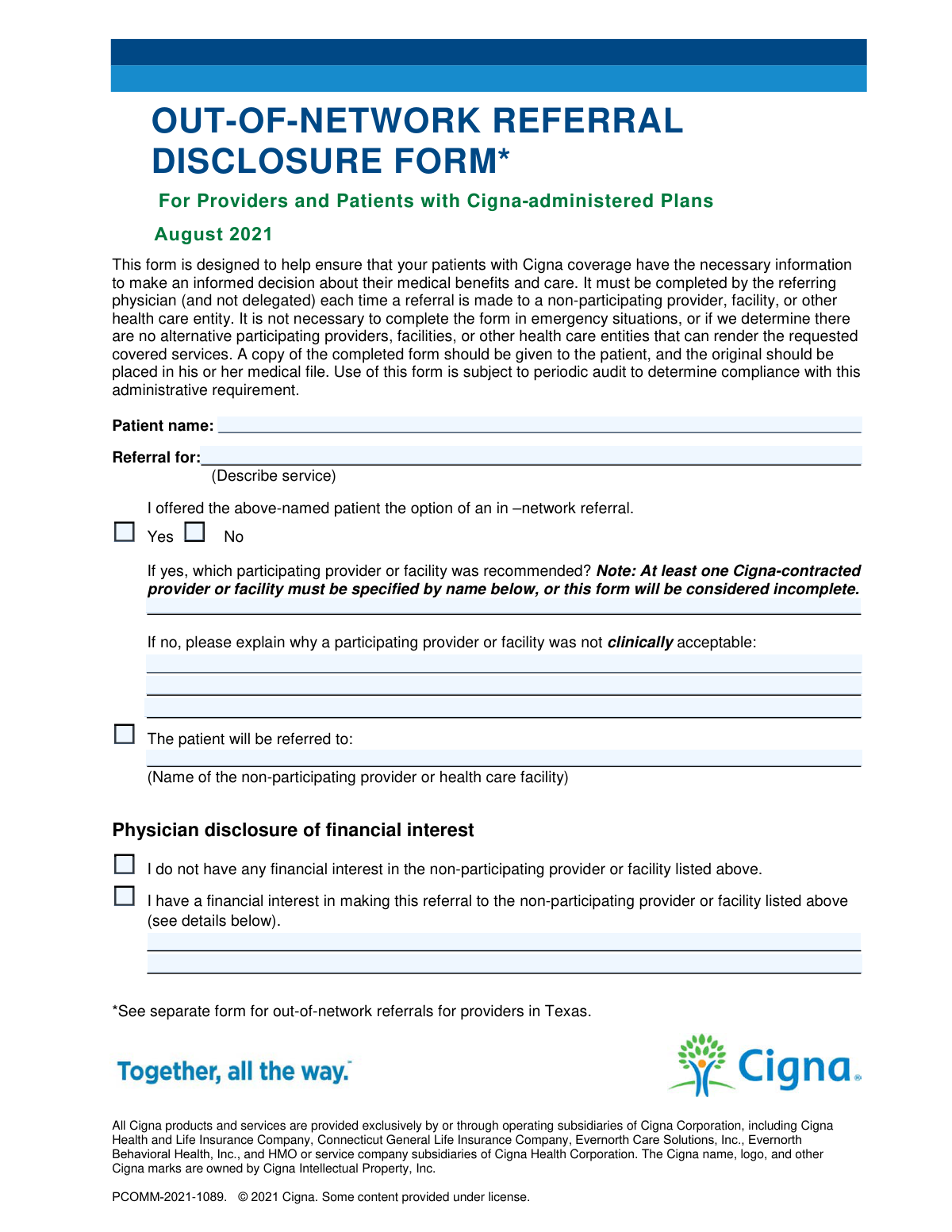
Yes! You can use AI to fill out Cigna Out-of-Network Referral Disclosure Form

This form is a required document for physicians referring patients with Cigna-administered health plans to an out-of-network provider or facility. It serves to inform the patient about the potential for higher out-of-pocket costs and ensures they make a conscious decision to proceed with a non-participating provider. The form documents that the patient was offered an in-network alternative and includes a disclosure of any financial interest the referring physician may have. Today, this form can be filled out quickly and accurately using AI-powered services like Instafill.ai, which can also convert non-fillable PDF versions into interactive fillable forms.
Our AI automatically handles information lookup, data retrieval, formatting, and form filling.
It takes less than a minute to fill out PCOMM-2021-1089 using our AI form filling.
Securely upload your data. Information is encrypted in transit and deleted immediately after the form is filled out.

Form specifications

Form name: Cigna Out-of-Network Referral Disclosure Form
Number of pages: 2
Language: English
Categories: disclosure forms
main-image

Instafill Demo: How to fill out PDF forms in seconds with AI

How to Fill Out PCOMM-2021-1089 Online for Free in 2026

Are you looking to fill out a PCOMM-2021-1089 form online quickly and accurately? Instafill.ai offers the #1 AI-powered PDF filling software of 2026, allowing you to complete your PCOMM-2021-1089 form in just 37 seconds or less.
Follow these steps to fill out your PCOMM-2021-1089 form online using Instafill.ai:
  1. 1 Navigate to Instafill.ai and upload or select the Cigna Out-of-Network Referral Disclosure Form.
  2. 2 The referring physician uses the AI assistant to fill in the patient's name, the service being referred, and details about the non-participating provider.
  3. 3 The physician documents whether an in-network referral was offered and, if so, which provider was recommended, or explains why an in-network option was not clinically appropriate.
  4. 4 The physician completes the financial interest disclosure section, indicating whether they have a financial stake in the out-of-network referral.
  5. 5 The patient reviews the 'Cigna customer out-of-network informed consent' section and checks the boxes to acknowledge their understanding of the financial implications.
  6. 6 The patient provides their digital signature and the date to confirm their choice to use a non-participating provider.
  7. 7 Finally, the physician signs and dates the endorsement section to certify that they have reviewed the form with the patient.

Our AI-powered system ensures each field is filled out correctly, reducing errors and saving you time.

Why Choose Instafill.ai for Your Fillable PCOMM-2021-1089 Form?

Speed

Complete your PCOMM-2021-1089 in as little as 37 seconds.

Up-to-Date

Always use the latest 2026 PCOMM-2021-1089 form version.

Cost-effective

No need to hire expensive lawyers.

Accuracy

Our AI performs 10 compliance checks to ensure your form is error-free.

Security

Your personal information is protected with bank-level encryption.

Frequently Asked Questions About Form PCOMM-2021-1089

This form ensures that patients with Cigna coverage are fully informed about their choices and potential costs before being referred to a healthcare provider or facility that is not in the Cigna network.

The referring physician must initiate and complete the provider sections of the form, and the patient must review the information and sign the consent portion.

It must be completed each time a physician refers a Cigna patient to a non-participating provider, except in emergency situations or if Cigna has determined no in-network alternatives exist.

You will generally pay more because your claim will be processed with a lower benefit. If your plan has no out-of-network coverage, the claim may be denied, leaving you responsible for the full bill.

The physician must provide a clinical reason why a participating provider was not acceptable. The form is considered incomplete if an in-network option or a valid reason is not provided.

The physician's office should give a copy to the patient for their records and place the original form in the patient's medical file.

This is when a non-participating provider offers to waive your out-of-pocket costs, which is against Cigna's policy and may be considered fraud. Such offers should be reported to Cigna's Special Investigations Unit.

This section requires the referring physician to state whether they have a financial stake in the non-participating facility or provider they are recommending, ensuring transparency for the patient.

You can review your benefit plan documents or call the Cigna Customer Service number located on your Cigna ID card to verify your coverage.

No, the form specifies that a separate, different form must be used for out-of-network referrals for providers located in Texas.

Yes, services like Instafill.ai use AI to accurately auto-fill form fields, which can save time and help the physician's office reduce errors.

You can use a service like Instafill.ai to upload a PDF of the form. It will make the document interactive so you can type your information, check boxes, and sign digitally.

Instafill.ai can convert flat, non-fillable PDFs into interactive, fillable forms. Simply upload the document to the service to make it easy to complete online.

Compliance PCOMM-2021-1089
Validation Checks by Instafill.ai

1
Ensures Patient Name is Provided
This check verifies that the 'Patient Name' field is not empty. This is a critical field as it identifies the individual to whom the referral and consent apply. If this field is left blank, the form is invalid as it cannot be associated with a specific patient's medical record or insurance plan.
2
Ensures Referral Service is Described
This validation ensures that the 'Referral for' service description field contains text. This information is essential for Cigna to understand the medical context of the out-of-network referral and for auditing purposes. A missing description makes the referral's purpose unclear and will cause the form to be rejected as incomplete.
3
Validates In-Network Referral Offer Selection
This check confirms that exactly one option, either 'Yes' or 'No', is selected for the 'I offered the above-named patient the option of an in-network referral' question. This is a mandatory choice that dictates the logic for the subsequent fields. Failure to select one and only one option makes the form logically incomplete and non-compliant.
4
Conditional Requirement for Recommended In-Network Provider
This validation is triggered if the physician selects 'Yes' for offering an in-network referral. It ensures that the 'Recommended In-Network Provider Name' field is filled out, as the form explicitly states it will be considered incomplete otherwise. This check confirms the physician provided a concrete in-network alternative to the patient.
5
Conditional Requirement for No In-Network Referral Explanation
This check is activated if the physician selects 'No' for offering an in-network referral. It verifies that a clinical justification is provided in the 'please explain why a participating provider or facility was not clinically acceptable' text box. This explanation is crucial for Cigna to understand why an in-network option was not suitable and is required for compliance.
6
Ensures Non-Participating Provider Name is Provided
This validation confirms that the name of the non-participating provider or facility is entered in the 'The patient will be referred to' field. This is the primary subject of the disclosure form, identifying the specific out-of-network entity. An empty field means the referral destination is unknown, rendering the form useless.
7
Validates Physician Financial Interest Disclosure
This check ensures that the physician has selected exactly one of the two financial interest disclosure options ('I do not have' or 'I have'). This is a critical legal and ethical declaration required for transparency in referrals. An ambiguous or missing selection fails the compliance check for the form.
8
Conditional Requirement for Financial Interest Details
If the physician indicates they 'have a financial interest' in the referral, this validation ensures the corresponding details field is populated. This information is necessary to fully understand the nature and extent of the potential conflict of interest. Failure to provide details when required results in an incomplete and non-compliant disclosure.
9
Ensures All Customer Decision Checkboxes are Marked
This check verifies that all three checkboxes under 'Customer’s decision' are selected by the patient. These acknowledgments are essential to confirm the patient's informed consent regarding their choice, potential costs, and rights. An unchecked box indicates incomplete understanding or acknowledgment, invalidating the patient's consent.
10
Verifies Presence of Customer Signature
This validation ensures that the 'Customer Signature' field is not blank. The patient's signature is the legal confirmation of their informed consent and decision to proceed with a non-participating provider. Without a signature, the form has no legal standing and cannot be processed.
11
Validates Customer Signature Date
This check confirms that the 'Date' provided next to the customer's signature is a valid, properly formatted date and is not set in the future. This date establishes the exact moment of informed consent. An invalid or future date would call the authenticity and timing of the signature into question.
12
Verifies Consistency Between Patient and Signatory Name
This validation compares the 'Patient name' at the top of the form with the 'Please print name' field under the customer signature. The names should match to confirm that the correct individual has signed the consent form. A mismatch could indicate a signature by the wrong person, invalidating the consent.
13
Ensures Physician Endorsement Checkbox is Marked
This check verifies that the physician has marked the checkbox under 'Physician endorsement' to confirm they reviewed the form with the patient. This attestation is the physician's proof of fulfilling their duty to inform the patient. An unchecked box means the physician has not confirmed their part of the process, making the form incomplete.
14
Validates Physician Endorsement Date Logic
This check ensures the 'Date' next to the physician's signature is a valid date and is not in the future. It also verifies that the physician's endorsement date is on or after the customer's signature date. This logical sequence is important, as the physician endorses the form after the patient has reviewed and signed it.
15
Verifies Presence of Physician Signature
This validation ensures that the 'Physician signature' field is not blank. The physician's signature is their final attestation that the referral process documented on the form has been followed correctly. A missing signature renders the physician's endorsement incomplete and the form invalid for audit purposes.

Common Mistakes in Completing PCOMM-2021-1089

Incomplete In-Network Provider Recommendation

Physicians often check 'Yes' to offering an in-network referral but then fail to list a specific provider name in the following field. The form explicitly states it will be considered incomplete without at least one named Cigna-contracted provider. This oversight can lead to processing delays and potential rejection of the referral form, requiring the physician's office to redo the paperwork. To avoid this, always verify and enter the full name of a specific, available in-network provider or facility before finalizing the form.

Vague Referral Service Description

In the 'Referral for' field, staff may enter generic terms like 'Consultation' or 'Follow-up' instead of the specific medical service. This ambiguity can cause issues during the benefits review process, as Cigna needs to understand the exact service being requested to determine coverage. This can delay patient care or lead to incorrect benefit application. Always describe the service with clinical specificity, such as 'MRI of the left knee' or 'Cardiology consultation for arrhythmia'.

Missing Physician Endorsement

The form has two distinct sections for the physician to complete, and the final 'Physician endorsement' at the bottom is frequently missed. This happens because the physician fills out the top part, gives it to the patient, and forgets to complete the final signature and date after the patient has signed. An unendorsed form is incomplete and fails to document that the physician reviewed the financial implications with the patient, which can cause compliance issues during an audit. Physicians should establish a workflow to ensure the form is returned for final sign-off.

Incomplete Patient Consent Section

Patients, sometimes feeling rushed or overwhelmed, may sign the form without checking all three required boxes under 'Customer’s decision'. Each box represents a specific acknowledgment of their choice and understanding of the financial risks. Missing a checkmark can invalidate the consent, potentially leading to claim disputes later if the patient states they were not fully informed. Staff should guide the patient to review and check each of the three items before signing to ensure their consent is complete and legally sound.

Ignoring the Financial Interest Disclosure

The 'Physician disclosure of financial interest' is a critical compliance section that is easily overlooked. Physicians must affirmatively check either 'I do not have' or 'I have' a financial interest. Leaving this section blank creates ambiguity and fails a key administrative requirement, which could trigger scrutiny during an audit. To prevent this, make it a mandatory step in the review process to check one of the two boxes before the form is given to the patient.

Illegible Handwriting on a Flat PDF

Since this form is often a non-fillable PDF, it is completed by hand, leading to illegible entries for names, services, and dates. Unreadable information can cause significant processing errors, from misspelling a patient's name in the system to being unable to identify the recommended or referred-to provider. This can result in delays and claim rejections. Using a tool like Instafill.ai can convert the flat PDF into a fillable form, ensuring all entries are typed, legible, and accurate, preventing these data entry errors.

Missing Patient's Printed Name

A patient may provide their signature but forget to legibly print their name in the designated field below it. A signature alone, especially if stylized or unclear, may not be sufficient for positive identification, particularly for record-keeping and audits. This omission can create administrative hurdles if there is any question about who signed the form. Always double-check that the patient has both signed and clearly printed their full name before filing the document.

Insufficient Reason for No In-Network Option

When a physician indicates 'No' to offering an in-network referral, the explanation provided is often not clinically sufficient. Stating 'patient preference' or 'closer to home' may not meet Cigna's criteria for why a participating provider was not 'clinically acceptable'. This can lead to the referral being questioned or denied. The explanation must detail a specific clinical reason, such as the lack of a required sub-specialty or necessary equipment in the Cigna network.

Missing or Mismatched Dates

The form requires three separate dates: one for the customer's signature, and two for the physician's signatures. It's common for one or more of these dates to be missing, or for the dates to be illogical (e.g., the physician's final endorsement is dated before the patient's signature). These errors can invalidate the timeline of consent and cause the form to be rejected during processing. AI-powered tools like Instafill.ai can help by auto-populating dates and flagging missing date fields to ensure accuracy and completeness.

Delegating Form Completion to Unauthorized Staff

The form explicitly states it 'must be completed by the referring physician (and not delegated)'. A common mistake in busy practices is for administrative staff to fill out the clinical justification and provider selection sections on behalf of the doctor. This violates Cigna's administrative requirement and can lead to serious compliance issues upon audit, as it misrepresents the physician's direct involvement in the referral decision and patient discussion. The physician must personally complete and attest to the information provided.
Saved over 80 hours a year

“I was never sure if my IRS forms like W-9 were filled correctly. Now, I can complete the forms accurately without any external help.”

Kevin Martin Green

Your data stays secure with advanced protection from Instafill and our subprocessors

Robust compliance program

Transparent business model

You’re not the product. You always know where your data is and what it is processed for.

ISO 27001, HIPAA, and GDPR

Our subprocesses adhere to multiple compliance standards, including but not limited to ISO 27001, HIPAA, and GDPR.

Security & privacy by design

We consider security and privacy from the initial design phase of any new service or functionality. It’s not an afterthought, it’s built-in, including support for two-factor authentication (2FA) to further protect your account.

Fill out PCOMM-2021-1089 with Instafill.ai

Worried about filling PDFs wrong? Instafill securely fills cigna-out-of-network-referral-disclosure-form forms, ensuring each field is accurate.