Fill out Oklahoma state forms
with AI.
Oklahoma state forms encompass a wide range of legal and administrative documents required for conducting business, managing property, and ensuring regulatory compliance within the state. These forms are essential for maintaining transparency in transactions and protecting the rights of all parties involved. Whether you are navigating a real estate deal, managing a rental property, or filing administrative paperwork, using the correct state-approved documentation is critical to avoid legal disputes and ensure that all state mandates are met.
By continuing, you acknowledge Instafill's Privacy Policy and agree to get occasional product update and promotional emails.
About Oklahoma state forms
This collection is particularly vital for real estate professionals, landlords, and homeowners. For example, sellers frequently require the Residential Property Condition Disclosure Statement to inform buyers of known defects, while landlords rely on standardized Residential Lease agreements and Pet Addenda to define tenancy terms. Additionally, these forms cover mandatory safety disclosures, such as Lead-Based Paint hazards and Flood Notices, which are required by law for residential dwellings. Individuals may also need specific state forms for personal transitions, such as retirement forms and other civil filings.
Managing these documents can be a complex and time-consuming process, but tools like Instafill.ai use AI to fill these forms in under 30 seconds while ensuring your data is handled accurately and securely. This practical solution streamlines the paperwork process, allowing you to complete your Oklahoma state filings with confidence and efficiency.
Every form on this page can be completed without typing. Instafill is form filling software that reads a PDF and fills it for you — including flat and scanned documents that carry no fillable fields at all.
Forms in This Category
The forms in this category have a median Form Complexity Index of 49/100 (Moderate), measured across 15 forms by field count, input difficulty, length, conditional logic and structure. See how it is calculated.
- Enterprise-grade security & data encryption
- 99%+ accuracy powered by AI
- 1,000+ forms from all industries
- Complete forms in under 60 seconds
How to Choose the Right Form
Navigating Oklahoma’s real estate requirements involves specific disclosures and contracts mandated by the Oklahoma Real Estate Commission (OREC). Whether you are selling a home, listing a rental, or managing a property, choosing the correct documentation ensures legal compliance and transparency.
Selling or Listing a Residential Property
If you are selling a home, your primary focus is on property disclosure and data accuracy.
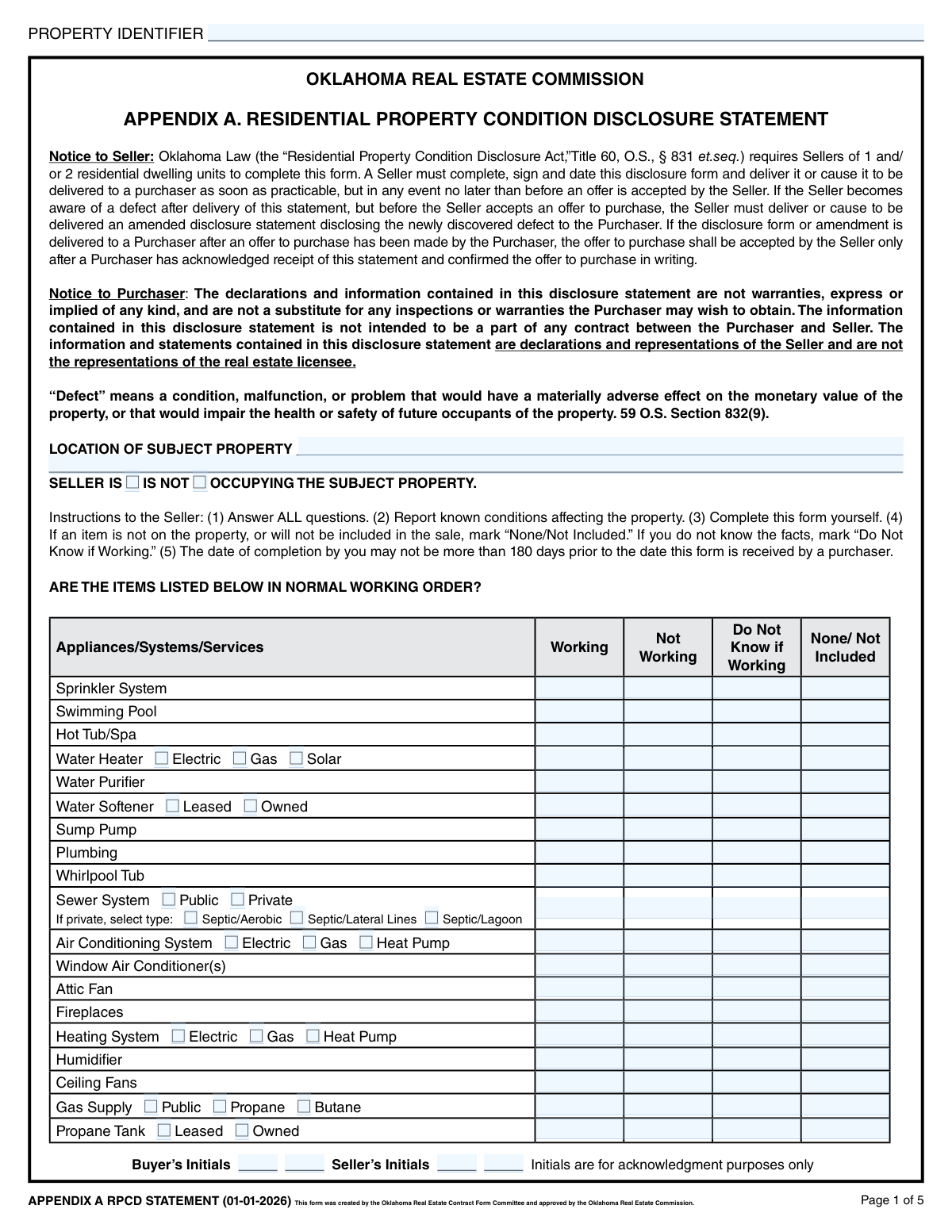
- For most sellers: Use the Oklahoma Appendix A, Residential Property Condition Disclosure Statement. This is the standard form used to disclose known defects to potential buyers.
- For exempt transfers: If the sale involves a court order, foreclosure, or a transfer between family members, use the Residential Property Condition Disclosure Exemption Form (RPCD EXEMPTION FORM).
- For Brokers: The Property Data Form (Residential) is essential for capturing the technical details and legal descriptions of a property for a new listing.
Leasing and Property Management
Landlords and property managers have a variety of forms to handle the lifecycle of a tenancy, from application to move-out.
- Vetting Tenants: Start with the Oklahoma Real Estate Commission Lease Application to collect employment and financial history.
- The Agreement: Use the Oklahoma Real Estate Commission Residential Lease as your primary contract. To modify an existing lease without rewriting it, use the Residential Lease Supplement.
- Setting Rules: Define specific responsibilities using the Tenancy Guidelines, the Pet Addendum, or the Keys and Re-Keying Addendum to clarify who pays for lock changes.
Mandatory Safety and Legal Disclosures
Certain disclosures are required by law regardless of the specific terms of your deal.
- Lead-Based Paint: If the property was built before 1978, you must provide the Disclosure of Information on Lead-Based Paint and/or Lead-Based Paint Hazards (available for both sales and rentals).
- Flood Risks: If a rental property is in a flood hazard area, the Tenant Flood Notice must be provided to the tenant.
- Brokerage Relationships: All parties in a transaction should receive the Disclosure of Broker Duties & Responsibilities to understand the agent's role.
Tips for Oklahoma state forms
When completing Appendix A or the RPCD form, disclose all known material defects, even minor ones. Incomplete disclosures are a frequent source of legal disputes in Oklahoma real estate transactions, so honesty is the best protection for sellers.
For any Oklahoma property built before 1978, federal law requires specific lead-based paint disclosures for both sales and rentals. Ensure you are using the correct version of the form to remain compliant with safety regulations.
Keep your Residential Lease, Pet Addendums, and Tenancy Guidelines organized as a single digital package. This ensures all parties have a complete understanding of their specific responsibilities and prevents missing critical attachments during the signing process.
AI-powered tools like Instafill.ai can complete these complex state forms in under 30 seconds with high accuracy. Your data stays secure during the process, making it an essential time-saver when managing multiple real estate or retirement documents.
Use the Keys and Re-Keying Addendum to explicitly state whether the owner or tenant pays for lock changes. Being specific about lawn care and minor repairs in the Tenancy Guidelines prevents future disagreements and protects the property's value.
Only use the RPCD Exemption Form if the transfer meets specific legal criteria, such as a foreclosure or a transfer between direct family members. Filing an exemption when a full disclosure is actually required can lead to significant financial liability.
Many Oklahoma Real Estate Commission forms require signatures from multiple parties, including brokers, buyers, and sellers. Review the entire document to ensure no signature line or date field is left blank, as missing info can delay closing or lease execution.
Frequently Asked Questions
These forms are primarily designed for real estate professionals, property owners, and tenants involved in the sale or rental of residential property in Oklahoma. They ensure compliance with state laws such as the Residential Property Condition Disclosure Act and the Landlord-Tenant Act.
This form must be completed by sellers of residential dwellings to inform potential buyers of any known defects. It should be provided to the buyer before an offer is accepted to ensure full transparency regarding the property's condition.
Yes, certain transfers are exempt, such as those involving newly constructed homes that have never been occupied, transfers between spouses, or court-ordered transfers like foreclosures. In these cases, the seller should complete the RPCD Exemption Form instead of Appendix A.
This form is legally required to ensure that all parties in a transaction understand the specific duties a broker owes to them. It covers confidentiality, the handling of offers, and the broker's role in the transaction, whether for a sale or a lease.
For any residential property built before 1978, federal law requires a specific lead-based paint disclosure form for both sales and leases. These forms inform the occupant or buyer of known lead hazards and provide them with a federally approved lead hazard information pamphlet.
Yes, you can use AI tools like Instafill.ai to complete these forms in under 30 seconds. The AI accurately extracts data from your source documents and places it directly into the correct fields on the official PDF forms.
Using modern AI-powered platforms, most Oklahoma state forms can be completed in less than a minute. These tools automate the data entry process, ensuring that complex documents like the Property Data Form or Residential Lease are filled out with high accuracy.
You should use the OREC Pet Addendum, which attaches to the standard residential lease. This document specifies the type of pet allowed, any additional deposits or fees, and the tenant's responsibilities for pet-related damages or behavior.
To amend an active agreement, you should use the Residential Lease Supplement. This form allows landlords and tenants to document changes or additional terms without needing to draft an entirely new lease agreement.
The responsibility for re-keying costs can be negotiated between the landlord and tenant using the Keys and Re-Keying Addendum. This form clearly states which party will pay for the service upon the tenant taking occupancy.
Landlords must provide this notice if the rental property is located in a known flood hazard area. This disclosure ensures the tenant is aware of potential risks to their personal property before they sign a lease agreement.
This addendum outlines specific maintenance expectations for the tenant, such as lawn care, smoke detector testing, and winterization steps. It serves as a practical guide to ensure the property is kept in good condition throughout the lease term.
Glossary
- Form Complexity Index
- Instafill’s 0–100 measure of how much effort a form takes to complete, calculated deterministically from the form’s own structure rather than estimated. It combines the number of fillable fields (the largest factor), how difficult those fields are to complete based on their type, the number of pages that contain fields, the amount of conditional “fill-only-if” logic, and how many sections the form is divided into, then adds modifiers for tables and repeating lists, bundled instruction pages, and dense page layouts. A higher score means the form is harder to fill out by hand. The forms in this category have a median Form Complexity Index of 49/100 (Moderate). See exactly how it is calculated.
- OREC (Oklahoma Real Estate Commission)
- The state agency responsible for regulating real estate licenses and providing standardized forms for property transactions and lease agreements.
- Residential Property Condition Disclosure Act
- An Oklahoma state law requiring sellers of residential property to provide a written statement to buyers detailing known defects or conditions of the home.
- Appendix A
- The official designation for the Residential Property Condition Disclosure Statement, which is the standard form used by sellers to list property defects.
- Broker Duties
- A set of mandatory legal responsibilities that an Oklahoma real estate agent owes to participants in a transaction, including honesty, accounting, and confidentiality.
- Material Defect
- A significant problem with a property's structure, systems, or environmental safety that could negatively affect its value or the health of occupants.
- RPCD Exemption Form
- A document used when a seller is legally excused from providing a property disclosure, often applicable to newly built homes, foreclosures, or transfers between family members.
- Addendum
- A supplemental document added to an original lease or contract to include extra terms, such as specific rules for pets or lock re-keying responsibilities.
- OPERS (Oklahoma Public Employees Retirement System)
- The state agency that manages retirement and disability benefits for public employees, often requiring specific forms for beneficiary designations or benefit elections.