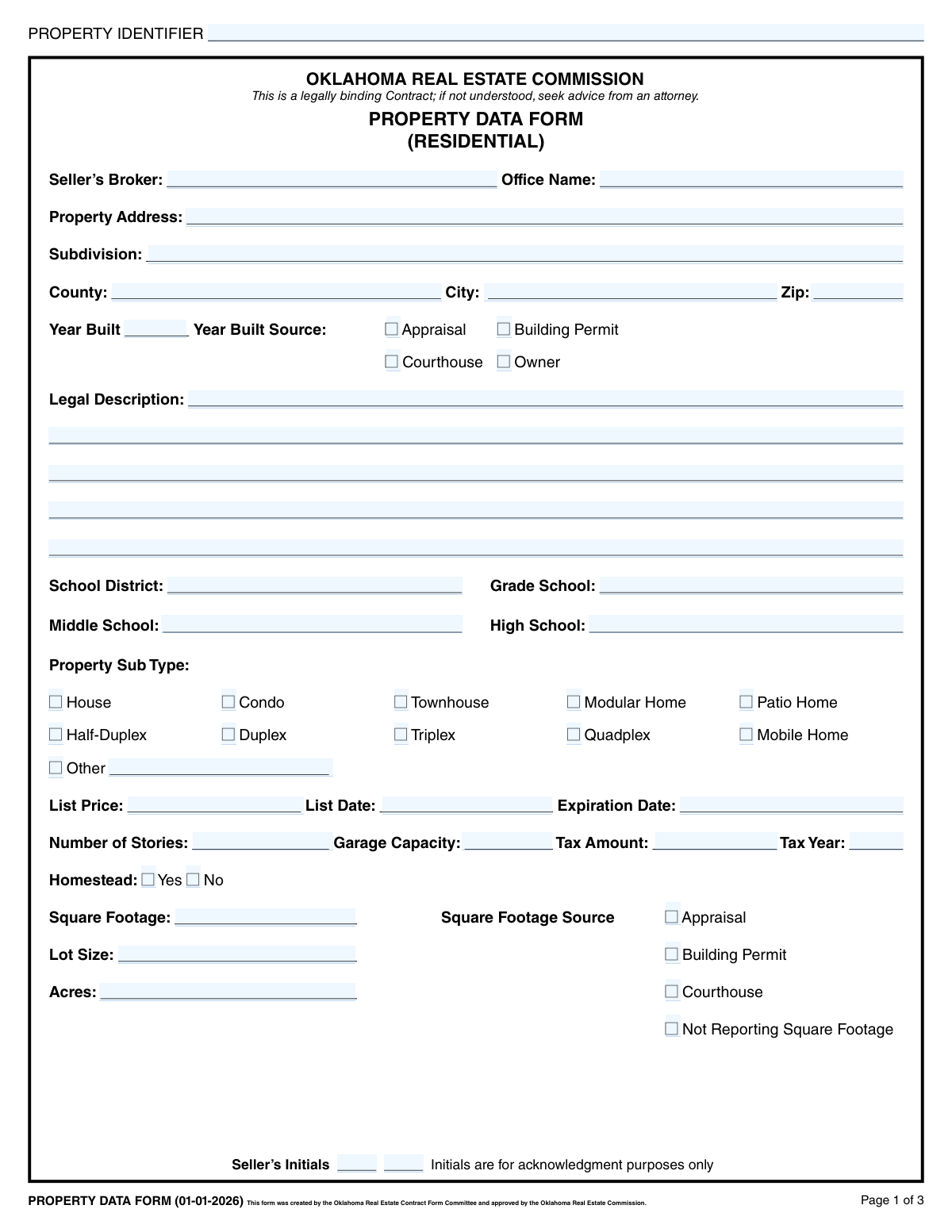
Yes! You can use AI to fill out Oklahoma Real Estate Commission Property Data Form (Residential)
| Fillable fields | 105 |
| Pages | 3 |
| Fields per page | 35 |
| Sections | 30 |
| Conditional rules | 1 |
| Tables & lists | 1 |
| Instruction pages | — |
| Instafill Form ID | IF-OKLAHOMA-REAL-ESTATE-COMMISSION-PROPERTY-DATA-FORM-RESIDENTIAL |
Rather not fill this in by hand? Instafill is an online form filler that completes PDF forms automatically — upload the blank form, answer a few questions, and the AI fills every field.
Form specifications
| Form name: | Oklahoma Real Estate Commission Property Data Form (Residential) |
| Number of fields: | 105 |
| Number of pages: | 3 |
| FCI: | Moderate (60/100) |
| Language: | English |
Instafill Demo: How to fill out PDF forms in seconds with AI
How to Fill Out Property Data Form Online for Free in 2026
- 1 Navigate to Instafill.ai and upload or select the Oklahoma Property Data Form.
- 2 Use the AI assistant to automatically populate property identifier details, such as address, county, and legal description, by connecting to public records.
- 3 Complete the property details section by entering information like year built, square footage, number of bedrooms/bathrooms, and selecting the property subtype.
- 4 Fill in the listing information, including the list price, list date, expiration date, and broker compensation details.
- 5 Provide any necessary public remarks, broker-specific notes, and clear directions to the property in the designated text fields.
- 6 Review all entered data for accuracy before the seller(s) and broker add their initials and signatures in the required fields.
- 7 Securely download, print, or share the completed and signed Property Data Form directly from the platform.
Our AI-powered system ensures each field is filled out correctly, reducing errors and saving you time.
Why Choose Instafill.ai for Your Fillable Property Data Form Form?
Speed
Complete your Property Data Form in as little as 37 seconds.
Up-to-Date
Always use the latest 2026 Property Data Form form version.
Cost-effective
No need to hire expensive lawyers.
Accuracy
Our AI performs 10 compliance checks to ensure your form is error-free.
Security
Your personal information is protected with bank-level encryption.
Frequently Asked Questions About Property Data Form
Property Data Form has a Form Complexity Index of 60 out of 100, placing it in the moderate complexity tier. This score is calculated deterministically from the form’s own structure using Instafill’s published Form Complexity Index methodology, so it can be reproduced and independently verified — it is not a subjective estimate.
For Property Data Form specifically, the score reflects 105 fillable fields across 3 pages, grouped into 30 sections, and 1 conditional fields that only apply depending on earlier answers, 1 table or repeating lists. The number of fields is the largest factor in the base score (weighted 36%), followed by how difficult those fields are to complete based on their type, where free-text and signature fields count for more than simple checkboxes (26%). The number of pages that actually contain fields (15%), the amount of conditional “fill-only-if” logic (16%), and how many sections the form is divided into (7%) account for the rest of the base. On top of that base, the index adds points for tables and repeating lists, bundled instruction pages, and dense page layouts — capturing difficulty the base alone can miss.
In practical terms, a moderate score means the form takes real effort: there are enough fields, pages and rules that errors are easy to make by hand. Instafill removes that effort entirely: our AI reads your information, maps each value to the correct field — including the conditional ones — and completes Property Data Form accurately in under a minute, with every field available for you to review before you download. See exactly how the Form Complexity Index is calculated.
Compliance Property Data Form
Validation Checks by Instafill.ai
Common Mistakes in Completing Property Data Form
“I was never sure if my IRS forms like W-9 were filled correctly. Now, I can complete the forms accurately without any external help.”
Your data stays secure with advanced protection from Instafill and our subprocessors




