
Yes! You can use AI to fill out Form 1098, Mortgage Interest Statement
Don't type 62 fields by hand. Tell our AI about yourself, or upload a document you already have, and it fills every field in seconds. You check it, then download, print or sign.
The AI does the filling. You just check it.
No typing into boxes, nothing to install.
What this form asks for
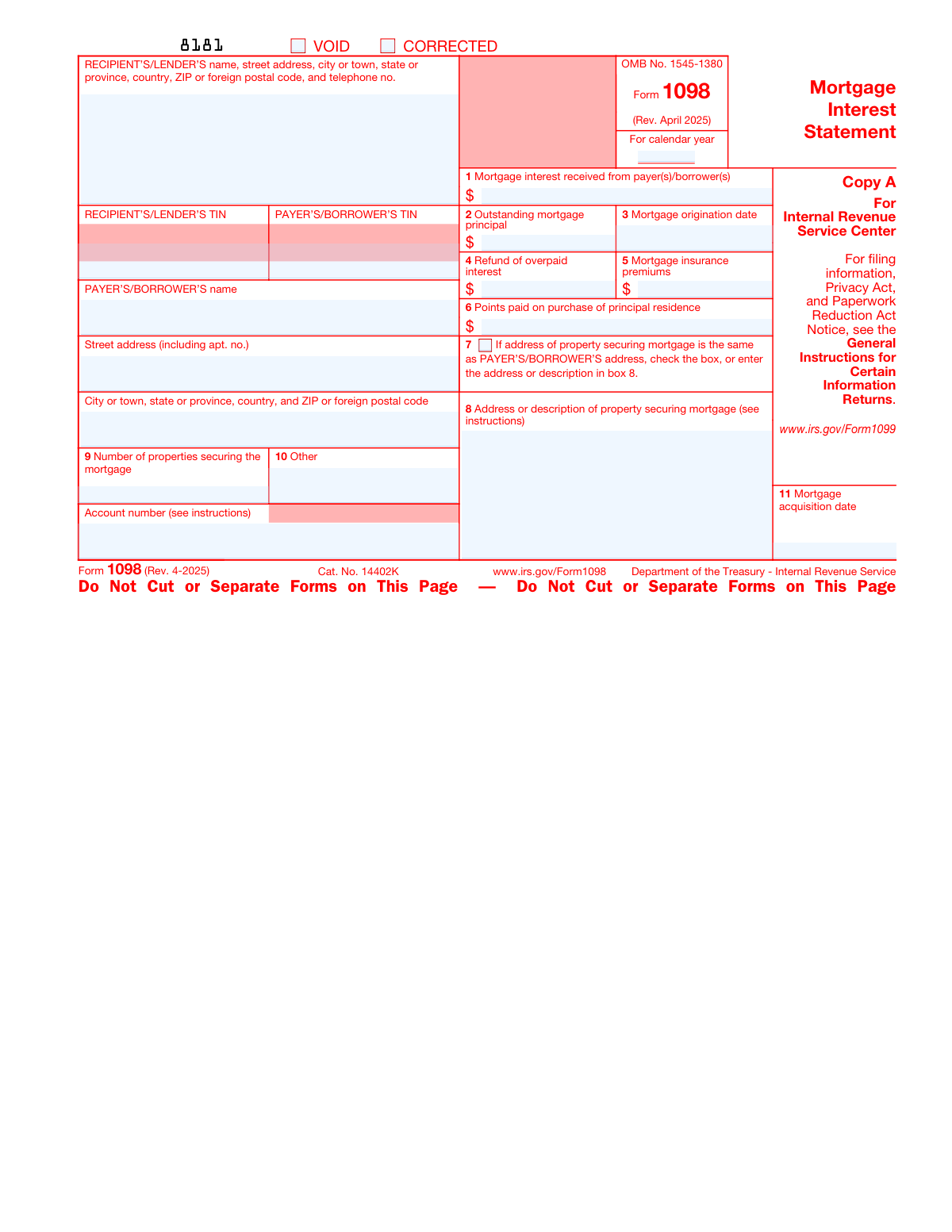
The AI fills all of it, from your answers or your documents.
The AI checks your answers before you download
19 checks built for this form, so a wrong date or a missing answer is caught before anyone else sees it.
The software ensures that the correct copy of Form 1098 is utilized for its intended recipient to maintain compliance with IRS regulations. It distinguishes between Copy A, which is designated for the IRS, Copy B, which is provided to the payer or borrower, and Copy C, which is retained by the recipient or lender. This validation is crucial to prevent the submission of incorrect copies to the wrong parties, which could result in processing delays or other issues.
The software confirms that Copy A of Form 1098 is not a version that has been downloaded from the internet, as such copies are not scannable and may not meet IRS requirements. It ensures that only official IRS forms or electronically filed documents are used for submission to the IRS. This check is important to avoid potential penalties associated with submitting non-conforming documents.
The software verifies that the Form 1098 being processed is an official form either ordered directly from the IRS website or filed electronically using the IRS's FIRE (Filing Information Returns Electronically) or AIR (Affordable Care Act Information Returns) systems. This validation ensures that the forms meet the IRS's standards for format and readability, which is essential for accurate processing and record-keeping.
The software checks that all required fields for the recipient's or lender's information on Form 1098 are complete and accurate. This includes the name, address, city, state, country, ZIP or foreign postal code, and telephone number. Ensuring the completeness of this information is vital for proper identification and contact purposes, as well as for the correct attribution of mortgage interest statements.
The software validates the accuracy of the recipient's or lender's Taxpayer Identification Number (TIN) on Form 1098. It checks that the TIN provided matches IRS records and is in the correct format. This validation is critical to prevent errors that could lead to misfiled returns or issues with credit claims for mortgage interest payments.
Ensures that the Taxpayer Identification Number (TIN) provided by the payer/borrower on Form 1098 is accurate and formatted correctly. The validation process includes checking the number of digits and the adherence to the appropriate TIN structure, such as a Social Security Number or Employer Identification Number. It also cross-references the TIN with official databases to confirm its validity and to prevent any issues with the IRS due to incorrect taxpayer identification.
And 13 more checks
- Ensures that the payer's/borrower's information is complete, including name and address.
- Confirms that the account number or unique identifier is entered for the borrower's account.
- Verifies the amount of mortgage interest received from the payer/borrower in Box 1.
- Checks the outstanding mortgage principal as of January 1 or the origination date in Box 2.
- Ensures the mortgage origination date is correctly entered in Box 3.
- Verifies any refund of overpaid interest reported in Box 4.
- Confirms the amount of mortgage insurance premiums paid in Box 5.
- Checks the points paid on the purchase of the principal residence in Box 6.
- Ensures the property address is correctly reported in Box 7 or Box 8, and that Box 7 is checked if the property address is the same as the borrower's.
- Verifies the number of properties securing the mortgage in Box 9.
- Ensures that Box 10 is used for other information such as real estate taxes or insurance paid from escrow.
- Checks the mortgage acquisition date in Box 11, if applicable.
- Confirms that the 'CORRECTED' box is checked if the form is a correction of a previously filed Form 1098.
Let AI fill out your Form 1098
No typing. Every field filled in seconds, checked, ready to sign.
How to Fill Out Form 1098 Online for Free in 2026
What the AI walks you through.
- Visit instafill.ai site and select Form 1098
- Enter lender's name and address
- Input lender's and borrower's TIN
- Fill in borrower's name and address
- Provide account and mortgage details
- Sign and date the form electronically
- Check for accuracy and submit form
Common Mistakes in Completing Form 1098
The ones the AI is built to catch.
Using a downloaded Copy A to file with the IRS
Failing to use the correct form copy for each recipient
Omitting the lender's name, address, or TIN
Entering incorrect borrower's TIN or address
Leaving the account number field blank
Misreporting the amount of mortgage interest in Box 1
Incorrectly stating the outstanding mortgage principal in Box 2
Forgetting to enter the mortgage origination date in Box 3
Neglecting to report refund of overpaid interest in Box 4
Failing to enter mortgage insurance premiums in Box 5
Omitting points paid on purchase in Box 6
Not checking Box 7 when the property address matches the borrower's
Leaving Box 8 blank when the property address differs
Incorrectly reporting the number of properties in Box 9
Misusing Box 10 for information not intended for that box
Forgetting to enter the mortgage acquisition date in Box 11
Not marking the 'CORRECTED' box when amending a form
Failing to keep a copy of the form for personal records
Not providing the necessary copies to the IRS and borrower
Overlooking the need to order official forms for IRS filing
Frequently Asked Questions About Form 1098
Is it really free for 7 days?
Can I fill other forms too?
How do I cancel?
How does the AI fill out Form 1098?
What happens to my information?
How complex is Form 1098 to fill out?
What is Form 1098, Mortgage Interest Statement?
Who needs to file Form 1098?
What information is required on Form 1098?
Where can I find the official IRS Form 1098 for filing?
Can I print and file Copy A of Form 1098 from the IRS website?
What are the penalties for filing a scannable Form 1098 that cannot be scanned by the IRS?
How can I order official IRS information returns including Form 1098?
Is it possible to file information returns electronically with the IRS?
What publications provide more information about printing tax forms like Form 1098?
What should I do if I receive a Form 1098 with the 'CORRECTED' box checked?
What is the purpose of the recipient/lender's and payer/borrower's TIN on Form 1098?
What should be included in Box 1 of Form 1098?
How is the outstanding mortgage principal reported on Form 1098?
What does the mortgage origination date in Box 3 of Form 1098 indicate?
How should a refund of overpaid interest reported in Box 4 of Form 1098 be handled for tax purposes?
Are mortgage insurance premiums reported on Form 1098 deductible?
What are points and how are they reported on Form 1098?
What should I do if the address of the property securing the mortgage is different from the payer's/borrower's address?
What does Box 9 on Form 1098 indicate about the number of properties securing the mortgage?
Where can I find the latest information about developments related to Form 1098?
Get your Form 1098 filled out by AI
$0 today. Cancel before Nov 1 and you pay nothing.
Other forms like this one
mortgage forms: Mortgage Renewal Agreement
PA state forms: Form 1095-A, Health Insurance Marketplace Statement, Form W-2, Wage and Tax Statement, Form 593, Real Estate Withholding, Form 8938, Statement of Specified Foreign Financial Assets, Form CMS-2567, Statement of Deficiencies, Form 1098-T, Tuition Statement, Form 1099-S, Proceeds From Real Estate Transactions, Form 1098-E, Student Loan Interest Statement, Form DS-3053, Statement of Consent, Form DS-86, Statement of Non-Receipt of a U.S. Passport, Form DS-86, Statement of Non-Receipt of a U.S. Passport, Form 108, Statement of Intention, Form 107, Statement of Financial Affairs, Form 121, Statement About Your SSNs, Form 122A-1, Chapter 7 Statement of Current Monthly Income, Center for Infertility & Reproductive Surgery – New Patient Questionnaire and Patient/Guarantor Statement (Brigham and Women’s Hospital, Department of Obstetrics and Gynecology), Adult Travel Document Application for Stateless and Protected Persons in Canada (16 years of age or over) (PPTC 190), Form W-8IMY (Rev. October 2021), Certificate of Foreign Intermediary, Foreign Flow-Through Entity, or Certain U.S. Branches for United States Tax Withholding and Reporting, Form W-2, Wage and Tax Statement (2025), State of New Mexico Workers’ Compensation Administration — Workers' Compensation Complaint (Rev. 8/22) (11.4.4.9 NMAC)
NJ state forms: Form 1095-A, Health Insurance Marketplace Statement, Form W-2, Wage and Tax Statement, Form 593, Real Estate Withholding, Form 8938, Statement of Specified Foreign Financial Assets, Form CMS-2567, Statement of Deficiencies, Form 1098-T, Tuition Statement, Form 1099-S, Proceeds From Real Estate Transactions, Form 1098-E, Student Loan Interest Statement, Form DS-3053, Statement of Consent, Form DS-86, Statement of Non-Receipt of a U.S. Passport, Form DS-86, Statement of Non-Receipt of a U.S. Passport, Form 108, Statement of Intention, Form 107, Statement of Financial Affairs, Form 121, Statement About Your SSNs, Form 122A-1, Chapter 7 Statement of Current Monthly Income, Center for Infertility & Reproductive Surgery – New Patient Questionnaire and Patient/Guarantor Statement (Brigham and Women’s Hospital, Department of Obstetrics and Gynecology), Adult Travel Document Application for Stateless and Protected Persons in Canada (16 years of age or over) (PPTC 190), Form W-8IMY (Rev. October 2021), Certificate of Foreign Intermediary, Foreign Flow-Through Entity, or Certain U.S. Branches for United States Tax Withholding and Reporting, Form W-2, Wage and Tax Statement (2025), State of New Mexico Workers’ Compensation Administration — Workers' Compensation Complaint (Rev. 8/22) (11.4.4.9 NMAC)
state ID forms: Application for Renewal or Duplicate of Alabama Driver License or ID card, Form 1095-A, Health Insurance Marketplace Statement, Form W-2, Wage and Tax Statement, Form 593, Real Estate Withholding, Form 8938, Statement of Specified Foreign Financial Assets, Form CMS-2567, Statement of Deficiencies, Form 1098-T, Tuition Statement, Form 1099-S, Proceeds From Real Estate Transactions, Form 1098-E, Student Loan Interest Statement, Form DS-3053, Statement of Consent, Form DS-86, Statement of Non-Receipt of a U.S. Passport, Form 108, Statement of Intention, Form 107, Statement of Financial Affairs, Form 121, Statement About Your SSNs, Form 122A-1, Chapter 7 Statement of Current Monthly Income, Center for Infertility & Reproductive Surgery – New Patient Questionnaire and Patient/Guarantor Statement (Brigham and Women’s Hospital, Department of Obstetrics and Gynecology), Adult Travel Document Application for Stateless and Protected Persons in Canada (16 years of age or over) (PPTC 190), Form W-8IMY (Rev. October 2021), Certificate of Foreign Intermediary, Foreign Flow-Through Entity, or Certain U.S. Branches for United States Tax Withholding and Reporting, Form W-2, Wage and Tax Statement (2025), State of New Mexico Workers’ Compensation Administration — Workers' Compensation Complaint (Rev. 8/22) (11.4.4.9 NMAC)
Let AI fill out your Form 1098
Your trial starts once a card is added. You pay nothing before Nov 1.
Our AI already knows this form, all 62 fields of it. Skip the typing: tell it about yourself, or upload what you have, and it fills the whole form in seconds.
- AI fills every field on all 5 pages, checkboxes included
- No typing into boxes: answer a few questions, or upload a document you already have, an old copy of this form, a photo of a document
- The AI checks the answers; you review and change anything before you download
- Download the finished PDF, print it, or sign it online
- Encrypted, and never used to train AI
Cancel before Nov 1 and you pay nothing.
A card is needed to start the trial. Cancel in two clicks from your account.
Terms · Privacy