Fill out mortgage forms
with AI.
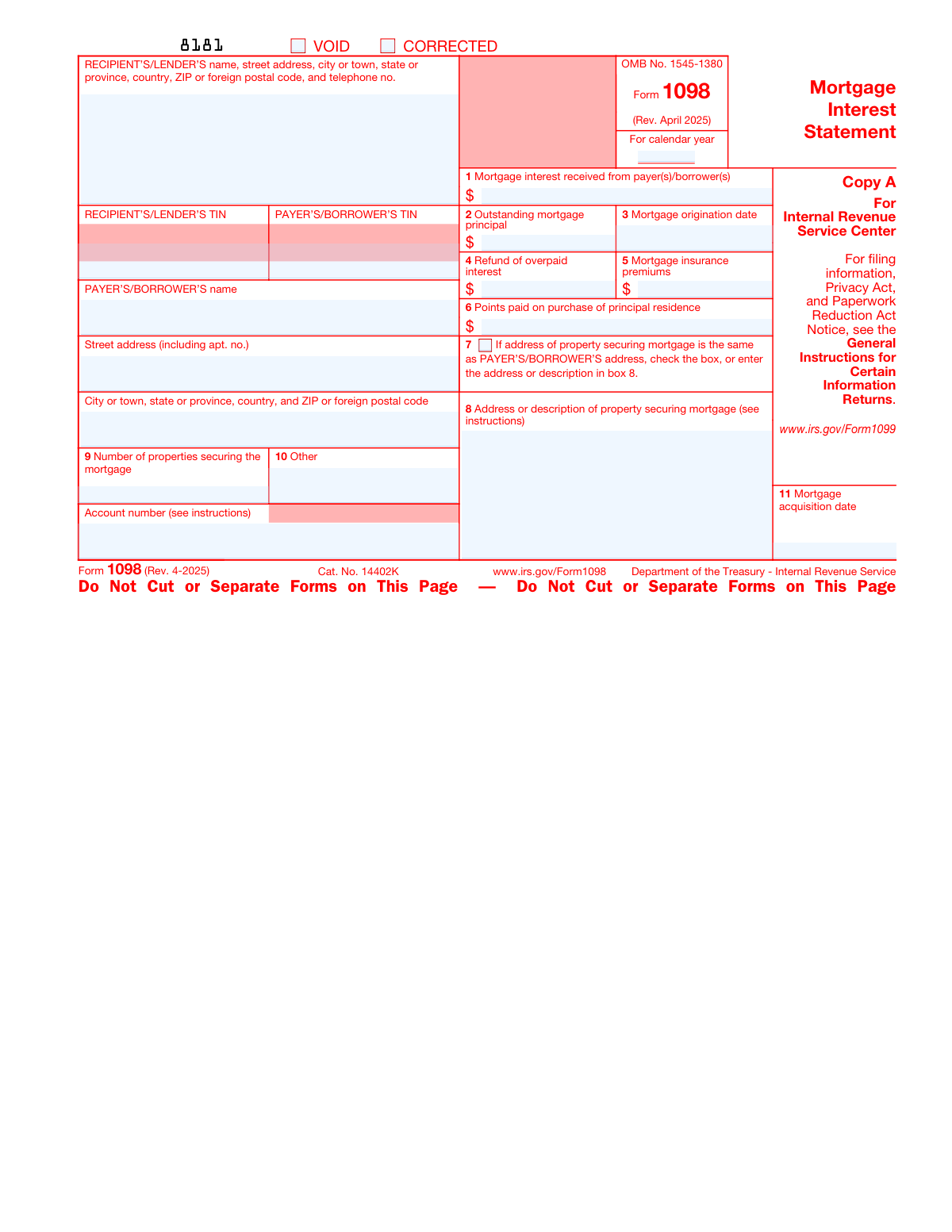
Mortgage forms are essential documents used throughout the lifecycle of a home loan, from the initial application process to annual tax reporting. These forms serve as the official record for financial transactions between lenders and borrowers, ensuring that loan terms, interest payments, and property details are documented accurately. For instance, the Form 1098 (Mortgage Interest Statement) is a vital piece of the puzzle for homeowners, as it tracks the interest paid over the year and is required to claim relevant tax deductions. Because these documents carry significant legal and financial weight, maintaining precise records is a priority for anyone involved in the real estate market.
By continuing, you acknowledge Instafill's Privacy Policy and agree to get occasional product update and promotional emails.
About mortgage forms
Typically, these forms are handled by homeowners, real estate professionals, and tax preparers who need to ensure compliance with IRS regulations and lending standards. Whether you are navigating a new loan application or preparing for tax season, having access to standardized real estate forms and Fannie Mae or Freddie Mac documentation is necessary to move the process forward without delays. Tools like Instafill.ai use AI to fill these forms in under 30 seconds, handling the data accurately and securely to serve as a practical time-saver for busy professionals and individuals alike. This allows you to focus on your financial strategy rather than the repetitive task of manual data entry.
Every form on this page can be completed without typing. Instafill is form filling software that reads a PDF and fills it for you — including flat and scanned documents that carry no fillable fields at all.
Forms in This Category
The forms in this category have a median Form Complexity Index of 51/100 (Moderate), measured across 2 forms by field count, input difficulty, length, conditional logic and structure. See how it is calculated.
| Form Name | Pages | FCI | |
|---|---|---|---|
| 1. | Form 1098, Mortgage Interest Statement | 6 | Moderate 51 |
| 2. | Mortgage Renewal Agreement | 2 | Basic 40 |
- Enterprise-grade security & data encryption
- 99%+ accuracy powered by AI
- 1,000+ forms from all industries
- Complete forms in under 60 seconds
How to Choose the Right Form
Navigating the complexities of real estate and financing requires precision, especially when it comes to tax reporting and loan management. While the mortgage lifecycle involves various documents—from initial loan application forms to closing disclosures—the forms in this category are specifically designed to handle the financial reporting phase of homeownership.
To ensure you are selecting the correct document for your needs, consider the following breakdown of purpose and audience.
Reporting Mortgage Interest for Taxes
If your goal is to report or claim interest paid on a home loan, the primary document you need is Form 1098, Mortgage Interest Statement. This form is essential for two specific groups:
- Lenders and Financial Institutions: Use this form to report interest, points, and mortgage insurance premiums totaling $600 or more received from a borrower during the tax year.
- Homeowners and Borrowers: You will need the data from this form to accurately claim mortgage interest deductions on your federal income tax return. It provides the necessary figures for interest paid, points paid on the purchase of a principal residence, and any overpaid interest refunds.
Distinguishing Mortgage Forms by Use Case
It is important to distinguish tax-related mortgage forms from other real estate forms you might encounter:
- Application vs. Reporting: If you are in the process of applying for a new mortgage, you are likely looking for Fannie Mae or Freddie Mac forms (such as the Uniform Residential Loan Application). In contrast, Form 1098 is used only after a loan is active to track annual interest.
- Closing vs. Maintenance: Closing documents like the Closing Disclosure or ALTA statements are used at the point of sale. Form 1098 is a maintenance document used annually throughout the life of the loan.
By using Instafill.ai, you can quickly populate Form 1098 by allowing our AI to extract data from your financial records, ensuring that interest amounts and lender information are accurately reflected for the IRS.
Form Comparison
| Form | Purpose | Key Information | Primary Recipients | Tax Utility |
|---|---|---|---|---|
| Form 1098, Mortgage Interest Statement | Reports mortgage interest of $600 or more paid to a lender. | Contains total interest, points, and mortgage insurance premiums paid. | The borrower and the Internal Revenue Service (IRS). | Used to claim mortgage interest deductions on annual tax returns. |
Tips for mortgage forms
Ensure your Taxpayer Identification Number or Social Security Number matches exactly what your lender has on file. Even a minor typo in your personal details can lead to discrepancies when the IRS processes your mortgage interest deductions.
Remember that mortgage forms like the 1098 only report the interest paid, not the total monthly payments toward your principal. Focus on the specific boxes indicating interest and points to ensure your tax calculations are accurate.
Look closely at the boxes for points paid on the purchase of a principal residence and mortgage insurance premiums. These amounts are often deductible but are frequently overlooked by first-time filers during tax season.
If you refinanced your home during the year, you will likely receive a separate Form 1098 from both your old and new lenders. Make sure to aggregate the data from all forms to claim the total interest paid throughout the entire year.
AI-powered tools like Instafill.ai can complete these forms in under 30 seconds with high accuracy, drastically reducing the time spent on manual entry. Your data stays secure during the process, providing a fast and safe way to handle complex real estate paperwork.
Keep copies of all mortgage-related forms and year-end statements for at least three to seven years. Having these organized and accessible is crucial if you need to provide proof of deductions to tax authorities in the future.
Frequently Asked Questions
Mortgage forms are legal and financial documents used to record home loans, report interest paid for tax purposes, or apply for property financing. They ensure that both the lender and the borrower have a clear, standardized record of loan terms and annual financial activity.
Homeowners who pay mortgage interest and lenders who receive it are the primary users of these forms. For tax reporting, anyone who paid $600 or more in mortgage interest during the year will typically receive a statement to help them claim deductions on their federal tax return.
You generally need Form 1098 if you are a homeowner looking to deduct mortgage interest on your income tax return. Your lender is required to provide this form if you paid at least $600 in interest, points, or mortgage insurance premiums during the calendar year.
Tax-related mortgage forms are usually submitted to the IRS as part of your annual tax filing, whereas loan applications are submitted directly to your bank or mortgage broker. If you are a lender, you are responsible for providing copies to both the borrower and the IRS.
No, they serve different stages of the home-buying process. Loan application forms, such as those from Fannie Mae or Freddie Mac, are used to request financing, while forms like the 1098 are used for reporting financial activity after the loan is already in place.
To complete these forms, you usually need your loan account number, Social Security number, and detailed records of payments made throughout the year. For application-based forms, you may also need income verification documents like W-2s or bank statements.
Yes, AI tools like Instafill.ai can fill out mortgage forms in under 30 seconds by accurately extracting data from your source documents. These tools automatically place the information into the correct PDF fields, which helps reduce manual entry errors.
While manual entry can take significant time, using an AI-powered platform allows you to complete mortgage forms almost instantly. The system processes your data and populates the form in seconds, ensuring all required fields are addressed efficiently.
Fannie Mae and Freddie Mac provide standardized forms used by the mortgage industry to ensure loans meet specific criteria for the secondary market. While many of their forms are identical or very similar, they may have slight variations depending on the specific underwriting guidelines of the entity purchasing the loan.
Most standard mortgage forms, including the Mortgage Interest Statement, are primarily designed for residential properties. Commercial real estate transactions typically involve different documentation and more complex reporting requirements tailored to business financing.
Glossary
- Form Complexity Index
- Instafill’s 0–100 measure of how much effort a form takes to complete, calculated deterministically from the form’s own structure rather than estimated. It combines the number of fillable fields (the largest factor), how difficult those fields are to complete based on their type, the number of pages that contain fields, the amount of conditional “fill-only-if” logic, and how many sections the form is divided into, then adds modifiers for tables and repeating lists, bundled instruction pages, and dense page layouts. A higher score means the form is harder to fill out by hand. The forms in this category have a median Form Complexity Index of 51/100 (Moderate). See exactly how it is calculated.
- Mortgage Interest Deduction
- A tax benefit that allows homeowners to reduce their taxable income by the amount of interest paid on a qualified home loan during the year.
- Escrow
- An account managed by a lender to hold funds for the payment of property taxes and homeowners insurance premiums on behalf of the borrower.
- Principal
- The remaining balance of the original amount of money borrowed, excluding interest and other fees.
- Points (Mortgage Points)
- Prepaid interest paid to a lender at closing to secure a lower interest rate, which may be reported as deductible interest on tax forms.
- Private Mortgage Insurance (PMI)
- A type of insurance required for most conventional loans when the down payment is less than 20%, protecting the lender against loss if the borrower defaults.
- Fannie Mae & Freddie Mac
- Government-sponsored enterprises that provide liquidity to the mortgage market by purchasing and guaranteeing loans, often dictating the standard forms used in the industry.
- Amortization
- The process of paying off a mortgage debt over time through a schedule of fixed payments consisting of both interest and principal.
- Lien
- A legal claim or right against a property that serves as security for the repayment of a debt, such as a mortgage.