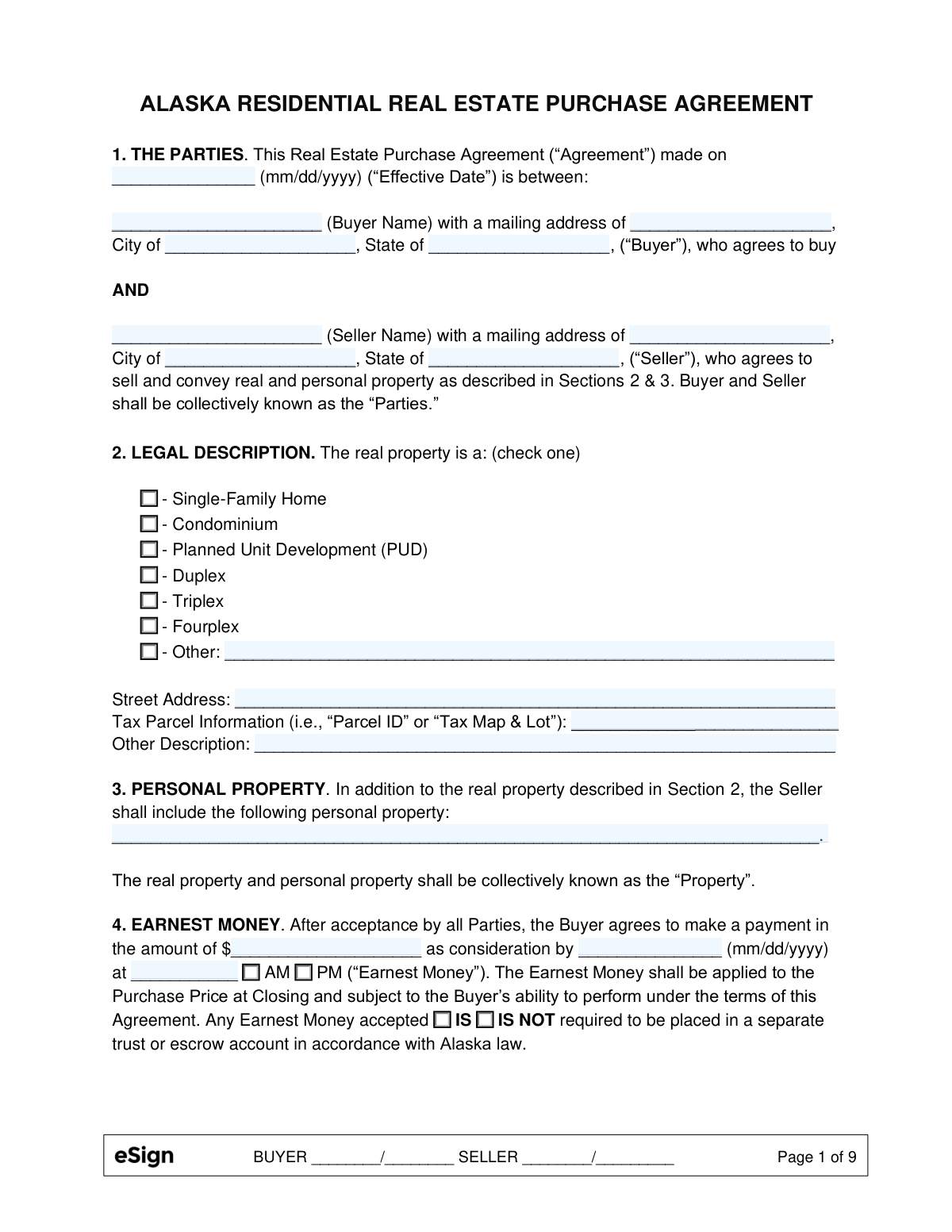
Yes! You can use AI to fill out Alaska Residential Real Estate Purchase Agreement
This form is a legally binding contract that outlines the specific terms and conditions of a residential property sale in the state of Alaska. It details crucial information such as the parties involved, property description, purchase price, financing arrangements, contingencies, and closing procedures, making it an essential document for any home sale. Today, this form can be filled out quickly and accurately using AI-powered services like Instafill.ai, which can also convert non-fillable PDF versions into interactive fillable forms.
Our AI automatically handles information lookup, data retrieval, formatting, and form filling.
It takes less than a minute to fill out Alaska Residential Purchase Agreement using our AI form filling.
Securely upload your data. Information is encrypted in transit and deleted immediately after the form is filled out.
Form specifications
| Form name: | Alaska Residential Real Estate Purchase Agreement |
| Number of pages: | 9 |
| Language: | English |
| Categories: | real estate forms, estate forms, PA state forms, NJ state forms |
Instafill Demo: How to fill out PDF forms in seconds with AI
How to Fill Out Alaska Residential Purchase Agreement Online for Free in 2026
Are you looking to fill out a ALASKA RESIDENTIAL PURCHASE AGREEMENT form online quickly and accurately? Instafill.ai offers the #1 AI-powered PDF filling software of 2026, allowing you to complete your ALASKA RESIDENTIAL PURCHASE AGREEMENT form in just 37 seconds or less.
Follow these steps to fill out your ALASKA RESIDENTIAL PURCHASE AGREEMENT form online using Instafill.ai:
- 1 Navigate to Instafill.ai and upload or select the Alaska Residential Real Estate Purchase Agreement.
- 2 Use the AI assistant to input the full names and mailing addresses of both the Buyer and the Seller.
- 3 Provide the complete legal description of the property, including its address, parcel ID, and a list of any personal property included in the sale.
- 4 Detail the financial terms of the agreement, such as the total purchase price, the earnest money deposit amount, and the method of financing (e.g., all cash, bank financing, seller financing).
- 5 Specify important dates, deadlines, and contingencies related to inspections, appraisals, financing approval, and the closing date.
- 6 Indicate how closing costs will be divided and address any additional terms, conditions, or required disclosures.
- 7 Carefully review all auto-filled information for accuracy before the Buyer and Seller provide their final signatures to execute the agreement.
Our AI-powered system ensures each field is filled out correctly, reducing errors and saving you time.
Why Choose Instafill.ai for Your Fillable Alaska Residential Purchase Agreement Form?
Speed
Complete your Alaska Residential Purchase Agreement in as little as 37 seconds.
Up-to-Date
Always use the latest 2026 Alaska Residential Purchase Agreement form version.
Cost-effective
No need to hire expensive lawyers.
Accuracy
Our AI performs 10 compliance checks to ensure your form is error-free.
Security
Your personal information is protected with bank-level encryption.
Frequently Asked Questions About Form Alaska Residential Purchase Agreement
This is a legally binding contract that establishes the terms and conditions for the sale of a residential property between a buyer and a seller in Alaska. It details the purchase price, financing, contingencies, and closing process.
Both the buyer(s) and seller(s) must fill out their respective information and sign the agreement to make it a valid offer and contract. If real estate agents are involved, they may also sign the form.
Earnest Money is a deposit made by the buyer to show their serious intent to purchase the property, as detailed in Section 4. It is typically applied to the purchase price at closing and may be refunded if the agreement is terminated due to a failed contingency, such as inspection or financing issues.
You must clearly list all personal property to be included with the home, such as refrigerators, washers, or specific furniture, in Section 3. Anything not explicitly written in this section can be removed by the seller before closing.
If your purchase is contingent on obtaining bank financing (Section 5), and you are unable to secure a loan after making a good faith effort, you may be able to terminate the agreement. If you meet the contract's requirements, your Earnest Money should be returned.
If your agreement includes an appraisal contingency (Section 15), and the property appraises for less than the agreed-upon price, you have a specified period to renegotiate with the seller. If you cannot reach a new agreement, the contract can be terminated, and your Earnest Money is returned.
This period allows the buyer to hire professionals to inspect the property for any defects. If issues are discovered, the buyer can present them to the seller to negotiate repairs or, if an agreement can't be reached, terminate the contract.
Section 7 requires the parties to specify who will pay the closing costs. You must check the box indicating if the Buyer, Seller, or Both Parties will be responsible for fees like the title search and recording fees.
If you default on the agreement without a valid reason, the seller's remedy is typically limited to keeping your Earnest Money deposit as liquidated damages, as stated in Section 20. You would forfeit this amount for failing to fulfill your obligations.
Yes, Section 28 requires you to set an offer expiration date and time. If the seller does not sign and deliver the accepted agreement back to you by this deadline, your offer is considered revoked.
According to Section 23, if a dispute arises, the parties must first attempt to resolve it through mediation. If mediation is unsuccessful, the agreement requires the dispute to be settled by neutral, binding arbitration instead of court action.
Yes, services like Instafill.ai use AI to auto-fill form fields accurately and save time. This can help you complete the complex agreement more efficiently and reduce the chance of errors.
You can use a service like Instafill.ai to easily complete this form online. Simply upload the document, and the platform will make it fillable, allowing you to type your information directly into the fields and sign it electronically.
If you have a non-fillable or 'flat' PDF, you can use a tool like Instafill.ai to convert it into an interactive, fillable form. The service automatically identifies the fields, so you can type in your information without having to print and write by hand.
Compliance Alaska Residential Purchase Agreement
Validation Checks by Instafill.ai
1
Closing Date Chronology
This check ensures the 'Closing' date in Section 9 is set for a date after the 'Effective Date' in Section 1. A real estate closing cannot legally occur before the purchase agreement is effective, so this validation is critical for creating a valid and logical contract timeline. If the closing date precedes the effective date, the form submission will fail, prompting the user to correct the impossible timeline.
2
Purchase Price Numeric and Written Match
Validates that the numeric 'Purchase Price' in Section 5 is identical to the amount written out in words in the subsequent field. This is a crucial check to prevent ambiguity and potential legal disputes over the property's price, which is the most fundamental term of the agreement. A mismatch would trigger an error, forcing the user to reconcile the two fields before submission.
3
Exclusive Financing Method Selection
Ensures that exactly one financing option ('All Cash Offer', 'Bank Financing', or 'Seller Financing') is selected in Section 5. The contract's contingencies and required documentation are entirely dependent on this choice, making it a critical data point. The system will reject a form with zero or multiple selections to avoid ambiguity in the buyer's obligations.
4
Seller Financing Sum Verification
If 'Seller Financing' is selected in Section 5, this check verifies that the sum of the 'Loan Amount' and the 'Down Payment' equals the total 'Purchase Price'. This validation ensures the financing terms are mathematically sound and fully account for the property's sale price. An error would indicate a miscalculation that must be corrected to create a coherent and enforceable financing agreement.
5
Contingent Property Sale Completeness
Verifies that if the 'Shall be contingent upon selling another property' option is checked in Section 6, then the corresponding address fields and the number of days to sell are all filled out. This information is essential for defining the scope and timeline of this major contingency, which significantly impacts the agreement. If the contingency is selected but the details are missing, the form will be considered incomplete and rejected.
6
Property Type Specification
This check ensures that exactly one property type checkbox is selected in Section 2. Furthermore, if the 'Other' checkbox is selected, it validates that the corresponding text description field is not empty. This is important for accurately identifying the property for legal and title purposes, and an omission would make the contract unclear.
7
Mandatory Party Information
Confirms that the 'Buyer Name' and 'Seller Name' fields in Section 1 are not empty. An agreement is not legally valid without clearly identified parties. This check prevents the submission of an unenforceable contract by ensuring the primary participants are named.
8
Deadline Chronology Validation
This validation performs a comprehensive check on multiple date fields, ensuring a logical chronological order. It verifies that the Inspection Deadline (Section 13), Financing Verification Deadline (Section 5), and Offer Expiration (Section 28) all occur after the Effective Date but before the Closing Date. This prevents the creation of a contract with impossible or conflicting timelines that would render it void.
9
Offer Expiration Date Logic
Ensures the 'Offer Expiration' date and time in Section 28 is a future point in time and logically precedes other key dates like the Closing Date. An offer must be accepted before the transaction can proceed, so the expiration must be set appropriately. This check prevents the creation of a nonsensical contract where the offer expires after the deal is already supposed to be finalized.
10
Signature Date Validation
This check verifies that all signature dates in Section 34 are on or after the 'Effective Date' specified in Section 1. A party cannot legally sign and bind themselves to an agreement before it is considered effective. This validation upholds the integrity of the execution process and prevents invalid backdating.
11
Bank Financing Completeness
If 'Bank Financing' is selected in Section 5, this validation ensures a specific loan type is chosen and the 'Verification Deadline' date is provided. These details are critical for defining the buyer's obligations and the seller's right to terminate if deadlines are missed. The form would be considered incomplete and rejected without this essential financing information.
12
Positive Integer for Day-Based Periods
This check scans all fields that require a number of days (e.g., Section 5d, Section 10, Section 12, Section 15) and validates that the input is a positive integer. Using zero, negative numbers, or text would make the contractual periods for notices, remedies, or negotiations ambiguous or invalid. This ensures all timeframes are clearly and correctly defined.
13
Appraisal Contingency Completeness
Validates that if the appraisal contingency in Section 15 is selected ('Shall be contingent...'), the 'Negotiation Period' in business days is filled with a positive integer. This period is a critical term that defines how long the parties have to renegotiate if the appraisal is low. A failure to define this period would create uncertainty and potential disputes, so the form is invalid without it.
14
Disclosure Attachment Declaration
Validates that if the checkbox indicating 'The following addendums or disclosures are attached' (Section 31) is selected, then at least one of the specific addendum checkboxes or description fields is also filled. This prevents a user from declaring that attachments exist without specifying what they are. An error would prompt the user to either specify the attachments or select the 'no attached addendums' option.
Common Mistakes in Completing Alaska Residential Purchase Agreement
People often enter nicknames or incomplete names for the Buyer and Seller in Section 1. This is a critical error because the names on the purchase agreement must exactly match the names on government-issued ID and the property's title to ensure a valid transfer of ownership. Any discrepancy can lead to significant delays or rejection at closing. To avoid this, always use full legal names as they appear on official documents.
In Section 2, filers frequently provide the street address but leave the 'Tax Parcel Information' field blank. A street address can sometimes be ambiguous or incorrect, whereas the Tax Parcel ID is a unique identifier used by the municipality for legal and tax purposes. Failing to include it can create title search complications and questions about the exact property being conveyed. Always locate this number on a recent tax bill or the county assessor's website.
When listing items in Section 3, 'Personal Property,' users often write generic terms like 'kitchen appliances' or 'window coverings.' This ambiguity can lead to disputes at the final walk-through if the seller replaces a high-end refrigerator with a basic model. To prevent this, list each item with specific details, including brand and model number if possible, to create a clear and enforceable record of what is included in the sale.
A common data entry error in Section 5 is when the numerical purchase price (e.g., '$500,000') does not match the price written out in words (e.g., 'Five Hundred Five Thousand Dollars'). In legal contracts, the written-out amount often governs, which could unintentionally alter the purchase price and jeopardize the agreement or financing. Double-checking that both entries are identical is crucial. AI-powered tools like Instafill.ai can prevent this by auto-populating one field based on the other.
In Section 5 (Bank Financing) or Section 31 (Disclosures), a user might check a box indicating a specific loan type (like FHA/VA) or disclosure (like Lead-Based Paint) but forget to physically attach the corresponding document. This renders the offer incomplete and may violate legal requirements, giving the other party grounds to terminate the agreement. Always compile all necessary addendums before submitting the offer.
This form contains numerous time-sensitive deadlines for earnest money, financing verification, inspections, and offer expiration. People often overlook these fields, creating ambiguity and potential for default. An agreement without clear deadlines is weak and can lead to disputes over performance timelines. It is essential to fill in every date and time field, including AM/PM, to make the contract's terms clear and enforceable.
Each page of the agreement has a space for the Buyer and Seller to initial at the bottom. It is a frequent oversight to miss one or more of these initial boxes. These initials serve as acknowledgment that both parties have reviewed and accepted the terms on every single page. Missing initials can weaken the contract's enforceability, as a party could later claim they were unaware of the terms on an uninitialed page.
When making the agreement contingent on the sale of another property (Section 6), buyers sometimes check the box but fail to provide the full property address and the number of days to sell. This makes the contingency vague and potentially unenforceable, putting the buyer's earnest money at risk if they cannot secure financing without selling their other home. All details for any contingency must be filled out completely to be valid.
In Section 7, filers must designate whether the Buyer, Seller, or Both Parties are responsible for closing costs. Forgetting to check one of these boxes leaves a significant financial component of the transaction undecided. This will halt progress as the title company and lenders cannot proceed without clear instructions on how to allocate fees, leading to closing delays until the ambiguity is resolved and agreed upon in writing.
Section 4 requires the parties to indicate whether the Earnest Money 'IS' or 'IS NOT' required to be placed in a separate trust or escrow account. Overlooking this checkbox violates the terms of the agreement and can create legal uncertainty regarding the handling of the funds. This can lead to disputes and potential non-compliance with Alaska law, jeopardizing the deposit. Using a tool like Instafill.ai, which can convert flat PDFs into fillable forms, helps ensure mandatory fields like this are not missed.
Saved over 80 hours a year
“I was never sure if my IRS forms like W-9 were filled correctly. Now, I can complete the forms accurately without any external help.”
Kevin Martin Green
Your data stays secure with advanced protection from Instafill and our subprocessors

Robust compliance program
Transparent business model
You’re not the product. You always know where your data is and what it is processed for.
ISO 27001, HIPAA, and GDPR
Our subprocesses adhere to multiple compliance standards, including but not limited to ISO 27001, HIPAA, and GDPR.
Security & privacy by design
We consider security and privacy from the initial design phase of any new service or functionality. It’s not an afterthought, it’s built-in, including support for two-factor authentication (2FA) to further protect your account.
Fill out Alaska Residential Purchase Agreement with Instafill.ai
Worried about filling PDFs wrong? Instafill securely fills alaska-residential-real-estate-purchase-agreement forms, ensuring each field is accurate.