
Yes! You can use AI to fill out Form 1098-E, Student Loan Interest Statement
Don't type 21 fields by hand. Tell our AI about yourself, or upload a document you already have, and it fills every field in seconds. You check it, then download, print or sign.
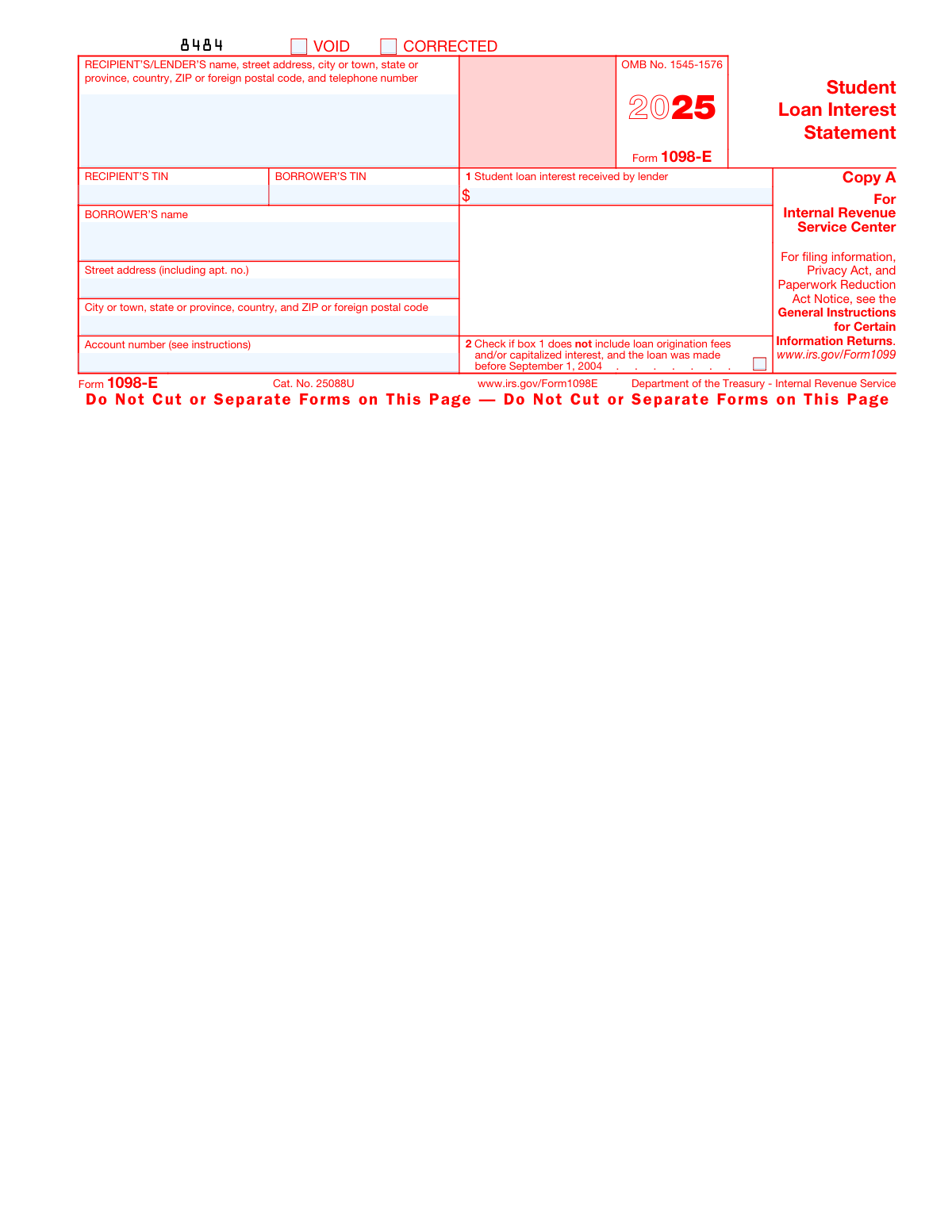
The AI does the filling. You just check it.
No typing into boxes, nothing to install.
What this form asks for
The AI fills all of it, from your answers or your documents.
The AI checks your answers before you download
15 checks built for this form, so a wrong date or a missing answer is caught before anyone else sees it.
The software ensures that the correct copy of Form 1098-E is being used for its intended recipient. It distinguishes between Copy A, which is designated for the Internal Revenue Service (IRS), and Copy B, which is intended for the borrower. The system prevents the use of an incorrect copy to avoid processing errors and potential penalties. This validation is crucial for maintaining compliance with IRS regulations.
The software confirms that if Form 1098-E is being filed on paper, Copy A has not been downloaded from the internet but rather ordered officially from the IRS. This check is important because the IRS requires scannable official forms for paper submissions. The system alerts the user to obtain the correct version of the form to ensure it is processed correctly by the IRS. This validation helps to prevent the submission of non-scannable forms that could lead to processing delays or rejections.
The software verifies the number of information returns being filed and determines if e-filing is mandatory. For 10 or more information returns, the system ensures that e-filing is utilized, as required by the IRS. For fewer than 10 returns, the software encourages e-filing due to its efficiency and faster processing times. This validation promotes adherence to IRS e-filing mandates and optimizes the filing process.
The software checks that the recipient's or lender's information on Form 1098-E is complete and accurate. It verifies that the name, address, and telephone number fields are filled out correctly. This validation is essential to ensure that the IRS and the borrower have the necessary information to contact the lender if needed. It also helps in preventing issues that may arise from incomplete or incorrect information.
The software validates the accuracy of the recipient's Taxpayer Identification Number (TIN) on Form 1098-E. It checks that the TIN provided matches IRS records and is in the correct format. This validation is critical to prevent identity mismatches and potential tax reporting issues. Ensuring the correct TIN is used also facilitates accurate tax credit claims for the borrower.
The AI ensures that the borrower's Taxpayer Identification Number (TIN) is accurately captured on the form. It cross-references the provided TIN with official databases to confirm its validity and checks for the correct format. Any discrepancies or errors in the TIN are flagged for correction to prevent issues with tax reporting and identification.
And 9 more checks
- Ensures the borrower's information is fully filled out, including name, address, and ZIP or foreign postal code
- Verifies that the account number is present and accurately reflects the lender's unique identifier for the borrower's account
- Confirms that Box 1 accurately reports the amount of student loan interest received by the lender during the year, including loan origination fees and capitalized interest for loans made on or after September 1, 2004
- Checks if Box 2 is appropriately marked if Box 1 does not include loan origination fees and/or capitalized interest for loans made before September 1, 2004
- Ensures that the borrower's TIN is partially masked on the borrower's copy for protection while the full TIN is reported to the IRS.
- Verifies the completeness and correctness of the lender's information, ensuring compliance with IRS requirements.
- Confirms that the form includes the latest information about developments related to Form 1098-E as per the IRS website.
- Checks for the availability and proper guidance regarding the Free File Program for eligible individuals.
- Ensures that the form is filled out in accordance with IRS Publication 970 and the Student Loan Interest Deduction Worksheet in the Instructions for Form 1040.
Let AI fill out your Form 1098-E
No typing. Every field filled in seconds, checked, ready to sign.
How to Fill Out Form 1098-E Online for Free in 2026
What the AI walks you through.
- Visit instafill.ai and select Form 1098-E
- Enter lender's information
- Input borrower's TIN and name
- Provide borrower's address
- Fill in account number
- Report student loan interest received
- Check box if applicable for origination fees
- Sign and date the form electronically
- Review for accuracy and submit form
Common Mistakes in Completing Form 1098-E
The ones the AI is built to catch.
Using non-scannable Copy A from the internet
Filing the wrong copy of the form (Copy A vs. Copy B)
Not ordering official forms from the IRS for paper filing
Failing to e-file when having 10 or more information returns
Incorrectly entering recipient's/lender's information
Omitting or mistyping the recipient's TIN
Omitting or mistyping the borrower's TIN
Entering borrower's information inaccurately
Not including apt. no. in borrower's street address
Failing to enter the correct amount in Box 1
Not checking Box 2 when applicable
Including loan origination fees for loans made before 09/01/2004
Not using the interest reported for tax deduction purposes
Not referring to IRS Publication 970 for deduction details
Not using the Student Loan Interest Deduction Worksheet
Not masking the borrower's TIN on borrower's copy
Not reporting the full TIN to the IRS
Not checking the latest information on www.irs.gov/Form1098E
Not taking advantage of the Free File Program when eligible
Frequently Asked Questions About Form 1098-E
Is it really free for 7 days?
Can I fill other forms too?
How do I cancel?
How does the AI fill out Form 1098-E?
What happens to my information?
How complex is Form 1098-E to fill out?
What is Form 1098-E?
Who needs to file Form 1098-E?
What information is reported on Form 1098-E?
Can I print and file Copy A of Form 1098-E from the IRS website?
What should I do if I have 10 or more information returns to file?
Is e-filing recommended for fewer than 10 information returns?
Where can I order official IRS information returns if I want to file on paper?
What publications provide more information about printing Form 1098-E?
What is the purpose of Copy A of Form 1098-E?
What is the purpose of Copy B of Form 1098-E?
What are the consequences of overstating a deduction for student loan interest?
Who must furnish Form 1098-E to the borrower?
What is the minimum amount of interest payments required to furnish Form 1098-E?
Can I deduct the full amount of interest reported on Form 1098-E?
Where can I find more information about the student loan interest deduction?
Why might my TIN only show the last four digits on Form 1098-E?
What should I do if box 1 of Form 1098-E does not include loan origination fees and/or capitalized interest?
What does it mean if box 2 on Form 1098-E is checked?
Where can I find the latest information about developments related to Form 1098-E?
How can I qualify for no-cost online federal tax preparation through the Free File Program?
Get your Form 1098-E filled out by AI
$0 today. Cancel before Nov 1 and you pay nothing.
Other forms like this one
student loan forms: 2026–27 FAFSA® Form, Free Application for Federal Student Aid, Public Service Loan Forgiveness (PSLF) & TEPSLF Certification & Application
PA state forms: Form 1095-A, Health Insurance Marketplace Statement, Form W-2, Wage and Tax Statement, Form 593, Real Estate Withholding, Form 8938, Statement of Specified Foreign Financial Assets, Form CMS-2567, Statement of Deficiencies, Form 1098, Mortgage Interest Statement, Form 1098-T, Tuition Statement, Form 1099-S, Proceeds From Real Estate Transactions, Form DS-3053, Statement of Consent, Form DS-86, Statement of Non-Receipt of a U.S. Passport, Form DS-86, Statement of Non-Receipt of a U.S. Passport, Form 108, Statement of Intention, Form 107, Statement of Financial Affairs, Form 121, Statement About Your SSNs, Form 122A-1, Chapter 7 Statement of Current Monthly Income, Center for Infertility & Reproductive Surgery – New Patient Questionnaire and Patient/Guarantor Statement (Brigham and Women’s Hospital, Department of Obstetrics and Gynecology), Adult Travel Document Application for Stateless and Protected Persons in Canada (16 years of age or over) (PPTC 190), Form W-8IMY (Rev. October 2021), Certificate of Foreign Intermediary, Foreign Flow-Through Entity, or Certain U.S. Branches for United States Tax Withholding and Reporting, Form W-2, Wage and Tax Statement (2025), State of New Mexico Workers’ Compensation Administration — Workers' Compensation Complaint (Rev. 8/22) (11.4.4.9 NMAC)
loan forms: Empower Loan Administration Form, Form 5, SBA Disaster Loan Application, Uniform Residential Loan Application (Freddie Mac Form 65 / Fannie Mae Form 1003), HomePlus Loan Application (Individuals) – China Banking Corporation (CBC), Income-Driven Repayment (IDR) Plan Request (PAYE, IBR, and ICR) — William D. Ford Federal Direct Loan (Direct Loan) Program and Federal Family Education Loan (FFEL) Programs (OMB No. 1845-0102), Direct Consolidation Loan Request to Add Loans (William D. Ford Federal Direct Loan Program) (OMB No. 1845-0007), Vanguard Taking a Loan from Your Retirement Plan, Empower Loan Payment Change Request Form, Account Reduction Loan Application 401(a) Plan, Electrical Workers Local Union No. 369 Retirement Plan, General Purpose Loan Application Packet, IW DC of SOV Annuity Trust, Account Reduction Loan Application 403(b) Plan, Empower 401(k) Loan Prepayment Request Form, Account Reduction Loan Application 401(a) Plan, Loan Rehabilitation: Income and Expense Information, William D. Ford Federal Direct Loan (Direct Loan) Program/Federal Family Education Loan (FFEL) Program, Transamerica Online Loan and Distribution Request, Uniform Residential Loan Application (Freddie Mac Form 65 / Fannie Mae Form 1003), Uniform Residential Loan Application (Fannie Mae Form 1003 / Freddie Mac Form 65), uniform-residential-loan-application, Uniform Residential Loan Application, Fannie Mae Form 1003 / Freddie Mac Form 65, DSCR Business Purpose Loan Application
NJ state forms: Form 1095-A, Health Insurance Marketplace Statement, Form W-2, Wage and Tax Statement, Form 593, Real Estate Withholding, Form 8938, Statement of Specified Foreign Financial Assets, Form CMS-2567, Statement of Deficiencies, Form 1098, Mortgage Interest Statement, Form 1098-T, Tuition Statement, Form 1099-S, Proceeds From Real Estate Transactions, Form DS-3053, Statement of Consent, Form DS-86, Statement of Non-Receipt of a U.S. Passport, Form DS-86, Statement of Non-Receipt of a U.S. Passport, Form 108, Statement of Intention, Form 107, Statement of Financial Affairs, Form 121, Statement About Your SSNs, Form 122A-1, Chapter 7 Statement of Current Monthly Income, Center for Infertility & Reproductive Surgery – New Patient Questionnaire and Patient/Guarantor Statement (Brigham and Women’s Hospital, Department of Obstetrics and Gynecology), Adult Travel Document Application for Stateless and Protected Persons in Canada (16 years of age or over) (PPTC 190), Form W-8IMY (Rev. October 2021), Certificate of Foreign Intermediary, Foreign Flow-Through Entity, or Certain U.S. Branches for United States Tax Withholding and Reporting, Form W-2, Wage and Tax Statement (2025), State of New Mexico Workers’ Compensation Administration — Workers' Compensation Complaint (Rev. 8/22) (11.4.4.9 NMAC)
student forms: NSFAS Consent Form (National Student Financial Aid Scheme) – APP2026, International Student Application for Financial Aid 2026-2027 (International Student Application for Financial Assistance 2026-2027), Barber & Hairdresser Student/Apprentice Quarterly Report Form (Alaska Board of Barbers and Hairdressers) – Form 08-4315, ROTC Cadet Academic Plan / Degree and Credit Hour Worksheet (Student Identification, Term-by-Term Courses, GPA Summary, and Completion Certification), DNA Kingston Training Enrolment and Genuine Student Form for International Students, South Sydney College International Student Application Form, Darwin Institute of Trade International Student Application Form, 2026–27 FAFSA® Form, Free Application for Federal Student Aid, Free Application for Federal Student Aid (FAFSA), Student Change of Circumstances Form, Form SY022, Claim for ABSTUDY for students or Australian Apprentices in lawful custody, Student Claim for Essential Equipment Form, Form SY042, Details of income for student payments, Tertiary Student Enrolment Declaration, Education Course Costs and Student Details Claim Form
state ID forms: Application for Renewal or Duplicate of Alabama Driver License or ID card, Form 1095-A, Health Insurance Marketplace Statement, Form W-2, Wage and Tax Statement, Form 593, Real Estate Withholding, Form 8938, Statement of Specified Foreign Financial Assets, Form CMS-2567, Statement of Deficiencies, Form 1098, Mortgage Interest Statement, Form 1098-T, Tuition Statement, Form 1099-S, Proceeds From Real Estate Transactions, Form DS-3053, Statement of Consent, Form DS-86, Statement of Non-Receipt of a U.S. Passport, Form 108, Statement of Intention, Form 107, Statement of Financial Affairs, Form 121, Statement About Your SSNs, Form 122A-1, Chapter 7 Statement of Current Monthly Income, Center for Infertility & Reproductive Surgery – New Patient Questionnaire and Patient/Guarantor Statement (Brigham and Women’s Hospital, Department of Obstetrics and Gynecology), Adult Travel Document Application for Stateless and Protected Persons in Canada (16 years of age or over) (PPTC 190), Form W-8IMY (Rev. October 2021), Certificate of Foreign Intermediary, Foreign Flow-Through Entity, or Certain U.S. Branches for United States Tax Withholding and Reporting, Form W-2, Wage and Tax Statement (2025), State of New Mexico Workers’ Compensation Administration — Workers' Compensation Complaint (Rev. 8/22) (11.4.4.9 NMAC)
Let AI fill out your Form 1098-E
Your trial starts once a card is added. You pay nothing before Nov 1.
Our AI already knows this form, all 21 fields of it. Skip the typing: tell it about yourself, or upload what you have, and it fills the whole form in seconds.
- AI fills every field on all 3 pages, checkboxes included
- No typing into boxes: answer a few questions, or upload a document you already have, an old copy of this form, a photo of a document
- The AI checks the answers; you review and change anything before you download
- Download the finished PDF, print it, or sign it online
- Encrypted, and never used to train AI
Cancel before Nov 1 and you pay nothing.
A card is needed to start the trial. Cancel in two clicks from your account.
Terms · Privacy