
Yes! You can use AI to fill out Texas Real Estate Commission (TREC) One to Four Family Residential Contract (Resale) (TREC No. 20-18)
Don't type 267 fields by hand. Tell our AI about yourself, or upload a document you already have, and it fills every field in seconds. You check it, then download, print or sign.
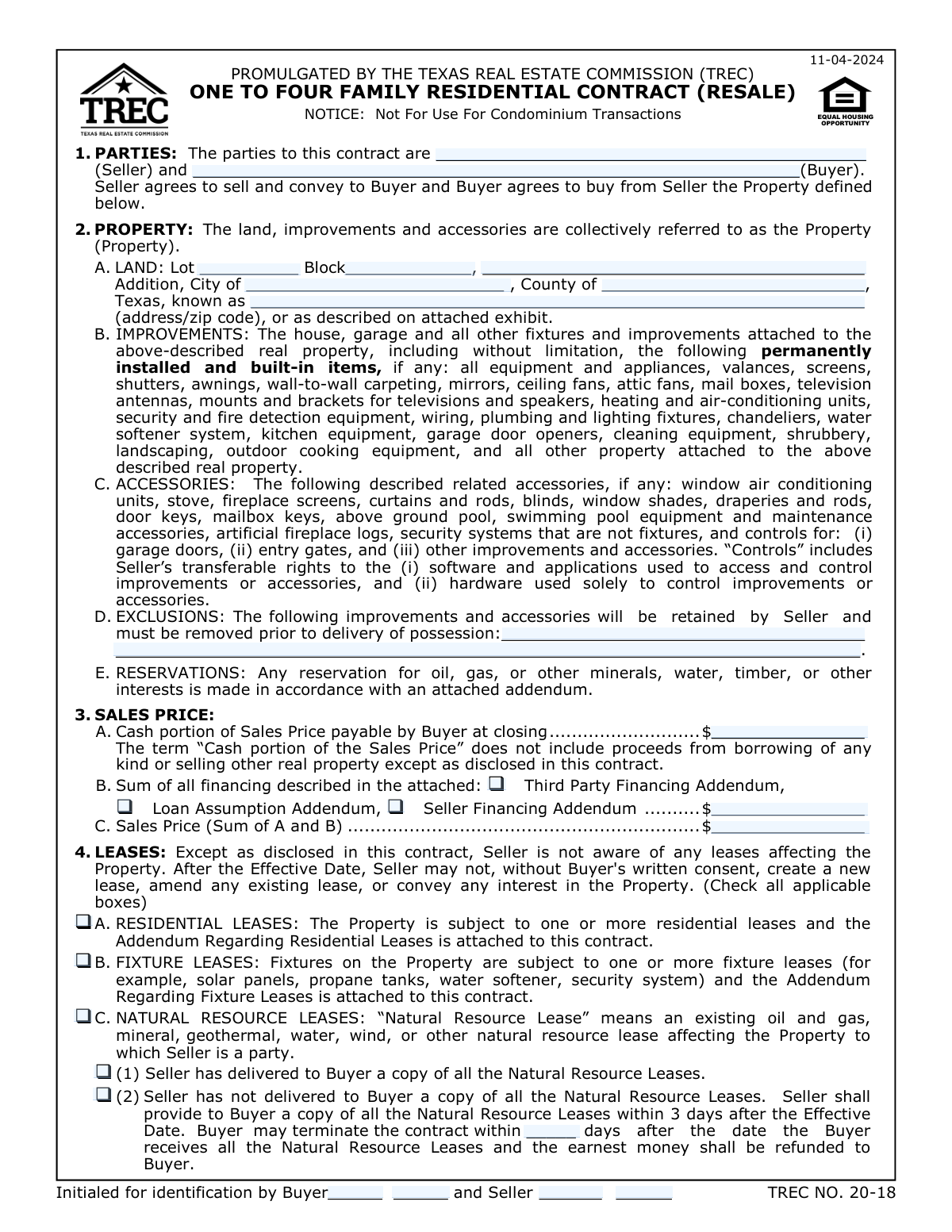
The AI does the filling. You just check it.
No typing into boxes, nothing to install.
What this form asks for
The AI fills all of it, from your answers or your documents.
The AI checks your answers before you download
16 checks built for this form, so a wrong date or a missing answer is caught before anyone else sees it.
Checks that the Seller and Buyer fields in Paragraph 1 are completed with full legal names (not blank, not initials only) and that the same parties are referenced consistently anywhere else the form repeats “Buyer”/“Seller” signature blocks. This is important because party identity is fundamental to enforceability and to prevent mismatches with title, lender, and escrow records. If missing or inconsistent, the submission should be rejected or flagged for correction before execution.
Validates that Paragraph 2A includes either a complete platted legal description (Lot, Block, Addition, City, County, Texas) plus the street address and ZIP, or explicitly references an attached exhibit that contains the legal description. This prevents ambiguity about what is being conveyed and supports title commitment and deed preparation. If any required components are missing and no exhibit is attached, the form should fail validation and require completion.
If Paragraph 2D (Exclusions) contains any text, validate it is specific (identifies items clearly) and not generic phrases like “personal property” without detail; if blank, ensure it is truly intended as no exclusions. If Paragraph 2E indicates reservations are made via an attached addendum, validate that the referenced minerals/water/timber reservation addendum is actually included in the addenda list. If ambiguity or missing addendum is detected, flag as high risk because it can materially change what transfers at closing.
Checks that Paragraph 3A (cash portion), 3B (financing sum), and 3C (sales price) are all present, numeric, non-negative currency values, and that 3C equals 3A + 3B. This is critical for closing statements, lender underwriting, and to avoid disputes about consideration. If the math does not reconcile or any amount is missing, the submission should be blocked until corrected.
If Paragraph 3B is greater than $0, validate that at least one financing addendum checkbox is selected (Third Party Financing, Loan Assumption, or Seller Financing) and that the selected addendum(s) are included in the addenda section. Conversely, if 3B is $0, validate that no financing addendum is selected unless explicitly required for another reason. If mismatched, flag because it creates uncertainty about financing obligations and termination rights.
Checks Paragraph 4 selections: if Residential Leases is checked, the Addendum Regarding Residential Leases must be attached; if Fixture Leases is checked, the Addendum Regarding Fixture Leases must be attached. For Natural Resource Leases, validate that either (1) or (2) is selected (not both, not neither), and if (2) is selected, the termination-days blank is completed with a valid integer. If any required addendum or required sub-selection is missing, fail validation because lease obligations materially affect possession and title.
And 10 more checks
- Earnest Money/Option Fee delivery fields completeness and deadline logic
- Option Period requires a stated number of days and a non-zero Option Fee
- Title Policy payer selection and Title Company identification validation
- Survey election is exclusive and required dependent fields are completed
- Title objections deadline and prohibited-use blank validation
- Seller’s Disclosure Notice selection is exclusive and delivery deadline is present when required
- As-Is acceptance selection is exclusive and repair list is specific when required
- Closing Date format and chronological consistency with Effective Date
- Possession selection requires a valid choice and lease addendum when applicable
- Notices and contact information fields validate phone/email formats when provided and require at least one delivery method
Let AI fill out your TREC 20-18
No typing. Every field filled in seconds, checked, ready to sign.
How to Fill Out TREC 20-18 Online for Free in 2026
What the AI walks you through.
- Enter the parties and property details: fill in Seller/Buyer names, the property address, and the legal description (lot/block/addition/city/county) and attach any required exhibits.
- Define what conveys with the sale: confirm improvements/accessories included, list any exclusions to be removed by Seller, and note any mineral/water/timber reservations via the appropriate addendum.
- Complete the financial terms: fill in the sales price breakdown (cash portion and financing), select and attach the correct financing addendum(s), and specify escrow agent, earnest money, option fee, and any additional earnest money with delivery deadlines.
- Set contract timelines and contingencies: choose the option period length, complete title policy responsibility, title company, commitment delivery timing, survey choice (existing/new and who pays), and objection/cure periods.
- Disclosures and property condition: indicate Seller’s Disclosure Notice status, address lead-based paint requirements (if pre-1978), select the “As Is” option and list any specific agreed repairs/treatments, and include any required statutory notices/addenda (HOA, districts, coastal, propane, etc.).
- Closing, possession, and expenses: enter the closing date, possession method (at closing or via temporary lease), allocate settlement costs/credits, prorations, and any special provisions permitted by the form.
- Attach addenda and finalize execution: check all applicable addenda boxes, complete notices/attorney contact sections, obtain initials/signatures and the effective date, and ensure escrow receipts (earnest money/option fee/additional earnest money) are completed as funds are delivered.
Common Mistakes in Completing TREC 20-18
The ones the AI is built to catch.
Leaving the Parties section incomplete or using informal names
Incorrect or incomplete property legal description (Lot/Block/Addn/County/City)
Not clearly listing exclusions (Seller-retained items) in Paragraph 2D
Sales price math errors and mismatched financing addenda
Missing escrow agent details or incorrect payment instructions for earnest money/option fee
Option Period mistakes (blank days, wrong deadline, or misunderstanding 5:00 p.m. cutoff)
Survey selection errors (checking multiple boxes or not setting deadlines/cost responsibility)
Title/HOA notice checkboxes left unchecked or inconsistent with reality
Seller’s Disclosure Notice selection mistakes (wrong box or missing delivery deadline)
Using vague repair language in the ‘As Is’ with repairs section
Possession terms not properly selected or missing lease addendum when needed
Notices and contact information left blank or inconsistent (Paragraph 21)
Frequently Asked Questions About TREC 20-18
Is it really free for 7 days?
Can I fill other forms too?
How do I cancel?
How does the AI fill out TREC 20-18?
What happens to my information?
How complex is TREC 20-18 to fill out?
What is the TREC One to Four Family Residential Contract (Resale) used for?
Who should use and complete this form?
Can this contract be used for a condominium purchase?
What counts as the “Property” in this contract—what is included in the sale?
How do we specify items the seller will remove or keep (like a chandelier or TV mount)?
How is the sales price broken down in Paragraph 3?
What are earnest money and the option fee, and when are they due?
What is the “Option Period,” and how do I terminate during it?
What happens if the buyer is late delivering earnest money or the option fee?
Who pays for the owner’s title policy, and what does the title commitment deadline mean?
Do we need a new survey, and who pays for it?
How long does the buyer have to object to title or survey issues?
What disclosures and statutory notices might be required with this contract?
What does “As Is” mean in Paragraph 7, and can the buyer still inspect or negotiate repairs?
When does possession transfer, and what are the smart device requirements?
Get your TREC 20-18 filled out by AI
$0 today. Cancel before Nov 1 and you pay nothing.
Other forms like this one
real estate forms: Form 593, Real Estate Withholding, Form 1099-S, Proceeds From Real Estate Transactions, Inland Residential Real Estate Services LLC Application for Lease (Form 4301, Rev. 11/14), New licence application – Form 1–1 (IND), Application for an individual’s licence (Real estate agent, property auctioneer, resident letting agent, motor dealer, chattel auctioneer, field agent), City of Harvey Real Estate Transfer Declaration & Application (with Certificate for Exemption), Alaska Residential Real Estate Purchase Agreement, Form 21, Residential Purchase and Sale Agreement, Form L-4260, Property Transfer Affidavit, Form TC201, Income and Expense Schedule for Rent Producing Properties, Memorandum of Contract, Notice of Transfer Forms Packet, Oklahoma Real Estate Commission Tenancy Guidelines (01-01-2026), Oklahoma Real Estate Commission Residential Property Condition Disclosure Exemption Form (RPCD EXEMPTION FORM), Oklahoma Real Estate Commission Residential Lease, Oklahoma Real Estate Commission Tenant Flood Notice (01-01-2026), Oklahoma Real Estate Commission Property Data Form (Residential), Oklahoma Real Estate Commission Pet Addendum, Oklahoma Real Estate Commission Lease Application, Oklahoma Real Estate Commission Keys and Re-Keying Addendum, Oklahoma Real Estate Commission, Disclosure of Broker Duties & Responsibilities
estate forms: Form 593, Real Estate Withholding, Form 1099-S, Proceeds From Real Estate Transactions, Inland Residential Real Estate Services LLC Application for Lease (Form 4301, Rev. 11/14), New licence application – Form 1–1 (IND), Application for an individual’s licence (Real estate agent, property auctioneer, resident letting agent, motor dealer, chattel auctioneer, field agent), Judicial Council of California Form DE-111, Petition for Probate (Probate—Decedents Estates), City of Harvey Real Estate Transfer Declaration & Application (with Certificate for Exemption), Judicial Council of California Form DE-120, Notice of Hearing—Decedent's Estate or Trust, Form DE-160/GC-040, Inventory and Appraisal (Declaration of Representative/Guardian/Conservator or Small Estate Claimant and Declaration of Probate Referee), Judicial Council of California Form DE-120, Notice of Hearing—Decedent's Estate or Trust, Fidelity Change of Account Ownership — Mutual Fund Only Accounts (Changing to a Trust, Estate, Guardian, or Conservator Account), Fidelity Change of Account Registration — Changing to a Trust, Estate, Guardian, or Conservator Brokerage Account, Valuing Your Estate Worksheet (from Vanguard's 'Understanding the basics of estate planning' guide), Alaska Residential Real Estate Purchase Agreement, Merrill Edge Self-Directed Trust and Estate Cash Management Account (CMA Account) Account Application Booklet and Agreements, Affidavit for Collection of Personal Property California Probate Code Section 13100, Oklahoma Real Estate Commission Tenancy Guidelines (01-01-2026), Oklahoma Real Estate Commission Residential Property Condition Disclosure Exemption Form (RPCD EXEMPTION FORM), Oklahoma Real Estate Commission Residential Lease, Oklahoma Real Estate Commission Tenant Flood Notice (01-01-2026), Oklahoma Real Estate Commission Property Data Form (Residential)
residential contract forms: Form 21, Residential Purchase and Sale Agreement, Form CBS1-8-24, Contract to Buy and Sell Real Estate (Residential)
PA state forms: Form 1095-A, Health Insurance Marketplace Statement, Form W-2, Wage and Tax Statement, Form 593, Real Estate Withholding, Form 8938, Statement of Specified Foreign Financial Assets, Form CMS-2567, Statement of Deficiencies, Form 1098, Mortgage Interest Statement, Form 1098-T, Tuition Statement, Form 1099-S, Proceeds From Real Estate Transactions, Form 1098-E, Student Loan Interest Statement, Form DS-3053, Statement of Consent, Form DS-86, Statement of Non-Receipt of a U.S. Passport, Form DS-86, Statement of Non-Receipt of a U.S. Passport, Form 108, Statement of Intention, Form 107, Statement of Financial Affairs, Form 121, Statement About Your SSNs, Form 122A-1, Chapter 7 Statement of Current Monthly Income, Center for Infertility & Reproductive Surgery – New Patient Questionnaire and Patient/Guarantor Statement (Brigham and Women’s Hospital, Department of Obstetrics and Gynecology), Adult Travel Document Application for Stateless and Protected Persons in Canada (16 years of age or over) (PPTC 190), Form W-8IMY (Rev. October 2021), Certificate of Foreign Intermediary, Foreign Flow-Through Entity, or Certain U.S. Branches for United States Tax Withholding and Reporting, Form W-2, Wage and Tax Statement (2025)
NJ state forms: Form 1095-A, Health Insurance Marketplace Statement, Form W-2, Wage and Tax Statement, Form 593, Real Estate Withholding, Form 8938, Statement of Specified Foreign Financial Assets, Form CMS-2567, Statement of Deficiencies, Form 1098, Mortgage Interest Statement, Form 1098-T, Tuition Statement, Form 1099-S, Proceeds From Real Estate Transactions, Form 1098-E, Student Loan Interest Statement, Form DS-3053, Statement of Consent, Form DS-86, Statement of Non-Receipt of a U.S. Passport, Form DS-86, Statement of Non-Receipt of a U.S. Passport, Form 108, Statement of Intention, Form 107, Statement of Financial Affairs, Form 121, Statement About Your SSNs, Form 122A-1, Chapter 7 Statement of Current Monthly Income, Center for Infertility & Reproductive Surgery – New Patient Questionnaire and Patient/Guarantor Statement (Brigham and Women’s Hospital, Department of Obstetrics and Gynecology), Adult Travel Document Application for Stateless and Protected Persons in Canada (16 years of age or over) (PPTC 190), Form W-8IMY (Rev. October 2021), Certificate of Foreign Intermediary, Foreign Flow-Through Entity, or Certain U.S. Branches for United States Tax Withholding and Reporting, Form W-2, Wage and Tax Statement (2025)
state ID forms: Application for Renewal or Duplicate of Alabama Driver License or ID card, Form 1095-A, Health Insurance Marketplace Statement, Form W-2, Wage and Tax Statement, Form 593, Real Estate Withholding, Form 8938, Statement of Specified Foreign Financial Assets, Form CMS-2567, Statement of Deficiencies, Form 1098, Mortgage Interest Statement, Form 1098-T, Tuition Statement, Form 1099-S, Proceeds From Real Estate Transactions, Form 1098-E, Student Loan Interest Statement, Form DS-3053, Statement of Consent, Form DS-86, Statement of Non-Receipt of a U.S. Passport, Form 108, Statement of Intention, Form 107, Statement of Financial Affairs, Form 121, Statement About Your SSNs, Form 122A-1, Chapter 7 Statement of Current Monthly Income, Center for Infertility & Reproductive Surgery – New Patient Questionnaire and Patient/Guarantor Statement (Brigham and Women’s Hospital, Department of Obstetrics and Gynecology), Adult Travel Document Application for Stateless and Protected Persons in Canada (16 years of age or over) (PPTC 190), Form W-8IMY (Rev. October 2021), Certificate of Foreign Intermediary, Foreign Flow-Through Entity, or Certain U.S. Branches for United States Tax Withholding and Reporting, Form W-2, Wage and Tax Statement (2025)
ESA forms: WestRock Credit Application and Uniform Sales & Use Tax Exemption/Resale Certificate — Multijurisdiction, Form 01-339, Texas Sales and Use Tax Resale Certificate / Texas Sales and Use Tax Exemption Certification, SOL·LICITUD DE PARTICIPACIÓ AL MERCAT ARTESANAL DE LA FIRA ANDRATX (Application to Participate in the Andratx Fair Artisan Market), Vanguard Wholesale Funds - Application Form – Associations, Vanguard Wholesale Funds - Application Form – Companies, Vanguard Wholesale Funds – Application Form – Trusts, Vanguard Wholesale Funds – Know Your Customer (KYC) Refresh Form – Company, Vanguard Wholesale Funds – Know Your Customer (KYC) Refresh Form – Trusts, California Department of Tax and Fee Administration Form CDTFA-230, General Resale Certificate, Form ST-120, New York State and Local Sales and Use Tax Resale Certificate, IRA/ESA Distribution Request Instructions, IRA/ESA Distribution Request
contract forms: Memorandum of Contract, Form WH-347, Payroll for Contractors, Form 0896A, Report of Subcontracts to Small and Veteran-Owned Business, Form 1449, Solicitation/Contract/Order for Commercial Products and Services, application-and-contract-for-electric-facilities-w, DBPR CILB 6-B, Application for Certified Building Contractor Who is Qualifying a Business, State of Hawaii Department of Commerce and Consumer Affairs (DCCA) Contractors License Board – Application for Contractor's License (Sole Proprietor) (CT-36) with supporting forms (Experience Certificate CT-03, Contractors Financial Statement CT-02, and Chronological History of Projects/Project List), NJ Department of Labor & Workforce Development Form MW-562, Payroll Certification for Public Works Projects (Contractor and Subcontractor’s Weekly and Final Certification), DBPR CILB 6-A, Application for Certified General Contractor Who is Qualifying a Business, Proposal Form 3, Attestation Regarding County Contract, TIAA Trust, N.A. Private Asset Management, Request for a Direct Transfer From IRA Contracts, Contrato de Trabajo en Prácticas (Código 420), Professional Practice Employment Contract, State of California Department of Transportation Darfur Contracting Act Certification, Form DOT ADM-0077, State of California Department of Transportation, Contract Requirements, State of California Department of Transportation Subcontractor List, DCMA Guidebook for Government Contract Property Administration, Official Form 106G, Schedule G: Executory Contracts and Unexpired Leases, Form ADR-106, Petition to Confirm, Correct, or Vacate Contractual Arbitration Award, Newly Contracted Provider Training Attestation Form, State of Florida Department of Business and Professional Regulation Form DBPR CILB 6-B, Application for Certified Building Contractor Who is Qualifying a Business
Let AI fill out your TREC 20-18
Your trial starts once a card is added. You pay nothing before Nov 1.
Our AI already knows this form, all 267 fields of it. Skip the typing: tell it about yourself, or upload what you have, and it fills the whole form in seconds.
- AI fills every field on all 11 pages, checkboxes included
- No typing into boxes: answer a few questions, or upload a document you already have, an old copy of this form, a photo of a document
- The AI checks the answers; you review and change anything before you download
- Download the finished PDF, print it, or sign it online
- Encrypted, and never used to train AI
Cancel before Nov 1 and you pay nothing.
A card is needed to start the trial. Cancel in two clicks from your account.
Terms · Privacy