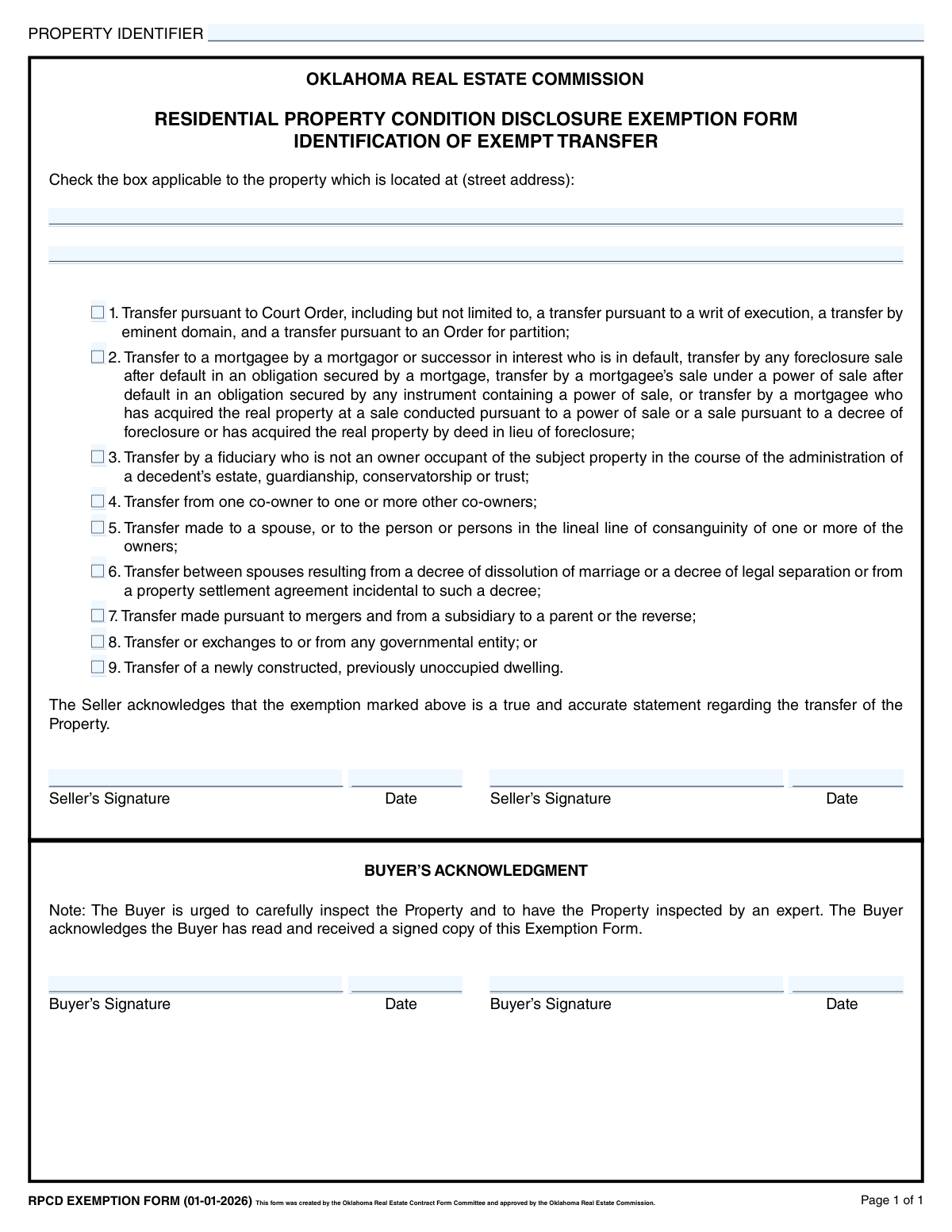
Yes! You can use AI to fill out Oklahoma Real Estate Commission Residential Property Condition Disclosure Exemption Form (RPCD EXEMPTION FORM)
This form is used in Oklahoma real estate transactions by a seller to certify that the property transfer is exempt from the requirements of the Residential Property Condition Disclosure Act. Common exemptions include transfers due to court order, foreclosure, between certain family members, or for newly constructed homes. Today, this form can be filled out quickly and accurately using AI-powered services like Instafill.ai, which can also convert non-fillable PDF versions into interactive fillable forms.
Our AI automatically handles information lookup, data retrieval, formatting, and form filling.
It takes less than a minute to fill out RPCD Exemption Form using our AI form filling.
Securely upload your data. Information is encrypted in transit and deleted immediately after the form is filled out.
Form specifications
| Form name: | Oklahoma Real Estate Commission Residential Property Condition Disclosure Exemption Form (RPCD EXEMPTION FORM) |
| Number of pages: | 1 |
| Language: | English |
| Categories: | real estate forms, disclosure forms, estate forms, PA state forms, property forms, NJ state forms |
Instafill Demo: How to fill out PDF forms in seconds with AI
How to Fill Out RPCD Exemption Form Online for Free in 2026
Are you looking to fill out a RPCD EXEMPTION FORM form online quickly and accurately? Instafill.ai offers the #1 AI-powered PDF filling software of 2026, allowing you to complete your RPCD EXEMPTION FORM form in just 37 seconds or less.
Follow these steps to fill out your RPCD EXEMPTION FORM form online using Instafill.ai:
- 1 Navigate to Instafill.ai and upload or select the Oklahoma RPCD Exemption Form.
- 2 Use the AI assistant to automatically fill in the property's street address and identifier.
- 3 Review the nine exemption categories and check the box that accurately describes the reason for the exempt transfer.
- 4 The seller(s) will digitally sign and date the form to attest to the accuracy of the claimed exemption.
- 5 The buyer(s) will then sign and date the acknowledgment section, confirming they have received a copy of the form.
- 6 Review all entered information, signatures, and dates for completeness and accuracy before finalizing.
- 7 Securely download, print, or share the completed exemption form with all relevant parties in the real estate transaction.
Our AI-powered system ensures each field is filled out correctly, reducing errors and saving you time.
Why Choose Instafill.ai for Your Fillable RPCD Exemption Form Form?
Speed
Complete your RPCD Exemption Form in as little as 37 seconds.
Up-to-Date
Always use the latest 2026 RPCD Exemption Form form version.
Cost-effective
No need to hire expensive lawyers.
Accuracy
Our AI performs 10 compliance checks to ensure your form is error-free.
Security
Your personal information is protected with bank-level encryption.
Frequently Asked Questions About Form RPCD Exemption Form
This form is used by a property seller in Oklahoma to certify that their real estate transaction is legally exempt from the standard requirement of providing a full Residential Property Condition Disclosure Statement. It specifies the exact reason for the exemption, such as a foreclosure or a transfer between close relatives.
The seller of a residential property must complete this form if their sale qualifies for one of the nine specific exemptions listed. Both the seller and the buyer are required to sign the form to acknowledge the exemption status of the sale.
You will need the property's full street address and a 'Property Identifier,' which is typically the legal description or tax parcel number. The seller must then select the appropriate exemption and sign, and the buyer must also sign to acknowledge receipt.
Your signature confirms that you have received a copy of the Exemption Form and understand that the seller is not providing a detailed property condition disclosure. The form strongly advises you to conduct your own thorough property inspections with an expert.
Yes, the sale of a newly constructed home that has never been occupied is an eligible exemption. You would check box #9, 'Transfer of a newly constructed, previously unoccupied dwelling.'
This legal term refers to a direct line of family descent, such as transfers between parents and their children or grandparents and their grandchildren. It generally does not include transfers to siblings, cousins, aunts, or uncles.
You should check box #2, which covers various transfers related to default and foreclosure. This includes transfers to a mortgagee from a mortgagor in default or transfers resulting from a foreclosure sale.
If your property transfer does not meet any of the nine exemption criteria, you cannot use this form. You are likely required to complete the standard, more detailed Oklahoma Residential Property Condition Disclosure Statement.
The completed and signed form should be given to the buyer as part of the transaction's legal documents. Both the buyer and seller should keep a copy for their records, and it is typically included in the final closing package.
Yes, this situation is covered under exemption #3, 'Transfer by a fiduciary who is not an owner occupant...in the course of the administration of a decedent’s estate.' This applies to fiduciaries like executors or trustees who are managing a property they don't personally occupy.
Yes, services like Instafill.ai use AI to accurately auto-fill form fields with your information, which saves time and helps prevent errors. The AI can populate fields like names, addresses, and property details.
You can use a service like Instafill.ai to complete this form digitally. Simply upload the form to the platform, and it will become an interactive document where you can type your information and sign electronically.
If you have a non-fillable or 'flat' PDF, you can use a tool like Instafill.ai to instantly convert it into an interactive, fillable form. This allows you to easily type in your information online without needing to print and fill it out by hand.
Compliance RPCD Exemption Form
Validation Checks by Instafill.ai
1
Ensures Property Address is Provided
This check verifies that the 'Property Street Address Line 1' field is not empty. The street address is essential for uniquely identifying the property to which this exemption applies. Failure to provide a complete address would render the form legally insufficient as it would be unclear which property is being discussed.
2
Requires at Least One Exemption Reason
This validation ensures that at least one checkbox under 'Identification of Exempt Transfer' has been selected. The entire purpose of this form is to declare a specific reason for exemption from the standard property condition disclosure. If no reason is selected, the form is incomplete and fails to serve its legal function.
3
Restricts Exemption Reason to a Single Selection
This check validates that only one exemption reason checkbox is selected from the list of nine options. While they are checkboxes, legally only one exemption category should apply to a single transfer. Allowing multiple selections could create legal ambiguity and complicate the transaction.
4
Verifies Presence of at Least One Seller Signature
This validation confirms that at least the 'First Seller Signature' field is signed. The seller's signature is a declaration that the selected exemption is true and accurate for the property transfer. Without a seller's signature, the exemption claim is not legally asserted.
5
Verifies Presence of at Least One Buyer Signature
This check ensures that at least the 'First Buyer Signature' field is signed. The buyer's signature serves as an acknowledgment that they have received a copy of this exemption form and are aware of the seller's claim. This is a critical step in the disclosure process, and its absence indicates the buyer has not formally acknowledged receipt.
6
Validates First Seller Signature Date Dependency
This rule checks that the 'First Seller Signature Date' field is filled if and only if the 'First Seller Signature' field is also signed. A date without a corresponding signature is invalid, and a signature without a date is incomplete. This ensures the integrity and completeness of the seller's declaration.
7
Validates Second Seller Signature Date Dependency
This validation ensures the 'Second Seller's Signature Date' is provided only when the 'Second Seller's Signature' field is signed. This maintains logical consistency between the signature and its date. An orphaned signature or date would indicate a data entry error and make the record incomplete.
8
Validates First Buyer Signature Date Dependency
This rule checks that the 'First Buyer Signature Date' is present if and only if the 'First Buyer Signature' field is signed. This pairing is crucial for creating a valid record of the buyer's acknowledgment. A failure indicates an incomplete submission that could be legally challenged.
9
Validates Second Buyer Signature Date Dependency
This validation ensures the 'Second Buyer's Signature Date' is provided only when the 'Second Buyer's Signature' field is signed. This maintains logical consistency for the second buyer's acknowledgment. An error here would mean the second buyer's acknowledgment is not properly documented.
10
Ensures All Signature Dates are in a Valid Format
This check verifies that all provided signature dates (for sellers and buyers) adhere to a standard format, such as MM/DD/YYYY. Consistent and valid date formatting is crucial for data integrity, system processing, and legal clarity. An invalid format would cause processing failures and could be grounds for rejecting the form.
11
Verifies Chronological Order of Signatures
This validation checks that the buyer's signature date is on or after the seller's signature date. Logically, the seller must first declare the exemption before the buyer can acknowledge receiving it. A buyer's signature dated before the seller's would indicate a procedural error and invalidate the timeline of events.
12
Checks for Plausible Signature Dates
This rule ensures that all signature dates are not set in the future. A signature date must represent the actual day the document was signed, which cannot be a future event. This check prevents simple data entry errors and ensures the legal timeline of the document is accurate and believable.
13
Ensures Property Identifier is Provided
This check verifies that the 'Property Identifier' field is filled out. This identifier, often a parcel or tax ID number, provides a unique, official reference to the property that complements the street address. Its absence can create ambiguity and hinder official recording and tracking of the transaction.
Common Mistakes in Completing RPCD Exemption Form
Users often mistake the 'Property Identifier' field for the street address, or they enter an incomplete parcel number. This happens because the correct identifier, such as a legal description or full parcel number, is not always readily available. An incorrect identifier can cause significant delays in processing the transaction as the property cannot be uniquely located in official records. To avoid this, find the official property identifier on a recent tax bill or property deed before filling out the form.
The form lists nine legally specific exemption categories, using terms like 'fiduciary' or 'lineal line of consanguinity' that are easily misinterpreted by sellers. Choosing an inapplicable exemption can invalidate the form, exposing the seller to legal risks or forcing them to complete a full property condition disclosure later. Sellers should carefully read each option and consult a real estate professional or attorney to ensure they select the correct exemption for their situation.
The form requires the user to select the single most applicable reason for the exemption. However, people sometimes check multiple boxes if they believe several reasons apply, or they overlook the section entirely and check none. A form with incorrect markings will be rejected by the commission or title company, requiring correction and resubmission which delays the closing process. Always ensure one, and only one, box is checked.
It is a very common oversight for either the seller or the buyer to leave a signature or date field blank, especially when multiple parties are involved. An unsigned or undated form is legally incomplete and invalid, halting the property transfer until a properly executed version is provided. Before submitting, all parties should double-check that every required signature and date line is filled.
The form includes two signature lines for sellers and two for buyers, anticipating joint ownership. A frequent error is for only one co-owner or co-buyer to sign when the property title lists multiple individuals. This renders the acknowledgment legally insufficient, as all parties on the title must typically sign off. Ensure all co-sellers and co-buyers provide their signatures in the designated spaces to create a valid document.
The property address section is split into two lines, with the second line intended for unit-specific information like an apartment or suite number. Fillers often ignore the second line, even for properties in multi-unit buildings. This omission can create ambiguity and lead to administrative errors or delays in identifying the correct property. Always provide the complete address, including the unit number on the second line if applicable.
Buyers may hesitate to sign the acknowledgment, incorrectly believing their signature approves of the property's condition or waives their right to an inspection. The form explicitly states the signature is merely to acknowledge receipt of the exemption notice. This misunderstanding can cause unnecessary delays and friction; buyers should understand they are only confirming they received the document, not agreeing with its contents.
The form header includes a version date, indicating it is subject to updates by the Oklahoma Real Estate Commission. Using an obsolete version, often found through an unverified internet search, will result in the form being rejected. This forces all parties to start over with the current version, wasting valuable time. Always source forms directly from the official real estate commission or your real estate agent to ensure compliance.
When a form is only available as a non-fillable PDF, it must be printed and filled out by hand, often resulting in illegible handwriting. Unclear text in critical fields like the property identifier or names can lead to processing errors and potential title issues. To prevent this, write clearly in block letters. Advanced tools like Instafill.ai can convert such flat PDFs into digitally fillable forms, ensuring all entries are perfectly legible and accurate.
Users may enter dates in various formats (e.g., DD-MM-YYYY, Month Day, YYYY) or enter different dates for signatures that were executed on the same day. Inconsistent or non-standard date formats can create ambiguity and legal vulnerabilities regarding the timeline of the transaction. It is crucial to use a consistent MM/DD/YYYY format for all dates. AI-powered form fillers like Instafill.ai can help by automatically formatting dates correctly, preventing these errors.
Saved over 80 hours a year
“I was never sure if my IRS forms like W-9 were filled correctly. Now, I can complete the forms accurately without any external help.”
Kevin Martin Green
Your data stays secure with advanced protection from Instafill and our subprocessors

Robust compliance program
Transparent business model
You’re not the product. You always know where your data is and what it is processed for.
ISO 27001, HIPAA, and GDPR
Our subprocesses adhere to multiple compliance standards, including but not limited to ISO 27001, HIPAA, and GDPR.
Security & privacy by design
We consider security and privacy from the initial design phase of any new service or functionality. It’s not an afterthought, it’s built-in, including support for two-factor authentication (2FA) to further protect your account.
Fill out RPCD Exemption Form with Instafill.ai
Worried about filling PDFs wrong? Instafill securely fills oklahoma-real-estate-commission-residential-property-condition-disclosure-exemption-form-rpcd-exemption-form forms, ensuring each field is accurate.