
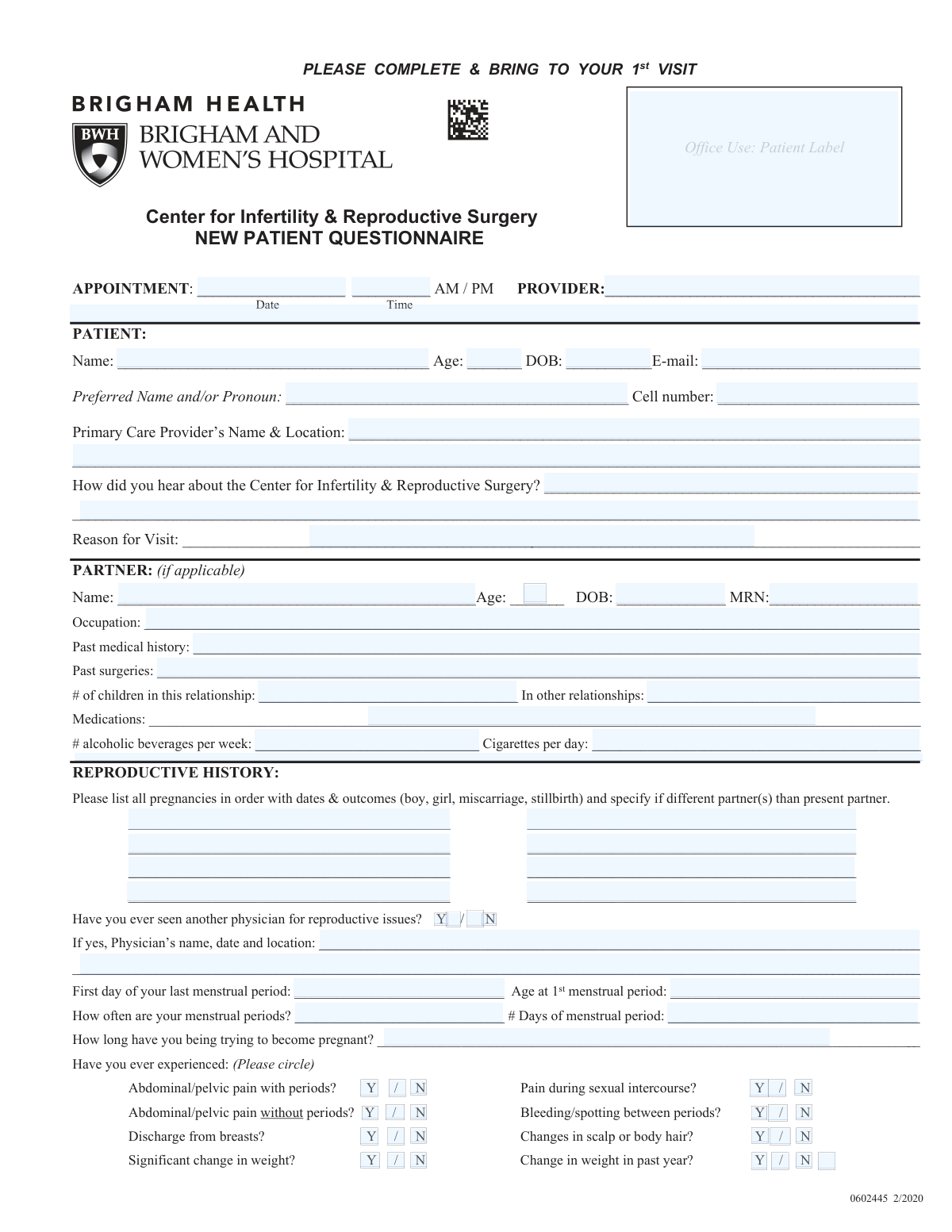
Yes! You can use AI to fill out Center for Infertility & Reproductive Surgery – New Patient Questionnaire and Patient/Guarantor Statement (Brigham and Women’s Hospital, Department of Obstetrics and Gynecology)
Don't type 314 fields by hand. Tell our AI about yourself, or upload a document you already have, and it fills every field in seconds. You check it, then download, print or sign.
The AI does the filling. You just check it.
No typing into boxes, nothing to install.
What this form asks for
The AI fills all of it, from your answers or your documents.
The AI checks your answers before you download
16 checks built for this form, so a wrong date or a missing answer is caught before anyone else sees it.
Validates that the appointment date is a real calendar date (e.g., MM/DD/YYYY) and the time is in a valid format (e.g., HH:MM) with exactly one AM/PM selection. This is important for scheduling accuracy and to prevent missed or mis-timed visits. If invalid or missing, the submission should be flagged and the patient prompted to correct the date/time before the appointment can be confirmed.
Ensures the PROVIDER field is completed with a real provider name and not left blank or filled with placeholders (e.g., underscores, 'N/A', or 'unknown'). Provider identification is required for routing the questionnaire to the correct clinical team and for medical record integrity. If validation fails, the form should be rejected for completion or routed to staff for reconciliation.
Checks that the patient’s full legal name, date of birth, and age are provided and that age is consistent with DOB (within an acceptable tolerance based on current date). This prevents patient misidentification and reduces charting errors. If inconsistent or incomplete, the system should require correction and/or trigger an identity verification workflow.
If any partner fields are started (e.g., partner name, DOB, MRN, occupation), validates that the partner name and DOB (or age) are also provided and internally consistent. This is important because partner history and semen analysis/treatment history may be clinically relevant and must be attributable to the correct person. If partial data is entered without required identifiers, the system should prompt the user to either complete the partner section or clear it.
Validates that MRN values (patient and partner) match the organization’s expected format (e.g., numeric-only and correct length) and are not obviously invalid (all zeros, too short, or containing letters if not allowed). Correct MRNs are critical for matching the questionnaire to the correct medical record. If invalid, the system should block submission or mark the record as unmatched for manual review.
Ensures the patient email follows standard email syntax ([email protected]) and does not contain spaces or invalid characters. Email is often used for portal access, instructions, and follow-up communication. If invalid, the system should request correction or allow submission only if an alternate contact method (e.g., phone) is present.
And 10 more checks
- Cell Phone Number Format and Length Validation
- Yes/No Questions Must Have Exactly One Selection
- Conditional Detail Requirement for 'Yes' Responses
- Menstrual History Date and Range Validation (LMP and Menarche Age)
- Cycle Length and Period Duration Numeric Validation
- Trying-to-Conceive Duration Completeness and Plausibility
- Alcohol and Tobacco Use Numeric and Cross-Field Consistency
- Reproductive History Entries Require Date and Outcome Structure
- Diagnostic Test Result Format Validation (Numeric Labs vs. Text Procedures)
- Signature, Printed Name, and Date/Time Completion for Consents and Financial Statement
Let AI fill out your CIRS New Patient Questionnaire
No typing. Every field filled in seconds, checked, ready to sign.
How to Fill Out CIRS New Patient Questionnaire Online for Free in 2026
What the AI walks you through.
- Enter appointment details (date, time, provider) and complete patient identifiers and contact information (name, DOB, age, email, phone, PCP).
- Fill in partner information (if applicable), including demographics, medical/surgical history, medications, children, and lifestyle factors (alcohol, smoking).
- Complete reproductive and menstrual history: list all pregnancies with dates/outcomes, last menstrual period, cycle frequency/length, symptoms (pain, bleeding, discharge), and how long you’ve been trying to conceive.
- Document prior infertility evaluation and diagnostic testing (e.g., blood tests, HSG, laparoscopy/hysteroscopy findings, semen analysis) and check any previous fertility treatments (IUI, IVF, ICSI, medications, etc.).
- Provide gynecologic and general medical history: pap/mammogram history, STDs/PID/DES exposure, medical conditions checklist, past surgeries with dates, allergies, and current medications with dosages.
- Complete family medical history and social/personal safety sections (marital status, stressors, smoking/alcohol/drug use, safety at home, falls/balance).
- Review for accuracy, acknowledge the information becomes part of your medical record, then sign/date/time the consent statements and the Patient/Guarantor Statement (including written name and MRN if available).
Common Mistakes in Completing CIRS New Patient Questionnaire
The ones the AI is built to catch.
Leaving appointment details blank or inconsistent (date/time/AM-PM/provider)
Mixing up patient vs partner sections (or omitting partner info when applicable)
Missing identifiers (DOB, MRN) or using nicknames instead of legal names
Not listing all pregnancies with dates/outcomes and partner differences
Incorrect menstrual history entries (LMP, cycle frequency, duration, age at menarche)
Failing to circle Y/N consistently (or circling both/none)
Incomplete medication and allergy details (missing dose, frequency, or reaction)
Underreporting or misreporting tobacco, alcohol, and drug use (units not defined)
Listing prior fertility testing/treatment without dates, results, or documentation
Skipping family medical history details (ages and conditions) or writing “unknown” without clarifying
Not completing signatures/dates/times on consent and guarantor statements
Frequently Asked Questions About CIRS New Patient Questionnaire
Is it really free for 7 days?
Can I fill other forms too?
How do I cancel?
How does the AI fill out CIRS New Patient Questionnaire?
What happens to my information?
How complex is CIRS New Patient Questionnaire to fill out?
What is the purpose of the Center for Infertility & Reproductive Surgery New Patient Questionnaire?
Who needs to fill out this form—just the patient, or the partner too?
When should I complete the questionnaire and what should I do with it?
What information should I gather before filling this out?
How do I fill out the reproductive history section about pregnancies?
What does “First day of your last menstrual period” mean?
What if I don’t have regular periods or I don’t get periods at all?
Do I need to fill in the diagnostic testing section even if I don’t know my lab values?
How do I complete the “Previous Fertility Treatment” checklist?
The form asks about sexual performance, lubricants, and birth control—why is that included?
What should I include under past surgeries, and what is an “operative note”?
How should I list medications and allergies on this form?
What are the personal safety questions used for, and do I have to answer them?
What am I consenting to when I sign the section about mental health provider notes?
What is the Patient/Guarantor Statement and what financial responsibilities am I agreeing to?
Get your CIRS New Patient Questionnaire filled out by AI
$0 today. Cancel before Nov 1 and you pay nothing.
Other forms like this one
hospital forms: St. Paul’s Hospital Application for Employment (職位申請表) – SPHF-HRD-035, HDFC ERGO General Insurance Company Limited – Request for Cashless Hospitalisation for Health Insurance (Policy Part – C), Demande de Validation des Acquis de l'Expérience (VAE) – BTS Hospitality Management, Texas Out-of-Hospital Do-Not-Resuscitate (OOH-DNR) Order, St. Jude Children’s Research Hospital IRA Sample Letter of Instruction, King Faisal Specialist Hospital and Research Centre (General Organization) Employment Application Form, Provider Application for Hospital Affiliations and Board Certification, Hospital Affiliation and Privileges Form, Form CMS-1763, Request for Termination of Premium Hospital and/or Supplementary Medical Insurance
patient forms: Form BHVH, Outpatient Behavioral Health – ABA Treatment Request, New Patient Information (Initial Contact) Form, ACT Interstate Patient Travel Assistance Scheme (ACT IPTAS) Claim Form (Reviewed: July 2023), Outpatient Behavioral Health (BH) – ABA Treatment Request: Required Information for Precertification (GR-69017-4), Patient Encounter and Authorization Tracking Form, Outpatient Imaging Prior Authorization Request Form, Kaiser Permanente Authorization for Use or Disclosure of Patient Health Information, Inpatient Rehabilitation Facility Patient Assessment Instrument (IRF-PAI), Form CMS-1490S, Patient's Request for Medical Payment, DD Form 2642, TRICARE DoD/CHAMPUS Medical Claim Patient's Request for Medical Payment
PA state forms: Form 1095-A, Health Insurance Marketplace Statement, Form W-2, Wage and Tax Statement, Form 593, Real Estate Withholding, Form 8938, Statement of Specified Foreign Financial Assets, Form CMS-2567, Statement of Deficiencies, Form 1098, Mortgage Interest Statement, Form 1098-T, Tuition Statement, Form 1099-S, Proceeds From Real Estate Transactions, Form 1098-E, Student Loan Interest Statement, Form DS-3053, Statement of Consent, Form DS-86, Statement of Non-Receipt of a U.S. Passport, Form DS-86, Statement of Non-Receipt of a U.S. Passport, Form 108, Statement of Intention, Form 107, Statement of Financial Affairs, Form 121, Statement About Your SSNs, Form 122A-1, Chapter 7 Statement of Current Monthly Income, Adult Travel Document Application for Stateless and Protected Persons in Canada (16 years of age or over) (PPTC 190), Form W-8IMY (Rev. October 2021), Certificate of Foreign Intermediary, Foreign Flow-Through Entity, or Certain U.S. Branches for United States Tax Withholding and Reporting, Form W-2, Wage and Tax Statement (2025), State of New Mexico Workers’ Compensation Administration — Workers' Compensation Complaint (Rev. 8/22) (11.4.4.9 NMAC)
Department of State forms: State of Illinois Department of Human Services (IDHS) – Bureau of Child Care and Development Child Care Application (Form IL444-3455), State of Illinois Department of Children and Family Services Medical Report on an Adult in a Child Care Facility (CFS 602), State of Florida Department of Highway Safety and Motor Vehicles (FLHSMV) Form HSMV 82993, Separate Odometer Disclosure Statement and Acknowledgment, DS 1891, Applicant/Vendor Disclosure Statement (State of California Department of Developmental Services), New York State Department of State (Division of Licensing Services) Property Condition Disclosure Statement (DOS-1614-f), State of Hawaii Department of Commerce and Consumer Affairs (DCCA) Contractors License Board – Application for Contractor's License (Sole Proprietor) (CT-36) with supporting forms (Experience Certificate CT-03, Contractors Financial Statement CT-02, and Chronological History of Projects/Project List), Murrieta Police Department Citizen Complaint Form (California Penal Code § 148.6 Advisory Statement), Pennsylvania Department of State — Certificate of Termination (Domestic Limited Liability Company) (15 Pa.C.S. § 8872(f)) (DSCB:15-8872(f)), Colorado Judicial Department Form JDF 1111SC (Form 35.2), Sworn Financial Statement, New York State Department of Labor (NYSDOL) Division of Labor Standards Complaint Form (LS 223), New York State Department of Labor, Division of Labor Standards Complaint Form (LS 223), Dallas Area Rapid Transit Police Department Personal History Statement (Peace Officer / Telecommunicator), California Department of Social Services, Sworn Statement, State of California Department of Transportation California Civil Rights Laws Certification, State of California Department of Transportation Darfur Contracting Act Certification, Form DOT ADM-0077, State of California Department of Transportation, Contract Requirements, State of California Department of Transportation Subcontractor List, State of California Department of Transportation, Certified DVBE Summary, State of Florida Department of Business and Professional Regulation Form DBPR CILB 6-B, Application for Certified Building Contractor Who is Qualifying a Business, New York State Department of Health Certificate of Qualification Questionnaire - Virology
NJ state forms: Form 1095-A, Health Insurance Marketplace Statement, Form W-2, Wage and Tax Statement, Form 593, Real Estate Withholding, Form 8938, Statement of Specified Foreign Financial Assets, Form CMS-2567, Statement of Deficiencies, Form 1098, Mortgage Interest Statement, Form 1098-T, Tuition Statement, Form 1099-S, Proceeds From Real Estate Transactions, Form 1098-E, Student Loan Interest Statement, Form DS-3053, Statement of Consent, Form DS-86, Statement of Non-Receipt of a U.S. Passport, Form DS-86, Statement of Non-Receipt of a U.S. Passport, Form 108, Statement of Intention, Form 107, Statement of Financial Affairs, Form 121, Statement About Your SSNs, Form 122A-1, Chapter 7 Statement of Current Monthly Income, Adult Travel Document Application for Stateless and Protected Persons in Canada (16 years of age or over) (PPTC 190), Form W-8IMY (Rev. October 2021), Certificate of Foreign Intermediary, Foreign Flow-Through Entity, or Certain U.S. Branches for United States Tax Withholding and Reporting, Form W-2, Wage and Tax Statement (2025), State of New Mexico Workers’ Compensation Administration — Workers' Compensation Complaint (Rev. 8/22) (11.4.4.9 NMAC)
state ID forms: Application for Renewal or Duplicate of Alabama Driver License or ID card, Form 1095-A, Health Insurance Marketplace Statement, Form W-2, Wage and Tax Statement, Form 593, Real Estate Withholding, Form 8938, Statement of Specified Foreign Financial Assets, Form CMS-2567, Statement of Deficiencies, Form 1098, Mortgage Interest Statement, Form 1098-T, Tuition Statement, Form 1099-S, Proceeds From Real Estate Transactions, Form 1098-E, Student Loan Interest Statement, Form DS-3053, Statement of Consent, Form DS-86, Statement of Non-Receipt of a U.S. Passport, Form 108, Statement of Intention, Form 107, Statement of Financial Affairs, Form 121, Statement About Your SSNs, Form 122A-1, Chapter 7 Statement of Current Monthly Income, Adult Travel Document Application for Stateless and Protected Persons in Canada (16 years of age or over) (PPTC 190), Form W-8IMY (Rev. October 2021), Certificate of Foreign Intermediary, Foreign Flow-Through Entity, or Certain U.S. Branches for United States Tax Withholding and Reporting, Form W-2, Wage and Tax Statement (2025), State of New Mexico Workers’ Compensation Administration — Workers' Compensation Complaint (Rev. 8/22) (11.4.4.9 NMAC)
Let AI fill out your CIRS New Patient Questionnaire
Your trial starts once a card is added. You pay nothing before Nov 1.
Our AI already knows this form, all 314 fields of it. Skip the typing: tell it about yourself, or upload what you have, and it fills the whole form in seconds.
- AI fills every field on all 4 pages, tables and checkboxes included
- No typing into boxes: answer a few questions, or upload a document you already have, an old copy of this form, a photo of a document
- The AI checks the answers; you review and change anything before you download
- Download the finished PDF, print it, or sign it online
- Encrypted, and never used to train AI
Cancel before Nov 1 and you pay nothing.
A card is needed to start the trial. Cancel in two clicks from your account.
Terms · Privacy