Yes! You can use AI to fill out Form 21, Residential Purchase and Sale Agreement
NWMLS Form 21, the Residential Purchase and Sale Agreement (PSA), is a legally binding contract that outlines the specific terms and conditions for the purchase of a residential property. It is the foundational document for the transaction, detailing everything from the purchase price and earnest money to inspection contingencies and closing procedures, protecting the interests of both the buyer and seller. Today, this form can be filled out quickly and accurately using AI-powered services like Instafill.ai, which can also convert non-fillable PDF versions into interactive fillable forms.
Our AI automatically handles information lookup, data retrieval, formatting, and form filling.
It takes less than a minute to fill out NWMLS Form 21 using our AI form filling.
Securely upload your data. Information is encrypted in transit and deleted immediately after the form is filled out.
Form specifications
| Form name: | Form 21, Residential Purchase and Sale Agreement |
| Number of pages: | 13 |
| Language: | English |
Instafill Demo: How to fill out PDF forms in seconds with AI
How to Fill Out NWMLS Form 21 Online for Free in 2026
Are you looking to fill out a NWMLS FORM 21 form online quickly and accurately? Instafill.ai offers the #1 AI-powered PDF filling software of 2026, allowing you to complete your NWMLS FORM 21 form in just 37 seconds or less.
Follow these steps to fill out your NWMLS FORM 21 form online using Instafill.ai:
- 1 Navigate to Instafill.ai and upload or select the NWMLS Form 21 Residential Purchase and Sale Agreement.
- 2 Enter the key transaction dates in Section 1, including the agreement date, MLS number, and offer expiration date.
- 3 Provide the full legal names of all Buyers and Sellers in Sections 2 and 3, and the complete property details, including address and tax parcel number, in Section 4.
- 4 Specify the financial terms, including the purchase price (Section 6), earnest money amount and holder (Section 7), and the chosen default remedy (Section 8).
- 5 Detail the closing information, such as the title insurance and closing agents (Sections 9-10), closing and possession dates (Section 11), and Seller's FIRPTA status (Section 14).
- 6 List all accompanying addenda (e.g., Financing Addendum, Inspection Addendum) that are part of the agreement in Section 18.
- 7 Carefully review all entered information, then have all parties (Buyers and Sellers) provide their signatures, contact information, and dates to finalize and execute the agreement.
Our AI-powered system ensures each field is filled out correctly, reducing errors and saving you time.
Why Choose Instafill.ai for Your Fillable NWMLS Form 21 Form?
Speed
Complete your NWMLS Form 21 in as little as 37 seconds.
Up-to-Date
Always use the latest 2026 NWMLS Form 21 form version.
Cost-effective
No need to hire expensive lawyers.
Accuracy
Our AI performs 10 compliance checks to ensure your form is error-free.
Security
Your personal information is protected with bank-level encryption.
Frequently Asked Questions About Form NWMLS Form 21
This form is the primary legal contract between a buyer and a seller for a residential property. It outlines all the specific terms, conditions, and timelines for the transaction, from the offer to the final closing.
Typically, the buyer's real estate agent prepares the initial offer by filling out the form on behalf of the buyer. The seller then reviews the offer and can accept, reject, or submit a counteroffer with changes.
These are personal property items like refrigerators, washers, and dryers that can be included in the sale. To include an item, you must check the box next to it; otherwise, it is not part of the sale unless specified elsewhere.
Earnest Money is a deposit made by the buyer to show good faith in the purchase. It is typically due a specified number of days after mutual acceptance of the agreement, as detailed in Section 7.
If the buyer fails to complete the purchase without a legal excuse, the consequences are determined by the choice made in Section 8. The seller may either be entitled to keep the Earnest Money as the sole remedy or may have the option to pursue other legal remedies like suing for damages.
This section requires the seller to declare whether they are a 'foreign person' for U.S. income tax purposes under the Foreign Investment in Real Property Tax Act (FIRPTA). This is important because it may require the closing agent to withhold a portion of the sale proceeds for the IRS.
This is a contingency period, defined in Section 15, that allows the buyer time to verify all information provided by the seller or listing firm. If the buyer finds materially inaccurate information and provides timely notice, the agreement can be terminated and the Earnest Money refunded.
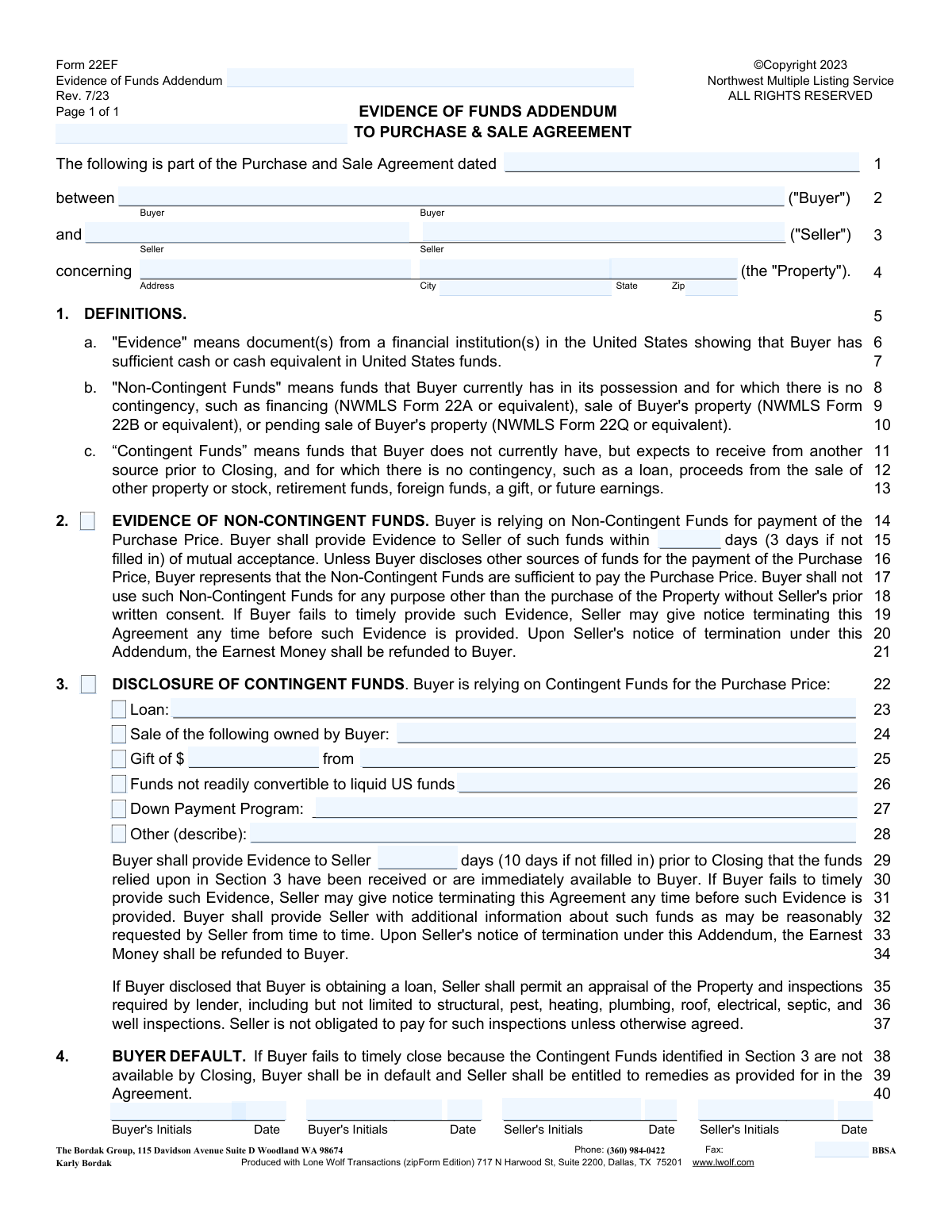
This addendum is used to provide the seller with proof that you have the financial means to purchase the property. It requires you to disclose whether your funds are non-contingent (cash in the bank) or contingent upon another event, like obtaining a loan or selling another property.
This addendum gives the buyer a set period to review the property's preliminary title report. If you find any unacceptable restrictions or encumbrances on the title, you can object and potentially terminate the agreement if the seller cannot or will not resolve them.
This disclosure is a federal requirement for any residential property built before 1978. The seller must disclose any known lead-based paint hazards and provide the buyer with a specific pamphlet and an opportunity to conduct an inspection.
As stated in the General Terms, if the Closing Date falls on a Saturday, Sunday, or legal holiday, the closing will automatically take place on the next business day.
Yes, services like Instafill.ai use AI to accurately auto-fill form fields, which saves time and helps reduce errors. This is especially useful for complex documents with many fields like a purchase and sale agreement.
You can upload the PDF of the purchase agreement to the Instafill.ai platform. It will convert the document into an interactive form that you can easily fill out, sign electronically, and share with the other parties.
If you have a flat or non-fillable PDF, you can use a service like Instafill.ai to make it interactive. Simply upload the file, and the platform's AI will identify the fields and allow you to fill them in online.
Compliance NWMLS Form 21
Validation Checks by Instafill.ai
1
Offer Expiration Date Chronology
This check ensures that the 'Offer Expiration Date' in Specific Term 1 is on or after the agreement 'Date'. An offer cannot expire before it is made. If the expiration date precedes the agreement date, the offer is invalid from the start, leading to legal and contractual confusion.
2
Earnest Money Amount Validity
Validates that the 'Earnest Money' amount in Specific Term 7 is a positive number that is less than the total 'Purchase Price' in Specific Term 6. Earnest money is a deposit and a fraction of the purchase price, so it cannot logically exceed the total price. An invalid amount could halt the transaction or indicate a significant data entry error.
3
Exclusive Default Remedy Selection
Ensures that for 'Default' in Specific Term 8, one and only one checkbox is selected, either 'Forfeiture of Earnest Money' or 'Seller’s Election of Remedies'. The contract requires a single, clear remedy in case of buyer default. Failure to select exactly one option creates ambiguity and potential legal disputes if a default occurs.
4
Possession Date Completeness
This validation checks 'Possession Date' in Specific Term 11. If the 'on Closing' checkbox is not selected, the 'Other' date field must be completed with a valid date. This is critical for defining when the buyer can legally take possession of the property, and an incomplete field leaves this crucial term undefined.
5
Seller FIRPTA Status Declaration
Verifies that one of the two options for 'Seller Citizenship (FIRPTA)' in Specific Term 14 ('is' or 'is not' a foreign person) is selected. This declaration is required by the Foreign Investment in Real Property Tax Act (FIRPTA) to determine if tax withholding is necessary at closing. An omission can lead to closing delays and tax compliance issues.
6
Agency Disclosure Completeness
Confirms that a representation status is selected for both the Buyer and the Seller in the 'Agency Disclosure' section (Specific Term 16). State laws require clear disclosure of who each broker represents in the transaction. Missing this information can result in regulatory violations and unclear lines of communication.
7
Addenda Cross-Reference Check
This check verifies that any completed addendum forms (e.g., Form 22D, 22EF, 22J) are listed by name or form number in the 'Addenda' section (Specific Term 18) of the main agreement. This ensures all parts of the contract are properly incorporated and legally binding. If an addendum is filled but not listed, its terms may not be enforceable.
8
Contingent Funds Specification
On the Evidence of Funds Addendum (Form 22EF), if any checkbox under Section 3 'Disclosure of Contingent Funds' is checked (e.g., 'Loan', 'Gift'), the corresponding detail field must be filled. This ensures the seller is properly informed about the source and nature of the buyer's funds. An unchecked box with filled data, or a checked box with no data, creates an ambiguous and incomplete disclosure.
9
Title Contingency Period Trigger
On the Title Contingency Addendum (Form 22T), this validation ensures that exactly one of the two checkboxes in Section 1 is selected to define the start of the buyer's review period ('from the date of Buyer's receipt' or 'mutual acceptance'). A clear trigger is necessary to calculate the contingency deadline accurately. Selecting none or both makes the start date ambiguous and could lead to disputes over timeliness.
10
Lead-Based Paint Disclosure Applicability
This check validates that the Lead-Based Paint Disclosure (Form 22J) is completed if the property was built prior to 1978. Federal law mandates this disclosure for such properties to warn buyers of potential lead hazards. Failure to provide this form when required can result in significant legal penalties and allows the buyer to rescind the contract.
11
Lead-Based Paint Inspection Waiver/Acceptance
On Form 22J, this ensures that exactly one option under 'Buyer's Acknowledgment' section (e) is checked, indicating whether the buyer waives the inspection or accepts the opportunity to conduct one. This choice is a critical part of the disclosure process and defines the buyer's rights regarding lead-based paint. An invalid selection makes the buyer's acknowledgment incomplete.
12
Contact Information Format Validation
Verifies that all phone number and email address fields for the Buyer, Seller, and Brokers on page 1 of the agreement follow a standard, valid format. Correct contact information is essential for delivering notices and maintaining communication as specified in the contract's 'Notices' clause. Invalid formats can lead to missed communications and procedural failures.
13
Homeowners' Association Review Period Validity
On the Optional Clauses Addendum (Form 22D), if the 'Homeowners' Association Review Period' clause is included, this check ensures the number of days entered for review is a positive integer. This period is a critical contingency deadline for the buyer. A non-numeric or zero value would make the contingency period invalid and unenforceable.
14
Signature and Date Presence
This validation confirms that all required signature and date fields for both Buyer and Seller on page 1 are filled. The signatures and dates are what make the agreement legally binding and establish the date of mutual acceptance. Missing signatures or dates render the contract unenforceable.
Common Mistakes in Completing NWMLS Form 21
Parties often forget to list every attached addendum in Section 18 of the main agreement. This happens when multiple documents are prepared separately and not cross-referenced before signing. The consequence is that the legal standing of an unlisted addendum, such as a financing or inspection contingency, could be challenged, potentially voiding critical terms of the offer. To avoid this, meticulously review all documents that form the complete agreement and ensure each one is explicitly named in Section 18 before signing.
Buyers and sellers sometimes enter nicknames, initials, or incomplete legal names in Sections 2 and 3. This error often occurs due to haste or not understanding the need for precision on a legal contract. Using incorrect names can cause significant delays and complications with financing, title insurance, and the legal recording of the deed, potentially requiring last-minute contract amendments. Always use the full, legal names of all parties as they appear on government-issued identification or property title documents.
An offeror may neglect to fill in the 'Offer Expiration Date' in Section 1, assuming the offer remains open indefinitely or not realizing its importance. While the contract defaults to a two-day expiration, this may not align with the offeror's intent, creating ambiguity and risk of a missed opportunity or an unintended acceptance. This can lead to disputes over whether a valid contract was formed. Always specify a clear date and time to create a firm deadline for acceptance, which provides certainty for both parties.
In Section 8, parties must choose between 'Forfeiture of Earnest Money' or 'Seller’s Election of Remedies' in case of buyer default, but this box is frequently missed. Overlooking this critical choice creates significant legal uncertainty if the buyer fails to close. The consequence is a potential dispute over the seller's rights, which may require costly legal intervention to resolve. To prevent this, buyers should carefully consider the implications of each option and make an explicit choice as part of their offer.
A simple typo when entering the Tax Parcel Number in Section 4 is a common but severe data entry error. This number is the unique government identifier for the property, and an incorrect number could mean the contract legally describes the wrong property. This can invalidate the entire agreement, derail financing, and create major title insurance problems that are expensive and time-consuming to fix. Always double-check the parcel number against official county records or the seller's property tax statement for accuracy.
When using the write-in portion of Section 5 ('Included Items') or Section 10 of the Optional Clauses Addendum ('Excluded Item(s)'), parties often use vague terms like 'drapes' or 'shelving'. This ambiguity leads to disputes at the final walk-through when the buyer's and seller's expectations don't match. To avoid this, be extremely specific (e.g., 'all window drapes in master bedroom' or 'freestanding metal shelves in garage') to ensure there is no confusion about what personal property is included or excluded from the sale.
In Section 14, a seller may incorrectly check that they are not a 'foreign person' for U.S. income tax purposes, either from misunderstanding the rule or by mistake. This misrepresentation can cause major closing delays when the Closing Agent verifies the seller's status, as specific tax withholding (FIRPTA) is required for foreign sellers. Correcting this late in the process can jeopardize the closing date and may lead to penalties. Sellers must accurately disclose their status from the outset to ensure compliance and a smooth closing.
On the Optional Clauses Addendum (Form 22D), a seller might incorrectly check the boxes in Section 5 regarding utility connections, often by assuming a property is on public sewer when it's actually on a septic system. This misrepresentation, even if unintentional, can lead to post-closing legal disputes if the buyer discovers the true situation and incurs unexpected costs. Sellers should verify all utility connections from their records rather than relying on memory to prevent claims of misrepresentation. AI-powered tools like Instafill.ai can help by pre-filling known property data, reducing the chance of such errors.
In the rush to complete a multi-page agreement, it's common for buyers or sellers to miss a signature, date, or initial field, especially on addenda or at the bottom of each page. An unsigned offer is not legally binding, and missing initials can create doubt as to whether a party reviewed and agreed to the terms on a specific page. This can invalidate the contract or lead to disputes. To avoid this, methodically review every page to ensure all required signature, date, and initial fields are completed by all parties. If the form is a non-fillable PDF, a tool like Instafill.ai can convert it into an interactive, fillable version where required fields are clearly marked.
On Form 22EF, buyers may mistakenly list funds as 'Non-Contingent' when they are actually 'Contingent' (e.g., funds in a stock account that must be sold, or money from a pending property sale). This happens when a buyer overestimates the liquidity of their assets. This gives the seller a false sense of security and can lead to the buyer defaulting if the funds are not accessible by the closing date, resulting in forfeiture of earnest money and potential legal action. Buyers must honestly assess whether their funds are truly available without any preconditions.
Section 4 of the agreement states that the legal description is attached as 'Exhibit A,' but parties sometimes forget to actually attach the document. A purchase agreement without a complete and accurate legal description may be considered unenforceable, as the subject matter of the contract is not properly identified. This can halt the transaction until the correct legal description is obtained from a title report or deed and formally added via an amendment. Always ensure Exhibit A is prepared and attached with the initial offer to create a valid and binding agreement from the start.
Saved over 80 hours a year
“I was never sure if my IRS forms like W-9 were filled correctly. Now, I can complete the forms accurately without any external help.”
Kevin Martin Green
Your data stays secure with advanced protection from Instafill and our subprocessors

Robust compliance program
Transparent business model
You’re not the product. You always know where your data is and what it is processed for.
ISO 27001, HIPAA, and GDPR
Our subprocesses adhere to multiple compliance standards, including but not limited to ISO 27001, HIPAA, and GDPR.
Security & privacy by design
We consider security and privacy from the initial design phase of any new service or functionality. It’s not an afterthought, it’s built-in, including support for two-factor authentication (2FA) to further protect your account.
Fill out NWMLS Form 21 with Instafill.ai
Worried about filling PDFs wrong? Instafill securely fills form-21-residential-purchase-and-sale-agreement forms, ensuring each field is accurate.