
Yes! You can use AI to fill out Adult Travel Document Application for Stateless and Protected Persons in Canada (16 years of age or over) (PPTC 190)
Don't type 243 fields by hand. Tell our AI about yourself, or upload a document you already have, and it fills every field in seconds. You check it, then download, print or sign.
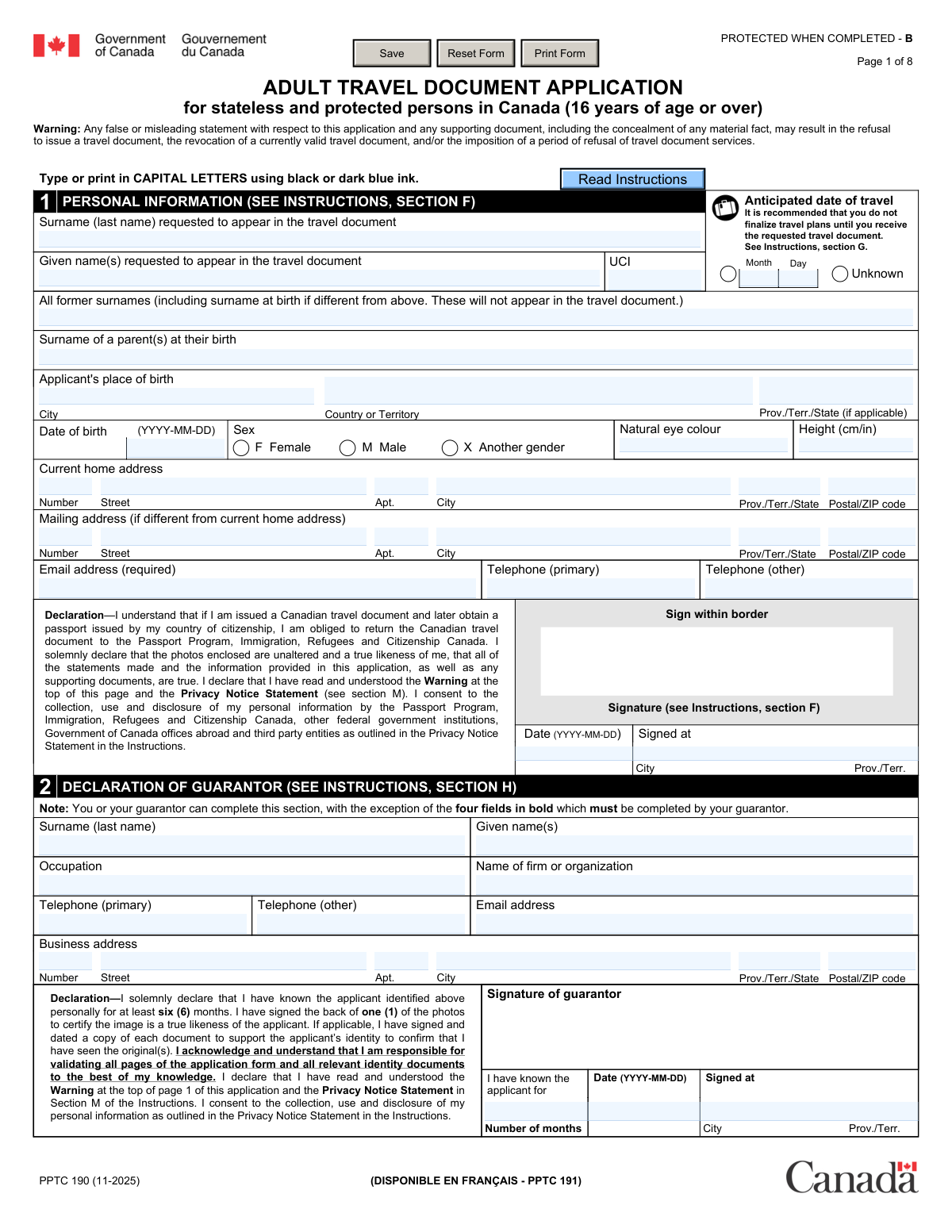
The AI does the filling. You just check it.
No typing into boxes, nothing to install.
What this form asks for
The AI fills all of it, from your answers or your documents.
The AI checks your answers before you download
17 checks built for this form, so a wrong date or a missing answer is caught before anyone else sees it.
Validates that the applicant’s date of birth indicates they are at least 16 years old on the application signature date (or submission date, depending on system rules). This is required because this form is explicitly for applicants 16 years of age or over; under-16 applicants must use a different form. If the applicant is under 16, the submission should be rejected with instructions to use the child application form.
Checks that all date fields follow the required format: YYYY-MM-DD for full dates (e.g., DOB, issue/expiry dates, signatures, travel dates) and YYYY-MM for address history periods, and that the values represent real calendar dates. For “Anticipated date of travel,” the system must also allow the explicit “Unknown” option and prevent partial/invalid combinations (e.g., month without day if not permitted). If any date is malformed or impossible (e.g., 2025-02-30), the application should be flagged for correction before processing.
Ensures mandatory applicant fields are present: surname, given name(s), UCI (if required by program rules), place of birth (city and country/territory), date of birth, sex selection, current home address, and email address (explicitly marked required). Completeness is critical for identity determination and for contacting the applicant to resolve issues. If any required field is missing, the submission should be blocked or routed to an “incomplete application” queue with a clear list of missing items.
Validates that the UCI/Client ID contains only digits and is exactly 8 or 10 digits long, as specified in the instructions. This prevents mismatches and failed lookups against IRCC records. If the UCI is present but not in the correct format, the system should reject the value and request correction (or allow blank only if the business rules permit).
Checks that name fields (requested surname/given names, former surnames, parent surname at birth, references, guarantor) contain acceptable characters (letters plus limited punctuation such as hyphen/apostrophe) and are not filled with numerals or symbols. The form instructs applicants to type/print in capital letters; systems should normalize case for storage while ensuring the entered content is legible and not obviously invalid (e.g., 'AAAA', '1234'). If invalid characters or clearly non-name content is detected, the application should be flagged for manual review or returned for correction.
Validates that the “All former surnames” field is completed when the applicant indicates or provides evidence of prior names (e.g., identity documents in Section 6 show a different surname) or when the requested surname differs from immigration status name (if captured in the system). Declaring former surnames is important for identity verification and record linkage. If a mismatch is detected and former surnames are blank, the submission should be flagged and the applicant asked to provide former surnames or supporting name-change documentation.
And 11 more checks
- Sex selection is exactly one of F/M/X and consistent with status document when required
- Address completeness and postal/ZIP code format (Canada vs non-Canada)
- Email and telephone number format validation
- Applicant signature and signature date presence and recency (within last 12 months)
- Guarantor mandatory fields completed by guarantor (bold fields) and known-for duration >= 6 months
- Proof of immigration status document details and expiry logic
- Previous Canadian travel document logic (Yes/No branching and required details)
- Foreign travel document possession and explanation requirement
- Travel history entries consistency (date left <= date returned; country/reason required)
- Identity documents section requirements (at least one ID; not same as immigration status; expiry and name present)
- References eligibility and uniqueness (2 non-relatives, not guarantor, 18+, known >= 6 months)
Let AI fill out your PPTC 190
No typing. Every field filled in seconds, checked, ready to sign.
How to Fill Out PPTC 190 Online for Free in 2026
What the AI walks you through.
- Select the document type you need (Refugee Travel Document or Certificate of Identity) and review eligibility, travel limitations, fees, and photo/translation requirements in the instructions.
- Complete Section 1 (Personal Information): enter your requested name, UCI, birth details, sex marker, contact information, addresses, and sign/date the applicant declaration.
- Complete Section 3 (Proof of Immigration Status in Canada): choose one valid status document, record its number and issue/expiry dates, and upload a clear photocopy.
- Provide travel and identity history: complete Sections 4–6 (previous Canadian travel document details, citizenship/travel documentation history, and at least one government-issued identity document), ensuring copies are signed/dated by the guarantor if required.
- Add background details: complete Sections 7–9 (addresses and occupation for the last 2 years, two non-relative references, and optional emergency contact), signing where indicated.
- Have an eligible guarantor complete and sign Section 2, certify one passport photo, and sign/date any required document copies; if you do not have an eligible guarantor, prepare the alternative statutory declaration (PPTC 326).
- Pay the fee online, assemble the application package (form, photos, receipt, supporting documents, any required translations and translator declaration forms), then submit by mail or courier to the designated Passport Program address.
Common Mistakes in Completing PPTC 190
The ones the AI is built to catch.
Not using CAPITAL LETTERS or using the wrong ink colour
Name on the application doesn’t match immigration status documents (without proof of change)
Forgetting to declare all former surnames (or listing them incorrectly)
Incorrect UCI/Client ID format or leaving it blank
Date fields completed in the wrong format or with incomplete dates
Providing an incomplete address history for the last two years
Guarantor section completed incorrectly (wrong person, missing bold fields, or not meeting criteria)
Identity documents submitted incorrectly (using immigration status document again, missing both sides, or not certified)
Not enclosing required documents about previous Canadian travel documents (or missing PPTC 203 when applicable)
Foreign passport/travel document questions answered incompletely (missing explanations or refusal evidence)
References don’t meet the rules (relatives, guarantor, under 18, or less than 6 months known)
Photo requirements not met (wrong size, altered, missing back-of-photo details, or not certified)
Frequently Asked Questions About PPTC 190
Is it really free for 7 days?
Can I fill other forms too?
How do I cancel?
How does the AI fill out PPTC 190?
What happens to my information?
How complex is PPTC 190 to fill out?
What is this application form (PPTC 190) used for?
Who should use PPTC 190, and what if the applicant is under 16?
What is the difference between a Refugee Travel Document and a Certificate of Identity?
Can I use a Canadian refugee travel document or certificate of identity to travel to my country of citizenship?
What documents do I need to include as proof of immigration status in Canada (Section 3)?
What do I need to provide for identity documents (Section 6), and can I use my immigration status document?
Do I need a guarantor, and who can be a guarantor for this application?
Which parts of the guarantor section must be completed by the guarantor?
What if I don’t know an eligible guarantor for at least 6 months?
How many photos are required, and what are the key photo rules?
Do I need to include my previous Canadian travel document (if I have one)?
Do I have to submit any foreign passport or travel document I still have?
What if I never applied for a passport from my country of origin, or my request was refused?
Where do I submit the completed application?
What are the fees, and how do I pay?
Get your PPTC 190 filled out by AI
$0 today. Cancel before Nov 1 and you pay nothing.
Other forms like this one
PA state forms: Form 1095-A, Health Insurance Marketplace Statement, Form W-2, Wage and Tax Statement, Form 593, Real Estate Withholding, Form 8938, Statement of Specified Foreign Financial Assets, Form CMS-2567, Statement of Deficiencies, Form 1098, Mortgage Interest Statement, Form 1098-T, Tuition Statement, Form 1099-S, Proceeds From Real Estate Transactions, Form 1098-E, Student Loan Interest Statement, Form DS-3053, Statement of Consent, Form DS-86, Statement of Non-Receipt of a U.S. Passport, Form DS-86, Statement of Non-Receipt of a U.S. Passport, Form 108, Statement of Intention, Form 107, Statement of Financial Affairs, Form 121, Statement About Your SSNs, Form 122A-1, Chapter 7 Statement of Current Monthly Income, Center for Infertility & Reproductive Surgery – New Patient Questionnaire and Patient/Guarantor Statement (Brigham and Women’s Hospital, Department of Obstetrics and Gynecology), Form W-8IMY (Rev. October 2021), Certificate of Foreign Intermediary, Foreign Flow-Through Entity, or Certain U.S. Branches for United States Tax Withholding and Reporting, Form W-2, Wage and Tax Statement (2025), State of New Mexico Workers’ Compensation Administration — Workers' Compensation Complaint (Rev. 8/22) (11.4.4.9 NMAC)
NJ state forms: Form 1095-A, Health Insurance Marketplace Statement, Form W-2, Wage and Tax Statement, Form 593, Real Estate Withholding, Form 8938, Statement of Specified Foreign Financial Assets, Form CMS-2567, Statement of Deficiencies, Form 1098, Mortgage Interest Statement, Form 1098-T, Tuition Statement, Form 1099-S, Proceeds From Real Estate Transactions, Form 1098-E, Student Loan Interest Statement, Form DS-3053, Statement of Consent, Form DS-86, Statement of Non-Receipt of a U.S. Passport, Form DS-86, Statement of Non-Receipt of a U.S. Passport, Form 108, Statement of Intention, Form 107, Statement of Financial Affairs, Form 121, Statement About Your SSNs, Form 122A-1, Chapter 7 Statement of Current Monthly Income, Center for Infertility & Reproductive Surgery – New Patient Questionnaire and Patient/Guarantor Statement (Brigham and Women’s Hospital, Department of Obstetrics and Gynecology), Form W-8IMY (Rev. October 2021), Certificate of Foreign Intermediary, Foreign Flow-Through Entity, or Certain U.S. Branches for United States Tax Withholding and Reporting, Form W-2, Wage and Tax Statement (2025), State of New Mexico Workers’ Compensation Administration — Workers' Compensation Complaint (Rev. 8/22) (11.4.4.9 NMAC)
state ID forms: Application for Renewal or Duplicate of Alabama Driver License or ID card, Form 1095-A, Health Insurance Marketplace Statement, Form W-2, Wage and Tax Statement, Form 593, Real Estate Withholding, Form 8938, Statement of Specified Foreign Financial Assets, Form CMS-2567, Statement of Deficiencies, Form 1098, Mortgage Interest Statement, Form 1098-T, Tuition Statement, Form 1099-S, Proceeds From Real Estate Transactions, Form 1098-E, Student Loan Interest Statement, Form DS-3053, Statement of Consent, Form DS-86, Statement of Non-Receipt of a U.S. Passport, Form 108, Statement of Intention, Form 107, Statement of Financial Affairs, Form 121, Statement About Your SSNs, Form 122A-1, Chapter 7 Statement of Current Monthly Income, Center for Infertility & Reproductive Surgery – New Patient Questionnaire and Patient/Guarantor Statement (Brigham and Women’s Hospital, Department of Obstetrics and Gynecology), Form W-8IMY (Rev. October 2021), Certificate of Foreign Intermediary, Foreign Flow-Through Entity, or Certain U.S. Branches for United States Tax Withholding and Reporting, Form W-2, Wage and Tax Statement (2025), State of New Mexico Workers’ Compensation Administration — Workers' Compensation Complaint (Rev. 8/22) (11.4.4.9 NMAC)
travel document forms: Domanda di visto Nazionale (D), National Visa Application (D), Form I-131, Application for Travel Document
Let AI fill out your PPTC 190
Your trial starts once a card is added. You pay nothing before Nov 1.
Our AI already knows this form, all 243 fields of it. Skip the typing: tell it about yourself, or upload what you have, and it fills the whole form in seconds.
- AI fills every field on all 8 pages, tables and checkboxes included
- No typing into boxes: answer a few questions, or upload a document you already have, an old copy of this form, a photo of a document
- The AI checks the answers; you review and change anything before you download
- Download the finished PDF, print it, or sign it online
- Encrypted, and never used to train AI
Cancel before Nov 1 and you pay nothing.
A card is needed to start the trial. Cancel in two clicks from your account.
Terms · Privacy