
Yes! You can use AI to fill out Selbstauskunft/ Vermögensaufstellung (Financial Self-Disclosure/Statement of Assets)
Don't type 539 fields by hand. Tell our AI about yourself, or upload a document you already have, and it fills every field in seconds. You check it, then download, print or sign.
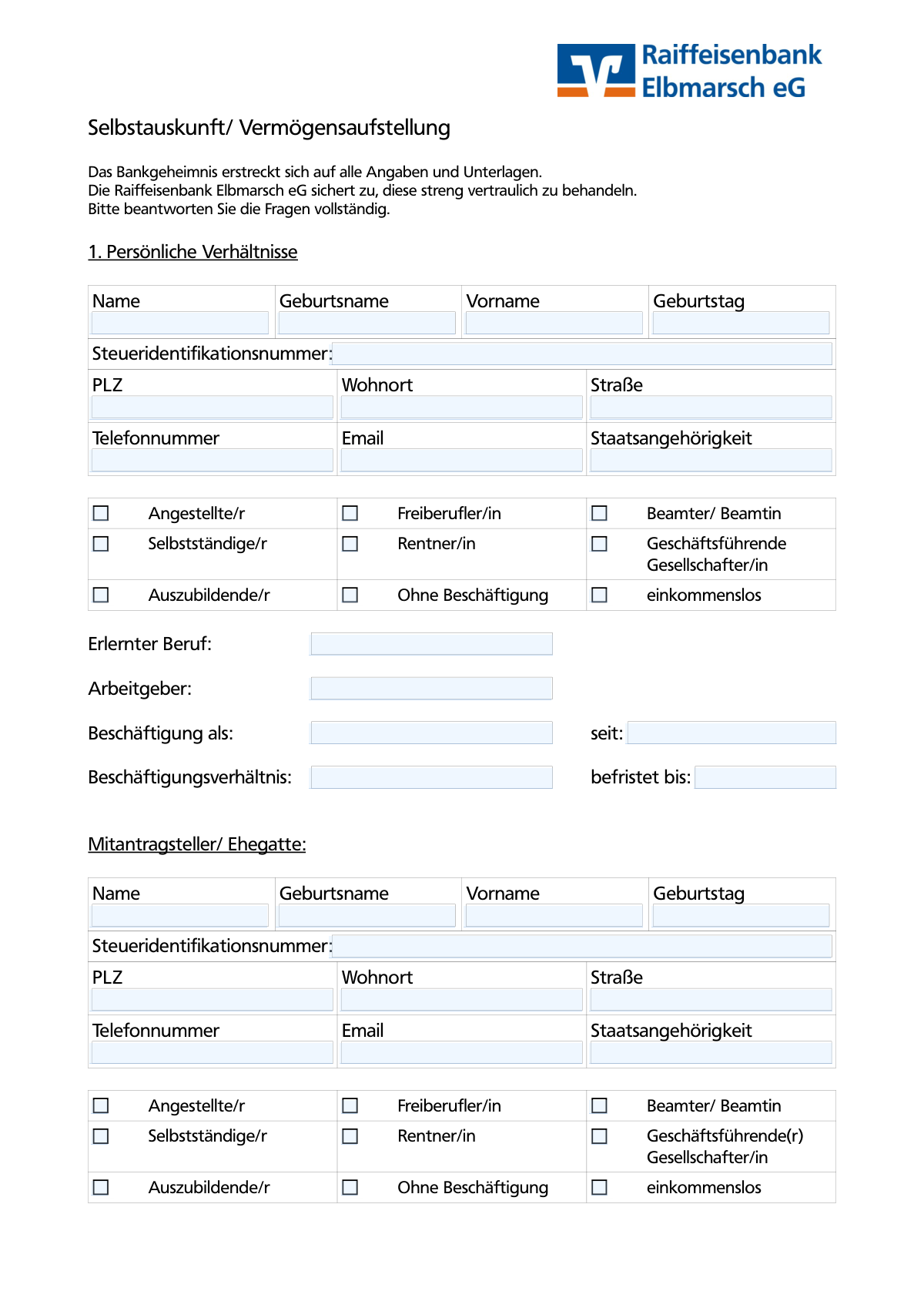
The AI does the filling. You just check it.
No typing into boxes, nothing to install.
What this form asks for
The AI fills all of it, from your answers or your documents.
The AI checks your answers before you download
13 checks built for this form, so a wrong date or a missing answer is caught before anyone else sees it.
This check ensures that the 'Steueridentifikationsnummer' for both the applicant and co-applicant is exactly 11 digits long and conforms to the official format, which includes specific rules about non-repeating digits and a valid checksum. This ID is crucial for correct identification with financial authorities and for tax purposes. An invalid number will lead to processing errors and potential rejection of the application by the bank.
This validation verifies that all International Bank Account Numbers (IBANs) entered in the assets, liabilities, and bank reference sections adhere to the correct format (e.g., starting with 'DE' for Germany followed by 20 digits) and have a valid checksum. This is critical for accurately identifying accounts for asset verification, debt servicing, and setting up direct debits. An incorrect IBAN will cause payment failures and delays in processing the loan application.
This check ensures that if an applicant or co-applicant indicates their employment relationship ('Beschäftigungsverhältnis') is 'befristet' (fixed-term), the corresponding 'befristet bis' (fixed-term until) date field must be filled with a future date. This date is essential for the bank to assess the stability and longevity of the applicant's income. Failure to provide this date when required will result in an incomplete application and prevent the bank from properly evaluating creditworthiness.
This check verifies that the 'Geburtstag' (Date of Birth) for both the applicant and co-applicant is a valid date in the past and indicates the person is of legal age to enter a contract (e.g., over 18). It prevents data entry errors like future dates or impossible dates. This is fundamental for identity verification and assessing legal capacity, and an invalid date will halt the application process immediately.
This validation cross-references the selected employment status (e.g., 'Ohne Beschäftigung' or 'einkommenslos') with the income section. If an applicant is marked as having no income ('einkommenslos'), their net income fields should be zero or empty. This check ensures logical consistency in the financial data, which is vital for an accurate assessment of the applicant's financial situation and repayment ability.
This check validates that if the applicant or co-applicant answers 'ja' (yes) to the question about past legal proceedings (Mahnverfahren, Zwangsvollstreckungen, etc.), the corresponding explanation text field must be filled out. This information is critical for the bank's risk assessment. Answering 'yes' without providing an explanation leaves a critical information gap and will cause the application to be flagged as incomplete.
And 7 more checks
- Ensures Completeness of Co-applicant Data
- Validates Employment Start Date Logic
- Validates Property Debt Against Market Value
- Validates German Postal Code (PLZ) Format
- Ensures Exclusive Selection for Employment Status
- Validates Consistency of Marital and Property Regime Status
- Ensures Dependent Data Completeness
Let AI fill out your Selbstauskunft/ Vermögensaufstellung
No typing. Every field filled in seconds, checked, ready to sign.
How to Fill Out Selbstauskunft/ Vermögensaufstellung Online for Free in 2026
What the AI walks you through.
- Navigate to Instafill.ai and upload or select the 'Selbstauskunft/ Vermögensaufstellung' form.
- Use the AI assistant to automatically fill in your personal details, employment information, and family status for both the applicant and co-applicant.
- Enter your monthly income and expenses in the 'Einnahmen / Ausgaben' section. The AI can help categorize and calculate totals from uploaded documents like pay stubs or bank statements.
- Detail your assets ('Vermögen'), including real estate, bank accounts, investments, and insurance policies. Instafill.ai can help structure this complex information from various source documents.
- List all your liabilities ('Verbindlichkeiten'), such as existing loans, credit lines, and other financial obligations, by filling the guided fields.
- Review the completeness declaration and authorizations, then use the AI tool to check for any missing information or inconsistencies before finalizing.
- Securely sign the document electronically and download the completed, validated form, ready for submission to the bank.
Common Mistakes in Completing Selbstauskunft/ Vermögensaufstellung
The ones the AI is built to catch.
Confusing Gross (Brutto) and Net (Netto) Income
Omitting Small or Irregular Liabilities
Providing Inaccurate or Incomplete Real Estate Details
Incorrectly Reporting Monthly Expenses
Mismatching Monthly and Annual Financial Figures
Entering the Incorrect German Tax Number
Confusing Insurance Surrender Value with Maturity Value
Forgetting to Complete Authorization and Signature Fields
Misinterpreting 'Dependents' vs. 'Children'
Incomplete Disclosure of Employment Status
Frequently Asked Questions About Selbstauskunft/ Vermögensaufstellung
Is it really free for 7 days?
Can I fill other forms too?
How do I cancel?
How does the AI fill out Selbstauskunft/ Vermögensaufstellung?
What happens to my information?
How complex is Selbstauskunft/ Vermögensaufstellung to fill out?
What is the purpose of this 'Selbstauskunft' form?
Do I have to fill out the 'Mitantragsteller/Ehegatte' section if I'm applying alone?
What is the difference between 'brutto' and 'netto' income in Section 2?
What documents do I need to attach to this form?
Who is considered an 'unterhaltspflichtige Person'?
I am self-employed. What special information do I need to provide?
Is the financial information I provide kept confidential?
Why does the form ask for my permission to contact my tax advisor or other banks?
What happens if I make a mistake or leave something out?
Can AI tools help me fill out this detailed form?
How can I fill out this form online using Instafill.ai?
The PDF I received from the bank is not fillable. What can I do?
Get your Selbstauskunft/ Vermögensaufstellung filled out by AI
$0 today. Cancel before Nov 2 and you pay nothing.
Other forms like this one
financial forms: Form 8938, Statement of Specified Foreign Financial Assets, Form 12.902(b), Family Law Financial Affidavit (Short Form), Form I-361, Affidavit of Financial Support, Form CJA-23, Financial Affidavit, Form 107, Statement of Financial Affairs, SBA Form 413, Personal Financial Statement, Personal Financial Statement (REV 06/2018) – Northwest Federal Credit Union, NSFAS Consent Form (National Student Financial Aid Scheme) – APP2026, International Student Application for Financial Aid 2026-2027 (International Student Application for Financial Assistance 2026-2027), State of Hawaii Department of Commerce and Consumer Affairs (DCCA) Contractors License Board – Application for Contractor's License (Sole Proprietor) (CT-36) with supporting forms (Experience Certificate CT-03, Contractors Financial Statement CT-02, and Chronological History of Projects/Project List), Colorado Judicial Department Form JDF 1111SC (Form 35.2), Sworn Financial Statement, Northwestern University Office of Undergraduate Financial Aid International Applicant Document Upload Cover Sheet, Vanguard Super Apply for a financial hardship payment, Selbstauskunft - vertraulich - (Financial Self-Disclosure), Empower Financial Services, Inc. (EFSI) and Empower Advisory Group, LLC (EAG) Form CRS Customer Relationship Summary, Rollover Form (Principal Financial Group), Principal Financial 401(k) Withdrawal Form, Principal Financial Group Pre-Approved Basic Savings Plan - Plus, DoD 7000.14-R, Department of Defense Financial Management Regulation, Volume 12: Special Accounts, Funds and Programs, Principal Financial Group Notice of Data Breach
disclosure forms: Arizona Form 285, General Disclosure/Representation Authorization Form, Arizona Form 285-I, Individual Income Tax Disclosure/Representation Authorization Form, State of Florida Department of Highway Safety and Motor Vehicles (FLHSMV) Form HSMV 82993, Separate Odometer Disclosure Statement and Acknowledgment, C.A.R. Form FLD, Lead-Based Paint and Lead-Based Paint Hazards Disclosure, Acknowledgment and Addendum (Revised 11/10), DS 1891, Applicant/Vendor Disclosure Statement (State of California Department of Developmental Services), New York State Department of State (Division of Licensing Services) Property Condition Disclosure Statement (DOS-1614-f), Moving your Vanguard funds to a Vanguard Brokerage Account Disclosure statement, Moving your Vanguard funds to a Vanguard Brokerage Account Disclosure statement, Vermögensaufstellung / Selbstauskunft (Statement of Assets / Self-Disclosure), Selbstauskunft - vertraulich - (Financial Self-Disclosure), ADP Compensation and Fee Disclosure Statement, Cigna Out-of-Network Referral Disclosure Form, Kaiser Permanente Authorization for Use or Disclosure of Patient Health Information, Fidelity Roth Individual Retirement Account Custodial Agreement and Disclosure Statement, Oklahoma Real Estate Commission Residential Property Condition Disclosure Exemption Form (RPCD EXEMPTION FORM), Oklahoma Real Estate Commission, Disclosure of Broker Duties & Responsibilities, Oklahoma Appendix A, Residential Property Condition Disclosure Statement, Form AD, Disclosure Regarding Real Estate Agency Relationship, Oklahoma Residential Property Condition Disclosure Statement (Appendix A), Mediation Disclosure Notification and Acknowledgment
financial disclosure forms: Selbstauskunft - vertraulich - (Financial Self-Disclosure), Confidential Purchaser Questionnaire, Financial Disclosure Affidavit, Request for Disclosure of Judicial Financial Reporting Statement
asset disclosure forms: Vermögensaufstellung / Selbstauskunft (Statement of Assets / Self-Disclosure)
ERM forms: REQUEST FOR OWNERSHIP INFORMATION—ERM-14 FORM, Form I-90, Application to Replace Permanent Resident Card, Form I-485, Application to Register Permanent Residence, Form SS-8, Determination of Worker Status, Form CMS-1763, Request for Termination of Medicare Coverage, Form I-212, Application for Permission to Reapply, Form I-192, Application for Advance Permission to Enter as a Nonimmigrant, Form W-8IMY (Rev. October 2021), Certificate of Foreign Intermediary, Foreign Flow-Through Entity, or Certain U.S. Branches for United States Tax Withholding and Reporting, County of Louisa Department of Community Development – New Non-Residential Building Permit Package, Application Schedule 1: Designer Information (City of Toronto Building Permit Application), HR-Pol-Rec&Res-04 Employment Application Form (Recruitment of Permanent Employees), Fauquier County Department of Community Development – Building Trades Permit or Amendment to Existing Permit Application (Residential or Commercial), Belastingdienst VPB 075 – Verzoek fiscale eenheid Vennootschapsbelasting (Deel A – Gegevens moedermaatschappij), ROTC Cadet Academic Plan / Degree and Credit Hour Worksheet (Student Identification, Term-by-Term Courses, GPA Summary, and Completion Certification), Health Assessment – Ontario Health atHome (Fixing Long-Term Care Act, 2021) (Form 4768-69E), Health Assessment - Ontario Health atHome (Fixing Long-Term Care Act, 2021) — Form 4768-69E, Washington Single-Family Property Term Lease & Security Deposit Receipt (WA Single-Family Lease) | Revised 10/08/2025, Application for Mechanical Permit, Pennsylvania Department of State — Certificate of Termination (Domestic Limited Liability Company) (15 Pa.C.S. § 8872(f)) (DSCB:15-8872(f)), Document Checklist for a Study Permit (IMM 5483)
Let AI fill out your Selbstauskunft/ Vermögensaufstellung
Your trial starts once a card is added. You pay nothing before Nov 2.
Our AI already knows this form, all 539 fields of it. Skip the typing: tell it about yourself, or upload what you have, and it fills the whole form in seconds.
- AI fills every field on all 9 pages, tables and checkboxes included
- No typing into boxes: answer a few questions, or upload a document you already have, an old copy of this form, a photo of a document
- The AI checks the answers; you review and change anything before you download
- Download the finished PDF, print it, or sign it online
- Encrypted, and never used to train AI
Cancel before Nov 2 and you pay nothing.
A card is needed to start the trial. Cancel in two clicks from your account.
Terms · Privacy