Fill out asset disclosure forms
with AI.
Asset disclosure forms, often referred to as financial self-disclosures or statements of assets (Vermögensaufstellung), are critical documents used to provide a comprehensive overview of an individual's or business's financial health. These forms require a detailed breakdown of monthly income, regular expenses, liquid assets, real estate holdings, and outstanding liabilities. Providing accurate data is essential because these disclosures serve as the foundation for high-stakes financial evaluations, ensuring that all parties have a transparent understanding of available capital and existing debt obligations.
By continuing, you acknowledge Instafill's Privacy Policy and agree to get occasional product update and promotional emails.
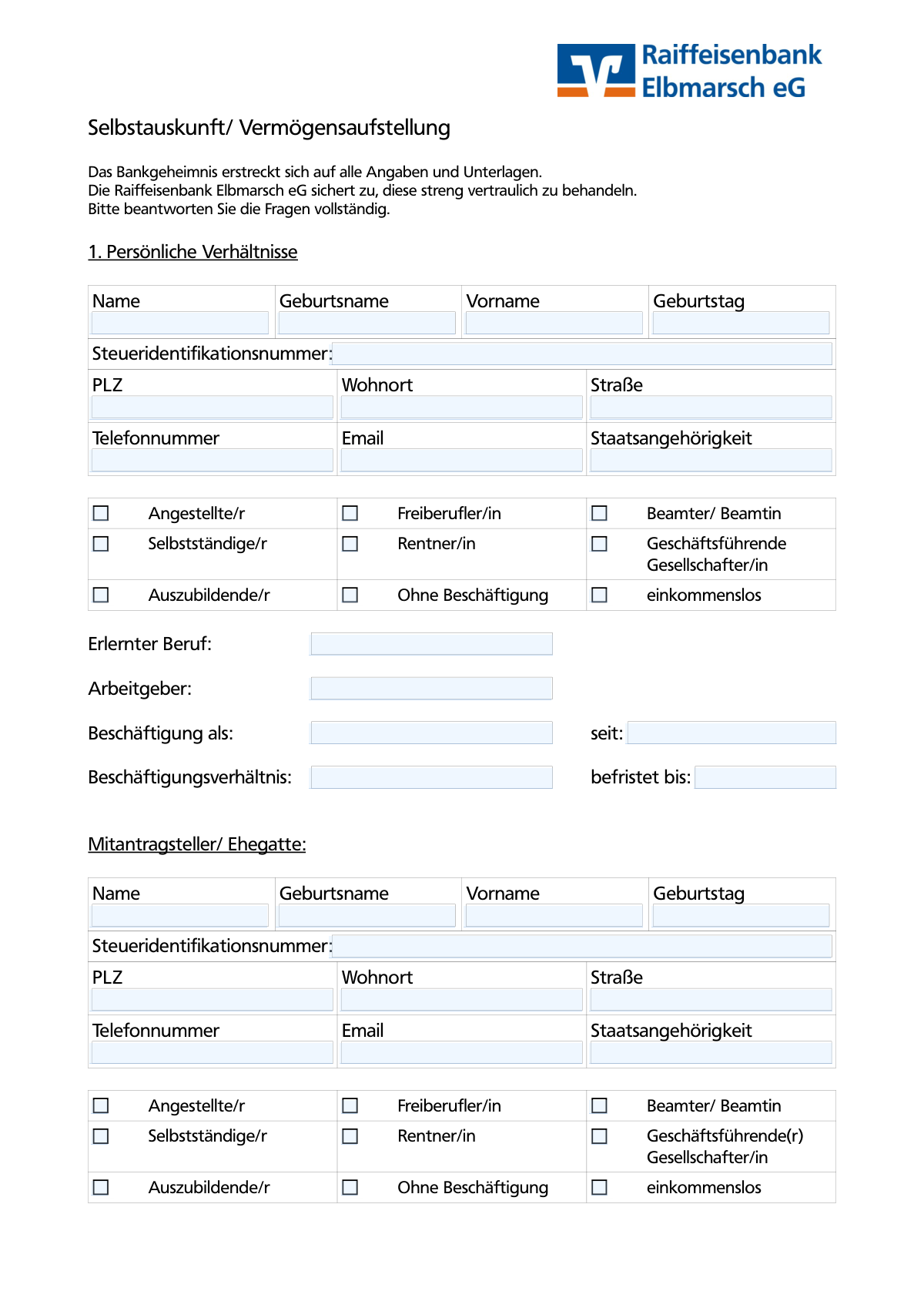
About asset disclosure forms
Typically, these forms are requested by financial institutions, such as banks or credit unions, during the loan application process or when securing a mortgage. For example, documents like the Selbstauskunft are standard requirements for assessing creditworthiness in Germany. Beyond banking, asset disclosure forms are frequently used in legal proceedings, such as divorce settlements or estate planning, where a clear accounting of marital or inherited property is necessary. They are also vital for business owners seeking investment or credit lines to demonstrate the stability of their enterprise.
Completing these extensive documents manually can be a meticulous and time-consuming task, often requiring the cross-referencing of various bank statements and records. Tools like Instafill.ai use AI to fill these forms in under 30 seconds, handling sensitive data accurately and securely while streamlining the entire process. This allows users to focus on their financial goals rather than the administrative burden of repetitive paperwork.
Every form on this page can be completed without typing. Instafill is form filling software that reads a PDF and fills it for you — including flat and scanned documents that carry no fillable fields at all.
Forms in This Category
The forms in this category have a median Form Complexity Index of 92/100 (Very Complex), measured across 2 forms by field count, input difficulty, length, conditional logic and structure. See how it is calculated.
| Form Name | Pages | FCI | |
|---|---|---|---|
| 1. | Selbstauskunft/ Vermögensaufstellung (Financial Self-Disclosure/Statement of Assets) | 9 | Very Complex 92 |
| 2. | Vermögensaufstellung / Selbstauskunft (Statement of Assets / Self-Disclosure) | 3 | Very Complex 81 |
- Enterprise-grade security & data encryption
- 99%+ accuracy powered by AI
- 1,000+ forms from all industries
- Complete forms in under 60 seconds
How to Choose the Right Form
When applying for a loan or credit in Germany, providing a clear picture of your financial health is a mandatory step. These asset disclosure forms, commonly known as a *Selbstauskunft*, allow banks to evaluate your creditworthiness by reviewing your income, expenses, assets, and liabilities. Choosing the right template depends largely on the specific banking institution you are working with.
For Standard Credit Applications
If you are applying for a mortgage, personal loan, or business credit with a general commercial bank, you should use the Selbstauskunft/ Vermögensaufstellung (Financial Self-Disclosure/Statement of Assets). This is the standard comprehensive statement used to provide a complete picture of an applicant's financial situation. It is designed to meet the general requirements of most German lending institutions and covers all the essential data points required for a credit check.
For Cooperative and Raiffeisen Banks
If you are specifically dealing with cooperative banks or local credit unions, choose the Vermögensaufstellung / Selbstauskunft (Statement of Assets / Self-Disclosure). While functionally similar to the standard version, this specific template is often preferred by institutions like Raiffeisenbank to gather detailed financial information from individuals or couples. It ensures that your data is presented in the format these specific banks are most accustomed to processing, which can help speed up the approval process.
Key Information to Have Ready
Regardless of which form you choose, ensure you have the following information prepared to complete the document accurately using Instafill.ai:
- Income & Expenses: Monthly net salary, rental income, and regular living costs.
- Asset Values: Current bank balances, real estate market values, and investment portfolios.
- Existing Liabilities: Current loan balances, leasing agreements, or other financial obligations.
Using Instafill’s AI tools, you can quickly turn these static PDF forms into interactive documents, ensuring your disclosure is professional, legible, and ready for bank review.
Form Comparison
| Form | Primary Purpose | Target Institution | Key Information Required |
|---|---|---|---|
| Selbstauskunft/ Vermögensaufstellung (Financial Self-Disclosure/Statement of Assets) | Assess creditworthiness for general loan applications and financial services | Standard German commercial and savings banks | Personal details, monthly income, expenses, current assets, and liabilities |
| Vermögensaufstellung / Selbstauskunft (Statement of Assets / Self-Disclosure) | Evaluate financial stability for specific cooperative bank loan processing | Cooperative banks such as Raiffeisenbank and Volksbank | Detailed breakdown of individual or joint assets and debt obligations |
Tips for asset disclosure forms
Verify that every figure entered on your asset disclosure matches your recent bank statements, pay stubs, and tax returns exactly. Discrepancies between your self-disclosure and your supporting documentation can lead to delays or the rejection of your credit application.
It is a common mistake to omit smaller debts like retail installment plans, leasing contracts, or credit card balances. Banks often cross-reference your disclosure with credit agencies, so full transparency is essential to prove your financial reliability.
Carefully check whether the form specifically requests your gross income or your net (take-home) pay. Mixing these up can significantly misrepresent your debt-to-income ratio, which is a primary factor banks use to determine your borrowing limit.
Manually transferring complex financial data into PDF fields is tedious and prone to manual errors. AI-powered tools like Instafill.ai can complete these forms in under 30 seconds with high accuracy, ensuring your sensitive data stays secure while saving you significant administrative effort.
When listing assets such as real estate, vehicles, or stock portfolios, use their current market value rather than the original purchase price. This provides the lender with a realistic view of your current net worth and available collateral.
If you are filling out a disclosure as a couple or business partners, clearly indicate which assets are held individually and which are joint property. This clarity helps the bank's underwriters correctly assess the legal standing of the assets being disclosed.
Frequently Asked Questions
These forms provide a comprehensive overview of an individual's or couple's financial standing, including income, expenses, assets, and liabilities. They are primarily used by financial institutions to assess creditworthiness and determine the risk associated with lending money for mortgages or large loans.
Loan applicants, mortgage seekers, and individuals applying for significant credit lines are usually required to submit these forms. In Germany, both private individuals and business owners may need to provide a Selbstauskunft to their bank during the financing process to prove their financial stability.
It is helpful to have recent bank statements, pay stubs, tax assessments, and documentation regarding existing loans or property ownership on hand. Having these records ready ensures that the data entered into the asset disclosure form is accurate and matches the supporting evidence required by the bank.
While the terms are often used interchangeably, a Selbstauskunft (Self-Disclosure) is a broader term for sharing personal financial details, whereas a Vermögensaufstellung (Statement of Assets) specifically focuses on the balance between what you own and what you owe. Most German bank forms combine both into a single document to get a full financial picture.
While the information requested is generally the same across the industry, many banks prefer that you use their specific branded templates. However, because the core data remains consistent, you can often reuse the same financial figures across different forms provided by different institutions.
Completing these forms manually can take 30 minutes or more, depending on the complexity of your financial situation. Using AI tools like Instafill.ai can reduce this time to under 30 seconds by accurately extracting data from your source documents and placing it directly into the PDF fields.
Yes, modern AI technology can assist in filling out complex financial forms by reading your uploaded documents and mapping the information to the correct fields. Instafill.ai allows users to automate this process, ensuring that income figures and asset values are transferred accurately and efficiently.
Providing false or incomplete information can lead to the rejection of a loan application or the immediate termination of an existing credit agreement. Accuracy is vital because banks often verify the information provided against external credit bureaus and the physical documents you submit.
If you are applying for a joint loan or mortgage, both parties usually need to disclose their financial details on the same form. This allows the lender to calculate the total household income and collective debt-to-income ratio to determine your total borrowing power.
Once the form is filled out and signed, it should be submitted directly to the bank or financial advisor handling your application. Most institutions now accept digital copies via secure upload portals or email, though some may still require a physical copy with a handwritten signature for their records.
Glossary
- Form Complexity Index
- Instafill’s 0–100 measure of how much effort a form takes to complete, calculated deterministically from the form’s own structure rather than estimated. It combines the number of fillable fields (the largest factor), how difficult those fields are to complete based on their type, the number of pages that contain fields, the amount of conditional “fill-only-if” logic, and how many sections the form is divided into, then adds modifiers for tables and repeating lists, bundled instruction pages, and dense page layouts. A higher score means the form is harder to fill out by hand. The forms in this category have a median Form Complexity Index of 92/100 (Very Complex). See exactly how it is calculated.
- Selbstauskunft
- A self-disclosure document where an individual provides personal and financial information to a lender or landlord to prove their financial standing.
- Vermögensaufstellung
- A comprehensive statement of assets that lists everything you own (assets) and everything you owe (liabilities) to determine your total net worth.
- Bonität
- A term used by German financial institutions to describe your creditworthiness or your estimated ability to fulfill financial obligations.
- Verbindlichkeiten
- The total financial debts or obligations you currently owe to third parties, such as bank loans, mortgages, or private debts.
- SCHUFA
- The primary German credit agency that tracks your payment history and provides a score to banks to help them decide whether to approve your application.
- Sicherheiten
- Assets or collateral pledged to a bank to secure a loan, which the bank can claim if the borrower fails to make payments.
- Nettoeinkommen
- Your actual take-home pay after all taxes, health insurance, and social security contributions have been deducted from your gross income.
- Sachwerte
- Tangible or physical assets such as real estate, machinery, or vehicles that hold value independently of currency fluctuations.