Fill out financial disclosure forms
with AI.
Financial disclosure forms are essential documents used to provide a comprehensive overview of an individual's or business's financial health. In banking and legal contexts, these forms—often referred to as a Selbstauskunft or Statement of Assets—are the primary tool for institutions to assess creditworthiness. By detailing assets, liabilities, income, and monthly expenses, these documents allow lenders like Deutsche Bank to make informed decisions regarding loan applications, mortgages, or credit line extensions. Providing this transparency is a fundamental step in establishing a formal relationship with a financial institution.
By continuing, you acknowledge Instafill's Privacy Policy and agree to get occasional product update and promotional emails.
About financial disclosure forms
These forms are typically required by individuals applying for personal loans, real estate financing, or opening specialized bank accounts. They are also common in legal proceedings where a clear picture of financial holdings is mandatory for a fair resolution. Because these documents require a high level of detail, accuracy is critical; any discrepancies can lead to significant delays in approval or administrative complications. Whether you are a first-time homebuyer or a business owner seeking capital, navigating these disclosures is a standard requirement for securing your financial objectives.
Completing these detailed statements can be a tedious process, especially when managing complex lists of assets and liabilities. Tools like Instafill.ai use AI to fill these forms in under 30 seconds, ensuring that your data is handled accurately and securely while saving you the hassle of manual data entry. This streamlined approach helps you move through the application process faster without sacrificing the precision required by banks.
Every form on this page can be completed without typing. Instafill is form filling software that reads a PDF and fills it for you — including flat and scanned documents that carry no fillable fields at all.
Forms in This Category
The forms in this category have a median Form Complexity Index of 68/100 (Complex), measured across 5 forms by field count, input difficulty, length, conditional logic and structure. See how it is calculated.
| Form Name | Pages | FCI | |
|---|---|---|---|
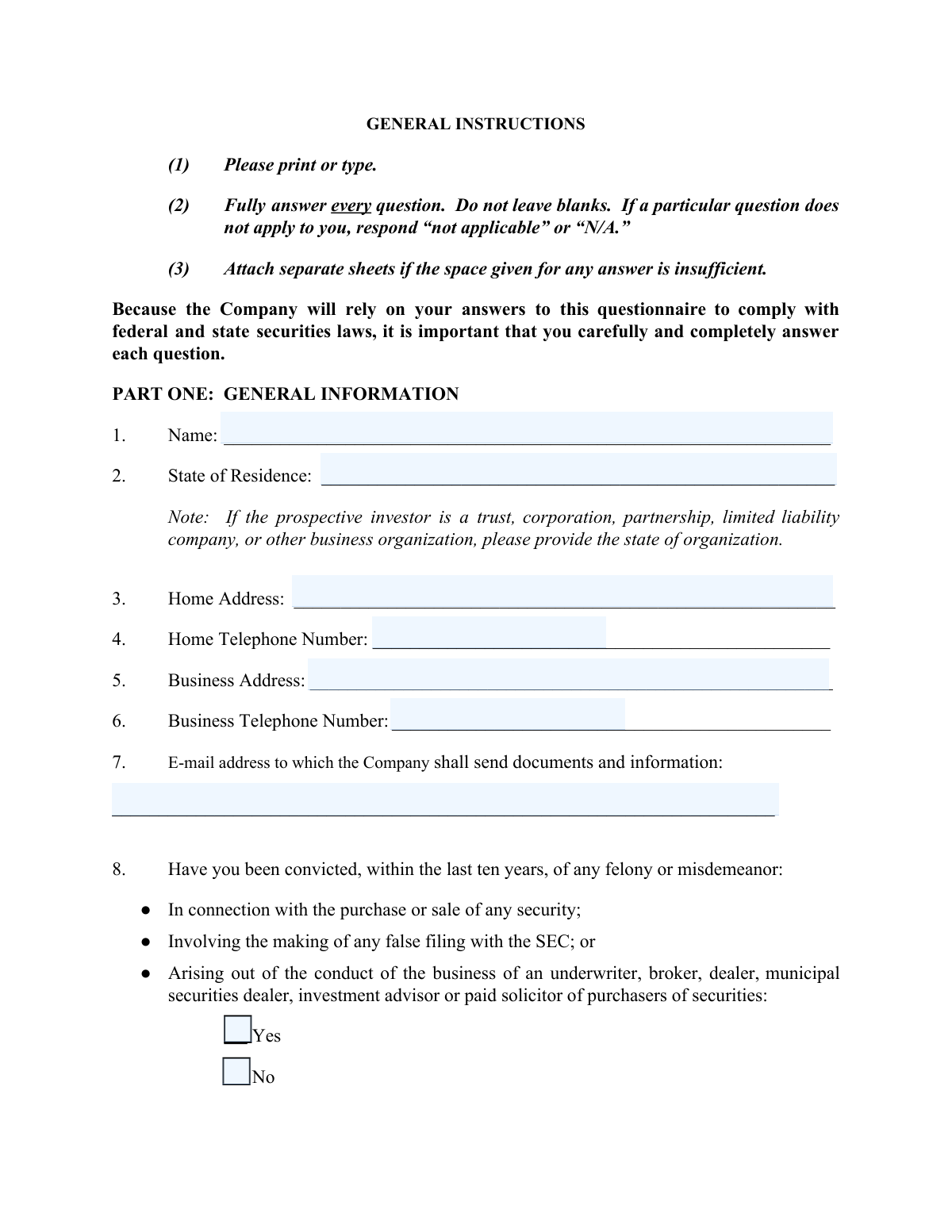
| 1. | Confidential Purchaser Questionnaire | 1 | Basic 43 |
| 2. | Financial Disclosure Affidavit | 3 | Complex 68 |
| 3. | Request for Disclosure of Judicial Financial Reporting Statement | 1 | Simple 26 |
| 4. | Selbstauskunft/ Vermögensaufstellung (Financial Self-Disclosure/Statement of Assets) | 9 | Very Complex 92 |
| 5. | Selbstauskunft - vertraulich - (Financial Self-Disclosure) | 7 | Very Complex 99 |
- Enterprise-grade security & data encryption
- 99%+ accuracy powered by AI
- 1,000+ forms from all industries
- Complete forms in under 60 seconds
How to Choose the Right Form
Navigating German financial disclosure forms is essential when applying for loans, mortgages, or opening specific bank accounts. These documents provide lenders with a snapshot of your financial health, ensuring they can accurately assess credit risk. To choose the right document, consider the specific request from your bank.
For Detailed Asset Reporting
If your lender requires a comprehensive breakdown of your net worth, choose the Selbstauskunft/ Vermögensaufstellung (Financial Self-Disclosure/Statement of Assets). This form is particularly important for:
- Mortgage Applications: Where real estate holdings and existing liabilities must be balanced.
- High-Value Credit Lines: When a standard income statement isn't enough to prove creditworthiness.
- Investment Loans: Situations where your total asset portfolio (Vermögensaufstellung) serves as collateral.
For Standard Loan and Credit Requests
For most routine banking needs, the Selbstauskunft - vertraulich - (Financial Self-Disclosure) is the standard choice. It is designed for privacy and efficiency, focusing on:
- Monthly Cash Flow: A clear look at your regular income versus living expenses.
- Co-Applicant Data: Easily including details for a spouse or partner on the same application.
- General Creditworthiness: The typical requirement for personal loans or increasing a credit card limit.
Which Form Do You Need?
While both financial disclosure forms cover personal details and liabilities, the distinction often lies in the depth of the asset section. If the bank specifically asks for a "Vermögensaufstellung," select the first option. If you are filling out general bank account forms or Deutsche Bank forms for a personal loan, the "vertraulich" version is usually sufficient.
By using Instafill.ai, you can quickly populate these complex PDFs. Our AI helps you accurately map your income and assets into the correct fields, ensuring your disclosure is professional and error-free before you submit it to the bank.
Form Comparison
| Form | Primary Purpose | Key Information Included | Ideal For |
|---|---|---|---|
| Selbstauskunft/ Vermögensaufstellung (Financial Self-Disclosure/Statement of Assets) | Assessing creditworthiness for comprehensive loan applications and credit-related services. | Detailed breakdown of personal assets, liabilities, monthly income, and recurring expenses. | Providing banks with a complete overview of an applicant's financial situation. |
| Selbstauskunft - vertraulich - (Financial Self-Disclosure) | Confidential risk assessment for individuals or joint applicants seeking financial products. | Confidential personal details, income, and financial obligations for one or more applicants. | Standard lending decisions requiring private financial data for risk evaluation. |
Tips for financial disclosure forms
To ensure accuracy, have your most recent pay stubs, bank statements, and loan balances ready before beginning the form. Having these figures at your fingertips prevents estimation errors that could delay your credit assessment or lead to discrepancies during the bank's verification process.
Banks use these forms to calculate your debt-to-income ratio, so it is vital to include all credit cards, car loans, and existing mortgages. Omitting a liability can lead to an immediate rejection once the bank performs its mandatory credit check and discovers undisclosed obligations.
If you are filing with a co-applicant, clearly distinguish which assets are held individually and which are joint property. This clarity helps the bank accurately assess the collateral and financial strength of each party involved in the credit request.
When listing real estate or high-value assets, use current conservative market estimates rather than the original purchase price. Providing realistic valuations builds trust with the lender and ensures the collateral assessment is grounded in current market reality.
AI-powered tools like Instafill.ai can complete these complex disclosure forms in under 30 seconds with high accuracy. Your sensitive financial data stays secure during the process, making it a highly efficient way to handle multiple bank documents without manual data entry.
Most German financial disclosure forms require your 'Netto-Einkommen' (net income) rather than your gross salary. Ensure you are subtracting taxes and social contributions consistently across all sections to provide a true picture of your actual disposable income.
Save a completed copy of your Selbstauskunft for your personal records to ensure consistency if you apply for credit at a different institution later. Having a baseline document makes it much faster to update your financial profile for future bank requests or annual reviews.
Frequently Asked Questions
Banks and financial institutions use these forms to assess an applicant's creditworthiness before approving loans, mortgages, or other credit products. The form provides a comprehensive overview of your financial health, allowing the lender to evaluate the risk associated with your application.
Any individual or business entity applying for significant financing in Germany is usually required to submit these documents. This includes primary applicants, co-applicants, and sometimes guarantors who are providing security for a loan.
You will generally need to provide details regarding your monthly net income, regular household expenses, and a list of all assets such as real estate, savings, and investments. Additionally, you must disclose all existing liabilities, including current loans, credit card debts, and any outstanding financial obligations.
Yes, AI tools like Instafill.ai can process financial disclosure forms in under 30 seconds by accurately extracting data from your source documents. The AI identifies relevant information from your pay stubs or bank statements and places it directly into the required fields on the PDF.
While manual entry can be time-consuming due to the level of detail required, using an AI-powered service can complete the entire form in less than 30 seconds. This significantly speeds up the application process compared to traditional manual handwriting or typing.
Financial disclosure forms contain highly sensitive personal and economic data that is protected under strict privacy laws. The 'confidential' label signifies that the information is intended solely for the bank's internal risk assessment and will not be shared with unauthorized third parties.
While institutions like Deutsche Bank may have their own branded versions, the core data requirements for a Selbstauskunft are largely standardized across the industry. They all aim to capture the same fundamental data points regarding income, expenses, assets, and debts to meet regulatory lending standards.
Yes, banks usually require proof for the figures you provide, such as recent salary statements, tax assessments, or bank statements. Ensuring that the data on your disclosure form matches your supporting documents is crucial for a successful application.
A SCHUFA report is an external record of your credit history and payment behavior, whereas a Selbstauskunft is a self-reported statement of your current financial position. Banks use the self-disclosure to see your current cash flow and asset base, which a credit report does not provide.
If there is a significant change in your income or liabilities before the loan is finalized, you are generally obligated to inform the bank. Providing an updated disclosure ensures that the credit decision is based on accurate, current information.
Glossary
- Form Complexity Index
- Instafill’s 0–100 measure of how much effort a form takes to complete, calculated deterministically from the form’s own structure rather than estimated. It combines the number of fillable fields (the largest factor), how difficult those fields are to complete based on their type, the number of pages that contain fields, the amount of conditional “fill-only-if” logic, and how many sections the form is divided into, then adds modifiers for tables and repeating lists, bundled instruction pages, and dense page layouts. A higher score means the form is harder to fill out by hand. The forms in this category have a median Form Complexity Index of 68/100 (Complex). See exactly how it is calculated.
- Selbstauskunft
- A formal self-disclosure document where a borrower provides a comprehensive overview of their financial status to a bank or lender.
- Creditworthiness (Bonität)
- An evaluation of a person's ability to repay a debt, used by financial institutions to determine the risk of lending money.
- SCHUFA
- Germany's leading credit bureau that tracks payment history and provides credit scores used by banks during the application process.
- Liabilities (Verbindlichkeiten)
- Financial obligations or debts owed to others, such as existing mortgages, personal loans, or outstanding credit card balances.
- Vermögensaufstellung
- A detailed statement of assets that lists everything of value owned by the applicant, including real estate, bank balances, and investments.
- Net Income (Netto-Einkommen)
- The actual amount of money an individual receives in their bank account after taxes and social insurance contributions have been deducted.
- Collateral (Sicherheiten)
- Assets or property offered by a borrower to a lender to secure a loan, which the lender can claim if the borrower defaults.
- Haushaltsrechnung
- A monthly household budget calculation used by banks to compare total income against living expenses to determine how much a borrower can afford in loan payments.