Yes! You can use AI to fill out Financial Disclosure Affidavit
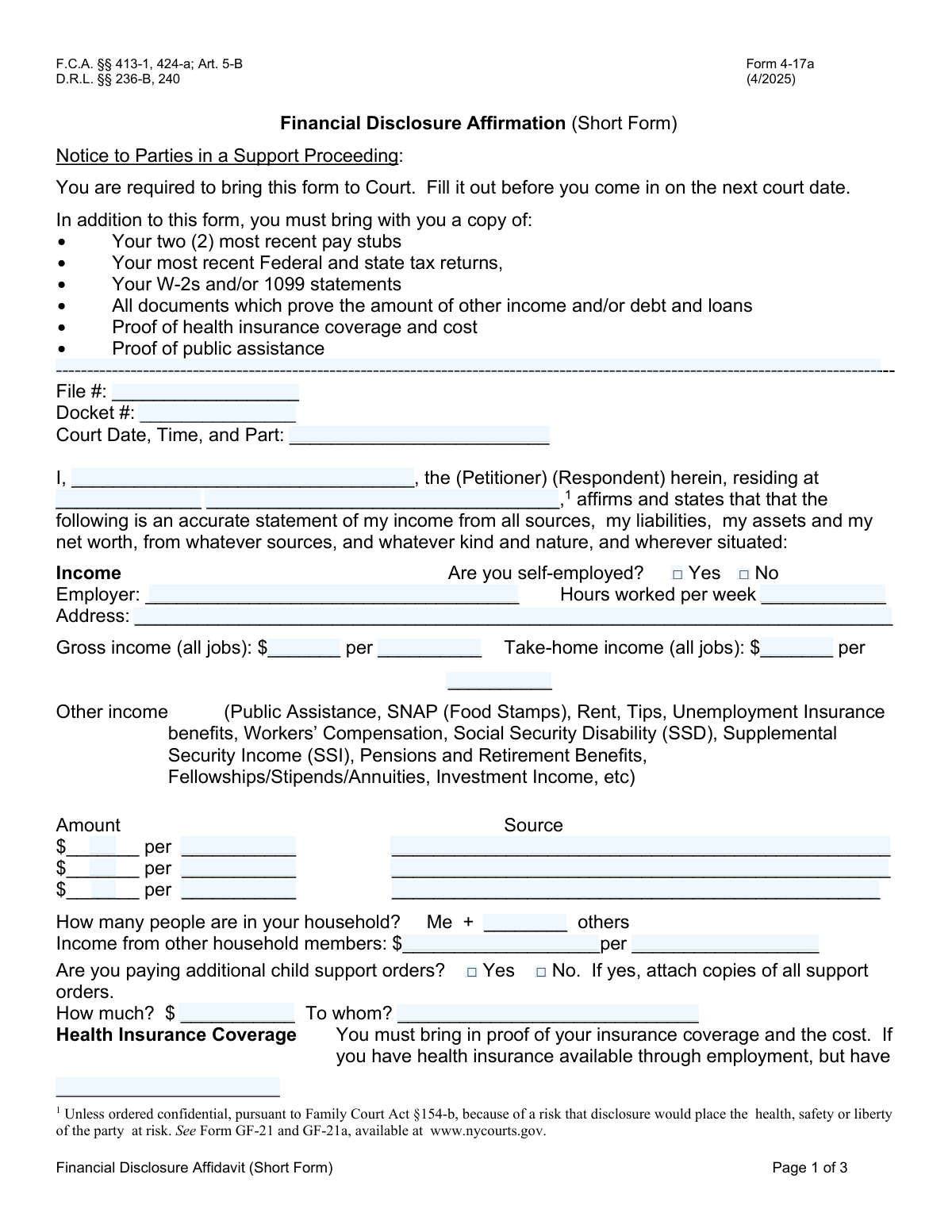
A Financial Disclosure Affidavit is a sworn legal statement that provides a comprehensive overview of an individual's complete financial situation, including all income, assets, debts, and expenses. This document is critically important in court cases involving financial matters, such as child support or divorce, as it provides the judge with the necessary information to make fair and equitable decisions. Today, this form can be filled out quickly and accurately using AI-powered services like Instafill.ai, which can also convert non-fillable PDF versions into interactive fillable forms.
Financial Disclosure Affidavit is part of the
affidavit forms, disclosure forms, financial affidavit forms, financial disclosure forms and financial forms categories on Instafill.
Our AI automatically handles information lookup, data retrieval, formatting, and form filling.
It takes less than a minute to fill out Financial Disclosure Affidavit using our AI form filling.
Securely upload your data. Information is encrypted in transit and deleted immediately after the form is filled out.
Form specifications
| Form name: | Financial Disclosure Affidavit |
| Number of fields: | 114 |
| Number of pages: | 3 |
| Filled form examples: | Form Financial Disclosure Affidavit Examples |
| Language: | English |
Instafill Demo: How to fill out PDF forms in seconds with AI
How to Fill Out Financial Disclosure Affidavit Online for Free in 2026
Are you looking to fill out a FINANCIAL DISCLOSURE AFFIDAVIT form online quickly and accurately? Instafill.ai offers the #1 AI-powered PDF filling software of 2026, allowing you to complete your FINANCIAL DISCLOSURE AFFIDAVIT form in just 37 seconds or less.
Follow these steps to fill out your FINANCIAL DISCLOSURE AFFIDAVIT form online using Instafill.ai:
- 1 Navigate to Instafill.ai and upload or select the Financial Disclosure Affidavit form.
- 2 Provide your personal details and the court case information, such as the docket and file numbers.
- 3 Use the AI-powered tool to detail your employment, income from all sources, and any household contributions.
- 4 List all your assets, including bank accounts, real estate, vehicles, and other valuable property.
- 5 Enter your monthly expenses, covering housing, utilities, transportation, insurance, and personal spending, as well as any debts or loans.
- 6 Review all the information for accuracy, then electronically sign and date the affirmation section to certify its truthfulness.
- 7 Download, print, or securely share your completed affidavit as required by the court.
Our AI-powered system ensures each field is filled out correctly, reducing errors and saving you time.
Why Choose Instafill.ai for Your Fillable Financial Disclosure Affidavit Form?
Speed
Complete your Financial Disclosure Affidavit in as little as 37 seconds.
Up-to-Date
Always use the latest 2026 Financial Disclosure Affidavit form version.
Cost-effective
No need to hire expensive lawyers.
Accuracy
Our AI performs 10 compliance checks to ensure your form is error-free.
Security
Your personal information is protected with bank-level encryption.
Frequently Asked Questions About Form Financial Disclosure Affidavit
This form is a financial disclosure statement used in court proceedings, likely for family law cases such as child support. It provides the court with a detailed summary of your income, assets, debts, and expenses to help make a financial determination.
This form must be completed by the parties involved in the court case, referred to as the petitioner or respondent. It is used to declare your complete financial situation to the court.
Gross income is your total earnings before any deductions are taken out, such as taxes, insurance, or retirement contributions. Take-home income, or net income, is the actual amount of money you receive in your paycheck after all deductions have been made.
You should list any income you receive that is not from your primary job. This can include public assistance, unemployment benefits, workers' compensation, SSI/SSD, pension payments, rent from property you own, or investment income.
Check the box indicating you are self-employed and list your business name as the employer. For income, you should calculate your average gross and net income from your business records, such as profit and loss statements.
Yes, if the form asks for 'Other Household Members' Total Income,' you must report the total income of other people contributing to the household finances. This helps provide a complete picture of the financial resources available in your home.
For your house, you can use a recent appraisal, a property tax assessment, or look at recent sales of similar homes in your area. For your car, you can use online valuation tools like Kelley Blue Book or Edmunds to get a current estimated value.
Yes, for variable expenses like utilities or groceries, it is best to calculate an average based on the last 6 to 12 months. For fixed expenses like rent or a car payment, use the exact monthly amount.
You should gather recent pay stubs, tax returns (W-2s, 1099s), bank statements, mortgage or loan statements, and bills for all your monthly expenses. Having these documents on hand will ensure the information you provide is accurate.
The Docket Number and File Number are assigned by the court and can be found on any official court documents you have received for this case. If you cannot find them, you may need to contact the court clerk's office.
List the two most significant debts in the spaces provided. You can attach a separate sheet of paper with the heading 'Continuation of Debts' to list any additional debts, ensuring you include all the same information requested on the form.
Yes, services like Instafill.ai use AI to auto-fill form fields accurately and save time. This can be particularly helpful for lengthy forms with repetitive information, helping to reduce errors and speed up completion.
Simply upload the form to the Instafill.ai platform. Its AI will identify the fields and you can provide your information once, allowing the tool to automatically populate the correct data throughout the document.
You can use a service like Instafill.ai, which can convert flat, non-fillable PDFs into interactive, fillable forms. This allows you to type your information directly into the fields instead of having to print and fill it out by hand.
Compliance Financial Disclosure Affidavit
Validation Checks by Instafill.ai
1
Validates Gross Income Exceeds Take-Home Income
This check ensures that the 'Gross income amount' is greater than or equal to the 'Take-home income amount' when their respective pay periods are identical. This is a logical consistency check to catch data entry errors, as net income cannot exceed gross income for the same period. If validation fails, the user should be prompted to review and correct the income amounts before submission.
2
Ensures Additional Child Support Details are Provided When Required
This validation verifies that if the user checks 'Yes (paying additional child support orders)', they must also fill in the 'Additional Child Support Amount' and 'Recipient of Additional Child Support' fields. This is crucial for completeness, as simply indicating the existence of other orders without details is insufficient for legal and financial calculations. A failure would prevent submission and highlight the required detail fields.
3
Validates Household Income Details Based on Household Size
This check ensures that the 'Other Household Members' Total Income Amount' and 'Income Frequency' fields are only filled if the 'Number of Other Household Members' is greater than zero. Conversely, if the number is greater than zero, these income fields become required. This prevents the submission of irrelevant data and ensures that when household members are declared, their financial contribution is also captured.
4
Enforces Mutually Exclusive Selection for Employment Status
This validation ensures that the user selects either 'Yes (self-employed)' or 'No (not self-employed)', but not both. These options are mutually exclusive, and selecting both creates an ambiguous and invalid state for the user's employment status. If the user tries to select both, the system should automatically deselect the previous choice or show an error message.
5
Verifies Accuracy of Total Monthly Expenses Calculation
This check validates that the value entered in 'Total monthly expenses' is the correct sum of all individual monthly expense fields (Housing, Utilities, Insurance, etc.). This serves as a cross-check to prevent mathematical errors by the user, ensuring the financial summary is accurate. If the user-entered total does not match the calculated sum, the system should flag the discrepancy and suggest auto-calculating the correct total.
6
Validates Vehicle Model Year is a Plausible Four-Digit Year
This check ensures that the 'Vehicle Year' field contains a valid four-digit number that falls within a reasonable range, such as between 1900 and the current year plus one. This prevents typos like '202' or '99' and ensures the year is realistic for a vehicle. An invalid entry would trigger an error message asking the user to enter a valid 4-digit year.
7
Flags Inconsistent Property Value and Mortgage Balance
This validation checks if the 'Mortgage Balance' is greater than the 'Market Value' of the owned property. While possible in some market conditions (being 'underwater'), this is an unusual financial state that warrants a warning or confirmation from the user. The check helps identify potential data entry errors and ensures the user confirms the data if the balance truly exceeds the value.
8
Requires Description for 'Other' Expense Amounts
This validation rule ensures that if a value greater than zero is entered into an 'Other' amount field like 'Other utilities expense', the corresponding description field ('Other Utilities Expense Description') must be filled out. This is critical for context, as an amount without an explanation is meaningless for financial assessment. Failure to provide a description would result in an error prompting the user to specify the nature of the expense.
9
Ensures Affirmation Date is a Valid and Non-Future Date
This check combines the 'Affirmation date (day of month)', 'Affirmation Month', and 'Affirmation Year' fields to ensure they form a valid calendar date. Furthermore, it validates that the constructed date is not in the future. This is a critical check to ensure the legal validity and integrity of the signed document, as a post-dated affirmation is invalid.
10
Validates Paired Completeness of Income Amount and Frequency
This check ensures that if an income amount is provided (e.g., 'Gross income amount'), its corresponding frequency ('Gross income pay period') must also be selected, and vice-versa. This rule applies to all income pairs, such as gross, take-home, and other income sources. It prevents incomplete data entries that would be impossible to annualize or use in calculations.
11
Validates Health Insurance Cost Fields are Enabled Conditionally
This validation ensures that health insurance cost fields (e.g., 'Health Insurance Monthly Cost', 'Individual Plan premium cost') are only active and available for input if the user has not checked the 'I don't have health insurance coverage' box. If that box is checked, these cost fields should be disabled and cleared to prevent contradictory information. This logic maintains the internal consistency of the form's data.
12
Ensures Asset Value and Description are Both Provided
This validation rule checks that for any listed asset, if a value is entered in the 'Value' field, the corresponding 'Details' field must not be empty. Similarly, if an asset is described in the 'Details' field, a 'Value' must be provided. This ensures that every declared asset is both identified and quantified, preventing incomplete financial disclosures.
13
Requires 'Other' Health Coverage Description When Selected
This validation ensures that if the 'Other (specify)' checkbox for child health insurance is checked, the 'Other Health Insurance Coverage Description' text field must be filled in. This prevents a user from indicating an 'Other' coverage type without providing the necessary details for what that coverage is. An error will prompt the user to either provide the description or uncheck the 'Other' box.
14
Validates Consistency of Printed Name and Party Name
This check compares the 'Printed or Typed Name' field with the 'Party Full Name' field provided at the beginning of the form. While not a strict character-for-character match, it should verify a high degree of similarity to ensure the person signing the form is the same party who is completing it. A significant mismatch would trigger a warning to prevent potential identity errors or fraud.
Common Mistakes in Completing Financial Disclosure Affidavit
Applicants often incorrectly enter their take-home pay in the 'Gross income' field or vice-versa. This mistake happens because people may not be familiar with the distinction or may only know one of the figures offhand. Incorrectly reporting income significantly misrepresents financial standing, which can lead to inaccurate support calculations and potential legal challenges. To avoid this, carefully check your pay stubs for the pre-tax (gross) and post-tax (net/take-home) amounts and enter them in the correct fields.
A frequent error is entering an income amount for one period (e.g., a monthly salary) but selecting a different frequency (e.g., 'per two weeks'). This drastically inflates or deflates the calculated annual income, leading to a rejection of the form or a grossly incorrect support order. Always double-check that the income figure you provide in fields like 'Gross income amount' corresponds exactly to the time frame selected in 'Gross income pay period'. Advanced form fillers like Instafill.ai can flag potential mismatches between amounts and frequencies, helping to ensure accuracy.
The form contains many 'if yes, then...' sections, such as for 'Additional Child Support Orders'. People often check 'Yes' but then forget to fill in the required details like amounts and recipients. This incomplete information makes it impossible to process the section, causing delays and requiring follow-up from the court. To prevent this, treat the follow-up questions as mandatory whenever you select an affirmative answer. Intelligent form systems, such as Instafill.ai, can automatically reveal and highlight these required fields based on your answers, making them impossible to miss.
Leaving the signature or date fields blank is one of the most common and easily avoidable mistakes. An unsigned or undated financial disclosure is legally invalid and will be immediately rejected by the court clerk, causing significant delays in the case. Always perform a final review of the form, paying special attention to the signature block at the end, to ensure you have signed and dated it correctly on the day of submission.
When listing expenses like food or utilities, the form asks for monthly amounts, but people often enter costs based on a weekly or annual basis without converting them. This leads to an inaccurate 'Total monthly expenses' calculation and a skewed financial picture. To avoid this, convert all non-monthly expenses to their monthly equivalent (e.g., multiply weekly costs by 4.33) before entering them. AI tools like Instafill.ai can assist by providing built-in calculators and prompts to ensure all expenses are standardized to a monthly figure.
Applicants sometimes focus solely on their primary employment income and forget to report other sources like public assistance, unemployment benefits, tips, or investment income. This omission can be seen as an attempt to hide income, which has serious legal consequences, including sanctions or unfavorable rulings. It is crucial to carefully review the 'Other Income Source' fields and declare all forms of income, no matter how small or infrequent.
Fields like 'Docket Number' and 'File Number' are critical for associating the form with the correct legal case. People may leave these blank if they don't have the documents handy, or they may transpose numbers. An error here can cause the document to be lost or misfiled, halting case progress. Always copy these numbers directly from official court documents to ensure accuracy. If the form is a non-fillable PDF, a tool like Instafill.ai can convert it into an interactive version, making it easier to type and review these critical numbers.
In the 'Party Full Name' field, individuals sometimes enter a nickname or a shortened version of their name. Legal and financial documents require your full legal name as it appears on government-issued identification. Using an incorrect name can lead to identity verification failures, rejection of the form, and complications in enforcing any resulting court orders. Always use your complete legal name to ensure the document is valid.
The form includes a field for 'Total monthly expenses' which is often left blank because filers assume the clerk will do the math. This is not the case, and leaving this field empty can result in the form being considered incomplete and returned. It is essential to sum all individual monthly expense entries and write the final number in the total field. AI-powered form filling tools like Instafill.ai can help prevent this by automatically performing calculations as you fill out the form.
This form has several pairs of 'Yes'/'No' checkboxes, such as for self-employment or additional child support orders. A common mistake is to check both boxes, or neither, leaving the response ambiguous. This forces the processor to guess or return the form for clarification. You must select one and only one option for each pair to provide a clear answer.
Saved over 80 hours a year
“I was never sure if my IRS forms like W-9 were filled correctly. Now, I can complete the forms accurately without any external help.”
Kevin Martin Green
Your data stays secure with advanced protection from Instafill and our subprocessors

Robust compliance program
Transparent business model
You’re not the product. You always know where your data is and what it is processed for.
ISO 27001, HIPAA, and GDPR
Our subprocesses adhere to multiple compliance standards, including but not limited to ISO 27001, HIPAA, and GDPR.
Security & privacy by design
We consider security and privacy from the initial design phase of any new service or functionality. It’s not an afterthought, it’s built-in, including support for two-factor authentication (2FA) to further protect your account.
Fill out Financial Disclosure Affidavit with Instafill.ai
Worried about filling PDFs wrong? Instafill securely fills financial-disclosure-affidavit forms, ensuring each field is accurate.



