Yes! You can use AI to fill out Selbstauskunft - vertraulich - (Financial Self-Disclosure)
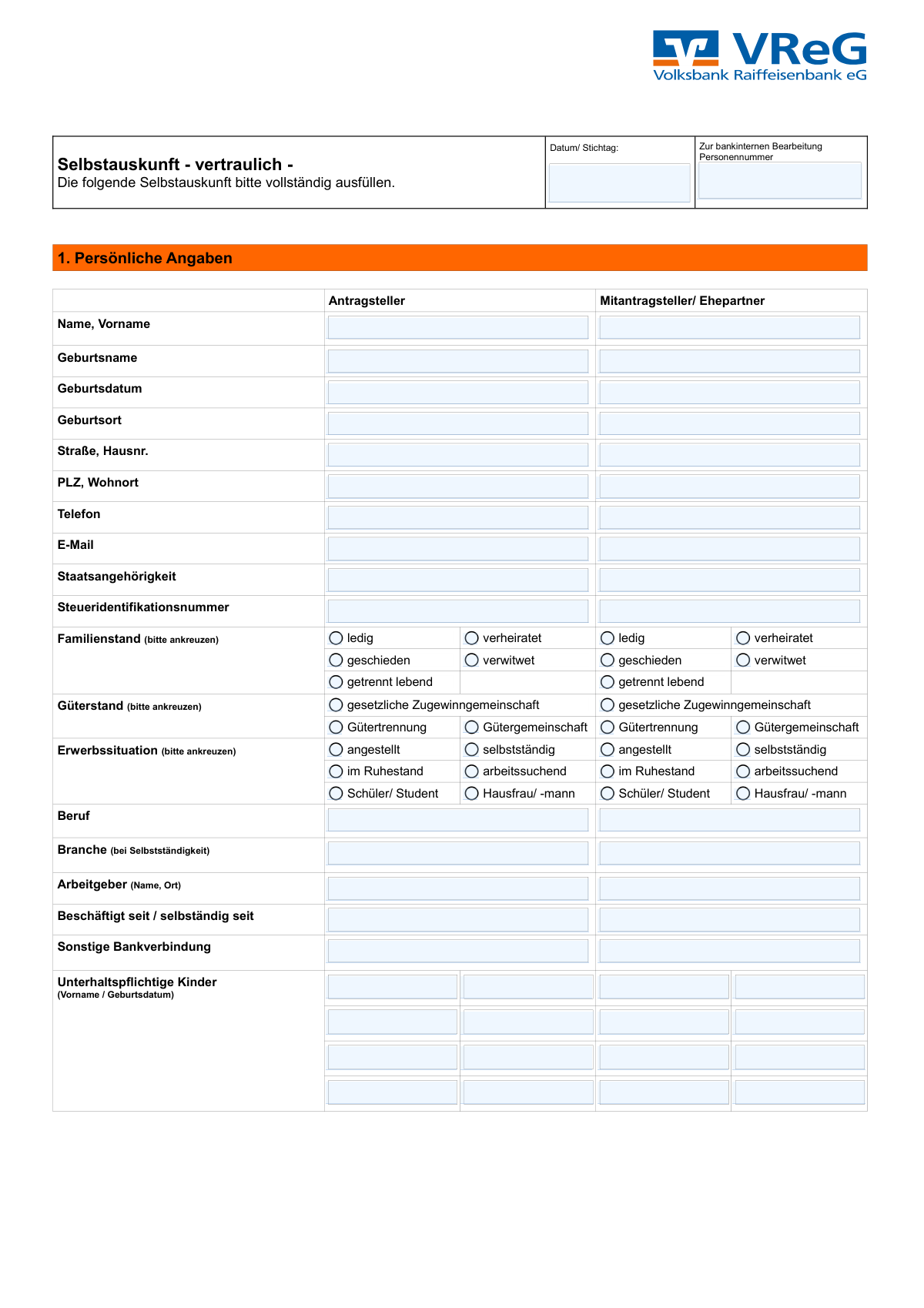
The "Selbstauskunft - vertraulich -" is a standard German financial self-disclosure document used by banks to evaluate an individual's creditworthiness for loans or other financial products. It requires a comprehensive overview of the applicant's (and co-applicant's) personal details, income, expenses, assets, and liabilities. This detailed financial picture is crucial for the bank's risk assessment and lending decision, and today this form can be filled out quickly and accurately using AI-powered services like Instafill.ai, which can also convert non-fillable PDF versions into interactive fillable forms.
Our AI automatically handles information lookup, data retrieval, formatting, and form filling.
It takes less than a minute to fill out Selbstauskunft using our AI form filling.
Securely upload your data. Information is encrypted in transit and deleted immediately after the form is filled out.
Form specifications
| Form name: | Selbstauskunft - vertraulich - (Financial Self-Disclosure) |
| Number of pages: | 7 |
| Language: | English |
Instafill Demo: How to fill out PDF forms in seconds with AI
How to Fill Out Selbstauskunft Online for Free in 2026
Are you looking to fill out a SELBSTAUSKUNFT form online quickly and accurately? Instafill.ai offers the #1 AI-powered PDF filling software of 2026, allowing you to complete your SELBSTAUSKUNFT form in just 37 seconds or less.
Follow these steps to fill out your SELBSTAUSKUNFT form online using Instafill.ai:
- 1 Navigate to Instafill.ai and upload your "Selbstauskunft" form or select it from the template library.
- 2 Use the AI assistant to automatically fill in personal details for the applicant and co-applicant, such as name, address, date of birth, and tax ID.
- 3 Enter your monthly income and expenses in the designated sections. The AI can help calculate totals and ensure all fields are correctly populated.
- 4 Detail your assets, including bank accounts, savings plans, insurance policies, and real estate. Upload supporting documents like account statements for the AI to process.
- 5 List all liabilities, such as existing loans, credit lines, and mortgages. The platform guides you through each required detail for accuracy.
- 6 Review all the information entered for completeness and correctness, making any necessary adjustments before finalizing the document.
- 7 Sign the form electronically and download the completed, confidential "Selbstauskunft" document, ready to be submitted to your bank.
Our AI-powered system ensures each field is filled out correctly, reducing errors and saving you time.
Why Choose Instafill.ai for Your Fillable Selbstauskunft Form?
Speed
Complete your Selbstauskunft in as little as 37 seconds.
Up-to-Date
Always use the latest 2026 Selbstauskunft form version.
Cost-effective
No need to hire expensive lawyers.
Accuracy
Our AI performs 10 compliance checks to ensure your form is error-free.
Security
Your personal information is protected with bank-level encryption.
Frequently Asked Questions About Form Selbstauskunft
This is a confidential self-disclosure form used by the bank to get a complete overview of your financial situation. It is necessary to assess your creditworthiness for a loan or other financial products.
The main applicant must complete the form. If you are applying with a spouse or partner, they must fill out the 'Mitantragsteller/Ehepartner' (Co-applicant/Spouse) sections as well.
You generally need to provide your last three pay stubs, recent tax documents, and statements for accounts or loans held at other banks. Self-employed individuals must also submit their last three annual financial statements and a current business analysis (BWA).
You can enter either, but you must check the corresponding box ('Brutto' or 'Netto') for your income. This ensures the bank can accurately calculate your financial standing.
No, the form primarily asks for details on accounts and loans held at *other* financial institutions. For several sections, you can simply check a box to confirm your assets or loans are exclusively with Volksbank Raiffeisenbank eG.
This refers to the legal arrangement of assets within a marriage. The default in Germany is 'gesetzliche Zugewinngemeinschaft' (community of accrued gains), but other options include 'Gütertrennung' (separation of property).
For additional properties, the form advises using a separate 'Anlage Immobilienübersicht' (Real Estate Overview attachment). For other sections, you can attach a separate, clearly labeled sheet with the extra information.
Financial institutions are legally required to collect your tax ID number for reporting purposes and to comply with national and international tax laws.
Once submitted with all required documents, the bank will review your financial information to process your application. An advisor may contact you if they have any questions.
Yes, services like Instafill.ai use AI to help you fill out forms faster and more accurately. The AI can recognize form fields and help auto-fill your personal information, saving you time and reducing potential errors.
Simply upload the 'Selbstauskunft' PDF to the Instafill.ai platform. The service will make the form interactive, guide you through the fields, and allow you to securely auto-fill your information to complete the document digitally.
If you have a non-fillable or 'flat' PDF, you can use a service like Instafill.ai to instantly convert it into an interactive, fillable form. This allows you to type your information directly into the fields online.
Compliance Selbstauskunft
Validation Checks by Instafill.ai
1
Ensures Applicant is of Legal Age
This check validates that the date entered in the 'Geburtsdatum' (Date of Birth) field makes the applicant at least 18 years old. This is a critical legal requirement for entering into a binding financial contract like a loan. If the validation fails, the form submission should be blocked and an error message displayed, as a minor cannot legally be the primary applicant.
2
Validates German Tax ID Format
This validation ensures the 'Steueridentifikationsnummer' (Tax Identification Number) field contains exactly 11 digits. The tax ID is a unique and mandatory identifier for financial reporting in Germany, and an incorrect format will cause downstream processing failures. A failed validation should prompt the user with an error message to correct the entry before submission.
3
Conditional Requirement for Employment Details
This check enforces that if an applicant's employment status is 'selbstständig' (self-employed), the 'Branche' (Industry) field must be filled. Likewise, if the status is 'angestellt' (employed), the 'Arbeitgeber' (Employer) field is required. This ensures the bank receives essential information to assess income stability and risk. Failure to provide these details would result in an incomplete application and a request for the user to provide the missing information.
4
Ensures Matrimonial Property Regime is Declared if Married
This validation checks that if the marital status is 'verheiratet' (married) or 'getrennt lebend' (separated), one of the 'Güterstand' (matrimonial property regime) options is selected. This information is legally significant for determining liability and asset ownership in Germany. If the condition is not met, the form should display an error message highlighting the required selection to ensure legal and financial completeness.
5
Validates 'Employed Since' Date is Logical
This check ensures the 'Beschäftigt seit' (Employed since) date is not in the future and is after the applicant's 16th birthday. This prevents illogical or impossible data entries that would compromise the assessment of employment history and stability. An invalid date would trigger an error, requiring the user to enter a plausible date relative to their age and the current date.
6
Verifies Income Summation Accuracy
This validation automatically calculates the sum of all individual monthly income fields (e.g., 'Lohn/Gehalt', 'Kindergeld') and compares it to the value entered in the 'Summe Einnahmen' (Total Income) field. This ensures the financial data is internally consistent and free from manual calculation errors, which is fundamental for an accurate credit assessment. If the sums do not match, the system should flag the discrepancy and prompt the user to review their entries.
7
Verifies Expense Summation Accuracy
This validation automatically calculates the sum of all individual monthly expense fields (e.g., 'Kaltmiete', 'Lebenshaltungskosten') and compares it to the value entered in the 'Summe Ausgaben' (Total Expenses) field. This cross-check is vital for ensuring the household budget calculation is accurate and reliable for determining affordability. A mismatch would prevent submission and require the user to correct the figures to ensure data integrity.
8
Correlates Gross Income with Tax Expense
This check verifies that if the income type is marked as 'Brutto' (Gross), a corresponding value greater than zero is entered in the 'Steuern' (Taxes) expense field. This logical check helps ensure that applicants who declare gross income also account for the necessary tax deductions, leading to a more realistic net income picture. If taxes are missing for a gross income declaration, a warning should be displayed to the user to confirm their entry.
9
Links Child Benefit Income to Dependent Children
This validation ensures that if an amount is entered for 'Kindergeld' (Child Benefit), at least one entry exists in the 'Unterhaltspflichtige Kinder' (Dependent Children) section. This confirms the legitimacy of the claimed income, as child benefit is only paid for dependent children. If Kindergeld is claimed without any children listed, the form should prompt the user to add dependent details or remove the income entry.
10
Ensures Details are Provided for Declared Assets/Liabilities
This check validates that if a checkbox like 'es sind folgende Bausparguthaben vorhanden' (the following building savings exist) is selected, at least one row in the corresponding data table is filled out. This prevents users from declaring the existence of an asset or liability without providing the necessary details for the bank's assessment. If the table is empty after such a declaration, an error message should direct the user to provide the details or uncheck the box.
11
Validates German Postal Code (PLZ) Format
This validation ensures that the 'PLZ' (Postal Code) field contains a 5-digit numeric value. A correct postal code is essential for address verification, communication, and compliance with regional banking regulations. An invalid format would trigger an error message requiring the user to enter a valid 5-digit German postal code.
12
Validates Consistency of Negative Declarations
This check ensures that if a user selects 'nein' (no) for the question about legal proceedings in the last 10 years, the corresponding text field for details is empty. This prevents contradictory information where a user denies proceedings but also provides details about them. If 'nein' is selected and the details box contains text, the system should prompt the user to clear the text box or change their selection.
13
Validates Real Estate Ownership Share Sum
This check verifies that the sum of all ownership 'Anteil' (share) percentages or fractions for a single property does not exceed 100% (or 1). This prevents logical errors in the declaration of property ownership, which is critical for understanding the applicant's true asset value and potential liabilities. If the sum exceeds 100%, an error message should prompt the user to correct the ownership shares.
14
Validates Interest Rate Percentage Range
This check ensures that any field for an interest rate ('Zins %') contains a numeric value within a plausible range, such as 0 to 50. This prevents data entry errors like typing a full amount instead of a percentage or accidentally adding extra digits. An entry outside this range would trigger a warning or error, asking the user to confirm or correct the value.
Common Mistakes in Completing Selbstauskunft
Applicants often incorrectly report their income, for example, by entering their net (after-tax) salary while checking the 'Brutto' (gross) box, or vice-versa. This leads to a miscalculation of their disposable income, as the bank cannot accurately account for tax expenses if the figures are inconsistent. To avoid this, carefully check your pay stub, select the correct box (Brutto/Netto), and if you report gross income, ensure you list all corresponding taxes in the expenses section.
Applicants sometimes fail to declare all existing financial obligations, such as small personal loans, store financing, or credit lines with other banks, believing they are insignificant. However, banks conduct credit checks (like a SCHUFA inquiry in Germany) and will discover these omissions, which can lead to a loss of trust and immediate rejection of the application. It is crucial to list every single liability, no matter how small, to provide a complete and honest financial picture.
The 'Lebenshaltungskosten' field requires an estimate for costs like food, clothing, and transportation, which people often significantly underestimate to make their financial situation appear stronger. Banks use standardized cost-of-living tables (Pauschalen) and will likely correct an unrealistically low number upwards, which can negatively impact the debt-to-income ratio calculation. To avoid this, create a realistic monthly budget or use a plausible, well-considered estimate rather than a low-ball figure.
When listing life insurance policies, applicants frequently enter the 'Vers.-summe' (the total payout upon death) instead of the 'Rückkaufswert' (the current surrender value). For a loan application, the bank is interested in the surrender value as a potential liquid asset or collateral, not the future death benefit. This mistake overstates the applicant's actual available assets; you should always refer to the latest policy statement to find the correct current surrender value.
The form explicitly requests supporting documents like the last three pay stubs ('Lohn- und Gehaltsabrechnungen'), tax assessments, and account statements for assets held at other banks. A very common mistake is submitting the self-disclosure form without these attachments. This will halt the application process immediately, causing significant delays as the bank must request the missing documentation.
The form asks for the legal matrimonial property regime ('Güterstand'), with options like 'gesetzliche Zugewinngemeinschaft' (the default in Germany), 'Gütertrennung,' or 'Gütergemeinschaft.' Many applicants are unsure of their legal status and either guess or leave it blank. This information is legally significant for liability and asset assessment, and an incorrect entry can cause legal and processing complications. If unsure, married couples should confirm their status; most will fall under the default 'gesetzliche Zugewinngemeinschaft' unless a specific notarial agreement was made.
Many sections (e.g., 'Bausparguthaben,' 'Verbindlichkeiten') have checkboxes for 'none exist' and 'the following exist.' Applicants often make clerical errors, such as checking 'none exist' but then filling out the corresponding table, or vice-versa. This indicates carelessness and forces the bank to seek clarification, delaying the process. Always double-check that your checkbox selection matches the information you provide in the associated table.
A simple but critical error is forgetting to sign the form or to include the place and date. If a co-applicant is involved, both signatures are required, which is often missed. An unsigned or incomplete declaration is legally invalid and cannot be processed, leading to the form being returned and causing unnecessary delays.
The German Tax Identification Number ('Steueridentifikationsnummer') is a unique 11-digit number that people often confuse with their shorter, region-specific tax number ('Steuernummer') or simply mistype. This can cause problems for the bank's verification and reporting processes. It's essential to copy this number carefully from an official document, such as a tax assessment or a letter from the Federal Central Tax Office (Bundeszentralamt für Steuern).
Self-employed applicants often provide incomplete information, such as forgetting to specify their 'Branche' (industry) or failing to attach the required three years of financial statements ('Jahresabschlüsse') and a current BWA (business analysis). Simply stating 'selbstständig' is insufficient and will immediately trigger a request for more information, delaying the entire credit assessment. All requested business documents must be current and complete.
Saved over 80 hours a year
“I was never sure if my IRS forms like W-9 were filled correctly. Now, I can complete the forms accurately without any external help.”
Kevin Martin Green
Your data stays secure with advanced protection from Instafill and our subprocessors

Robust compliance program
Transparent business model
You’re not the product. You always know where your data is and what it is processed for.
ISO 27001, HIPAA, and GDPR
Our subprocesses adhere to multiple compliance standards, including but not limited to ISO 27001, HIPAA, and GDPR.
Security & privacy by design
We consider security and privacy from the initial design phase of any new service or functionality. It’s not an afterthought, it’s built-in, including support for two-factor authentication (2FA) to further protect your account.
Fill out Selbstauskunft with Instafill.ai
Worried about filling PDFs wrong? Instafill securely fills selbstauskunft-vertraulich-financial-self-disclosure forms, ensuring each field is accurate.