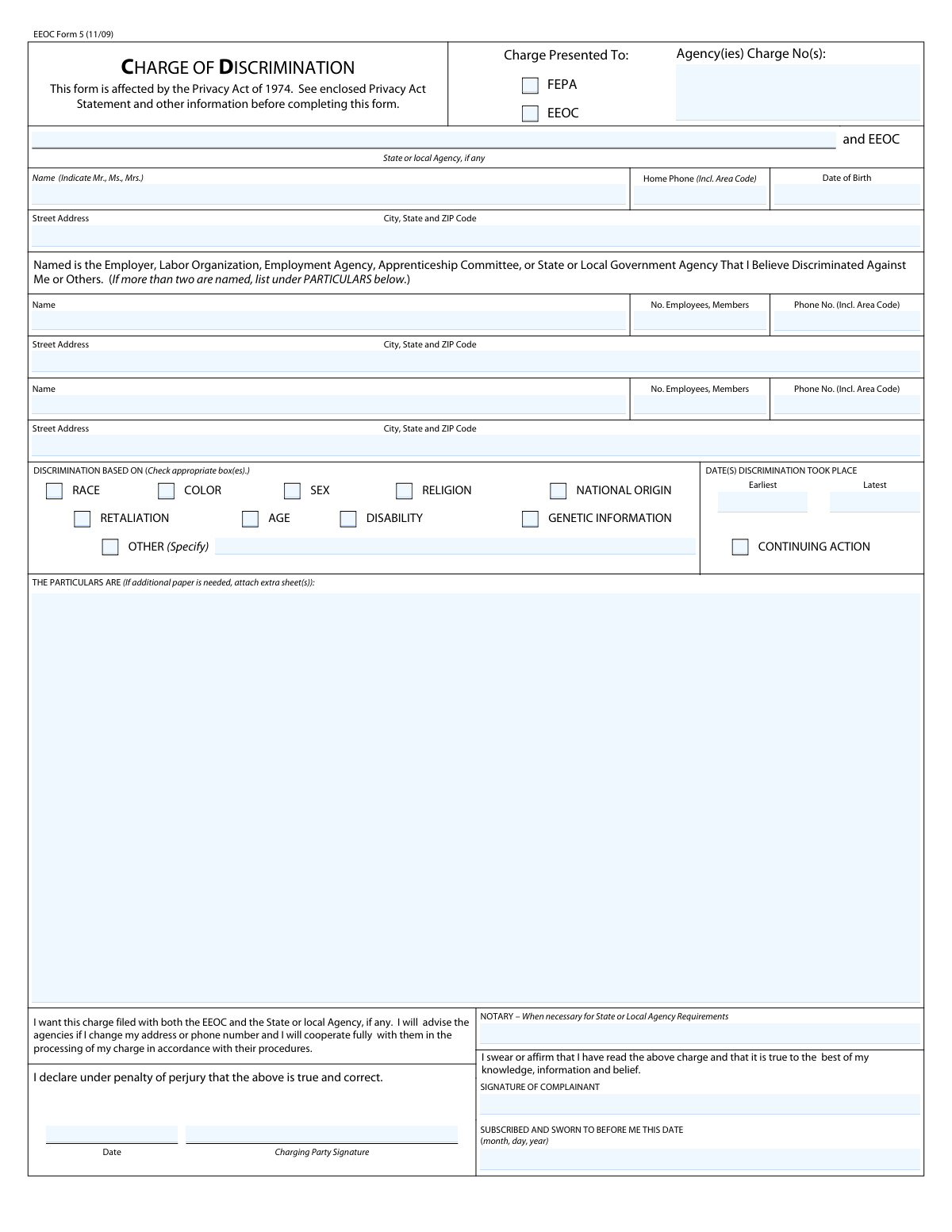
Yes! You can use AI to fill out EEOC Form 5 (11/09), Charge of Discrimination

EEOC Form 5, Charge of Discrimination, is the official form used to put an employment discrimination complaint in writing and initiate the EEOC’s administrative process. It identifies the charging party (complainant), the respondent (employer/union/agency/government entity), the protected basis (e.g., race, sex, age, disability, genetic information), and the dates and details of the alleged discrimination. Filing a written charge is generally required for the EEOC to act and may be necessary to preserve the right to bring a private lawsuit under laws such as Title VII, the ADA, the ADEA, and GINA. The charge is typically shared with the respondent and may be dual-filed with a state or local Fair Employment Practices Agency (FEPA) where applicable.
Our AI automatically handles information lookup, data retrieval, formatting, and form filling.
It takes less than a minute to fill out EEOC Form 5 using our AI form filling.
Securely upload your data. Information is encrypted in transit and deleted immediately after the form is filled out.

Form specifications

Form name: EEOC Form 5 (11/09), Charge of Discrimination
Number of pages: 3
Filled form examples: Form EEOC Form 5 Examples
Language: English
main-image

Instafill Demo: filling out a legal form in seconds

How to Fill Out EEOC Form 5 Online for Free in 2026

Are you looking to fill out a EEOC FORM 5 form online quickly and accurately? Instafill.ai offers the #1 AI-powered PDF filling software of 2026, allowing you to complete your EEOC FORM 5 form in just 37 seconds or less.
Follow these steps to fill out your EEOC FORM 5 form online using Instafill.ai:
  1. 1 Select where the charge is presented (EEOC and/or the state/local FEPA) and enter any agency charge numbers if already assigned.
  2. 2 Enter the charging party’s personal information, including name, date of birth, mailing address, and phone numbers, and confirm you will update contact information if it changes.
  3. 3 Identify the respondent organization(s) you believe discriminated (employer, labor organization, employment agency, apprenticeship committee, or government agency), including name, address, and approximate number of employees/members.
  4. 4 Check the discrimination basis box(es) that apply (e.g., race, color, sex, religion, national origin, retaliation, age, disability, genetic information, or other) and indicate whether it is a continuing action.
  5. 5 Provide the date range of the discrimination (earliest and latest dates) and write the “Particulars” describing what happened, who was involved, and how the actions were discriminatory; attach additional sheets if needed.
  6. 6 Review the statements and certifications (including Privacy Act notice implications and the declaration under penalty of perjury) and confirm the information is true and correct to the best of your knowledge.
  7. 7 Sign and date the charge as the charging party/complainant, and complete notarization only if required by the state or local agency.

Our AI-powered system ensures each field is filled out correctly, reducing errors and saving you time.

Why Choose Instafill.ai for Your Fillable EEOC Form 5 Form?

Speed

Complete your EEOC Form 5 in as little as 37 seconds.

Up-to-Date

Always use the latest 2026 EEOC Form 5 form version.

Cost-effective

No need to hire expensive lawyers.

Accuracy

Our AI performs 10 compliance checks to ensure your form is error-free.

Security

Your personal information is protected with bank-level encryption.

Frequently Asked Questions About Form EEOC Form 5

EEOC Form 5 is used to file a formal charge alleging employment discrimination. Filing a charge can preserve your right to sue under certain federal anti-discrimination laws and allows the EEOC (and sometimes a state/local agency) to review the allegations.

You should complete this form if you believe an employer, union, employment agency, apprenticeship committee, or a state/local government agency discriminated against you or others in employment. The person filing is the “Charging Party.”

No. The Privacy Act Statement explains it is not mandatory to use this specific form, but the charge must be in writing and should identify you, the organization you are charging, and the actions or policies you are complaining about.

The form lists bases such as race, color, sex, religion, national origin, retaliation, age, disability, genetic information, and “other” (which you can specify). You can check more than one box if multiple bases apply.

List the earliest and latest dates the discrimination occurred. If it is ongoing, you can indicate “continuing action” and describe the pattern in the “Particulars” section.

Provide the name and address of the employer/organization and, if known, the number of employees or members. If you are naming more than two organizations, list the additional ones in the “Particulars” section.

Describe what happened, who was involved, and why you believe it was discrimination (including the protected basis you checked). Include key dates, job titles, locations, and any relevant actions or policies; attach extra sheets if needed.

Yes. The form includes an option stating you want the charge filed with both the EEOC and the state or local agency (if any), which is often called “dual-filing” under worksharing arrangements.

The Privacy Act Statement explains that a copy of the charge will ordinarily be sent to the employer/organization you are charging. This is part of the process so the respondent can be notified and the agency can investigate or mediate.

For charges under Title VII, the ADA, or GINA, the charge must be sworn to or affirmed (either notarized or as an unsworn declaration under penalty of perjury). “Penalty of perjury” means you are declaring the information is true and you can face legal consequences for knowingly false statements.

The form notes “NOTARY – When necessary for State or Local Agency Requirements.” Whether notarization is required can depend on the state or local agency involved, so follow the instructions from the agency handling your charge.

The Privacy Act Statement says the EEOC will ordinarily not act without a written charge that identifies the charging party, the respondent, and the actions or policies complained of. However, charges may be clarified or amplified later by amendment.

The form states you will advise the agencies if you change your address or phone number. Update your contact information promptly so you don’t miss notices or deadlines.

If a state or local Fair Employment Practices Agency (FEPA) handles your dual-filed charge first, you may request that the EEOC give “Substantial Weight Review” to the FEPA’s final findings. You must request this in writing within 15 days of receiving the FEPA’s findings, or the EEOC will ordinarily adopt the FEPA’s finding and close its file.

The notice explains retaliation is unlawful under several federal statutes and asks you to notify the EEOC or the state/local agency if retaliation occurs. Report any threats, discipline, termination, or other negative actions that you believe are connected to filing or cooperating with the charge.

Compliance EEOC Form 5
Validation Checks by Instafill.ai

1
Charging Party Name and Title Completeness
Validate that the Charging Party’s name is present and includes an honorific selection where the form requests it (Mr., Ms., Mrs.). This ensures the charge is attributable to an identifiable individual and supports correct correspondence and record matching. If missing or clearly invalid (e.g., only initials or symbols), the submission should be flagged as incomplete and routed for correction.
2
Charging Party Date of Birth Format and Plausibility
Check that Date of Birth is provided in a valid date format (month/day/year) and represents a plausible past date (not in the future, not unreasonably old). This helps confirm identity and supports age-related jurisdictional analysis (e.g., ADEA relevance) without relying on free-text interpretation. If the date is malformed or implausible, reject or hold the submission for clarification.
3
Charging Party Address Completeness and ZIP Code Validation
Ensure the Charging Party street address, city, state, and ZIP code are all present and that the state is a valid US state/territory code/name and ZIP is 5 digits (or ZIP+4 if allowed). A complete address is required for notices, service, and agency communications. If any component is missing or the ZIP/state is invalid, the form should be returned for correction or flagged for manual review.
4
Charging Party Phone Number Format (Primary and Home)
Validate that phone numbers (including area code) contain the required digits and acceptable formatting (e.g., 10-digit NANP for US numbers, allowing separators). This is critical for time-sensitive contact during intake, mediation, and investigation. If phone numbers are missing or invalid, require at least one valid contact number or mark the submission incomplete.
5
Respondent (Employer/Organization) Identification Required Fields
Confirm that the named respondent organization (employer, labor organization, employment agency, apprenticeship committee, or government agency) has a non-empty name and address (street, city, state, ZIP). The EEOC generally cannot proceed without a clearly identified respondent to notify and investigate. If respondent identity or address is missing, the charge should be considered insufficient and held for follow-up.
6
Respondent Employee/Member Count Numeric Validation
If 'No. Employees, Members' is provided, validate it is a positive integer within a reasonable range (e.g., 1–10,000,000) and not text. This field can affect coverage thresholds and routing decisions, so it must be interpretable. If non-numeric or negative/zero, flag for correction or treat as unknown rather than ingesting bad data.
7
Discrimination Basis Selection (At Least One Box Checked)
Verify that at least one discrimination basis is selected from the listed categories (Race, Color, Sex, Religion, National Origin, Retaliation, Age, Disability, Genetic Information, Other). A basis is required to classify the charge and determine applicable statutes and processing rules. If none are selected, the submission should be rejected as incomplete or routed for clarification.
8
‘Other (Specify)’ Required When Other Basis Selected
If the 'Other' discrimination basis is checked, require a non-empty specification describing the basis. This prevents ambiguous categorization and ensures the allegation can be evaluated under the correct legal framework. If 'Other' is checked but no text is provided, fail validation and request completion.
9
Date(s) Discrimination Took Place: Earliest/Latest Date Validation
Validate that the 'Earliest' and 'Latest' discrimination dates are valid dates in month/day/year format and not in the future. These dates are essential for timeliness analysis and determining whether the charge is within filing deadlines. If either date is invalid, missing when required, or in the future, the submission should be flagged for correction.
10
Chronological Consistency: Earliest Date Must Be On/Before Latest Date
When both earliest and latest dates are provided, ensure the earliest date is not after the latest date. This prevents contradictory timelines that can break downstream calculations and confuse investigators. If earliest > latest, fail validation and require the filer to correct the date range.
11
Continuing Action Consistency with Date Range
If 'Continuing Action' is indicated, validate that a date range is provided (both earliest and latest) or that the latest date is present to reflect ongoing conduct. This supports accurate interpretation of continuing violations and timeliness considerations. If 'Continuing Action' is checked but dates are missing or only a single unclear date is provided, flag for clarification.
12
Agency Selection and Dual-Filing Consistency (EEOC/FEPA)
Validate that the charge destination selections are internally consistent: if the filer indicates they want the charge filed with both EEOC and a state/local agency, then a state/local agency name (if any) should be provided or the system should confirm a valid FEPA jurisdiction based on address. This prevents misrouting and ensures proper dual-filing procedures. If dual-filing is requested but no agency/jurisdiction can be determined, route to manual review.
13
Agency Charge Number Format (If Provided)
If 'Agency(ies) Charge No(s)' is entered, validate it matches expected patterns (e.g., alphanumeric with allowed separators) and is not free-form narrative text. Correct formatting supports record matching, deduplication, and status inquiries. If the value contains invalid characters or excessive length, flag for manual review rather than ingesting it as a charge number.
14
Particulars Narrative Required and Minimum Content Check
Ensure 'THE PARTICULARS ARE' contains a narrative description and meets a minimum content threshold (e.g., not blank, not only whitespace, not only 'N/A'). The EEOC requires identification of the actions or policies complained of; without particulars, the charge may be insufficient to act upon. If the narrative is missing or clearly non-substantive, fail validation and request additional details.
15
Complainant Signature and Date Required (Sworn/Affirmed Statement)
Validate that the complainant signature is present and that the signature date is provided in month/day/year format. The form states charges under Title VII, ADA, or GINA must be sworn/affirmed (or declared under penalty of perjury), and signature is the key attestation element for processing. If signature or date is missing/invalid, the submission should be rejected or held as not properly executed.
16
Notary Section Completeness When Notarization Is Required
If the submission indicates notarization is necessary for the selected state/local agency requirements (or if the notary section is filled), validate that the notary attestation date is present and properly formatted. This ensures the charge meets jurisdiction-specific execution requirements and avoids later invalidation. If notarization is required but notary fields are incomplete, route to correction before filing.

Common Mistakes in Completing EEOC Form 5

Not clearly identifying the correct respondent organization

People often list a supervisor’s name or a worksite location instead of the legal name of the employer, union, agency, or government entity that employed them or controlled the decision. This can delay notice to the respondent, complicate investigation, or require amendments to correct the party. Use the organization’s full legal name (as shown on pay stubs, offer letters, or HR documents) and include the correct address for the entity responsible for the alleged discrimination.

Leaving the respondent address or contact details incomplete

A common error is providing only a city/state, a P.O. box, or an outdated location, which makes it harder for the EEOC/FEPA to serve the charge and communicate with the respondent. Service delays can slow the case and may affect timelines for processing. Provide a complete street address, city, state, and ZIP code for the respondent’s main office or the location that handles HR/legal notices, and double-check it against official sources.

Checking the wrong discrimination basis (or forgetting to check all that apply)

Filers sometimes select only one box (e.g., “Race”) when the facts also involve retaliation, disability, age, sex, national origin, or genetic information, or they check “Other” without specifying. This can narrow the scope of the investigation and may require later amendments to add missing legal theories. Review the list carefully, check every basis supported by your facts, and if using “Other,” clearly specify the protected category in plain language.

Providing vague or inconsistent discrimination dates (earliest/latest/continuing action)

Many people write approximate dates (“sometime in March”) or list only one date when the form asks for earliest and latest dates and whether it is a continuing action. Missing or inconsistent dates can create confusion about filing deadlines and what events are included in the charge. Use the best specific dates you can (month/day/year), list the earliest and latest incidents, and mark “Continuing Action” only when the conduct truly continued over time.

Not selecting (or misunderstanding) dual-filing with EEOC and state/local agency

Some filers overlook the option stating they want the charge filed with both the EEOC and the state/local agency (FEPA), or they assume it happens automatically. This can affect which agency investigates first and may impact procedural rights and timelines. Read the dual-filing statement carefully, indicate your preference clearly, and confirm which agency will handle the charge if you are in a jurisdiction with a FEPA.

Incomplete charging party contact information or failure to update it

People frequently omit an area code, provide only one phone number, or forget to update their address after moving, even though the form states they will advise agencies of changes. Missed mail or calls can lead to missed deadlines, inability to schedule interviews/mediation, or administrative closure. Provide a reliable mailing address, include area codes for all numbers, add both home and mobile if available, and promptly notify the EEOC/FEPA in writing if anything changes.

Missing or incorrect personal identifiers (name title, date of birth)

Filers sometimes forget to indicate Mr./Ms./Mrs., enter a nickname instead of their legal name, or leave the date of birth blank. These details help agencies match records, confirm identity, and apply statutes that depend on age (e.g., ADEA). Use your legal name as it appears on government ID, include the requested title if applicable, and enter your full date of birth accurately.

Not providing enough detail in “THE PARTICULARS” section

A very common mistake is writing a short conclusion (“I was discriminated against”) without describing who did what, when, where, and how it relates to the checked basis(es). Vague particulars can slow intake, lead to requests for clarification, or limit the investigation to an unclear set of allegations. In 2–4 clear paragraphs, include key dates, decision-makers, specific actions (termination, demotion, harassment, failure to accommodate, etc.), comparators if relevant, and the harm suffered; attach extra sheets if needed.

Failing to list additional respondents when more than two are involved

When multiple entities may be responsible (e.g., staffing agency and client company, parent/subsidiary, union and employer), people often name only one and forget to list others under “PARTICULARS.” This can prevent the agency from pursuing all potentially liable parties and may require amendments later. If more than two entities are involved, list each additional respondent in the particulars with full legal names and addresses and explain each entity’s role.

Leaving the number of employees/members blank or guessing wildly

The form asks for “No. Employees, Members,” and filers often skip it or provide an unrealistic estimate. Coverage under certain laws can depend on employer size, and inaccurate information can cause delays while staff verify jurisdiction. If you don’t know the exact number, provide a reasonable estimate and note it is an estimate (e.g., “approx. 75 employees”), based on what you observed or what HR/public filings indicate.

Signature, date, and verification errors (sworn/affirmed requirements)

People sometimes forget to sign, forget to date the form, sign in the wrong place, or submit an unsigned draft, not realizing that Title VII/ADA/GINA charges must be sworn/affirmed and ADEA charges should ordinarily be signed. An unverified or unsigned submission can delay acceptance as a formal charge and may jeopardize timeliness if corrections occur after a deadline. Sign and date where indicated, follow the “under penalty of perjury” language, and complete notarization only if your state/local agency requires it.
Saved over 80 hours a year

“I was never sure if my IRS forms like W-9 were filled correctly. Now, I can complete the forms accurately without any external help.”

Kevin Martin Green

Your data stays secure with advanced protection from Instafill and our subprocessors

Robust compliance program

Transparent business model

You’re not the product. You always know where your data is and what it is processed for.

ISO 27001, HIPAA, and GDPR

Our subprocesses adhere to multiple compliance standards, including but not limited to ISO 27001, HIPAA, and GDPR.

Security & privacy by design

We consider security and privacy from the initial design phase of any new service or functionality. It’s not an afterthought, it’s built-in, including support for two-factor authentication (2FA) to further protect your account.

Fill out EEOC Form 5 with Instafill.ai

Worried about filling PDFs wrong? Instafill securely fills eeoc-form-5-1109-charge-of-discrimination forms, ensuring each field is accurate.