Fill out discrimination forms
with AI.
Discrimination forms are critical legal documents used to report unfair treatment in professional and public environments. These forms, often categorized under labor law and employment documentation, serve as the official record for complaints regarding harassment, unequal pay, or wrongful termination based on protected characteristics like race, age, gender, or disability. They are essential for ensuring that civil rights are upheld and that organizations are held accountable for their practices.
By continuing, you acknowledge Instafill's Privacy Policy and agree to get occasional product update and promotional emails.
About discrimination forms
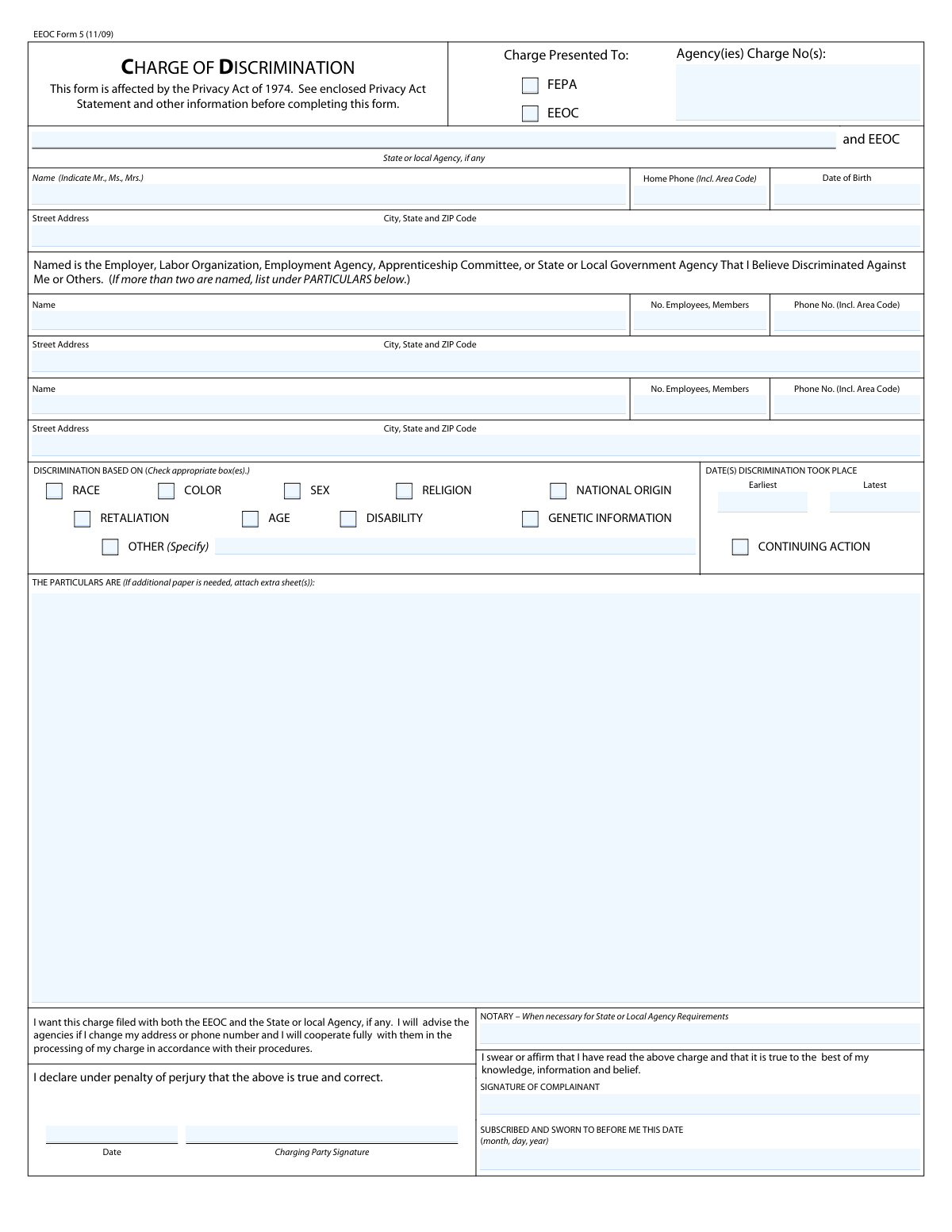
Individuals who feel they have been mistreated at work or during the hiring process typically require these forms to initiate a formal investigation. For instance, the EEOC Form 5 is used by employees to file a Charge of Discrimination with the Equal Employment Opportunity Commission. Whether you are dealing with a hostile work environment or seeking to preserve your right to a private lawsuit, accurately completing these labor law forms is a necessary step in the administrative process. Legal professionals and HR departments also use these documents to document disputes and comply with federal regulations.
Navigating the complexities of legal paperwork can be daunting, especially when dealing with sensitive personal information. Tools like Instafill.ai use AI to fill these forms in under 30 seconds, ensuring that data is handled accurately and securely while saving you significant time. By automating the process, you can focus on the details of your case rather than the logistics of document formatting.
Every form on this page can be completed without typing. Instafill is form filling software that reads a PDF and fills it for you — including flat and scanned documents that carry no fillable fields at all.
Forms in This Category
The forms in this category have a median Form Complexity Index of 62/100 (Moderate), measured across 4 forms by field count, input difficulty, length, conditional logic and structure. See how it is calculated.
| Form Name | Pages | FCI | |
|---|---|---|---|
| 1. | EEOC Form 5 (11/09), Charge of Discrimination | 3 | Moderate 49 |
| 2. | EEOC Form 5, Charge of Discrimination | 25 | Very Complex 83 |
| 3. | Form DOS-2156, New York State Housing Discrimination Disclosure Form | 2 | Simple 18 |
| 4. | Pro Se 7, Complaint for Employment Discrimination | 6 | Moderate 62 |
- Enterprise-grade security & data encryption
- 99%+ accuracy powered by AI
- 1,000+ forms from all industries
- Complete forms in under 60 seconds
How to Choose the Right Form
Navigating workplace rights can be complex, but choosing the correct documentation is the first step toward resolution. In this category, the primary document used to initiate a formal complaint against an employer, labor organization, or employment agency is the EEOC Form 5 (11/09), Charge of Discrimination.
When to Use EEOC Form 5
This form is the essential starting point for individuals who believe they have been discriminated against in an employment context. You should choose this form if your situation involves:
- Protected Bases: You are reporting discrimination based on race, color, religion, sex (including pregnancy, gender identity, and sexual orientation), national origin, age (40 or older), disability, or genetic information.
- Formal Action: You intend to initiate the Equal Employment Opportunity Commission’s (EEOC) administrative process to investigate your claim.
- Preserving Legal Rights: Filing this charge is often a mandatory prerequisite before you can file a private lawsuit under federal laws like Title VII, the Americans with Disabilities Act (ADA), or the Age Discrimination in Employment Act (ADEA).
Key Components of the Charge
When filling out the EEOC Form 5, ensure you have the following information ready to make the process efficient:
- Respondent Details: The legal name and contact information of the employer, union, or agency you are filing against.
- Detailed Allegations: Specific dates and a clear description of the discriminatory actions or incidents that occurred.
- Dual-Filing Considerations: In many jurisdictions, this form can be dual-filed with a state or local Fair Employment Practices Agency (FEPA). This allows you to protect your rights under both federal and local labor laws simultaneously.
If your grievance is related to a private employer, a labor union, or a local/state government entity, the EEOC Form 5 is the standard federal instrument required to move your case forward and ensure your allegations are officially documented and reviewed.
Form Comparison
| Form | Purpose | Protected Bases | Legal Impact |
|---|---|---|---|
| EEOC Form 5 (11/09), Charge of Discrimination | Formally initiates an employment discrimination complaint and begins the EEOC administrative process. | Covers race, color, religion, sex, age, disability, and genetic information. | Required to preserve the legal right to file a private lawsuit under federal law. |
Tips for discrimination forms
When describing the discriminatory actions in the Statement of Particulars, stick to clear, chronological facts rather than emotional language. Provide specific dates, names of individuals involved, and the exact nature of the adverse action to help investigators process your claim efficiently.
Ensure you accurately check the boxes for the protected basis of your claim, such as race, sex, age, or disability. Selecting the wrong category or leaving this section incomplete can lead to administrative delays or issues if you later decide to pursue a private lawsuit.
Filling out complex labor law forms can be overwhelming, but AI-powered tools like Instafill.ai can complete these forms in under 30 seconds with high accuracy. Your sensitive data stays secure during the process, providing a practical and time-saving solution for managing multiple employment forms.
A common mistake is providing an incomplete or incorrect name for the respondent, such as a parent company instead of the specific local entity. Verify the legal name and address of the employer or agency to ensure the charge is served to the correct party without jurisdictional errors.
Discrimination claims are subject to strict time limits, often calculated from the date of the last discriminatory act. Ensure all dates listed on your form are accurate and consistent to prevent your claim from being dismissed due to filing outside the legal window.
Before submitting your form, gather all related emails, performance reviews, and witness contact information. While you may not submit every document with the initial charge, having an organized file ensures you can respond quickly when the EEOC or a local agency requests more evidence.
Frequently Asked Questions
Discrimination forms are official documents used by employees or job applicants to report unfair treatment based on protected characteristics such as race, sex, age, or disability. Filing these forms, such as the EEOC Form 5, initiates a formal administrative process where a government agency investigates the claims against an employer or organization.
Any individual who believes they have been discriminated against by an employer, labor union, or employment agency can file these forms. This includes current employees, former employees who believe they were wrongfully terminated, and job applicants who feel they were unfairly passed over during the hiring process.
There are strict time limits for filing discrimination charges, which generally range from 180 to 300 days depending on the state and the nature of the claim. It is important to submit the forms as soon as possible to ensure your legal rights are preserved and the agency has sufficient time to act.
Yes, you can use AI tools to assist in completing these complex documents accurately. Platforms like Instafill.ai can fill out discrimination forms in under 30 seconds by extracting relevant details from your personal records and placing them into the correct fields automatically.
You will need to provide your contact information, the name and address of the employer, the specific basis for the discrimination (such as religion or genetic information), and a concise description of the alleged discriminatory actions. Including specific dates and the names of individuals involved is also necessary for a complete filing.
Completed forms are typically submitted to the nearest Equal Employment Opportunity Commission (EEOC) field office or a local Fair Employment Practices Agency (FEPA). Many of these agencies allow for electronic submission through their official portals, though mail and in-person delivery are also common options.
Manually filling out labor law forms can be time-consuming due to the level of detail required, but using AI-driven tools can complete the process in under 30 seconds. These tools ensure that data from your source documents is accurately mapped to the official PDF fields, reducing the risk of manual entry errors.
No, filing a form like EEOC Form 5 is an administrative step that precedes a lawsuit. In many cases, federal law requires you to file a formal charge with the EEOC and receive a 'Notice of Right to Sue' before you are permitted to take the matter to a federal court.
Once the form is filed, the EEOC will notify the employer and may offer a mediation process to resolve the dispute quickly. If mediation is not used or is unsuccessful, the agency will conduct an investigation to determine if there is reasonable cause to believe discrimination occurred.
While the EEOC Form 5 is the standard for federal claims, many states have their own specific forms and agencies for handling labor law violations. However, through 'dual-filing' agreements, submitting a charge to the EEOC often automatically files it with the corresponding state or local agency.
You are not required to have a lawyer to file a Charge of Discrimination, as the process is designed to be accessible to the general public. However, ensuring the form is filled out accurately and comprehensively is vital, which is why many users rely on AI tools or legal templates to help organize their information.
Glossary
- Form Complexity Index
- Instafill’s 0–100 measure of how much effort a form takes to complete, calculated deterministically from the form’s own structure rather than estimated. It combines the number of fillable fields (the largest factor), how difficult those fields are to complete based on their type, the number of pages that contain fields, the amount of conditional “fill-only-if” logic, and how many sections the form is divided into, then adds modifiers for tables and repeating lists, bundled instruction pages, and dense page layouts. A higher score means the form is harder to fill out by hand. The forms in this category have a median Form Complexity Index of 62/100 (Moderate). See exactly how it is calculated.
- EEOC
- The U.S. Equal Employment Opportunity Commission, the federal agency responsible for enforcing laws that make it illegal to discriminate against a job applicant or employee.
- Charging Party
- The individual who files a formal complaint of discrimination, usually the employee or job applicant who experienced the alleged unfair treatment.
- Respondent
- The employer, company, or organization against whom the discrimination charge is filed.
- Protected Basis
- The legal reason for a discrimination claim, such as race, sex, age, religion, or disability, which is protected under federal law.
- FEPA
- A Fair Employment Practices Agency, which is a state or local government office that investigates discrimination claims alongside the EEOC.
- Title VII
- A key federal law that prohibits employers from discriminating against employees based on race, color, religion, sex, or national origin.
- Dual-filing
- The process of submitting a discrimination charge to both the EEOC and a state or local agency at the same time to ensure legal protections under both sets of laws.
- ADA
- The Americans with Disabilities Act, which prohibits discrimination against qualified individuals with disabilities in job applications, hiring, and firing.