Fill out EEOC forms
with AI.
EEOC forms are official documents issued by the U.S. Equal Employment Opportunity Commission to support both the enforcement of federal anti-discrimination laws and the agency's internal administrative operations. These forms cover a range of purposes — from filing a formal complaint of workplace discrimination to managing employee recognition within the agency itself. Understanding which form applies to your situation is an important first step in navigating employment law or EEOC agency processes.
By continuing, you acknowledge Instafill's Privacy Policy and agree to get occasional product update and promotional emails.
About EEOC forms
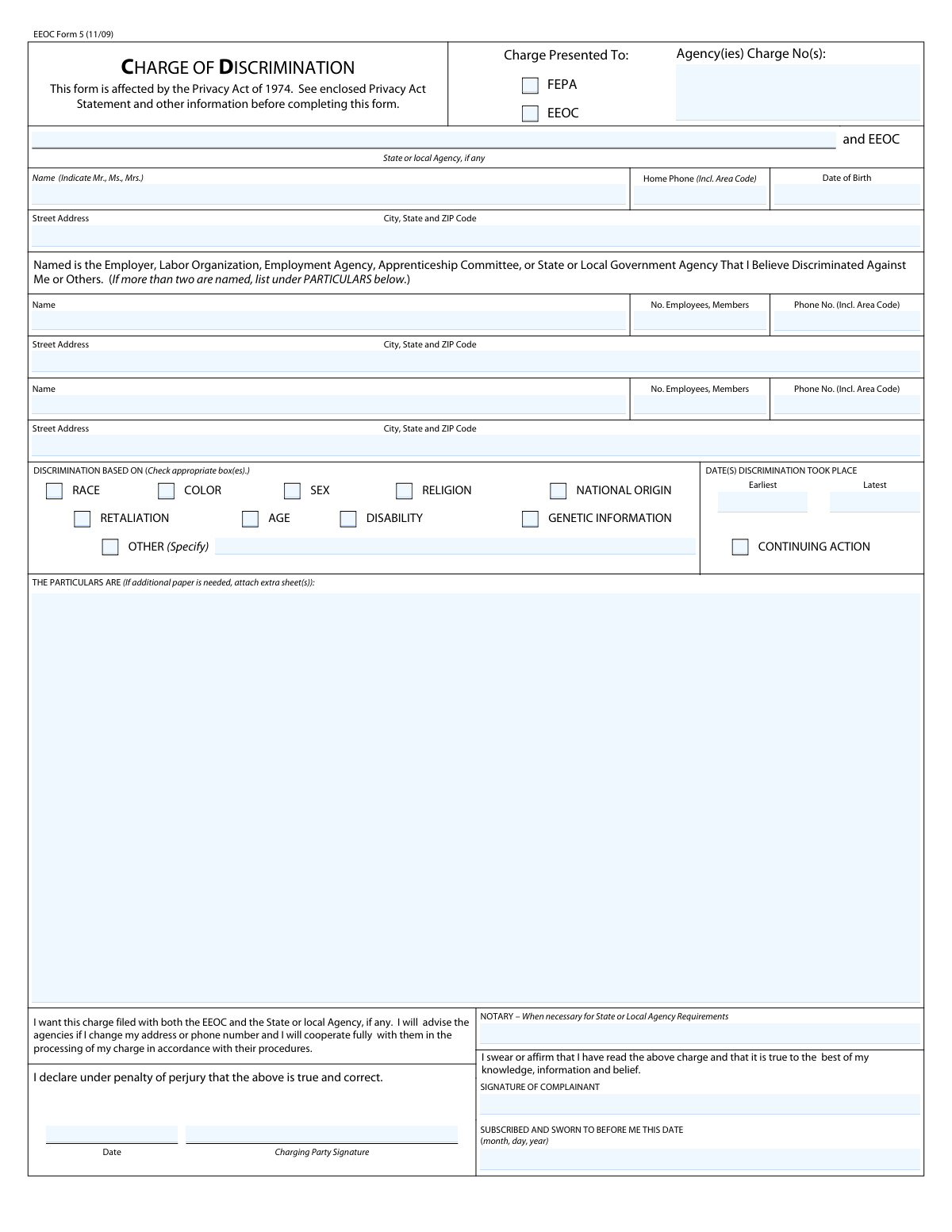
The most widely used form in this category is the Charge of Discrimination (EEOC Form 5), which individuals file when they believe an employer, union, or government entity has discriminated against them based on race, sex, age, disability, or other protected characteristics. Filing this form is typically a legal prerequisite before pursuing a private lawsuit under laws like Title VII, the ADA, or the ADEA. Other forms in this category, such as EEOC Form 453, serve internal agency purposes — in this case, nominating employees for awards and recognition under the EEOC's formal awards program.
Whether you're an employee documenting a discrimination complaint or an EEOC staff member processing an award nomination, these forms require careful, accurate completion. Tools like Instafill.ai use AI to fill out these forms in under 30 seconds, helping ensure the information is entered correctly and securely without the usual paperwork hassle.
Every form on this page can be completed without typing. Instafill is form filling software that reads a PDF and fills it for you — including flat and scanned documents that carry no fillable fields at all.
Forms in This Category
The forms in this category have a median Form Complexity Index of 54/100 (Moderate), measured across 4 forms by field count, input difficulty, length, conditional logic and structure. See how it is calculated.
| Form Name | Pages | FCI | |
|---|---|---|---|
| 1. | EEOC Form 5 (11/09), Charge of Discrimination | 3 | Moderate 49 |
| 2. | EEOC Form 5, Charge of Discrimination | 25 | Very Complex 83 |
| 3. | U.S. Equal Employment Opportunity Commission (EEOC) Form 453, Recommendation for Recognition | 1 | Moderate 54 |
| 4. | U.S. Equal Employment Opportunity Commission (EEOC) Form 453, Recommendation for Recognition | 1 | Moderate 52 |
- Enterprise-grade security & data encryption
- 99%+ accuracy powered by AI
- 1,000+ forms from all industries
- Complete forms in under 60 seconds
How to Choose the Right Form
This category contains two distinct types of EEOC forms — one for employees facing workplace discrimination and one for EEOC staff managing internal recognition programs. Here's how to find the right one quickly.
Filing a Workplace Discrimination Complaint?
If you've experienced discrimination at work — based on race, sex, age, disability, genetic information, or another protected characteristic — you need:
- EEOC Form 5, Charge of Discrimination — This is the official form to formally document your complaint and start the EEOC's review process. Filing this form is typically a required first step before you can pursue a private lawsuit under laws like Title VII, the ADA, the ADEA, or GINA. It identifies you (the complainant), your employer or organization, the type of discrimination, and the key dates and details involved.
> Who it's for: Employees, job applicants, or union members who believe they've been discriminated against by an employer, union, or government agency.
Nominating an EEOC Employee for an Award?
If you work at the EEOC and need to recommend a colleague or team for recognition, you need:
- EEOC Form 453, Recommendation for Recognition — This internal agency form is used to nominate individuals or groups for awards such as Special Act/Achievement Awards, Cash-In-Your-Account Awards, Time-Off Awards, and QSIs. It requires a narrative justification, award type and amount, estimated benefits, and signatures from multiple approving officials.
> Who it's for: EEOC managers, supervisors, or staff initiating an employee recognition or awards nomination through the agency's formal program.
---
Quick rule of thumb: If you're a member of the public dealing with a job discrimination issue, go with Form 5. If you're an EEOC employee handling internal HR recognition, use Form 453.
Form Comparison
| Form | Purpose | Who Files It | When to Use |
|---|---|---|---|
| EEOC Form 5 (11/09), Charge of Discrimination | File a formal employment discrimination complaint | Employee or job applicant (charging party) | When alleging workplace discrimination under Title VII, ADA, ADEA, or GINA |
| U.S. Equal Employment Opportunity Commission (EEOC) Form 453, Recommendation for Recognition | Nominate EEOC employee or group for an award | EEOC supervisor or nominating official | When recommending staff for cash, time-off, or achievement awards |
Tips for EEOC forms
EEOC forms serve very different purposes — Form 5 is for filing a discrimination complaint, while Form 453 is an internal award nomination document. Before you start filling anything out, confirm you have the correct form for your situation to avoid wasted effort or delays in processing.
For EEOC Form 5, timing is critical — there are strict filing windows after an alleged discriminatory act occurs, and missing them can affect your ability to pursue a claim. Contact the EEOC or a legal professional early to understand the applicable deadlines for your specific situation.
Whether you're describing discriminatory acts on Form 5 or justifying an award nomination on Form 453, vague descriptions weaken your submission. Include specific dates, actions, names, and outcomes to give reviewers the full picture and reduce the likelihood of follow-up requests.
Errors in names, employee identifiers, employer details, or dates are among the most common mistakes on EEOC forms and can cause processing delays. Review every field carefully before submitting, especially fields like ECI numbers on Form 453 or respondent details on Form 5.
For Form 5, collect records like emails, performance reviews, termination letters, or witness information before beginning. For Form 453, have benefit calculations and approval chains ready. Having everything on hand prevents incomplete submissions and speeds up the process.
AI-powered tools like Instafill.ai can complete EEOC forms quickly and accurately, saving significant time — especially when dealing with multiple forms or complex fields like benefit calculations and narrative justifications. Your data stays secure throughout the process, making it a practical and trustworthy option for both HR professionals and individual filers.
EEOC Form 453 requires signatures from multiple officials — nominating, recommending, reviewing, and approving parties — and missing any one of them can stall or invalidate the submission. Map out the required approval chain before routing the form to avoid back-and-forth delays.
When you file a Charge of Discrimination using EEOC Form 5, the charge is typically shared with the respondent (your employer or the organization you're filing against) as part of the EEOC's process. Be factual, professional, and thorough in your description, knowing it will be reviewed by all parties involved.
Frequently Asked Questions
This category includes three key EEOC forms: EEOC Form 5 (Charge of Discrimination), used by employees to file formal employment discrimination complaints, and EEOC Form 453 (Recommendation for Recognition), an internal agency form used to nominate employees or groups for awards. Each form serves a distinct purpose — one is public-facing for discrimination claims, while the other is an internal HR and awards management document.
EEOC Form 5 is used by individuals who believe they have experienced employment discrimination based on a protected characteristic such as race, sex, age, disability, national origin, religion, or genetic information. It is typically completed by the person filing the complaint (the charging party) and must be submitted to initiate the EEOC's formal administrative process. Filing this form may also be a legal prerequisite before pursuing a private lawsuit under laws like Title VII, the ADA, the ADEA, or GINA.
You should file a Charge of Discrimination as soon as possible after the alleged discriminatory act occurs, as there are strict time limits for filing. Generally, charges must be filed within 180 or 300 calendar days of the discriminatory act, depending on whether a state or local agency also enforces similar laws. Missing these deadlines can affect your ability to pursue legal action, so it is important not to delay.
Completed EEOC Form 5 charges are submitted to the EEOC, either at a local EEOC field office, online through the EEOC's public portal, or by mail. In many cases, the EEOC will also dual-file your charge with a relevant state or local Fair Employment Practices Agency (FEPA) if one exists in your jurisdiction. It is advisable to contact your nearest EEOC office to confirm the correct submission process for your location.
After a charge is filed, the EEOC notifies the employer (respondent) and begins its administrative process, which may include mediation, investigation, or conciliation efforts. The charge details are typically shared with the respondent as part of this process. Depending on the outcome, the EEOC may issue a Right to Sue letter, allowing you to pursue the matter in federal court.
EEOC Form 453 is an internal document used by EEOC managers, supervisors, and HR officials to nominate employees or groups for recognition under the agency's Employee Recognition and Awards Program. It supports various award types, including cash awards, time-off awards, and special achievement awards. This form is not used by the general public — it is specific to EEOC staff and agency operations.
EEOC Form 453 requires the employee's identifying information, the period of recognition, the type and amount of the award being requested, and an estimated calculation of first-year benefits (tangible or intangible). A narrative justification aligned to award criteria is also required, along with signatures from nominating, recommending, reviewing, and approving officials. Ensuring all sections are complete and accurate helps avoid delays in the awards approval process.
Yes, AI-powered tools like Instafill.ai can fill out EEOC forms in under 30 seconds by accurately extracting and placing data from your source documents into the correct fields. This is especially useful for forms like EEOC Form 453, where multiple data points, narrative sections, and approval fields must be completed precisely. Instafill.ai can also convert non-fillable PDF versions of these forms into interactive, fillable formats.
Manually completing EEOC forms can take anywhere from several minutes to much longer, depending on the complexity of the form and the information you need to gather. Using AI-assisted tools like Instafill.ai, these forms can be filled out in under 30 seconds, with data accurately extracted from supporting documents and placed into the appropriate fields. This significantly reduces the time spent on paperwork and minimizes the risk of errors.
EEOC Form 5 (Charge of Discrimination) must be signed and sworn under penalty of perjury by the person filing the charge, which is a legal requirement for the charge to be valid. EEOC Form 453 requires signatures from multiple levels of management and HR officials as part of the awards approval chain. Always review the specific signature requirements for each form before submitting.
The EEOC provides assistance and resources in multiple languages to ensure individuals can understand and exercise their rights, and staff at EEOC offices can often assist non-English speakers. However, the official forms themselves are typically published in English. If you need language assistance when completing a form, you can contact your local EEOC office for support.
There is no fee to file a Charge of Discrimination with the EEOC — the process is free for individuals. The EEOC's services, including investigation and mediation, are provided at no cost to the charging party. This ensures that all workers, regardless of financial means, have access to the agency's enforcement process.
Glossary
- Form Complexity Index
- Instafill’s 0–100 measure of how much effort a form takes to complete, calculated deterministically from the form’s own structure rather than estimated. It combines the number of fillable fields (the largest factor), how difficult those fields are to complete based on their type, the number of pages that contain fields, the amount of conditional “fill-only-if” logic, and how many sections the form is divided into, then adds modifiers for tables and repeating lists, bundled instruction pages, and dense page layouts. A higher score means the form is harder to fill out by hand. The forms in this category have a median Form Complexity Index of 54/100 (Moderate). See exactly how it is calculated.
- EEOC (Equal Employment Opportunity Commission)
- The federal agency responsible for enforcing workplace anti-discrimination laws in the United States, including Title VII, the ADA, the ADEA, and GINA. It investigates discrimination charges, mediates disputes, and can file lawsuits on behalf of employees.
- Charge of Discrimination
- A signed, written statement filed with the EEOC alleging that an employer, union, or other covered entity engaged in unlawful employment discrimination. Filing a charge is typically a required first step before an employee can pursue a discrimination lawsuit in federal court.
- Charging Party
- The individual who files a discrimination complaint with the EEOC, also referred to as the complainant. This is the person who believes they have been subjected to unlawful employment discrimination.
- Respondent
- The employer, labor union, employment agency, or government entity named in an EEOC discrimination charge as the party that allegedly committed the discriminatory act.
- Protected Basis
- A legally recognized characteristic—such as race, color, sex, religion, national origin, age, disability, or genetic information—upon which discrimination is prohibited by federal law. A charge of discrimination must identify which protected basis applies.
- FEPA (Fair Employment Practices Agency)
- A state or local government agency that enforces its own anti-discrimination laws alongside the EEOC. When a charge is filed with the EEOC in a state that has a FEPA, it is often dual-filed with both agencies automatically.
- Title VII
- A landmark federal law (part of the Civil Rights Act of 1964) that prohibits employment discrimination based on race, color, religion, sex, or national origin. It is one of the primary laws enforced by the EEOC.
- ADEA (Age Discrimination in Employment Act)
- A federal law that protects workers aged 40 and older from employment discrimination based on age. Employees must file an EEOC charge under the ADEA before they can sue an employer in court.
- QSI (Quality Step Increase)
- A type of federal employee recognition award that accelerates an employee's advancement within their pay grade as a reward for high-quality performance. It is one of the award types that can be recommended using EEOC Form 453.
- GINA (Genetic Information Nondiscrimination Act)
- A federal law that prohibits employers from discriminating against employees or job applicants based on genetic information, including family medical history. It is one of the laws enforced by the EEOC and a recognized protected basis on Form 5.