
Yes! You can use AI to fill out In Forma Pauperis Affidavit/Petition (AOPC 622A) – Pennsylvania Magisterial District Court
Don't type 270 fields by hand. Tell our AI about yourself, or upload a document you already have, and it fills every field in seconds. You check it, then download, print or sign.
The AI does the filling. You just check it.
No typing into boxes, nothing to install.
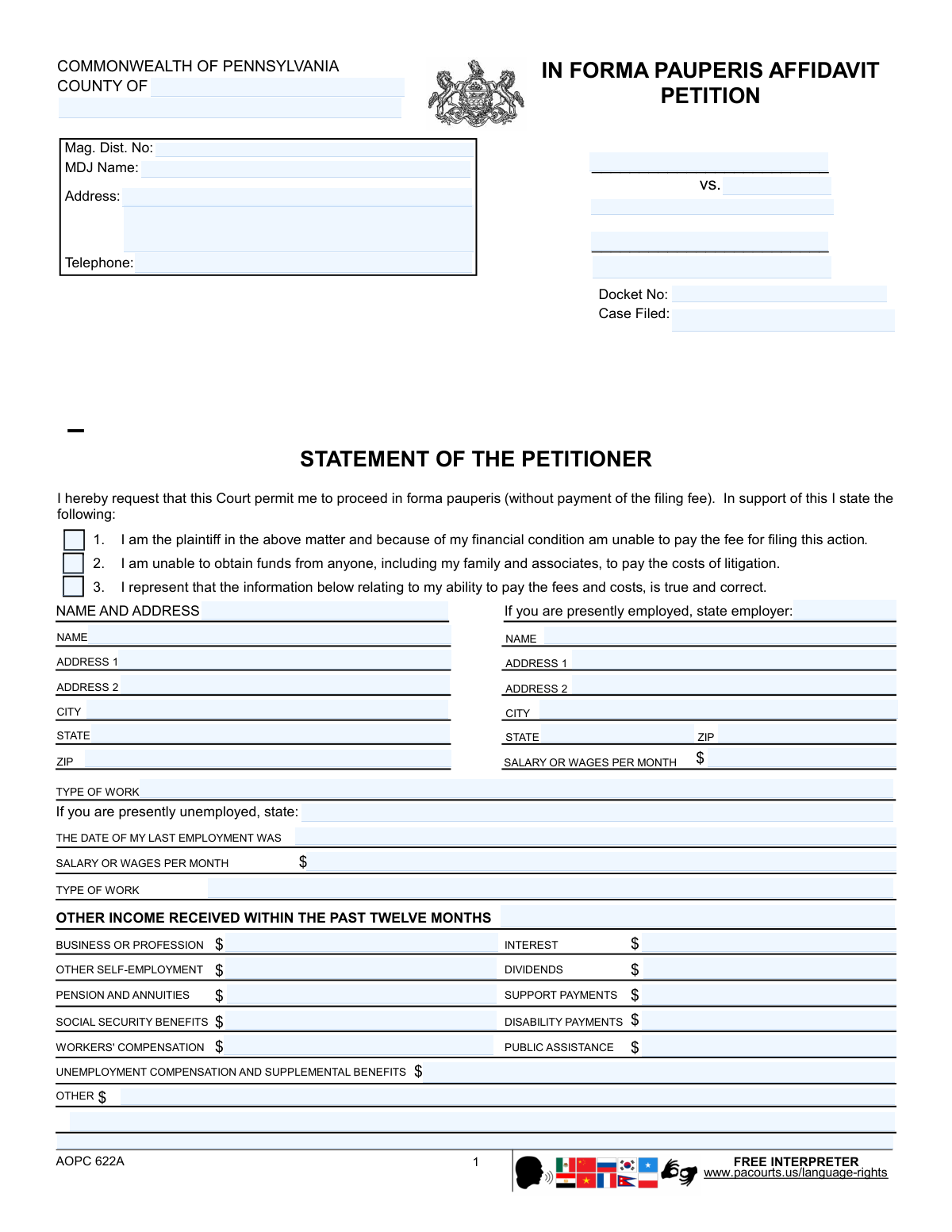
What this form asks for
The AI fills all of it, from your answers or your documents.
The AI checks your answers before you download
16 checks built for this form, so a wrong date or a missing answer is caught before anyone else sees it.
Validates that the in forma pauperis (IFP) petition includes the required court-identifying fields such as County, Magisterial District Number, MDJ Name, court Address, and Telephone. These fields are necessary to route the filing to the correct magisterial district and to ensure the court can contact the filer if issues arise. If any of these are missing or malformed, the submission should be flagged as incomplete and prevented from filing until corrected.
Checks that the caption contains two parties (the “___ vs. ___” lines) and that each party name is not blank or placeholder text (e.g., only underscores). Correct party identification is essential for docketing, service, and avoiding misfiled cases. If either party is missing, the system should reject the submission or require correction before acceptance.
Validates that any provided Docket No., Case No., and OTN # follow expected formatting rules (e.g., not empty, not all underscores, and matching local patterns if configured). These identifiers link the filing to the correct case and are critical for appellate processing and transcript requests. If the identifier is missing where required or fails format checks, the filing should be routed to manual review or blocked depending on the form type.
Ensures all dates are valid calendar dates and captured in an acceptable format (e.g., MM/DD/YYYY or a configured court standard), including “Case Filed,” the appealed order date (day/month/year), last employment date, and dated signatures. Date accuracy is required to calculate deadlines (especially for appeals) and to assess financial recency for IFP eligibility. If a date is invalid, in the future where not allowed, or incomplete (missing month/year), the system should prompt for correction and prevent final submission.
Checks that the petitioner does not simultaneously complete mutually exclusive sections in a contradictory way (e.g., providing a current employer while also stating they are presently unemployed without explanation). The IFP determination depends on a coherent financial picture, and conflicting employment information undermines reliability. If inconsistency is detected, the system should require the filer to clarify status and either complete the employed section or the unemployed section appropriately.
Validates that all monetary fields (salary/wages per month and each “other income received within the past twelve months” line) are numeric currency values with at most two decimal places and non-negative amounts. This prevents calculation errors and ensures the court can evaluate eligibility consistently. If any amount contains non-numeric characters (other than currency symbols/commas) or is negative, the system should reject the entry and request correction.
And 10 more checks
- Household Contribution Consistency (Spouse employed vs. spouse income fields)
- Asset and Debt Currency Validation (Property owned and obligations)
- Motor Vehicle Details Completeness (Make, Year, Cost, Amount Owed)
- Dependents Section Integrity (Names, relationships, and minor ages)
- Required Signatures and Verification Statements Present (IFP and appellate forms)
- Attorney vs. Pro Se Consistency (Cover sheet and appellate attorney fields)
- Telephone Number Format Validation (Court and filer contact numbers)
- Notice of Appeal Court Selection and Order Identification Completeness
- Transcript Request Completeness and Payment/Estimate Consistency
- Proof of Service Minimum Content Validation (served parties and method)
Let AI fill out your AOPC 622A (IFP Petition)
No typing. Every field filled in seconds, checked, ready to sign.
How to Fill Out AOPC 622A (IFP Petition) Online for Free in 2026
What the AI walks you through.
- Enter the court and case identifiers (County, Magisterial District number, MDJ name/contact info, party names, docket number, and case filed date if known).
- Complete the petitioner statement section confirming inability to pay and inability to obtain funds from others, then review the verification language for accuracy.
- Provide employment details (current employer and wages) or, if unemployed, last employment date, prior work type, and prior monthly wages.
- List all other income received in the past 12 months (e.g., public assistance, Social Security, unemployment, disability, support payments, interest/dividends) and any household contributions from spouse/children/parents/others.
- Disclose assets and property owned (cash, bank accounts, certificates of deposit, real estate, vehicles) and list debts/obligations (rent, mortgage, loans, other obligations).
- Identify all persons dependent on you for support (names/relationships and ages of minor children), then sign and date the petition and provide spouse name if requested.
- Certify compliance with Pennsylvania’s Case Records Public Access Policy regarding confidential information, then submit the form to the Magisterial District Judge for review and decision.
Common Mistakes in Completing AOPC 622A (IFP Petition)
The ones the AI is built to catch.
Leaving court-identifying fields blank or inconsistent (County, Magisterial District No., Docket/Case No., OTN)
Confusing party roles and captions (plaintiff vs. defendant; Commonwealth vs. Defendant)
Incomplete income reporting on the In Forma Pauperis (IFP) affidavit
Not providing employer details or unemployment details as required
Failing to list assets and debts (or listing them without amounts owed)
Omitting household contributions and dependent information
Missing signatures, dates, or verification language on sworn sections
Not attaching required appeal documents or checks (or attaching the wrong ones)
Incorrect or incomplete Proof of Service (wrong recipients or no method of service)
Transcript request errors (wrong hearing date/type, missing page estimate/cost/deposit info)
Civil Cover Sheet misclassification (wrong case category or multiple boxes checked)
Frequently Asked Questions About AOPC 622A (IFP Petition)
Is it really free for 7 days?
Can I fill other forms too?
How do I cancel?
How does the AI fill out AOPC 622A (IFP Petition)?
What happens to my information?
How complex is AOPC 622A (IFP Petition) to fill out?
What is an In Forma Pauperis (IFP) Affidavit/Petition and what does it do?
Who should file the In Forma Pauperis Affidavit/Petition?
Does filing IFP mean all costs are permanently waived?
What information do I need to complete the IFP financial sections?
What if I am unemployed—how do I fill out the employment section?
Do I have to include my spouse’s income or household contributions on the IFP form?
What happens if I leave out information or provide incorrect information on the IFP petition?
What is the “Case Records Public Access Policy” certification on the IFP form?
What is the Civil Cover Sheet and when is it required?
Are there cases where the Civil Cover Sheet is not required?
How do I choose the correct case category on the Civil Cover Sheet (Contract, Tort, Real Property, etc.)?
What does “Commencement of Action: Complaint vs. Writ of Summons vs. Petition” mean on the Civil Cover Sheet?
What is the Northampton County Criminal Notice of Appeal form used for?
What attachments are required with the Northampton County Criminal Notice of Appeal?
Who must be served according to the Proof of Service form (Pa.R.A.P. 906)?
Get your AOPC 622A (IFP Petition) filled out by AI
$0 today. Cancel before Nov 1 and you pay nothing.
Other forms like this one
court forms: Form Summons, Supreme Court of New York, Form SC-100, Plaintiff's Claim and ORDER to Go to Small Claims Court, Form AO 240, Application to Proceed in District Court Without Prepaying Fees or Costs, Form AO 239, Application to Proceed in District Court Without Prepaying Fees or Costs, Affidavit for Service by Publication/Posting (Circuit Court of Cook County, Illinois) (CCG 0013 A/B), Petition for Leave to Proceed In Forma Pauperis (Court of Common Pleas of Lehigh County, Pennsylvania, Civil Division), Judicial Council of California Form SC-105, Request for Court Order and Answer (Small Claims), SC-120, Defendant’s Claim and ORDER to Go to Small Claims Court (Small Claims), SC-105, Request for Court Order and Answer (Small Claims), Judicial Council of California Form SC-120, Defendant’s Claim and ORDER to Go to Small Claims Court (Small Claims), In Forma Pauperis Affidavit Petition (AOPC 622A) — Pennsylvania Magisterial District Court, Florida Supreme Court Approved Family Law Form 12.901(b)(3), Petition for Dissolution of Marriage with No Dependent or Minor Child(ren) or Property (02/18), Illinois Supreme Court Approved Form E-O 3500.3, Eviction Order, Form P3 (Rule 25-3(2)) — Affidavit of Applicant for Grant of Probate or Grant of Administration with Will Annexed (Short Form) (Supreme Court of British Columbia), Form SC-100, Plaintiff’s Claim and ORDER to Go to Small Claims Court, Designation of Record on Appeal (Civil) (Maricopa County Justice Courts, Arizona) (Form APP 8150-702), FW-003, Order on Court Fee Waiver (Superior Court), Judicial Council of California Form SER-001, Request for Sheriff to Serve Court Papers, FW-003, Order on Court Fee Waiver (Superior Court), Judicial Council of California Form SER-001, Request for Sheriff to Serve Court Papers
District court forms: Form AO 240, Application to Proceed in District Court Without Prepaying Fees or Costs, Form AO 239, Application to Proceed in District Court Without Prepaying Fees or Costs, In Forma Pauperis Affidavit Petition (AOPC 622A) — Pennsylvania Magisterial District Court, Form CR-417, Response by District Attorney to Petition to Terminate Sex Offender Registration, Taxing District Complaint (Local Property Tax), Supreme Court of New Jersey Disciplinary Review Board Notice of Appeal From a District Fee Arbitration Committee Determination
UK court forms: Form Summons, Supreme Court of New York, Form SC-100, Plaintiff's Claim and ORDER to Go to Small Claims Court, Form AO 240, Application to Proceed in District Court Without Prepaying Fees or Costs, Form AO 239, Application to Proceed in District Court Without Prepaying Fees or Costs, Affidavit for Service by Publication/Posting (Circuit Court of Cook County, Illinois) (CCG 0013 A/B), Petition for Leave to Proceed In Forma Pauperis (Court of Common Pleas of Lehigh County, Pennsylvania, Civil Division), Judicial Council of California Form SC-105, Request for Court Order and Answer (Small Claims), SC-120, Defendant’s Claim and ORDER to Go to Small Claims Court (Small Claims), SC-105, Request for Court Order and Answer (Small Claims), Judicial Council of California Form SC-120, Defendant’s Claim and ORDER to Go to Small Claims Court (Small Claims), In Forma Pauperis Affidavit Petition (AOPC 622A) — Pennsylvania Magisterial District Court, Florida Supreme Court Approved Family Law Form 12.901(b)(3), Petition for Dissolution of Marriage with No Dependent or Minor Child(ren) or Property (02/18), Illinois Supreme Court Approved Form E-O 3500.3, Eviction Order, Form P3 (Rule 25-3(2)) — Affidavit of Applicant for Grant of Probate or Grant of Administration with Will Annexed (Short Form) (Supreme Court of British Columbia), Form SC-100, Plaintiff’s Claim and ORDER to Go to Small Claims Court, Designation of Record on Appeal (Civil) (Maricopa County Justice Courts, Arizona) (Form APP 8150-702), FW-003, Order on Court Fee Waiver (Superior Court), Judicial Council of California Form SER-001, Request for Sheriff to Serve Court Papers, FW-003, Order on Court Fee Waiver (Superior Court), Judicial Council of California Form SER-001, Request for Sheriff to Serve Court Papers
AOPC forms: AOPC 308A, Civil Complaint, In Forma Pauperis Affidavit Petition (AOPC 622A) — Pennsylvania Magisterial District Court
Pennsylvania court forms: AOPC 308A, Civil Complaint, Petition for Leave to Proceed In Forma Pauperis (Court of Common Pleas of Lehigh County, Pennsylvania, Civil Division), In Forma Pauperis Affidavit Petition (AOPC 622A) — Pennsylvania Magisterial District Court
affidavit forms: Affidavit for Collection of Personal Property California Probate Code Section 13100, Form I-864, Affidavit of Support Under INA, Form DS-5507, Affidavit of Physical Presence, Form 12.902(b), Family Law Financial Affidavit (Short Form), Form E, Affidavit of Personal Service, Form I-361, Affidavit of Financial Support, Form EX550, Affidavit (Order to attend for questioning/suspended committal order), Form CJA-23, Financial Affidavit, Affidavit and Representations Regarding Next of Kin (Preference Beneficiary Affidavit) (The Hartford) – Form LC-7086-17, Affidavit for Service by Publication/Posting (Circuit Court of Cook County, Illinois) (CCG 0013 A/B), In Forma Pauperis Affidavit Petition (AOPC 622A) — Pennsylvania Magisterial District Court, Form P3 (Rule 25-3(2)) — Affidavit of Applicant for Grant of Probate or Grant of Administration with Will Annexed (Short Form) (Supreme Court of British Columbia), Uniform Domestic Relations Form – Affidavit 1 AFFIDAVIT OF BASIC INFORMATION, INCOME, AND EXPENSES, TIAA Brokerage Durable Power Of Attorney Affidavit Of Full Force And Effect, Form L-4260, Property Transfer Affidavit, Affidavit - Supporting Documents Not Attached to Eviction Complaint, Missouri Motion and Affidavit in Support of Request to Proceed As a Poor Person, Form AOC-SP-300, Petition And Affidavit/Affirmation For Involuntary Commitment, Florida Supreme Court Approved Family Law Form 12.902(d), Uniform Child Custody Jurisdiction and Enforcement Act (UCCJEA) Affidavit, Form 35.1A: Affidavit (child protection information)
Let AI fill out your AOPC 622A (IFP Petition)
Your trial starts once a card is added. You pay nothing before Nov 1.
Our AI already knows this form, all 270 fields of it. Skip the typing: tell it about yourself, or upload what you have, and it fills the whole form in seconds.
- AI fills every field on all 6 pages, tables and checkboxes included
- No typing into boxes: answer a few questions, or upload a document you already have, an old copy of this form, a photo of a document
- The AI checks the answers; you review and change anything before you download
- Download the finished PDF, print it, or sign it online
- Encrypted, and never used to train AI
Cancel before Nov 1 and you pay nothing.
A card is needed to start the trial. Cancel in two clicks from your account.
Terms · Privacy