
Yes! You can use AI to fill out Petition for Leave to Proceed In Forma Pauperis (Court of Common Pleas of Lehigh County, Pennsylvania, Civil Division)
Don't type 65 fields by hand. Tell our AI about yourself, or upload a document you already have, and it fills every field in seconds. You check it, then download, print or sign.
The AI does the filling. You just check it.
No typing into boxes, nothing to install.
What this form asks for
The AI fills all of it, from your answers or your documents.
The AI checks your answers before you download
15 checks built for this form, so a wrong date or a missing answer is caught before anyone else sees it.
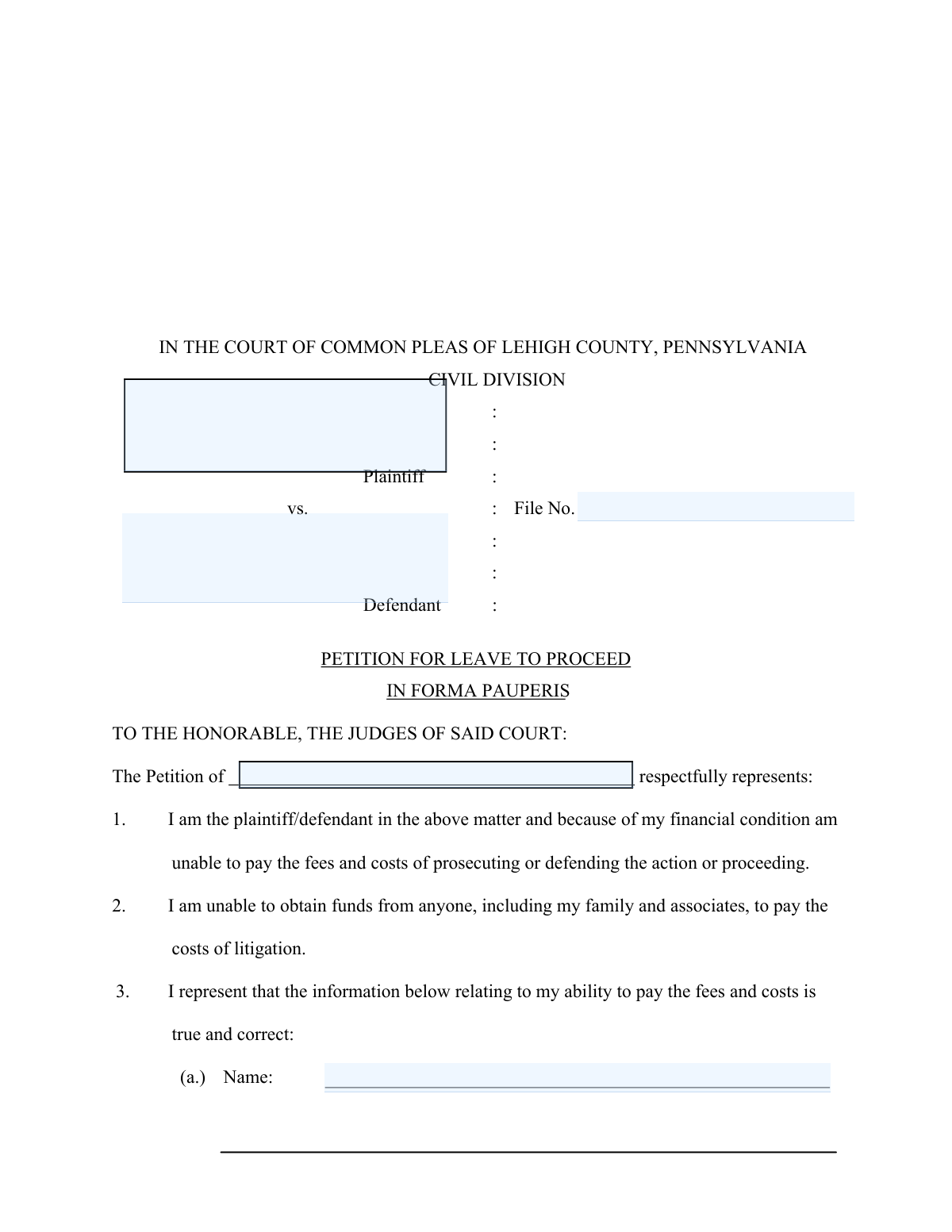
Validates that the caption includes the full legal names of the Plaintiff and Defendant and a File No. when required by the court/workflow. This is important to ensure the petition is correctly associated with the right case and parties, preventing misfiling or docketing errors. If any caption element is missing or clearly invalid (e.g., placeholder text only), the submission should be flagged for correction before acceptance.
Checks that the filer clearly indicates whether they are the plaintiff or defendant (as referenced in statement 1) and that this selection is consistent with the caption (i.e., the petitioner’s name matches the selected role’s party name). This prevents confusion about who is requesting in forma pauperis status and avoids processing the request under the wrong party. If the role is not selected or conflicts with the caption, the form should be rejected or routed for manual review.
Ensures the petitioner’s Name, Address, and Phone Number fields in section 3(a) are completed and not left blank. These fields are necessary for court communication, service-related issues, and verifying the applicant’s identity. If any are missing, the system should require completion or mark the submission incomplete.
Validates that all phone numbers provided (section 3(a) and the signature block phone number) match an acceptable format (e.g., 10 digits with optional separators, and optional country code if allowed). This is important because invalid phone numbers prevent the court or clerk from contacting the petitioner about deficiencies or hearings. If the phone number fails format checks, the system should prompt correction and prevent final submission.
Checks that the petitioner completes either the 'presently employed' subsection or the 'presently unemployed' subsection in 3(b), and does not leave both blank. This is critical because employment status is a primary factor in determining ability to pay fees. If neither branch is completed (or both are partially completed in a contradictory way), the submission should be flagged as incomplete or inconsistent.
If the petitioner indicates they are presently employed, validates that Employer name, Employer address, Salary/Wages per month, and Type of work are provided. These details support the financial assessment and help prevent underreporting or ambiguity about income. If any required employed-field is missing, the system should require completion or route for review.
And 9 more checks
- Last Employment Date Format and Plausibility (When Unemployed)
- Monthly Wage/Salary Numeric Validation (All Wage Fields)
- Other Income Fields Numeric Validation and Timeframe Consistency
- Spouse/Household Contribution Logic (Spouse Name vs. Spouse Employment Fields)
- Assets/Property Numeric and Completeness Validation
- Motor Vehicle Year and Amounts Plausibility
- Debts and Obligations Numeric Validation (Mortgage/Rent/Loans/Other)
- Dependents Section Consistency (Names, Ages, Relationships)
- Signature/Verification and Date Required
Let AI fill out your Lehigh County IFP Petition (Civil)
No typing. Every field filled in seconds, checked, ready to sign.
How to Fill Out Lehigh County IFP Petition (Civil) Online for Free in 2026
What the AI walks you through.
- Enter the case caption information at the top (plaintiff name, defendant name, and the civil file number if already assigned).
- Identify yourself as the petitioner and indicate whether you are the plaintiff or defendant, then complete your personal contact details (name, address, phone number).
- Complete the employment section: provide current employer, address, monthly wages, and type of work, or if unemployed provide last employment date, prior wages, and type of work.
- List all other income received in the past 12 months (e.g., self-employment, interest/dividends, pension, Social Security, support, disability, unemployment, workers’ compensation, public assistance, and any other sources).
- Provide household support and financial picture: spouse contributions/employment details, contributions from children/parents/others, and list property owned (cash, bank accounts, CDs, real estate, vehicle details with cost and amount owed, stocks/bonds, and other assets).
- Disclose debts and obligations (mortgage, rent, loans, and other recurring obligations) and list all dependents (spouse, children with ages, and other dependents with relationship).
- Review the continuing duty to report improved finances, sign and date the petition/verification, and include your phone number before submitting it to the Lehigh County Court of Common Pleas Civil Division as required.
Common Mistakes in Completing Lehigh County IFP Petition (Civil)
The ones the AI is built to catch.
Leaving the caption incomplete (party names and File No.)
Not indicating whether you are the plaintiff or defendant
Providing incomplete contact information (address/phone)
Employment section filled out incorrectly (employed vs. unemployed)
Using inconsistent or unclear income amounts (monthly vs. yearly, gross vs. net)
Omitting “Other income” sources or listing them as zero without explanation
Not reporting household contributions (spouse/partner/family support)
Underreporting assets in the property section (cash, bank accounts, vehicles, real estate)
Listing debts without amounts or leaving out major obligations
Failing to list dependents fully (names, ages, relationships)
Missing signature/date/verification or misunderstanding the penalty statement
Frequently Asked Questions About Lehigh County IFP Petition (Civil)
Is it really free for 7 days?
Can I fill other forms too?
How do I cancel?
How does the AI fill out Lehigh County IFP Petition (Civil)?
What happens to my information?
How complex is Lehigh County IFP Petition (Civil) to fill out?
What is a Petition for Leave to Proceed In Forma Pauperis (IFP)?
Who should file this IFP petition?
Does filing this petition automatically waive all court costs?
What case information do I need to put at the top of the form?
What personal information is required in section (a)?
How do I complete the employment section (b) if I am employed?
How do I complete section (b) if I am unemployed?
What counts as “other income” in section (c)?
Do I have to include my spouse’s income or household contributions in section (d)?
What property and assets do I need to list in section (e)?
What should I include under debts and obligations in section (f)?
Who should I list as dependents in section (g)?
Do I need to attach documents like pay stubs or benefit letters?
Where do I sign, and what does the verification mean?
What does it mean that I have a “continuing obligation” to update the court?
Get your Lehigh County IFP Petition (Civil) filled out by AI
$0 today. Cancel before Nov 1 and you pay nothing.
Other forms like this one
court forms: Form Summons, Supreme Court of New York, Form SC-100, Plaintiff's Claim and ORDER to Go to Small Claims Court, Form AO 240, Application to Proceed in District Court Without Prepaying Fees or Costs, Form AO 239, Application to Proceed in District Court Without Prepaying Fees or Costs, Affidavit for Service by Publication/Posting (Circuit Court of Cook County, Illinois) (CCG 0013 A/B), In Forma Pauperis Affidavit/Petition (AOPC 622A) – Pennsylvania Magisterial District Court, Judicial Council of California Form SC-105, Request for Court Order and Answer (Small Claims), SC-120, Defendant’s Claim and ORDER to Go to Small Claims Court (Small Claims), SC-105, Request for Court Order and Answer (Small Claims), Judicial Council of California Form SC-120, Defendant’s Claim and ORDER to Go to Small Claims Court (Small Claims), In Forma Pauperis Affidavit Petition (AOPC 622A) — Pennsylvania Magisterial District Court, Florida Supreme Court Approved Family Law Form 12.901(b)(3), Petition for Dissolution of Marriage with No Dependent or Minor Child(ren) or Property (02/18), Illinois Supreme Court Approved Form E-O 3500.3, Eviction Order, Form P3 (Rule 25-3(2)) — Affidavit of Applicant for Grant of Probate or Grant of Administration with Will Annexed (Short Form) (Supreme Court of British Columbia), Form SC-100, Plaintiff’s Claim and ORDER to Go to Small Claims Court, Designation of Record on Appeal (Civil) (Maricopa County Justice Courts, Arizona) (Form APP 8150-702), FW-003, Order on Court Fee Waiver (Superior Court), Judicial Council of California Form SER-001, Request for Sheriff to Serve Court Papers, FW-003, Order on Court Fee Waiver (Superior Court), Judicial Council of California Form SER-001, Request for Sheriff to Serve Court Papers
civil court forms: Designation of Record on Appeal (Civil) (Maricopa County Justice Courts, Arizona) (Form APP 8150-702), Certificate of Service (Civil Court Claim), Pfändungs- und Überweisungsbeschluss (Garnishment and Transfer Order) – German Civil Enforcement Court Form, AOPC 308A, Civil Complaint, Form MC 03, Answer, Civil, Form POS-040, Proof of Service—Civil, ONTARIO Form 8: Application (General), Form ATJ 601.9, Application for Waiver of Court Fees (Civil), Nevada Justice / Municipal Civil Court Cover Sheet, Form MC 01, Summons, Form MC 10, Judgment, Civil, Form MC 99, Motion and Affidavit to Set Aside Default (Civil), Form MC 281a, Civil Mediator Application, Ex Parte Motion and Order to Renew Civil Judgment, AO 88B, Subpoena to Produce Documents, Information, or Objects or to Permit Inspection of Premises in a Civil Action, Form APP-031A, Application for Extension of Time to File Brief (Civil Case), Civil Appeal Case Information Statement, Form APP-014, Appellant's Proposed Statement on Appeal (Unlimited Civil Case), form-app-015-respondents-proposed-corrections-toadditions-to-appellants-proposed-settled-statement-unlimited-civil-case, Form APP-015, Order on Proposed Settled Statement (Unlimited Civil Case)
UK court forms: Form Summons, Supreme Court of New York, Form SC-100, Plaintiff's Claim and ORDER to Go to Small Claims Court, Form AO 240, Application to Proceed in District Court Without Prepaying Fees or Costs, Form AO 239, Application to Proceed in District Court Without Prepaying Fees or Costs, Affidavit for Service by Publication/Posting (Circuit Court of Cook County, Illinois) (CCG 0013 A/B), In Forma Pauperis Affidavit/Petition (AOPC 622A) – Pennsylvania Magisterial District Court, Judicial Council of California Form SC-105, Request for Court Order and Answer (Small Claims), SC-120, Defendant’s Claim and ORDER to Go to Small Claims Court (Small Claims), SC-105, Request for Court Order and Answer (Small Claims), Judicial Council of California Form SC-120, Defendant’s Claim and ORDER to Go to Small Claims Court (Small Claims), In Forma Pauperis Affidavit Petition (AOPC 622A) — Pennsylvania Magisterial District Court, Florida Supreme Court Approved Family Law Form 12.901(b)(3), Petition for Dissolution of Marriage with No Dependent or Minor Child(ren) or Property (02/18), Illinois Supreme Court Approved Form E-O 3500.3, Eviction Order, Form P3 (Rule 25-3(2)) — Affidavit of Applicant for Grant of Probate or Grant of Administration with Will Annexed (Short Form) (Supreme Court of British Columbia), Form SC-100, Plaintiff’s Claim and ORDER to Go to Small Claims Court, Designation of Record on Appeal (Civil) (Maricopa County Justice Courts, Arizona) (Form APP 8150-702), FW-003, Order on Court Fee Waiver (Superior Court), Judicial Council of California Form SER-001, Request for Sheriff to Serve Court Papers, FW-003, Order on Court Fee Waiver (Superior Court), Judicial Council of California Form SER-001, Request for Sheriff to Serve Court Papers
leave forms: ADP Leave Management Application for Leave of Absence, Form WH-384, Military Family Leave, Form 8994, Employer Credit for Paid Family and Medical Leave, Leave of Absence Application (LOA), Vanguard University Leave of Absence Form, Michaels Leave of Absence (LOA) Request Form, Scheduled Medical Leave of Absence (MLOA) - BLET 13, Long-Term Leave of Absence (LOA) Request for an Extended Unpaid Leave, JPMorgan Chase As You Leave Guide, WCBOE Request for Approved Leave of Absence, Employee’s Frequently Asked Questions: Leave of Absence, Merakey Personal Leave of Absence Request Form, Sodexo Leave of Absence Request Packet, Application for Special Leave of Absence without Pay, Application for Sabbatical Leave, Leave of Absence Request Form - ESI PEO, OPM Form 71, Request for Leave or Approved Absence, Form WH-380-E, Certification of Health Care Provider
County court forms: Affidavit for Service by Publication/Posting (Circuit Court of Cook County, Illinois) (CCG 0013 A/B), Designation of Record on Appeal (Civil) (Maricopa County Justice Courts, Arizona) (Form APP 8150-702), Maricopa County Justice Courts, Motion to Set Aside / Vacate Judgment, Circuit Court of Cook County, Illinois, Form CCM 0346, Order/Trial Call, Superior Court of Chatham County, Georgia, Hearing Request Form, Form CFS 601-2, County Treasurer's and Judge's Certification of Expenditures for Care and Support of Minors Other Than Wards of the Court, Tax Court of New Jersey, County Equalization Table Complaint (CN 10339), Application for Judgment to Apply Freeze Act using County Board of Taxation figures (N.J.S.A. 54:3-26), Family Department Pleading/Motion and Order, Disclosure Statement (Superior Court of Arizona in Maricopa County), Proposed Divorce / Legal Separation Resolution Statement, Notice of Default Hearing, Superior Court of Arizona in Maricopa County, Acceptance of Service for Family Court Cases, A.R.F.L.P. Rule 40(F), Affidavit of Direct Payments (Superior Court of Arizona in Maricopa County), Affidavit of Financial Information, Superior Court of Arizona in Maricopa County, Affidavit of Non-Compliance (Form DR41f), Affidavit Regarding Minor Children (Superior Court of Arizona in Maricopa County), Affidavit of Service with Signature Confirmation for Family Cases, Alternative Dispute Resolution Statement to the Court (A.R.F.L.P. 66(E)), Current Employer or Other Payor Information (DRS88f)
Pennsylvania court forms: AOPC 308A, Civil Complaint, In Forma Pauperis Affidavit/Petition (AOPC 622A) – Pennsylvania Magisterial District Court, In Forma Pauperis Affidavit Petition (AOPC 622A) — Pennsylvania Magisterial District Court
Let AI fill out your Lehigh County IFP Petition (Civil)
Your trial starts once a card is added. You pay nothing before Nov 1.
Our AI already knows this form, all 65 fields of it. Skip the typing: tell it about yourself, or upload what you have, and it fills the whole form in seconds.
- AI fills every field on all 5 pages, tables and checkboxes included
- No typing into boxes: answer a few questions, or upload a document you already have, an old copy of this form, a photo of a document
- The AI checks the answers; you review and change anything before you download
- Download the finished PDF, print it, or sign it online
- Encrypted, and never used to train AI
Cancel before Nov 1 and you pay nothing.
A card is needed to start the trial. Cancel in two clicks from your account.
Terms · Privacy