
Yes! You can use AI to fill out Affidavit for Service by Publication/Posting (Circuit Court of Cook County, Illinois) (CCG 0013 A/B)
Don't type 30 fields by hand. Tell our AI about yourself, or upload a document you already have, and it fills every field in seconds. You check it, then download, print or sign.
The AI does the filling. You just check it.
No typing into boxes, nothing to install.
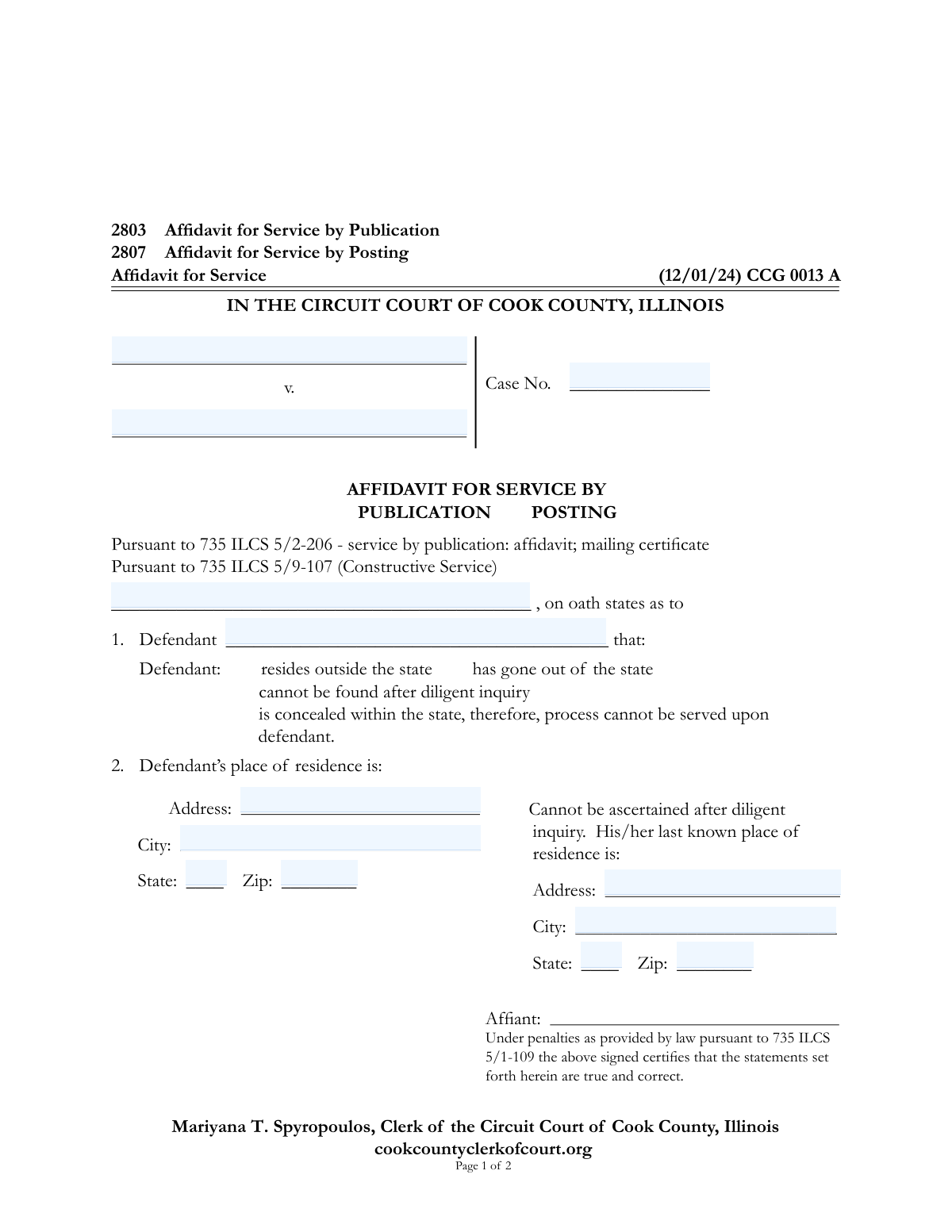
What this form asks for
The AI fills all of it, from your answers or your documents.
The AI checks your answers before you download
15 checks built for this form, so a wrong date or a missing answer is caught before anyone else sees it.
Checks that the "Case No." field is not blank and conforms to the expected local case numbering pattern (e.g., year + case type + sequence, as configured for Cook County). This is critical to ensure the affidavit is filed into the correct court case and can be docketed and retrieved. If the case number is missing or malformed, the submission should be rejected or routed to manual review because it may be misfiled or unusable.
Validates that the case caption includes the parties (the line above/beside “v.” and the defendant name line) and that the defendant name is not empty. Party identification is essential for legal sufficiency and for matching the affidavit to the correct litigants. If either party name is missing, the form should fail validation because the affidavit cannot be reliably associated with a specific case and defendant.
Checks that the defendant field contains a plausible full name (e.g., at least two alphabetic tokens) and is not a placeholder (e.g., “unknown,” “N/A,” or a blank line). Service by publication/posting requires clear identification of the person to be served. If the name appears incomplete or generic, the submission should be flagged for correction or manual review to prevent defective service.
Validates that at least one of the listed grounds is affirmatively selected/indicated: resides outside the state, has gone out of the state, cannot be found after diligent inquiry, or is concealed within the state. The affidavit must state a legally recognized reason why personal service cannot be made. If none are selected, the affidavit is legally insufficient and should be rejected.
Checks for logically conflicting combinations (e.g., selecting both “resides outside the state” and “is concealed within the state”) unless an additional explanation field is provided in the system. Contradictions can undermine credibility and may cause the court to deny the request for constructive service. If contradictions are detected, the system should require clarification or route to manual review.
If the form indicates the defendant’s place of residence is known (i.e., the “Cannot be ascertained after diligent inquiry” option is not selected), the system must require Address, City, State, and Zip to be completed. This ensures the affidavit contains the best available location information and supports required mailing steps. If any required subfield is missing, validation should fail and prompt the filer to complete the address.
And 9 more checks
- Validates last known residence section completeness when current residence cannot be ascertained
- Validates State field uses a valid two-letter US state/territory code
- Validates ZIP code format (5-digit or ZIP+4) for all address blocks
- Validates address fields are not empty/placeholder and meet minimum content rules
- Ensures Affiant identification and signature/attestation are present
- Validates attorney registration number (Atty. No.) format and presence when attorney fields are used
- Ensures attorney name and role fields are complete and consistent
- Validates attorney telephone number format and minimum digits
- Validates primary email address format and deliverability constraints
Let AI fill out your CCG 0013
No typing. Every field filled in seconds, checked, ready to sign.
How to Fill Out CCG 0013 Online for Free in 2026
What the AI walks you through.
- Enter the court caption information at the top (Circuit Court of Cook County, Illinois), including the plaintiff and defendant names and the case number.
- Select the type of constructive service requested (publication and/or posting) consistent with the case and the applicable statute cited on the form.
- Identify the defendant and check/complete the statements explaining why personal service cannot be made (resides outside Illinois, has gone out of state, cannot be found after diligent inquiry, or is concealed within the state).
- Provide the defendant’s current place of residence (address, city, state, zip) if known; if unknown, indicate it cannot be ascertained after diligent inquiry and provide the last known residence details.
- Complete the affiant section and review the certification language confirming the statements are true and correct under 735 ILCS 5/1-109.
- Fill in attorney information on page 2 (attorney number, name, party represented, address, phone, and primary email) or the filer’s contact details if applicable.
- Sign the affidavit under oath (as required for an affidavit), then save/print and file it with the Clerk of the Circuit Court of Cook County as part of the request for service by publication/posting.
Common Mistakes in Completing CCG 0013
The ones the AI is built to catch.
Leaving the case caption and case number blank or inconsistent
Not clearly selecting the correct service method (publication vs. posting)
Failing to identify the defendant precisely
Checking multiple defendant-status boxes without factual support
Using vague or conclusory language for “diligent inquiry”
Providing an incomplete or improperly formatted residence address
Marking “Cannot be ascertained” while still having last-known information
Confusing the affiant with the attorney or failing to identify the affiant
Signing without proper oath/verification requirements
Leaving attorney identification fields incomplete (Atty. No., contact info, email)
Inconsistent information between the affidavit and other case filings
Frequently Asked Questions About CCG 0013
Is it really free for 7 days?
Can I fill other forms too?
How do I cancel?
How does the AI fill out CCG 0013?
What happens to my information?
How complex is CCG 0013 to fill out?
What is this “Affidavit for Service by Publication/Posting” form used for?
Who should fill out and sign this affidavit?
When can I use service by publication or posting instead of personal service?
What does “diligent inquiry” mean on this form?
Do I have to choose between publication and posting, or can it be both?
What information about the defendant is required in Section 1?
What do I put in Section 2 if I know the defendant’s current address?
What if I do not know the defendant’s current address?
What is the “mailing certificate” mentioned in 735 ILCS 5/2-206, and is it included here?
Where do I put the case number and case caption (plaintiff/defendant names)?
Do I need to notarize this affidavit?
What does the certification under 735 ILCS 5/1-109 mean for me?
What attorney information is required on page 2?
How do I submit this form in Cook County Circuit Court?
How long does it take for service by publication/posting to be completed?
Get your CCG 0013 filled out by AI
$0 today. Cancel before Nov 1 and you pay nothing.
Other forms like this one
court forms: Form Summons, Supreme Court of New York, Form SC-100, Plaintiff's Claim and ORDER to Go to Small Claims Court, Form AO 240, Application to Proceed in District Court Without Prepaying Fees or Costs, Form AO 239, Application to Proceed in District Court Without Prepaying Fees or Costs, Petition for Leave to Proceed In Forma Pauperis (Court of Common Pleas of Lehigh County, Pennsylvania, Civil Division), In Forma Pauperis Affidavit/Petition (AOPC 622A) – Pennsylvania Magisterial District Court, Judicial Council of California Form SC-105, Request for Court Order and Answer (Small Claims), SC-120, Defendant’s Claim and ORDER to Go to Small Claims Court (Small Claims), SC-105, Request for Court Order and Answer (Small Claims), Judicial Council of California Form SC-120, Defendant’s Claim and ORDER to Go to Small Claims Court (Small Claims), In Forma Pauperis Affidavit Petition (AOPC 622A) — Pennsylvania Magisterial District Court, Florida Supreme Court Approved Family Law Form 12.901(b)(3), Petition for Dissolution of Marriage with No Dependent or Minor Child(ren) or Property (02/18), Illinois Supreme Court Approved Form E-O 3500.3, Eviction Order, Form P3 (Rule 25-3(2)) — Affidavit of Applicant for Grant of Probate or Grant of Administration with Will Annexed (Short Form) (Supreme Court of British Columbia), Form SC-100, Plaintiff’s Claim and ORDER to Go to Small Claims Court, Designation of Record on Appeal (Civil) (Maricopa County Justice Courts, Arizona) (Form APP 8150-702), FW-003, Order on Court Fee Waiver (Superior Court), Judicial Council of California Form SER-001, Request for Sheriff to Serve Court Papers, FW-003, Order on Court Fee Waiver (Superior Court), Judicial Council of California Form SER-001, Request for Sheriff to Serve Court Papers
Cook County forms: Circuit Court of Cook County, Illinois, Form CCM 0346, Order/Trial Call
Illinois court forms: Illinois Supreme Court Approved Form E-O 3500.3, Eviction Order, Illinois Circuit Court Eviction Summons and Proof of Service of Eviction Summons & Eviction Complaint (Form E-S 3507.3), Circuit Court of Cook County, Illinois, Form CCM 0346, Order/Trial Call
UK court forms: Form Summons, Supreme Court of New York, Form SC-100, Plaintiff's Claim and ORDER to Go to Small Claims Court, Form AO 240, Application to Proceed in District Court Without Prepaying Fees or Costs, Form AO 239, Application to Proceed in District Court Without Prepaying Fees or Costs, Petition for Leave to Proceed In Forma Pauperis (Court of Common Pleas of Lehigh County, Pennsylvania, Civil Division), In Forma Pauperis Affidavit/Petition (AOPC 622A) – Pennsylvania Magisterial District Court, Judicial Council of California Form SC-105, Request for Court Order and Answer (Small Claims), SC-120, Defendant’s Claim and ORDER to Go to Small Claims Court (Small Claims), SC-105, Request for Court Order and Answer (Small Claims), Judicial Council of California Form SC-120, Defendant’s Claim and ORDER to Go to Small Claims Court (Small Claims), In Forma Pauperis Affidavit Petition (AOPC 622A) — Pennsylvania Magisterial District Court, Florida Supreme Court Approved Family Law Form 12.901(b)(3), Petition for Dissolution of Marriage with No Dependent or Minor Child(ren) or Property (02/18), Illinois Supreme Court Approved Form E-O 3500.3, Eviction Order, Form P3 (Rule 25-3(2)) — Affidavit of Applicant for Grant of Probate or Grant of Administration with Will Annexed (Short Form) (Supreme Court of British Columbia), Form SC-100, Plaintiff’s Claim and ORDER to Go to Small Claims Court, Designation of Record on Appeal (Civil) (Maricopa County Justice Courts, Arizona) (Form APP 8150-702), FW-003, Order on Court Fee Waiver (Superior Court), Judicial Council of California Form SER-001, Request for Sheriff to Serve Court Papers, FW-003, Order on Court Fee Waiver (Superior Court), Judicial Council of California Form SER-001, Request for Sheriff to Serve Court Papers
circuit court forms: Illinois Circuit Court Eviction Summons and Proof of Service of Eviction Summons & Eviction Complaint (Form E-S 3507.3), Circuit Court of Cook County, Illinois, Form CCM 0346, Order/Trial Call, Form MC 60, Notice of Record Return from Circuit Court/Court of Appeals
County court forms: Petition for Leave to Proceed In Forma Pauperis (Court of Common Pleas of Lehigh County, Pennsylvania, Civil Division), Designation of Record on Appeal (Civil) (Maricopa County Justice Courts, Arizona) (Form APP 8150-702), Maricopa County Justice Courts, Motion to Set Aside / Vacate Judgment, Circuit Court of Cook County, Illinois, Form CCM 0346, Order/Trial Call, Superior Court of Chatham County, Georgia, Hearing Request Form, Form CFS 601-2, County Treasurer's and Judge's Certification of Expenditures for Care and Support of Minors Other Than Wards of the Court, Tax Court of New Jersey, County Equalization Table Complaint (CN 10339), Application for Judgment to Apply Freeze Act using County Board of Taxation figures (N.J.S.A. 54:3-26), Family Department Pleading/Motion and Order, Disclosure Statement (Superior Court of Arizona in Maricopa County), Proposed Divorce / Legal Separation Resolution Statement, Notice of Default Hearing, Superior Court of Arizona in Maricopa County, Acceptance of Service for Family Court Cases, A.R.F.L.P. Rule 40(F), Affidavit of Direct Payments (Superior Court of Arizona in Maricopa County), Affidavit of Financial Information, Superior Court of Arizona in Maricopa County, Affidavit of Non-Compliance (Form DR41f), Affidavit Regarding Minor Children (Superior Court of Arizona in Maricopa County), Affidavit of Service with Signature Confirmation for Family Cases, Alternative Dispute Resolution Statement to the Court (A.R.F.L.P. 66(E)), Current Employer or Other Payor Information (DRS88f)
affidavit forms: Affidavit for Collection of Personal Property California Probate Code Section 13100, Form I-864, Affidavit of Support Under INA, Form DS-5507, Affidavit of Physical Presence, Form 12.902(b), Family Law Financial Affidavit (Short Form), Form E, Affidavit of Personal Service, Form I-361, Affidavit of Financial Support, Form EX550, Affidavit (Order to attend for questioning/suspended committal order), Form CJA-23, Financial Affidavit, Affidavit and Representations Regarding Next of Kin (Preference Beneficiary Affidavit) (The Hartford) – Form LC-7086-17, In Forma Pauperis Affidavit/Petition (AOPC 622A) – Pennsylvania Magisterial District Court, In Forma Pauperis Affidavit Petition (AOPC 622A) — Pennsylvania Magisterial District Court, Form P3 (Rule 25-3(2)) — Affidavit of Applicant for Grant of Probate or Grant of Administration with Will Annexed (Short Form) (Supreme Court of British Columbia), Uniform Domestic Relations Form – Affidavit 1 AFFIDAVIT OF BASIC INFORMATION, INCOME, AND EXPENSES, TIAA Brokerage Durable Power Of Attorney Affidavit Of Full Force And Effect, Form L-4260, Property Transfer Affidavit, Affidavit - Supporting Documents Not Attached to Eviction Complaint, Missouri Motion and Affidavit in Support of Request to Proceed As a Poor Person, Form AOC-SP-300, Petition And Affidavit/Affirmation For Involuntary Commitment, Florida Supreme Court Approved Family Law Form 12.902(d), Uniform Child Custody Jurisdiction and Enforcement Act (UCCJEA) Affidavit, Form 35.1A: Affidavit (child protection information)
Let AI fill out your CCG 0013
Your trial starts once a card is added. You pay nothing before Nov 1.
Our AI already knows this form, all 30 fields of it. Skip the typing: tell it about yourself, or upload what you have, and it fills the whole form in seconds.
- AI fills every field on both pages, checkboxes included
- No typing into boxes: answer a few questions, or upload a document you already have, an old copy of this form, a photo of a document
- The AI checks the answers; you review and change anything before you download
- Download the finished PDF, print it, or sign it online
- Encrypted, and never used to train AI
Cancel before Nov 1 and you pay nothing.
A card is needed to start the trial. Cancel in two clicks from your account.
Terms · Privacy