Fill out Illinois court forms
with AI.
Illinois court forms are official legal documents required to initiate, support, or resolve proceedings in the state's circuit courts. This category focuses on forms commonly used in Cook County and across Illinois for civil matters — particularly eviction and service-of-process cases. These documents carry real legal weight: an Eviction Order can determine whether a tenant must vacate a property, while an Affidavit for Service by Publication ensures a case can proceed when a defendant cannot be located for personal service. Filing these forms incorrectly or incompletely can delay proceedings, invite legal challenges, or result in default judgments.
By continuing, you acknowledge Instafill's Privacy Policy and agree to get occasional product update and promotional emails.
About Illinois court forms
People who typically need these forms include landlords and property managers pursuing eviction (forcible detainer) actions, attorneys handling possession cases, and plaintiffs who need court approval to serve a defendant through alternative means like publication or posting. Whether you're a first-time filer or a legal professional managing multiple cases, accuracy and completeness are critical — especially for forms like the Notice by Posting, which triggers formal court-authorized notice and sets trial appearance deadlines.
Tools like Instafill.ai use AI to fill these forms in under 30 seconds, helping users avoid common errors and handle sensitive case information securely — a practical option whether you're working through one form or several.
Every form on this page can be completed without typing. Instafill is form filling software that reads a PDF and fills it for you — including flat and scanned documents that carry no fillable fields at all.
Forms in This Category
The forms in this category have a median Form Complexity Index of 58/100 (Moderate), measured across 4 forms by field count, input difficulty, length, conditional logic and structure. See how it is calculated.
- Enterprise-grade security & data encryption
- 99%+ accuracy powered by AI
- 1,000+ forms from all industries
- Complete forms in under 60 seconds
How to Choose the Right Form
Illinois court forms for eviction and service-related proceedings can look similar at a glance, but each serves a distinct purpose in the legal process. Here's how to identify which one you need.
Starting an Eviction Case — Or Finalizing One?
- If you're a landlord or plaintiff wrapping up an eviction case, you need the Illinois Eviction Order (Form E-O 3500.3). This is the court-approved order that grants possession, sets a move-out deadline, and authorizes the sheriff to carry out the eviction. It's the final step in an eviction proceeding — not a starting document.
- If your case is still in progress and you're trying to notify a defendant you can't locate, you'll need one or both of the service-related forms below.
Can't Serve the Defendant in Person?
When a defendant cannot be found or personally served, Illinois law allows alternative methods — but you must follow specific steps:
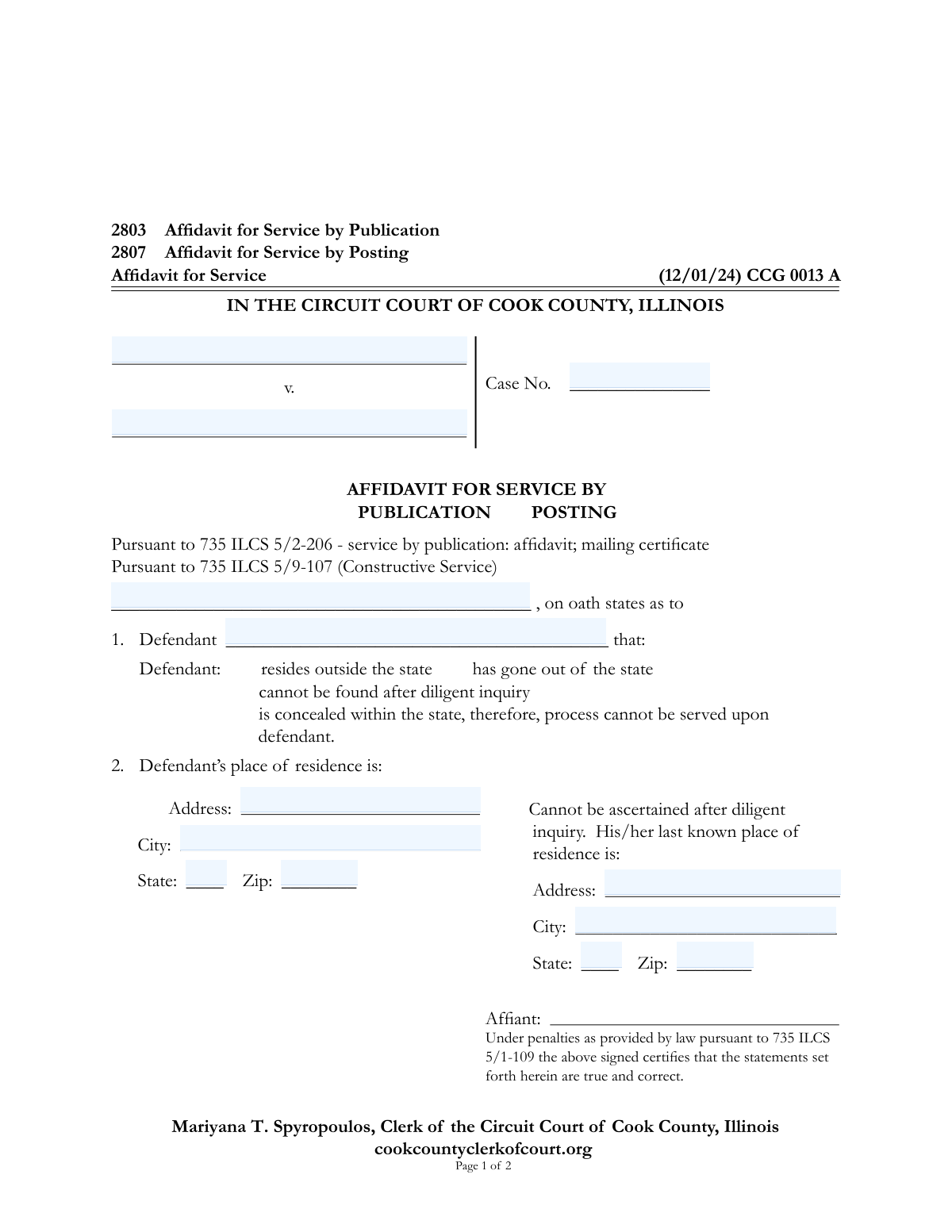
- Use the Affidavit for Service by Publication/Posting (CCG 0013 A/B) first. This sworn affidavit is filed with the Circuit Court of Cook County to explain *why* personal service failed (e.g., the defendant is out of state, concealed, or cannot be located after diligent inquiry). It's required to legally justify moving forward with constructive service.
- Use the Notice by Posting (CCM 0086) alongside or after the affidavit if you're in a forcible detainer (eviction) case specifically. This form provides the official court-authorized notice posted for the defendant, listing the trial date, time, and location they must appear. Skipping this step or completing it incorrectly can result in a default judgment being challenged.
Quick Summary
| Situation | Form to Use |
|---|---|
| Finalizing an eviction with a court order | E-O 3500.3 |
| Proving you tried to serve a defendant | CCG 0013 A/B |
| Posting notice in a Cook County eviction case | CCM 0086 |
For most eviction cases involving a missing defendant, you'll need both CCG 0013 A/B and CCM 0086 before you can proceed to the final order.
Form Comparison
| Form | Purpose | Who Files It | When to Use |
|---|---|---|---|
| Affidavit for Service by Publication/Posting (Circuit Court of Cook County, Illinois) (CCG 0013 A/B) | Sworn statement justifying service by publication or posting | Plaintiff or attorney filing the affidavit under oath | When defendant cannot be located or personally served |
| 2420 - Served by Publication/Posting Forcible Detainer - Notice by Posting (CCM 0086) | Official court notice of eviction hearing served by posting | Plaintiff in a forcible detainer (eviction) case | When summons is returned unserved in eviction proceedings |
| Illinois Supreme Court Approved Form E-O 3500.3, Eviction Order | Finalizes eviction by granting possession and authorizing sheriff | Judge enters; plaintiff or attorney prepares and submits | After eviction case is resolved by default, trial, or agreement |
Tips for Illinois court forms
When filing an Affidavit for Service by Publication/Posting, you must demonstrate that you made a genuine effort to locate the defendant before resorting to constructive service. Keep detailed records of every attempt — dates, methods, and results — because vague or incomplete search descriptions can cause a judge to reject the affidavit. A well-documented diligent inquiry protects your case from being challenged later on service grounds.
Party names, case numbers, and property addresses must be identical on every form you file — from the affidavit to the notice by posting to the eviction order. Even minor discrepancies, like a misspelled name or wrong unit number, can create grounds for a defendant to challenge service or the final judgment. Always cross-check each document against the original complaint before submitting.
Illinois law provides two methods of constructive service — publication in a newspaper and physical posting — and the appropriate method depends on the type of case and the court's requirements. Forcible detainer (eviction) cases often allow notice by posting, while other civil cases may require newspaper publication. Confirm with the clerk's office which method applies to your specific case before completing the affidavit.
The Notice by Posting form explicitly warns defendants that failing to appear can result in a default judgment for possession and potential Sheriff-enforced eviction. If you are a defendant who received or saw a posted notice, treat it as urgent — contact the court immediately to find out your hearing date and file a written appearance. Missing the court date, even unknowingly, can result in losing your home without a hearing on the merits.
The Illinois Eviction Order (E-O 3500.3) has multiple sections covering default judgments, trial outcomes, compliance hearings, money judgments, and dismissals — only complete the sections that apply to your specific case result. Filling in inapplicable sections or leaving required fields blank can cause the order to be rejected or create confusion during Sheriff enforcement. Review the form carefully alongside the judge's ruling before submitting it for signature.
Filling out multiple related court forms — like the affidavit, the notice by posting, and the eviction order — can be time-consuming and error-prone when done manually. AI-powered tools like Instafill.ai can complete these Illinois court forms in under 30 seconds with high accuracy, and your data stays secure throughout the process. This is especially valuable when you need to prepare a set of coordinated forms for the same case quickly.
Illinois constructive service forms follow a specific sequence: the affidavit must typically be filed and approved before the notice by posting is issued, and the eviction order comes only after the hearing concludes. Submitting forms out of order or too close to a hearing date can result in continuances or dismissal. Ask the clerk's office about the required timeline for each step when you first open your case.
Once forms like the affidavit or eviction order are file-stamped by the clerk, obtain certified copies for your records rather than relying on unfiled drafts. Certified copies may be needed to enforce a judgment, coordinate with the Sheriff's office, or respond to future legal challenges. Cook County courts charge a fee for certified copies, so request them at the time of filing to avoid a separate trip.
Frequently Asked Questions
This category includes three Circuit Court of Cook County and Illinois Supreme Court-approved forms related to eviction and service of process: the Affidavit for Service by Publication/Posting (CCG 0013 A/B), the Notice by Posting for Forcible Detainer cases (CCM 0086), and the Illinois Eviction Order (E-O 3500.3). Together, these forms cover key stages of an eviction or forcible detainer proceeding, from notifying a defendant who cannot be personally served to finalizing a court-ordered eviction.
These forms are most commonly used by landlords, property managers, attorneys, and plaintiffs involved in eviction or forcible detainer cases in Cook County or elsewhere in Illinois. The affidavit and notice forms are needed when a defendant cannot be located for personal service, while the Eviction Order is completed by or at the direction of the court once a case is resolved.
Service by publication or posting is used when a defendant cannot be located or personally served despite diligent efforts — for example, if they are out of state, concealed, or their address cannot be determined. Illinois law (735 ILCS 5/2-206 and 735 ILCS 5/9-107) allows this alternative method of service, but it requires filing a sworn affidavit explaining why personal service was not possible.
The Affidavit for Service by Publication/Posting (CCG 0013 A/B) is a sworn statement filed by the plaintiff or their attorney explaining why personal service failed and requesting court permission to serve by publication or posting. The Notice by Posting (CCM 0086) is the actual court-authorized notice that gets physically posted, informing the defendant of the court date and the consequences of failing to appear.
These forms are filed with the Circuit Court of Cook County, Illinois, which handles eviction and forcible detainer cases for the Chicago area. The specific courthouse or division where you file may depend on the type and location of your case, so it's advisable to confirm filing requirements directly with the Clerk of the Circuit Court of Cook County.
If a defendant fails to appear at the scheduled court date after being notified via posting, the court may enter a default judgment against them. In a forcible detainer case, this typically means the plaintiff can receive a judgment for possession of the property, and the Sheriff may be authorized to carry out the eviction.
Yes, the Illinois Eviction Order (form E-O 3500.3) can include money judgments covering items such as unpaid rent, court costs, and attorney's fees, depending on the circumstances of the case and the type of plaintiff. Because it is a court judgment, it can have lasting consequences for the defendant, including impacts on their housing and credit history.
While individuals can represent themselves (pro se) in Illinois court proceedings, eviction and forcible detainer cases involve specific procedural requirements and legal standards that can be difficult to navigate without legal knowledge. Consulting with a licensed Illinois attorney is strongly recommended to ensure forms are completed correctly and filed in compliance with applicable statutes.
Yes, AI-powered tools like Instafill.ai can fill out these Illinois court forms in under 30 seconds by accurately extracting and placing relevant data from your source documents. Instafill.ai can also convert non-fillable PDF versions of forms like the Eviction Order into interactive fillable forms, making the process faster and reducing the risk of manual errors.
Manually completing these forms can take anywhere from several minutes to over an hour, depending on your familiarity with the required information and legal terminology. Using an AI tool like Instafill.ai, the same forms can be populated with accurate data in under 30 seconds, significantly speeding up the preparation process.
The Affidavit for Service by Publication/Posting (CCG 0013 A/B) and the Notice by Posting (CCM 0086) are specific to the Circuit Court of Cook County. The Illinois Eviction Order (E-O 3500.3), however, is an Illinois Supreme Court-approved form and can be used by circuit courts throughout the state of Illinois.
Errors on these forms can have serious consequences, such as improper service being challenged by the defendant, delays in the case, or a default judgment being set aside. In the case of the Eviction Order, inaccuracies that don't match the underlying Eviction Complaint can create legal complications, so it's important to ensure all details are accurate and consistent across all filed documents.
Glossary
- Form Complexity Index
- Instafill’s 0–100 measure of how much effort a form takes to complete, calculated deterministically from the form’s own structure rather than estimated. It combines the number of fillable fields (the largest factor), how difficult those fields are to complete based on their type, the number of pages that contain fields, the amount of conditional “fill-only-if” logic, and how many sections the form is divided into, then adds modifiers for tables and repeating lists, bundled instruction pages, and dense page layouts. A higher score means the form is harder to fill out by hand. The forms in this category have a median Form Complexity Index of 58/100 (Moderate). See exactly how it is calculated.
- Affidavit
- A written statement of facts that the signer swears is true under penalty of law. In Illinois court forms, affidavits are used to provide sworn evidence to the court without requiring live testimony.
- Service by Publication/Posting
- A court-authorized method of notifying a defendant about a lawsuit by publishing a notice in a newspaper or physically posting it at a location when the defendant cannot be found or personally served. Illinois law requires filing an affidavit to justify using this method instead of personal service.
- Forcible Detainer
- The legal term used in Illinois for an eviction lawsuit, where a landlord (or other property owner) seeks to regain possession of a property from a tenant or occupant who refuses to leave. It is sometimes called a 'forcible entry and detainer' action.
- Default Judgment
- A court ruling entered against a defendant who fails to appear or respond to a lawsuit. In eviction cases, a default judgment can result in the court granting possession to the plaintiff without the defendant's side being heard.
- Constructive Service
- A legally recognized alternative to hand-delivering court documents, used when a defendant cannot be located or personally served. Illinois statutes 735 ILCS 5/2-206 and 5/9-107 govern when and how constructive service by publication or posting is permitted.
- Affiant
- The person who signs and swears to the truth of an affidavit. On Illinois court affidavit forms, the affiant is typically the plaintiff or their attorney who has personal knowledge of the facts stated.
- Diligent Inquiry
- A reasonable, good-faith effort to locate a defendant before the court permits service by publication or posting. Illinois courts require the affiant to describe the specific steps taken to find the defendant, such as checking known addresses or contacting relatives.
- Written Appearance
- A formal document filed with the court by a defendant to indicate they intend to participate in the case. Failure to file a written appearance by the deadline stated in a notice can result in a default judgment against the defendant.
- Eviction Order (E-O 3500.3)
- The Illinois Supreme Court-approved form that a judge signs to officially end an eviction case by granting possession of the property to the plaintiff and authorizing the sheriff to remove the defendant if they do not vacate by the stated deadline.
- 735 ILCS 5/1-109
- An Illinois statute that allows a sworn written statement (affidavit) to substitute for live testimony in court proceedings. References to this statute on Illinois court forms mean the signer is certifying the truth of their statements under penalty of perjury.