
Yes! You can use AI to fill out Illinois Circuit Court Eviction Summons and Proof of Service of Eviction Summons & Eviction Complaint (Form E-S 3507.3)
Don't type 140 fields by hand. Tell our AI about yourself, or upload a document you already have, and it fills every field in seconds. You check it, then download, print or sign.
The AI does the filling. You just check it.
No typing into boxes, nothing to install.
What this form asks for
The AI fills all of it, from your answers or your documents.
The AI checks your answers before you download
16 checks built for this form, so a wrong date or a missing answer is caught before anyone else sees it.
The Plaintiff field must contain a full legal name (or full legal entity name for associations, corporations, or agencies) and must not be left blank or contain abbreviations. This is critical because the plaintiff's identity must be clearly established in the court record to ensure proper legal standing. If the plaintiff name is missing or abbreviated, the summons may be rejected by the Circuit Clerk or deemed legally insufficient, potentially invalidating the eviction proceeding.
At least one defendant must be named in the Defendant fields (Lines 1, 2, or 3) using their full first, middle, and last name, OR the 'Unknown Occupants' checkbox must be checked. The form explicitly states that the sheriff will only evict unknown occupants if that box is checked, making this a legally consequential requirement. If no defendant is named and the Unknown Occupants box is unchecked, the summons cannot be properly served and the eviction proceeding cannot move forward.
The County field must be populated with a recognized Illinois county name, as this form is specifically for Illinois Circuit Courts and the county determines jurisdiction. The county entered must correspond to the county where the eviction case is being filed, and it must be spelled correctly and in full. Leaving this field blank or entering an invalid county name would result in the form being rejected by the Circuit Clerk, as jurisdiction cannot be established.
The Case Number field must be populated with the number assigned by the Circuit Clerk and must appear consistently across all pages of the form (Pages 1 through 6 each have a Case Number entry field). The case number should follow the standard Illinois court case number format (e.g., year followed by case type code and sequence number). A missing or inconsistent case number across pages would cause administrative confusion and could result in documents being mismatched or lost in the court filing system.
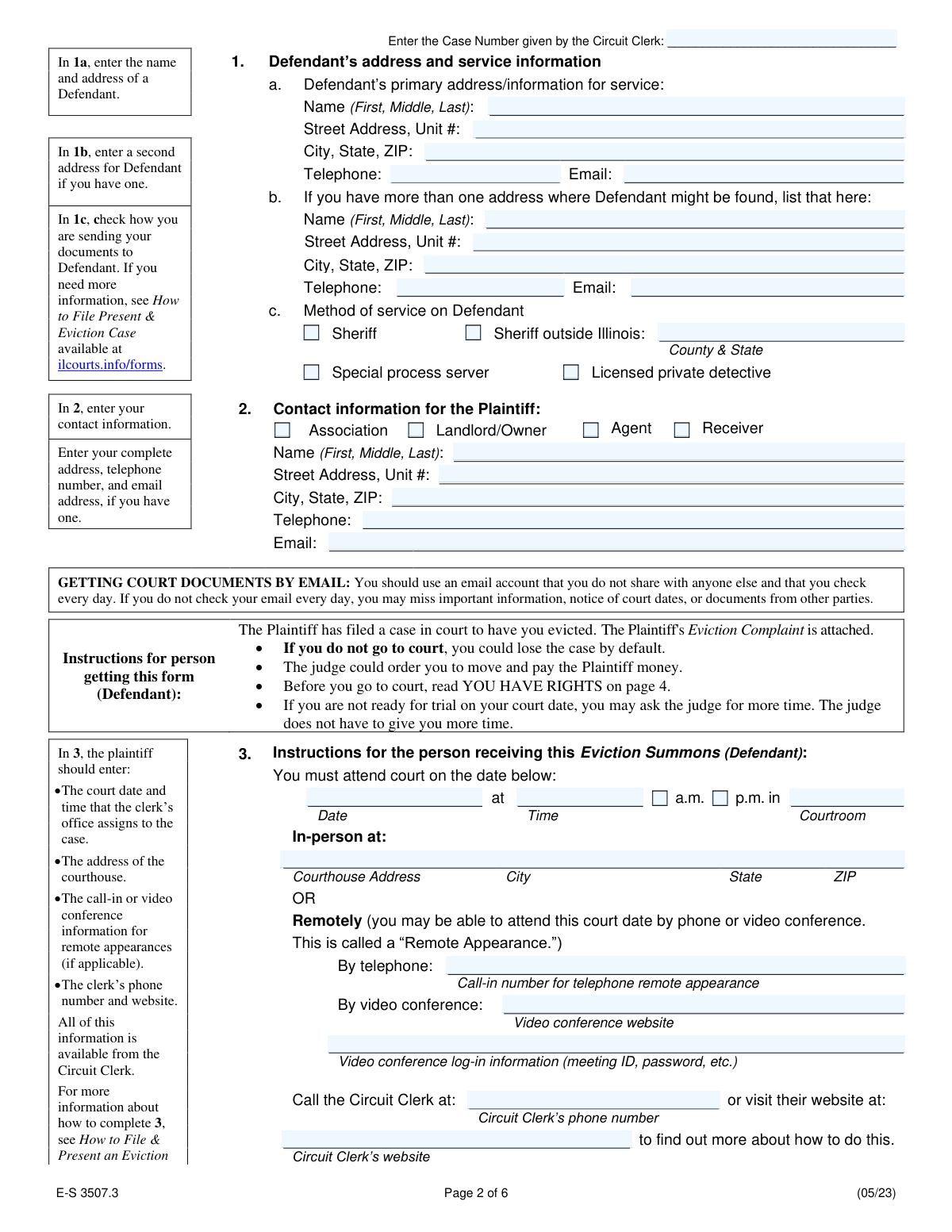
Section 1a requires a complete primary address for the defendant, including Street Address/Unit Number, City, State, and ZIP code — all of which must be filled in. This address is used by the sheriff or process server to locate and serve the defendant, making it a legally critical field. An incomplete or missing primary address would prevent proper service of the summons, which is a due process requirement, and could result in the case being dismissed or delayed.
Exactly one method of service must be selected from the available options in Section 1c: Sheriff, Sheriff outside Illinois, Special process server, or Licensed private detective. If 'Sheriff outside Illinois' is selected, the County and State field must also be populated. Leaving no method selected or selecting multiple conflicting methods would create ambiguity about who is responsible for serving the summons, potentially resulting in the defendant not being properly served and the case being invalidated.
And 10 more checks
- Plaintiff Role Classification is Required
- Plaintiff Contact Information Completeness
- Court Date Must Be a Valid Future Date
- Court Time and AM/PM Indicator Must Both Be Present
- Courthouse Address or Remote Appearance Information Must Be Provided
- Service Must Occur Within Required Lead Time Before Court Date
- Proof of Service: Exactly One Service Method Must Be Selected
- Substituted Service Recipient Must Be at Least 13 Years Old
- Server Certification Role Must Match Method of Service Selected on Page 1
- Email Address Format Validation for Plaintiff and Defendant
Let AI fill out your E-S 3507.3
No typing. Every field filled in seconds, checked, ready to sign.
How to Fill Out E-S 3507.3 Online for Free in 2026
What the AI walks you through.
- Navigate to Instafill.ai and search for or upload the Illinois Eviction Summons Form E-S 3507.3 to begin filling it out online.
- Enter the county name, plaintiff's name, and all defendant names (including checking the 'Unknown Occupants' box if applicable) in the header section of the form.
- Complete Section 1 by entering the defendant's primary and secondary address information, contact details, and selecting the method of service (Sheriff, special process server, or licensed private detective).
- Fill in Section 2 with the plaintiff's complete contact information, including name, address, telephone number, email, and plaintiff type (landlord/owner, agent, association, or receiver).
- Enter the court date, time, courtroom number, courthouse address, and any remote appearance information (call-in number or video conference details) in Section 3, using information provided by the Circuit Clerk.
- Review the completed form for accuracy, ensure the case number assigned by the Circuit Clerk is entered on all pages, and save or print the form.
- Submit the completed Eviction Summons to the Circuit Court by e-filing through an approved e-filing service provider, and provide copies to the sheriff or process server to complete the Proof of Service section (Pages 5–6) after serving the defendant.
Common Mistakes in Completing E-S 3507.3
The ones the AI is built to catch.
Failing to file a separate Eviction Summons for each defendant
Not checking the 'Unknown Occupants' box when occupants are unidentified
Entering the case number before receiving it from the Circuit Clerk
Providing incomplete or incorrect defendant name and address information
Selecting the wrong or no method of service in Section 1c
Omitting the plaintiff's role/type checkbox in Section 2
Leaving court date, time, or location information incomplete in Section 3
Plaintiff attempting to complete the Proof of Service section
Not serving the summons within the required time before the court date
Using a shared or infrequently checked email address for court communications
Checking 'Alias Summons' incorrectly or forgetting to check it when required
Entering incomplete contact information for the plaintiff in Section 2
Frequently Asked Questions About E-S 3507.3
Is it really free for 7 days?
Can I fill other forms too?
How do I cancel?
How does the AI fill out E-S 3507.3?
What happens to my information?
How complex is E-S 3507.3 to fill out?
What is the Illinois Eviction Summons form (E-S 3507.3) and what is it used for?
Who fills out the Eviction Summons form — the landlord or the court?
What should I do if I receive an Eviction Summons?
What happens if I don't go to court after receiving an Eviction Summons?
Do I need to file an Answer or Response to the Eviction Summons?
What is the 'Unknown Occupants' checkbox on the Eviction Summons, and when should it be used?
How many Eviction Summons forms do I need to fill out if I have multiple Defendants?
How is the Eviction Summons served on the Defendant, and what are the timing requirements?
Can I attend my eviction court date remotely instead of in person?
What if I cannot afford the filing fees for the eviction case?
Do I have the right to a jury trial in an eviction case?
Where can I get free or low-cost legal help if I receive an Eviction Summons?
Can I use AI tools like Instafill.ai to help fill out the Illinois Eviction Summons form?
What if the Eviction Summons PDF is not fillable — can I still complete it digitally?
How do I file the completed Eviction Summons with the court?
Get your E-S 3507.3 filled out by AI
$0 today. Cancel before Oct 30 and you pay nothing.
Other forms like this one
court forms: Form Summons, Supreme Court of New York, Form SC-100, Plaintiff's Claim and ORDER to Go to Small Claims Court, Form AO 240, Application to Proceed in District Court Without Prepaying Fees or Costs, Form AO 239, Application to Proceed in District Court Without Prepaying Fees or Costs, Affidavit for Service by Publication/Posting (Circuit Court of Cook County, Illinois) (CCG 0013 A/B), Petition for Leave to Proceed In Forma Pauperis (Court of Common Pleas of Lehigh County, Pennsylvania, Civil Division), In Forma Pauperis Affidavit/Petition (AOPC 622A) – Pennsylvania Magisterial District Court, Judicial Council of California Form SC-105, Request for Court Order and Answer (Small Claims), SC-120, Defendant’s Claim and ORDER to Go to Small Claims Court (Small Claims), SC-105, Request for Court Order and Answer (Small Claims), Judicial Council of California Form SC-120, Defendant’s Claim and ORDER to Go to Small Claims Court (Small Claims), In Forma Pauperis Affidavit Petition (AOPC 622A) — Pennsylvania Magisterial District Court, Florida Supreme Court Approved Family Law Form 12.901(b)(3), Petition for Dissolution of Marriage with No Dependent or Minor Child(ren) or Property (02/18), Illinois Supreme Court Approved Form E-O 3500.3, Eviction Order, Form P3 (Rule 25-3(2)) — Affidavit of Applicant for Grant of Probate or Grant of Administration with Will Annexed (Short Form) (Supreme Court of British Columbia), Form SC-100, Plaintiff’s Claim and ORDER to Go to Small Claims Court, Designation of Record on Appeal (Civil) (Maricopa County Justice Courts, Arizona) (Form APP 8150-702), FW-003, Order on Court Fee Waiver (Superior Court), Judicial Council of California Form SER-001, Request for Sheriff to Serve Court Papers, FW-003, Order on Court Fee Waiver (Superior Court)
Illinois court forms: Affidavit for Service by Publication/Posting (Circuit Court of Cook County, Illinois) (CCG 0013 A/B), Illinois Supreme Court Approved Form E-O 3500.3, Eviction Order, Circuit Court of Cook County, Illinois, Form CCM 0346, Order/Trial Call
eviction forms: Illinois Supreme Court Approved Form E-O 3500.3, Eviction Order, Affidavit - Supporting Documents Not Attached to Eviction Complaint, Illinois Eviction Order, Form SUM-130, Summons - Unlawful Detainer - Eviction, Illinois Eviction Complaint (06/24), Illinois Eviction Complaint (08/20)
UK court forms: Form Summons, Supreme Court of New York, Form SC-100, Plaintiff's Claim and ORDER to Go to Small Claims Court, Form AO 240, Application to Proceed in District Court Without Prepaying Fees or Costs, Form AO 239, Application to Proceed in District Court Without Prepaying Fees or Costs, Affidavit for Service by Publication/Posting (Circuit Court of Cook County, Illinois) (CCG 0013 A/B), Petition for Leave to Proceed In Forma Pauperis (Court of Common Pleas of Lehigh County, Pennsylvania, Civil Division), In Forma Pauperis Affidavit/Petition (AOPC 622A) – Pennsylvania Magisterial District Court, Judicial Council of California Form SC-105, Request for Court Order and Answer (Small Claims), SC-120, Defendant’s Claim and ORDER to Go to Small Claims Court (Small Claims), SC-105, Request for Court Order and Answer (Small Claims), Judicial Council of California Form SC-120, Defendant’s Claim and ORDER to Go to Small Claims Court (Small Claims), In Forma Pauperis Affidavit Petition (AOPC 622A) — Pennsylvania Magisterial District Court, Florida Supreme Court Approved Family Law Form 12.901(b)(3), Petition for Dissolution of Marriage with No Dependent or Minor Child(ren) or Property (02/18), Illinois Supreme Court Approved Form E-O 3500.3, Eviction Order, Form P3 (Rule 25-3(2)) — Affidavit of Applicant for Grant of Probate or Grant of Administration with Will Annexed (Short Form) (Supreme Court of British Columbia), Form SC-100, Plaintiff’s Claim and ORDER to Go to Small Claims Court, Designation of Record on Appeal (Civil) (Maricopa County Justice Courts, Arizona) (Form APP 8150-702), FW-003, Order on Court Fee Waiver (Superior Court), Judicial Council of California Form SER-001, Request for Sheriff to Serve Court Papers, FW-003, Order on Court Fee Waiver (Superior Court)
circuit court forms: Affidavit for Service by Publication/Posting (Circuit Court of Cook County, Illinois) (CCG 0013 A/B), Circuit Court of Cook County, Illinois, Form CCM 0346, Order/Trial Call, Form MC 60, Notice of Record Return from Circuit Court/Court of Appeals
proof of service forms: Form POS-040, Proof of Service—Civil, Judicial Council of California Form SC-104, Proof of Service (Small Claims), Judicial Council of California Form SC-104, Proof of Service (Small Claims), Form DV-200, Proof of Personal Service (CLETS) (Domestic Violence Prevention), proof-of-electronic-service-appellate, Form APP-009, Proof of Service (Appellate Division), Form APP-109, Proof of Service (Appellate Division), Form GC-020(P), PROOF OF PERSONAL SERVICE OF NOTICE OF HEARING— GUARDIANSHIP OR CONSERVATORSHIP, Form APP-109E, Proof of Electronic Service (Appellate Division), Proof of Personal Service of Notice of Initial Appearance—CARE Act Proceedings, Form CARE-116, Proof of Personal Service of Notice of Hearing—CARE Act Proceedings, Form CR-106, Proof of Service — Criminal Record Clearing, CARE-107, Proof of Personal Service of Notice of Order for CARE Act Report, Form CIV-120, Notice of Entry of Dismissal and Proof of Service, Form DAL-012, Proof of Service—Disability Access Litigation, Form DE-120(P), Proof of Personal Service of Notice of Hearing—Decedent's Estate or Trust, Form EA-200, Proof of Personal Service (Elder or Dependent Adult Abuse Prevention), Form EA-260, Proof of Service of Order After Hearing by Mail (Elder or Dependent Adult Abuse Prevention), Form FL-115, Proof of Service of Summons (Family Law—Uniform Parentage—Custody and Support), Form CR-401, Proof of Service for Petition/Application Under Health and Safety Code Section 11361.8—Adult Crimes
complaint forms: NCR Form 29, Complaint Initiation Form, Form UD-100, Complaint—Unlawful Detainer, Form NYS DHR, Employment Complaint Form, Form ADM 140, Language Access Complaint, Form 4, Complaint against a certificated bailiff, State of New Mexico Workers’ Compensation Administration — Workers' Compensation Complaint (Rev. 8/22) (11.4.4.9 NMAC), Murrieta Police Department Citizen Complaint Form (California Penal Code § 148.6 Advisory Statement), New York State Department of Labor (NYSDOL) Division of Labor Standards Complaint Form (LS 223), New York State Department of Labor, Division of Labor Standards Complaint Form (LS 223), AOPC 308A, Civil Complaint, Consumer Complaint Form - Office of the Arizona Attorney General, Minimum Wage Ordinance (MWO) Complaint Intake Form, Affidavit - Supporting Documents Not Attached to Eviction Complaint, Judicial Council of California Form UD-100, Complaint—Unlawful Detainer, Form CMS-10287, Medicare Beneficiary Complaint Form, CMS Survey and Certification Complaint/Revisit Report, Resource Family Complaint Report, Pro Se 7, Complaint for Employment Discrimination, Form DC-CV-001, Complaint/Application and Affidavit in Support of Judgment, Illinois Eviction Complaint (06/24)
Let AI fill out your E-S 3507.3
Your trial starts once a card is added. You pay nothing before Oct 30.
Our AI already knows this form, all 140 fields of it. Skip the typing: tell it about yourself, or upload what you have, and it fills the whole form in seconds.
- AI fills every field on all 6 pages, checkboxes included
- No typing into boxes: answer a few questions, or upload a document you already have, an old copy of this form, a photo of a document
- The AI checks the answers; you review and change anything before you download
- Download the finished PDF, print it, or sign it online
- Encrypted, and never used to train AI
Cancel before Oct 30 and you pay nothing.
A card is needed to start the trial. Cancel in two clicks from your account.
Terms · Privacy