Fill out eviction forms
with AI.
Eviction forms are the essential legal documents used to initiate or finalize the legal removal of a tenant from a property. They represent the formal process required by law to regain possession of a rental unit, ensuring that the rights of both landlords and tenants are documented and protected throughout the proceedings. Whether it is an initial summons to notify a tenant of a pending case or a final eviction order issued by the court, these documents are the backbone of any landlord-tenant dispute. Accuracy is paramount in these filings, as even minor errors in names or dates can lead to significant delays or the dismissal of a case in court.
By continuing, you acknowledge Instafill's Privacy Policy and agree to get occasional product update and promotional emails.
About eviction forms
These forms are primarily utilized by property owners, landlords, and legal professionals who need to navigate the complexities of local housing laws. Common situations requiring this paperwork include non-payment of rent, lease violations, or the expiration of a tenancy where the occupant refuses to vacate. For instance, a landlord might use an Eviction Summons to officially start a lawsuit, while an Eviction Order is necessary to conclude the case and authorize a move-out deadline. Having access to court-approved documentation helps ensure that all parties follow the correct judicial procedures.
Navigating the legal system can be time-consuming, especially when dealing with strict deadlines and precise filing requirements. Tools like Instafill.ai use AI to fill these forms in under 30 seconds, handling the data accurately and securely to ensure your paperwork is ready for the court. This provides a practical way to save time and reduce the stress of manual data entry during a legal process.
Every form on this page can be completed without typing. Instafill is form filling software that reads a PDF and fills it for you — including flat and scanned documents that carry no fillable fields at all.
Forms in This Category
The forms in this category have a median Form Complexity Index of 44/100 (Basic), measured across 7 forms by field count, input difficulty, length, conditional logic and structure. See how it is calculated.
| Form Name | Pages | FCI | |
|---|---|---|---|
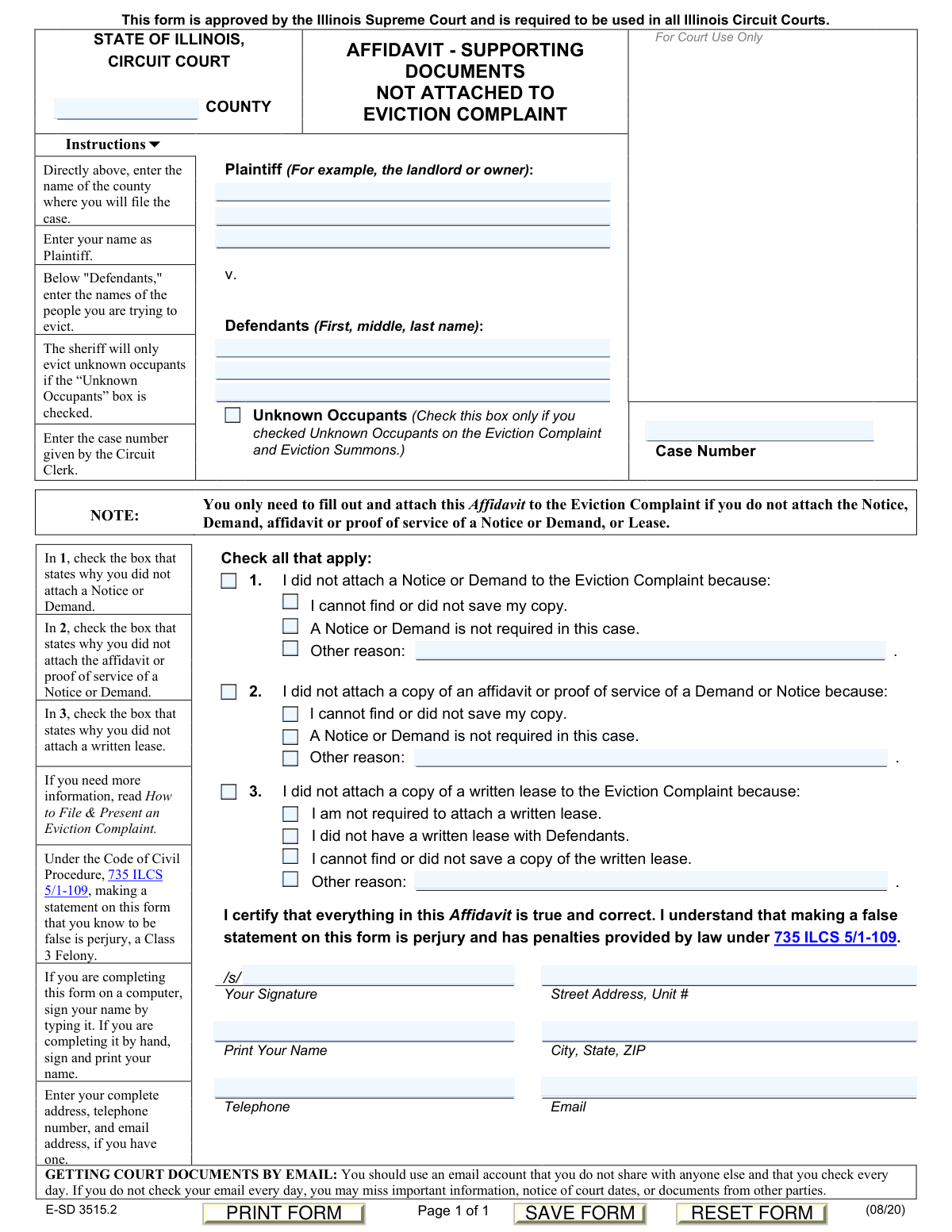
| 1. | Affidavit - Supporting Documents Not Attached to Eviction Complaint | 1 | Basic 40 |
| 2. | Form SUM-130, Summons - Unlawful Detainer - Eviction | 2 | Basic 41 |
| 3. | Illinois Circuit Court Eviction Summons and Proof of Service of Eviction Summons & Eviction Complaint (Form E-S 3507.3) | 6 | Moderate 58 |
| 4. | Illinois Eviction Complaint (06/24) | 2 | Basic 44 |
| 5. | Illinois Eviction Complaint (08/20) | 2 | Basic 44 |
| 6. | Illinois Eviction Order | 2 | Moderate 60 |
| 7. | Illinois Supreme Court Approved Form E-O 3500.3, Eviction Order | 2 | Moderate 53 |
- Enterprise-grade security & data encryption
- 99%+ accuracy powered by AI
- 1,000+ forms from all industries
- Complete forms in under 60 seconds
How to Choose the Right Form
Navigating the eviction process in Illinois requires specific legal documents approved by the Illinois Supreme Court. Choosing the right form depends primarily on whether you are just beginning the legal action or are at the point of finalizing a court judgment.
Starting a Case: The Summons
If you have already served a preliminary termination notice (such as a 5-day or 30-day notice) and the tenant has not vacated the property, your next step is to file a lawsuit in the Circuit Court. For this stage, you need the Illinois Circuit Court Eviction Summons and Proof of Service (Form E-S 3507.3).
- Purpose: To officially notify the tenant that an eviction case has been filed and to provide them with their mandatory court appearance information.
- Key Components: This form includes the "Proof of Service" section, which must be completed by a sheriff or authorized process server to document that the tenant was legally notified.
- Critical Timing: Note that this summons must be served at least 3 days before the court date, or 7 days if the case is located in Cook County.
Finalizing a Case: The Eviction Order
If you have already attended your court hearing and the judge has ruled in your favor—or if you have reached a formal agreement with the tenant—you need the document that makes the decision enforceable. You should use the Illinois Supreme Court Approved Eviction Order (Form E-O 3500.3).
- Purpose: This is the final judgment signed by the judge. It officially grants possession of the property back to the landlord.
- Key Components: The form sets a specific move-out deadline and authorizes the sheriff to perform an eviction if the defendants do not leave by that date. It also includes sections for money judgments regarding unpaid rent, court costs, and attorney’s fees.
- Use Case: This form is used at the conclusion of a trial, a compliance hearing, or when a default judgment is entered because the tenant failed to appear.
Using these standardized forms ensures your filings meet state requirements and are accepted in any Illinois Circuit Court. Instafill.ai can help you accurately populate these documents to ensure your legal process stays on track.
Form Comparison
| Form | Purpose | Timing | Key Content |
|---|---|---|---|
| Illinois Supreme Court Approved Form E-O 3500.3, Eviction Order | Finalizes the eviction case and grants possession to the landlord. | At the conclusion of the case after a hearing or trial. | Move-out deadline, money judgments, and sheriff authorization for eviction. |
| Illinois Circuit Court Eviction Summons and Proof of Service of Eviction Summons & Eviction Complaint (Form E-S 3507.3) | Formally notifies the defendant of the eviction lawsuit and court date. | At the start of the case to initiate legal proceedings. | Court appearance details, defendant's rights, and documentation of service. |
Tips for eviction forms
Double-check that the names of all tenants and the property address exactly match what is listed on the original lease agreement. Inconsistencies between the Eviction Summons and the final Eviction Order can lead to delays or the court requiring you to refile your paperwork.
The Eviction Summons must be served to the defendant within specific timeframes—usually three to seven days before the court date depending on the county. Failing to meet these strict legal timelines often results in the judge dismissing the case, forcing you to start the process over.
AI-powered tools like Instafill.ai can complete complex eviction forms in under 30 seconds with high accuracy, ensuring no critical fields are missed. Your data stays secure during the process, providing a reliable and efficient way to manage multiple forms when dealing with several properties or tenants.
After the summons is delivered, ensure the sheriff or process server fully completes the Proof of Service section on the summons form. Without this documented proof, the court has no legal confirmation that the tenant was properly notified, and you will be unable to proceed with a judgment.
When filling out the Eviction Order, clearly specify whether you are seeking only possession of the property or also a money judgment for back rent and legal fees. Separating these amounts clearly helps the court clerk record the judgment accurately for future credit reporting or collection efforts.
Once the judge signs the final Eviction Order, you will need multiple copies for the local sheriff to execute the move-out. Keeping a digital file of your completed forms allows you to quickly print extra copies if the sheriff requires additional documentation for their specific enforcement records.
Frequently Asked Questions
To initiate an eviction, you generally need an Eviction Complaint and an Eviction Summons, such as Form E-S 3507.3. The summons is the official notice to the tenant that a lawsuit has been filed and provides mandatory information on when and where they must appear in court.
Once the Summons is prepared and filed, it must be served by a sheriff or a licensed process server. The Proof of Service section included with the form is then completed by the server to document exactly how and when the defendant received the legal notice.
An Eviction Order, such as Illinois Form E-O 3500.3, is issued at the conclusion of the case, whether that happens after a trial, a default judgment, or a settlement agreement. This document officially grants possession of the property back to the landlord and sets a specific deadline for the tenant to move out.
Yes, these are Illinois Supreme Court-approved forms designed for use in all Circuit Courts throughout the state. While local rules for filing fees or specific scheduling may vary, the content of these standardized forms must be accepted by all Illinois court clerks.
The specific move-out date is determined by the judge and recorded directly on the Eviction Order. If the tenant fails to vacate by that deadline, the order authorizes the local sheriff to carry out the eviction and restore possession to the landlord.
If a defendant fails to appear in court after being properly served, the judge may enter a default judgment against them. This typically leads to the issuance of an Eviction Order in favor of the plaintiff, which can significantly impact the defendant's credit and housing history.
Yes, AI-powered tools like Instafill.ai can be used to fill out eviction forms by accurately extracting data from your source documents and placing it into the required fields. This process ensures that case numbers, names, and property details are consistent across all court documents.
Using AI-powered services like Instafill.ai, these forms can be completed in under 30 seconds. This is much faster than manual entry and helps prevent clerical errors that could lead to delays in the judicial process.
The Illinois Eviction Order form includes specific sections to address money judgments for past-due rent, court costs, and attorney’s fees. It is important to ensure the amounts requested in the final order match the evidence presented during the case.
The Proof of Service is a legal requirement that proves to the court that the defendant was notified of the lawsuit in accordance with state law. Without a properly completed and filed Proof of Service, the court may not have the authority to move forward with the eviction hearing.
These standardized Illinois forms are used for various eviction scenarios within the Circuit Court system. While they are most common in residential cases, they are also the standard instruments for regaining possession of property in other landlord-tenant contexts.
While individuals are permitted to represent themselves (pro se) and use these approved forms, the eviction process is strictly regulated. Many users choose to use automated tools to ensure their paperwork is accurate, but consulting with a legal professional is recommended for complex disputes or corporate landlords.
Glossary
- Form Complexity Index
- Instafill’s 0–100 measure of how much effort a form takes to complete, calculated deterministically from the form’s own structure rather than estimated. It combines the number of fillable fields (the largest factor), how difficult those fields are to complete based on their type, the number of pages that contain fields, the amount of conditional “fill-only-if” logic, and how many sections the form is divided into, then adds modifiers for tables and repeating lists, bundled instruction pages, and dense page layouts. A higher score means the form is harder to fill out by hand. The forms in this category have a median Form Complexity Index of 44/100 (Basic). See exactly how it is calculated.
- Summons
- A formal legal document that notifies a tenant they are being sued and provides instructions on when and where they must appear in court.
- Plaintiff
- The person or entity, usually a landlord or property owner, who initiates a lawsuit to regain possession of a property.
- Defendant
- The person or entity, typically the tenant or occupant, who is being sued and must answer the allegations in an eviction case.
- Possession
- The legal right to occupy a property; in eviction cases, the primary goal of the landlord is to obtain a court order for possession.
- Money Judgment
- A court's decision that the defendant owes the plaintiff a specific amount of money for unpaid rent, damages, or legal fees.
- Proof of Service
- A signed document that provides evidence to the court that the defendant was properly notified of the lawsuit in accordance with the law.
- Default Judgment
- A ruling issued by a judge in favor of the landlord when a tenant fails to appear in court or file a response by the required deadline.
- Compliance Hearing
- A scheduled court date where a judge reviews the case to ensure that both parties have followed the terms of a previous agreement or court order.