Fill out Cook County forms
with AI.
Cook County forms represent the administrative and legal requirements for one of the largest unified court systems in the United States. These documents are essential for initiating lawsuits, responding to motions, and fulfilling statutory requirements within the Circuit Court of Cook County. Whether you are filing an Affidavit for Service by Publication or managing other civil litigation paperwork, these standardized forms ensure that the court has a clear, legally compliant record of your claims and actions.
By continuing, you acknowledge Instafill's Privacy Policy and agree to get occasional product update and promotional emails.
About Cook County forms
Most often, these forms are utilized by legal professionals and self-represented litigants who must navigate the specific procedural rules of the Illinois court system. Accuracy is critical in these situations, as a single error in a legal affidavit or a filing notice can lead to significant delays or the challenge of a service. For example, documenting a 'diligent inquiry' for service of process is a precise legal requirement that must be handled with care to satisfy Illinois Compiled Statutes and move a case forward.
Managing this volume of paperwork manually can be a tedious process prone to human error. Tools like Instafill.ai use AI to fill these Cook County forms in under 30 seconds, ensuring that data is handled accurately and securely while saving you time on repetitive administrative tasks.
Every form on this page can be completed without typing. Instafill is form filling software that reads a PDF and fills it for you — including flat and scanned documents that carry no fillable fields at all.
Forms in This Category
The forms in this category have a median Form Complexity Index of 64/100 (Complex), measured across 2 forms by field count, input difficulty, length, conditional logic and structure. See how it is calculated.
| Form Name | Pages | FCI | |
|---|---|---|---|
| 1. | Affidavit for Service by Publication/Posting (Circuit Court of Cook County, Illinois) (CCG 0013 A/B) | 2 | Basic 38 |
| 2. | Circuit Court of Cook County, Illinois, Form CCM 0346, Order/Trial Call | 1 | Complex 64 |
- Enterprise-grade security & data encryption
- 99%+ accuracy powered by AI
- 1,000+ forms from all industries
- Complete forms in under 60 seconds
How to Choose the Right Form
Navigating the Circuit Court of Cook County requires precision, especially when it comes to notifying other parties involved in your case. In Illinois, "service of process" is a fundamental legal requirement. While personal service is the standard, there are specific instances where you may need to use alternative methods to move your case forward.
When to Use the Affidavit for Service by Publication
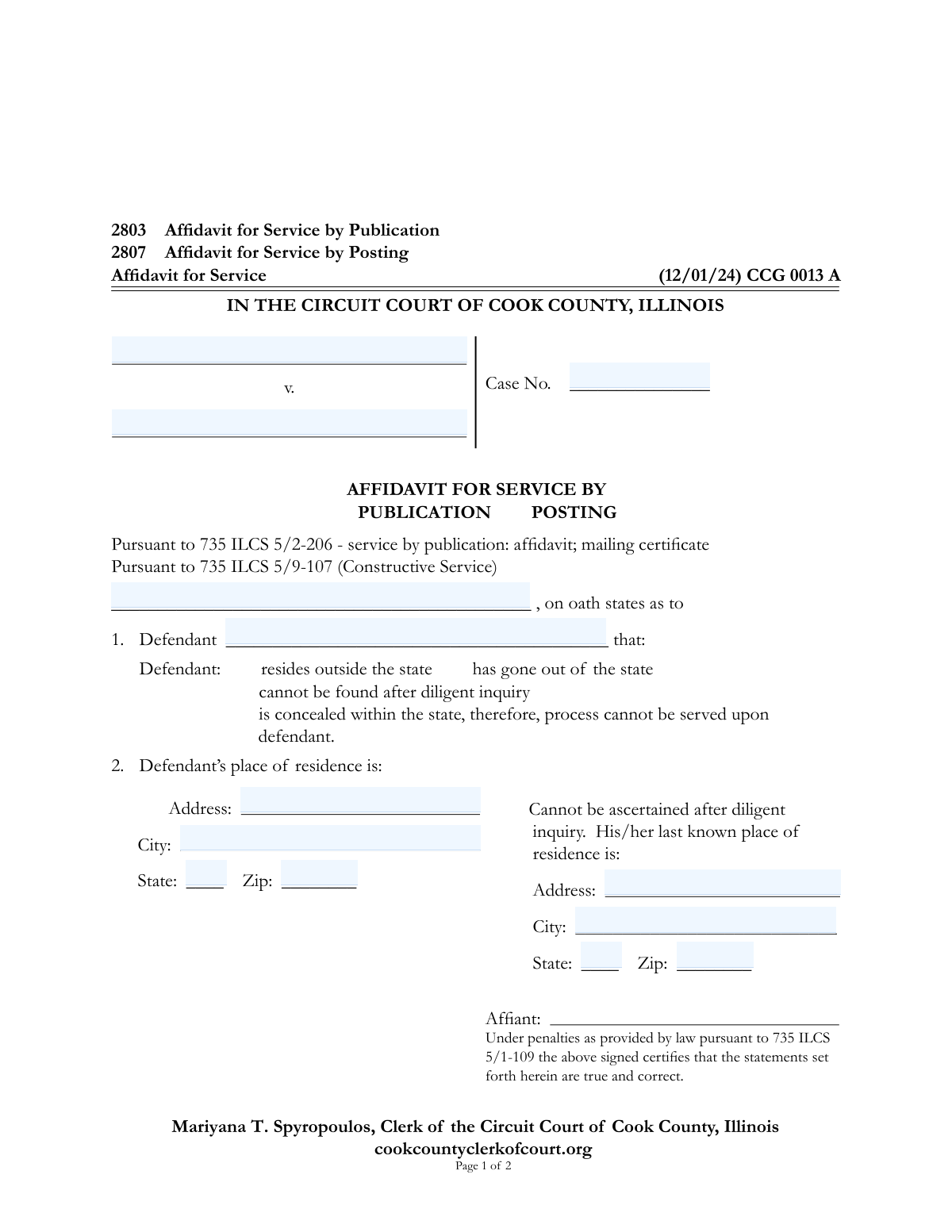
The Affidavit for Service by Publication/Posting (CCG 0013 A/B) is the essential form for litigants who are unable to serve a defendant through traditional means. You should select this form if your situation meets one of the following criteria:
- Unknown Residence: You have performed a "diligent inquiry" to find the defendant, but their whereabouts remain unknown.
- Concealment: The defendant is intentionally hiding within the state of Illinois to avoid being served with legal papers.
- Out-of-State Defendants: The defendant resides outside of Illinois, and you are seeking to satisfy the requirements for constructive service under 735 ILCS 5/2-206.
Key Considerations for Cook County Forms
Because this is a legal affidavit form, accuracy is paramount. When filling out the CCG 0013 A/B on Instafill.ai, keep the following in mind:
- Diligent Inquiry: You must be prepared to explain the steps you took to find the defendant. The court requires proof that you attempted to locate them through reasonable searches before allowing publication.
- Legal Penalties: This form is signed under penalty of perjury. Ensure all residence information provided—or the explanation for its absence—is truthful and documented.
- Case Type: This form is frequently used in eviction cases (under 735 ILCS 5/9-107) and other civil matters where the defendant cannot be reached.
Choosing the Affidavit for Service by Publication/Posting is a critical step in ensuring your case isn't delayed by service issues. Using our AI-assisted tool helps you complete these complex Illinois court forms accurately, ensuring you meet the strict statutory requirements of the Cook County court system.
Form Comparison
| Form | Primary Purpose | Filing Party | Required Conditions | Legal Authority |
|---|---|---|---|---|
| Affidavit for Service by Publication/Posting (Circuit Court of Cook County, Illinois) (CCG 0013 A/B) | Requests court permission to serve a defendant through public notice or posting. | The plaintiff or their legal representative seeking service on a defendant. | Use when personal service is impossible because the defendant is concealed or unlocatable. | Filed under 735 ILCS 5/2-206 and 735 ILCS 5/9-107 for constructive service. |
Tips for Cook County forms
In Cook County, you must demonstrate that you made a genuine effort to locate the defendant before opting for service by publication. Keep a record of the databases, public records, or individuals you consulted, as the court may require proof of these efforts to validate the affidavit.
Ensure your case number strictly follows the format used by the Circuit Court of Cook County, including the year and division codes. An incorrect case number can lead to filing rejections or cause your documents to be attached to the wrong legal matter.
AI-powered tools like Instafill.ai can complete these Cook County forms in under 30 seconds with high accuracy, serving as a major time-saver for those handling multiple legal filings. Your data stays completely secure during the process, ensuring privacy while you streamline your paperwork.
Many Cook County forms use Section 1-109 of the Illinois Code of Civil Procedure for certification instead of a traditional notary seal. This means your signature is a sworn statement under penalty of law, so it is vital to verify all information is truthful before submitting the form.
If you are stating that a defendant’s residence is unknown or they are concealing their whereabouts, provide as much detail as possible regarding their last known location. Vague or incomplete information can lead to the service being challenged later, potentially delaying your entire case.
Before submitting your affidavit to the Clerk of the Circuit Court, ensure it is bundled with any necessary supplemental documents like the original summons. Proper organization helps the clerk process your request for publication or posting more efficiently and prevents administrative delays.
Frequently Asked Questions
Cook County court forms are standardized legal documents used to initiate or respond to legal actions within the Circuit Court of Cook County. These forms ensure that all necessary information is presented to the court in a format that complies with Illinois legal statutes and local court rules.
This specific affidavit is required when a plaintiff is unable to serve a defendant personally because the individual cannot be found, is concealing themselves, or resides out of state. It serves as a sworn statement to the court explaining why traditional service methods failed and why public notice is necessary to move the case forward.
Legal affidavits in Illinois generally require the name and contact information of the person making the statement, a clear explanation of the facts being sworn to, and a signature. For Cook County forms specifically, you may need to provide details about the defendant's last known address or document your efforts to locate them.
Yes, you can use AI tools like Instafill.ai to complete Cook County forms quickly and accurately. These tools can extract data from your existing documents and place it into the correct fields of the PDF form in under 30 seconds, reducing the risk of manual entry errors.
While manual entry can take significant time, using an AI-powered platform allows you to complete these legal forms in less than a minute. The AI accurately maps your information to the required fields, ensuring the document is ready for review and filing almost immediately.
When you sign a Cook County form pursuant to 735 ILCS 5/1-109, you are certifying that the statements made in the document are true to the best of your knowledge. Providing false information under this certification can lead to legal consequences, including potential perjury charges.
Completed forms are typically filed with the Clerk of the Circuit Court of Cook County at the specific courthouse where your case is being heard. Most filers are now required to submit their documents through the Illinois e-filing system, though certain exemptions may apply depending on your situation.
A diligent inquiry involves making a genuine, documented effort to find a defendant, such as searching public records, checking social media, or contacting known associates. The court requires this proof to ensure that you have exhausted reasonable options for personal service before resorting to publication.
Inaccuracies in court forms can lead to the Clerk's office rejecting your filing or the judge dismissing your motion. Specifically for service forms, errors can result in the service being challenged later, which may cause significant delays or even void a court's judgment.
The person with personal knowledge of the facts described in the document, known as the affiant, must sign the affidavit. Depending on the specific form, this is usually the plaintiff, their attorney, or a person who has conducted a search for the defendant's whereabouts.
Glossary
- Form Complexity Index
- Instafill’s 0–100 measure of how much effort a form takes to complete, calculated deterministically from the form’s own structure rather than estimated. It combines the number of fillable fields (the largest factor), how difficult those fields are to complete based on their type, the number of pages that contain fields, the amount of conditional “fill-only-if” logic, and how many sections the form is divided into, then adds modifiers for tables and repeating lists, bundled instruction pages, and dense page layouts. A higher score means the form is harder to fill out by hand. The forms in this category have a median Form Complexity Index of 64/100 (Complex). See exactly how it is calculated.
- Service by Publication
- A legal method of notifying a defendant about a lawsuit by publishing a notice in a newspaper when the defendant cannot be located for personal service.
- Affiant
- The person who signs the affidavit and swears under penalty of perjury that the information contained in the document is true.
- Diligent Inquiry
- The required effort a plaintiff must make to locate a defendant's current address or whereabouts before the court permits alternative service methods.
- Constructive Service
- A legal substitute for personal service, such as publication or posting, used to notify a party of a court action when they cannot be physically served.
- Service by Posting
- A method of notifying a defendant by physically placing the notice in a designated public area or on the property, typically used in specific cases like evictions.
- 735 ILCS 5/1-109
- The Illinois statute that allows a person to certify that a court document is true without needing a notary public, provided they sign it under penalty of perjury.
- Ascertain
- The legal requirement to successfully find out or determine a defendant's residence or location through a thorough search.
- CCG
- An abbreviation for 'Cook County General,' which identifies standardized forms used across the various divisions of the Circuit Court of Cook County.