Fill out CLETS forms
with AI.
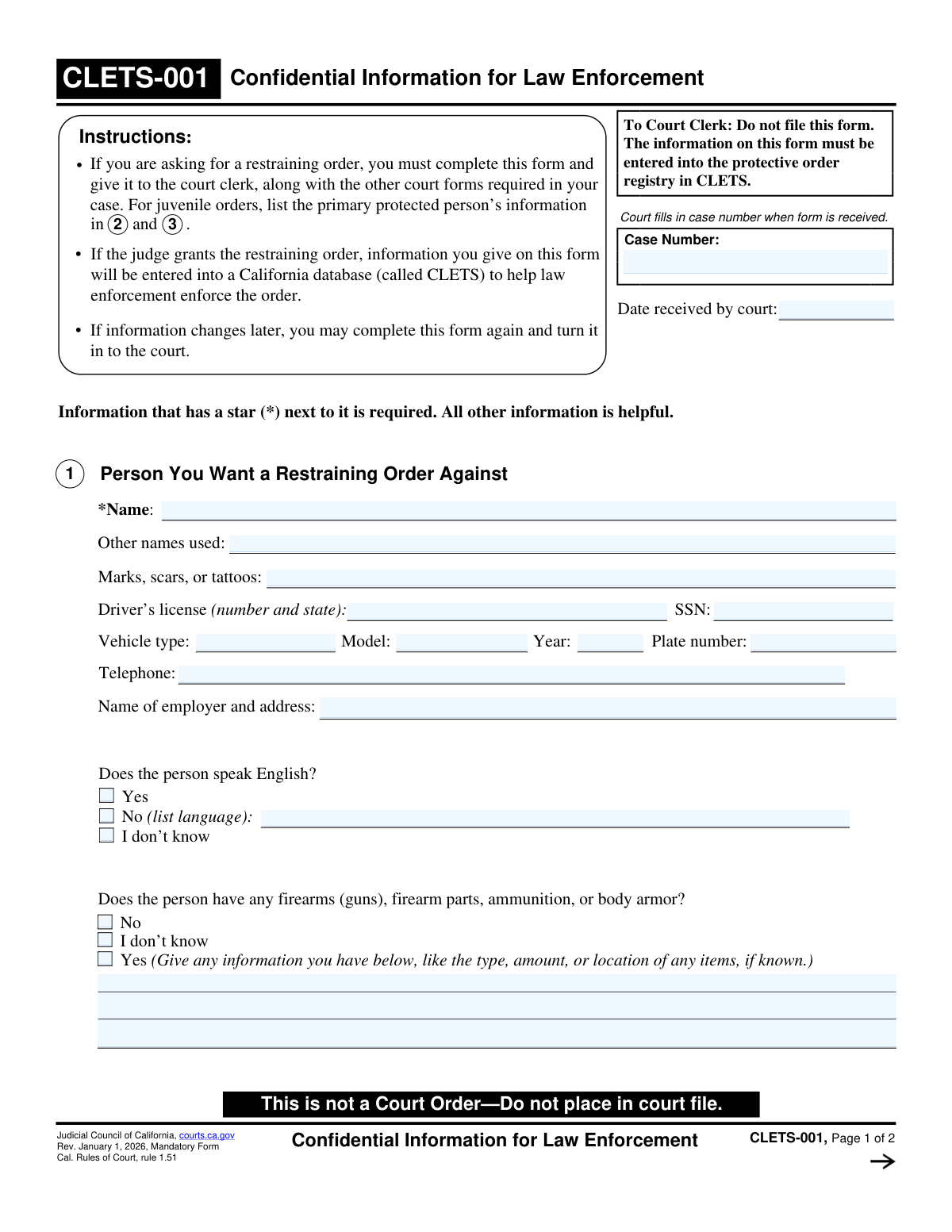
CLETS forms are a specific set of California court documents used in connection with restraining orders and domestic violence protective orders. The name refers to the California Law Enforcement Telecommunications System, a statewide database that allows police officers and other law enforcement agencies to quickly verify and enforce active restraining orders. When a California court issues a protective order, key information about the restrained person and protected parties must be entered into this system — and that's where these forms come in. They capture identifying details like dates of birth, physical descriptions, vehicle information, and employer details that help officers accurately identify individuals in the field, sometimes even outside of California.
By continuing, you acknowledge Instafill's Privacy Policy and agree to get occasional product update and promotional emails.
About CLETS forms
These forms are typically needed by people seeking restraining orders in family law or domestic violence cases, as well as the attorneys and court staff who assist them. The CLETS-001 form, for example, is a mandatory companion to nearly any restraining order filing in California, while the DV-200 documents that the restrained person was properly served with the order. Because these forms deal with sensitive personal information, accuracy and completeness are critical — incomplete entries can affect how effectively an order is enforced.
For anyone navigating the restraining order process, filling out these forms correctly under stress can be challenging. Tools like Instafill.ai use AI to fill these forms in under 30 seconds, handling the details accurately while keeping your information secure.
Every form on this page can be completed without typing. Instafill is form filling software that reads a PDF and fills it for you — including flat and scanned documents that carry no fillable fields at all.
Forms in This Category
The forms in this category have a median Form Complexity Index of 51/100 (Moderate), measured across 7 forms by field count, input difficulty, length, conditional logic and structure. See how it is calculated.
- Enterprise-grade security & data encryption
- 99%+ accuracy powered by AI
- 1,000+ forms from all industries
- Complete forms in under 60 seconds
How to Choose the Right Form
Most visitors to this page are dealing with a California restraining order — either filing for one or documenting that it was served. Here's how to quickly identify which form you need.
Submitting Confidential Details with a Restraining Order
All three versions of CLETS-001, Confidential Information for Law Enforcement serve the same core purpose: providing the court clerk with private identifying details about the restrained person and protected parties so that information can be entered into the California Law Enforcement Telecommunications System (CLETS).
- Use CLETS-001 if you are filing *any* type of California restraining order — domestic violence, civil harassment, elder abuse, or workplace violence.
- This form is mandatory and must be submitted alongside your restraining order paperwork.
- It is not placed in the public court file — it goes directly to the clerk for CLETS entry.
- If identifying details change after the order is granted (new vehicle, address, employer), you can resubmit an updated CLETS-001.
All three listings of CLETS-001 in this category represent the same Judicial Council form. Choose any one to get started.
Proving the Restrained Person Was Served
- Use Form DV-200, Proof of Personal Service (CLETS) if you need to document that copies of the restraining order documents were hand-delivered to the restrained party.
- This form is completed by the process server (not the protected person) and filed with the court to confirm service occurred.
- It applies specifically to domestic violence restraining order cases under California Family Code §§ 243, 245, and 6345.
Quick Summary
| Situation | Form to Use |
|---|---|
| Filing a restraining order (any type) | CLETS-001 |
| Updating identifying info after order is granted | CLETS-001 |
| Documenting personal service on the restrained party | DV-200 |
If you're at the beginning of the restraining order process, start with CLETS-001. Once the order is served, return for DV-200.
Form Comparison
| Form | Purpose | Who Files It | When to Use |
|---|---|---|---|
| CLETS-001, Confidential Information for Law Enforcement (Judicial Council of California) | Provide confidential identifying details for CLETS protective order registry | Person requesting the restraining order | Submitted with every restraining order application |
| Form DV-200, Proof of Personal Service (CLETS) (Domestic Violence Prevention) | Certify that restrained person was personally served with restraining order documents | Process server or qualified adult who served the documents | After restrained party is personally served with domestic violence order |
Tips for CLETS forms
The CLETS-001 form is confidential and must NOT be placed in the public court file — it goes directly to the clerk for law enforcement entry. Submitting it incorrectly alongside public documents can compromise the privacy of the protected parties. Always hand it to the clerk separately and confirm it will be routed for CLETS entry.
Law enforcement relies on the information in CLETS-001 to identify and locate the restrained person, so incomplete entries — like missing date of birth, physical description, or vehicle information — can hinder enforcement, especially outside California. Fill in every field you have access to, even if it seems minor. Accurate details like employer address or known languages can make a real difference in an emergency.
If the restrained person changes their address, vehicle, or employer after the order is issued, you can and should resubmit an updated CLETS-001 to the court. Outdated information in the CLETS registry can prevent officers from enforcing the order effectively. Keep a copy of any updates you submit so you have a record of what was filed and when.
Form DV-200 (Proof of Personal Service) must be filled out and signed by the person who actually served the documents — typically a process server or another adult who is not a party to the case. The protected person cannot serve the restrained person themselves. Make sure the server records the exact date, time, and location of service, as these details are legally significant.
Once the restrained person has been personally served, file the completed DV-200 with the court as soon as possible. A restraining order can only be fully enforced once the restrained party has been served, and the court needs the proof of service on file to confirm this. Delays in filing can create gaps in legal protection.
AI-powered tools like Instafill.ai can fill out CLETS forms — including CLETS-001 and DV-200 — with high accuracy in under 30 seconds, which is a major time-saver when you're managing multiple restraining order documents at once. Instafill.ai can also convert non-fillable PDF versions into interactive forms, so you're never stuck trying to type over a static document. Your data stays secure throughout the process.
When serving the restrained person, make sure all required documents are included — typically the restraining order itself, any accompanying orders, and notice of the hearing date. The DV-200 form has a checklist of documents served, and each item must be accurately recorded. Missing even one document in the service packet can create complications in court.
Because CLETS-001 is confidential and not part of the public record, you won't be able to retrieve it easily from the court file later. Keep a personal copy of every CLETS form you submit, along with any confirmation from the clerk. This is especially important if you need to update the form or reference it in future legal proceedings.
Frequently Asked Questions
CLETS forms are used in California to support the enforcement of restraining orders by entering key identifying information into the California Law Enforcement Telecommunications System (CLETS). This statewide database helps law enforcement officers identify restrained and protected parties and enforce orders accurately, even outside the immediate court jurisdiction. These forms are commonly filed alongside domestic violence and other restraining order paperwork.
Anyone seeking a restraining order in California — including domestic violence, civil harassment, elder abuse, or workplace violence restraining orders — is typically required to complete CLETS forms. The person requesting the order (the protected party or their attorney) fills out forms like CLETS-001, while a process server or qualified adult completes forms like DV-200 after serving the restrained party.
This category includes CLETS-001 (Confidential Information for Law Enforcement), which provides identifying details about the restrained and protected persons for law enforcement database entry, and Form DV-200 (Proof of Personal Service), which certifies that restraining order documents were personally delivered to the restrained party. Together, these forms support the filing and enforcement of California restraining orders.
No, CLETS-001 is a confidential form and is not placed in the public court file. Instead, it is provided directly to the court clerk, who uses the information to enter details into the CLETS protective order registry. This confidentiality helps protect the safety and privacy of the parties involved.
Form DV-200 (Proof of Personal Service) must be filed after the restrained person has been personally served with copies of the domestic violence restraining order documents. The person who served the documents — typically a process server or another qualified adult who is not a party to the case — completes and signs the form under penalty of perjury, and it is then filed with the court.
Yes, it is important to keep CLETS-001 information current. If identifying details about the restrained person, protected parties, vehicles, or other relevant information change, an updated form should be submitted to the court clerk so that the CLETS registry reflects accurate information. Outdated details can affect how effectively law enforcement can identify parties and enforce the order.
Yes, when complete and accurate identifying information — such as date of birth — is entered into CLETS, it can also be submitted to federal protective order databases, allowing enforcement across state lines. This makes thorough and accurate completion of forms like CLETS-001 especially important for the safety of protected parties.
CLETS forms are filed with the clerk of the California superior court handling your restraining order case. The clerk uses the confidential information to enter data into the CLETS system. Form DV-200 is also filed with the same court after service of the restraining order documents has been completed.
Yes, AI-powered tools like Instafill.ai can fill out CLETS forms in under 30 seconds by accurately extracting and placing data from your source documents. These tools can also convert non-fillable PDF versions of forms like CLETS-001 and DV-200 into interactive fillable forms, making the process faster and reducing the risk of errors.
Using an AI-powered service like Instafill.ai, CLETS forms can typically be completed in under 30 seconds, as the AI automatically extracts relevant information and places it in the correct fields. Filling these forms out manually can take significantly longer, especially if you are unfamiliar with legal terminology or the specific information required.
You are not required to have an attorney to complete CLETS forms, and many people file restraining order paperwork on their own. However, because restraining orders are legal documents with serious consequences, consulting a family law attorney or a court self-help center is recommended if you have questions about your specific situation.
CLETS-001 generally requires identifying details about the restrained person and protected parties, such as names, dates of birth, physical descriptions, vehicle information, employer details, and firearms information. Form DV-200 requires details about the documents served, the date, time, and location of service, and the server's identifying information. Providing complete and accurate details on both forms is essential for effective enforcement.
Glossary
- Form Complexity Index
- Instafill’s 0–100 measure of how much effort a form takes to complete, calculated deterministically from the form’s own structure rather than estimated. It combines the number of fillable fields (the largest factor), how difficult those fields are to complete based on their type, the number of pages that contain fields, the amount of conditional “fill-only-if” logic, and how many sections the form is divided into, then adds modifiers for tables and repeating lists, bundled instruction pages, and dense page layouts. A higher score means the form is harder to fill out by hand. The forms in this category have a median Form Complexity Index of 51/100 (Moderate). See exactly how it is calculated.
- CLETS (California Law Enforcement Telecommunications System)
- A statewide electronic network used by California law enforcement agencies to share critical information, including active restraining and protective orders, so officers anywhere in the state can quickly verify and enforce them.
- Protective Order Registry
- A database within CLETS where restraining and protective orders are recorded after a judge grants them, allowing law enforcement officers to look up order details during incidents or traffic stops.
- Restrained Person
- The individual named in a restraining order who is legally prohibited from certain actions or contact; their identifying details are entered into CLETS so officers can recognize and enforce the order against them.
- Protected Person
- The individual (or individuals) a restraining order is designed to protect; their information is also recorded in CLETS so law enforcement can confirm who is covered under the order.
- Personal Service
- The legal process of physically delivering court documents directly to the restrained person by hand, which is required to make a restraining order enforceable against that individual.
- Proof of Service
- A sworn document completed by the person who delivered court papers, certifying the details of when, where, and how the restrained party received the documents; without this, the court cannot confirm the order was properly served.
- Judicial Council of California
- The policy-making body for California's court system that creates and approves standardized court forms, including CLETS forms, which courts statewide are required to accept.
- Confidential Information (Court Context)
- Details submitted on forms like CLETS-001 that are withheld from the public court file and shared only with law enforcement to protect the privacy and safety of the parties involved.
- Penalty of Perjury
- A legal declaration signed on court forms certifying that the information provided is true; making false statements under penalty of perjury is a criminal offense in California.
- Process Server
- A qualified adult (not a party to the case) authorized to formally deliver legal documents to another person and complete a Proof of Service form documenting that delivery for the court.