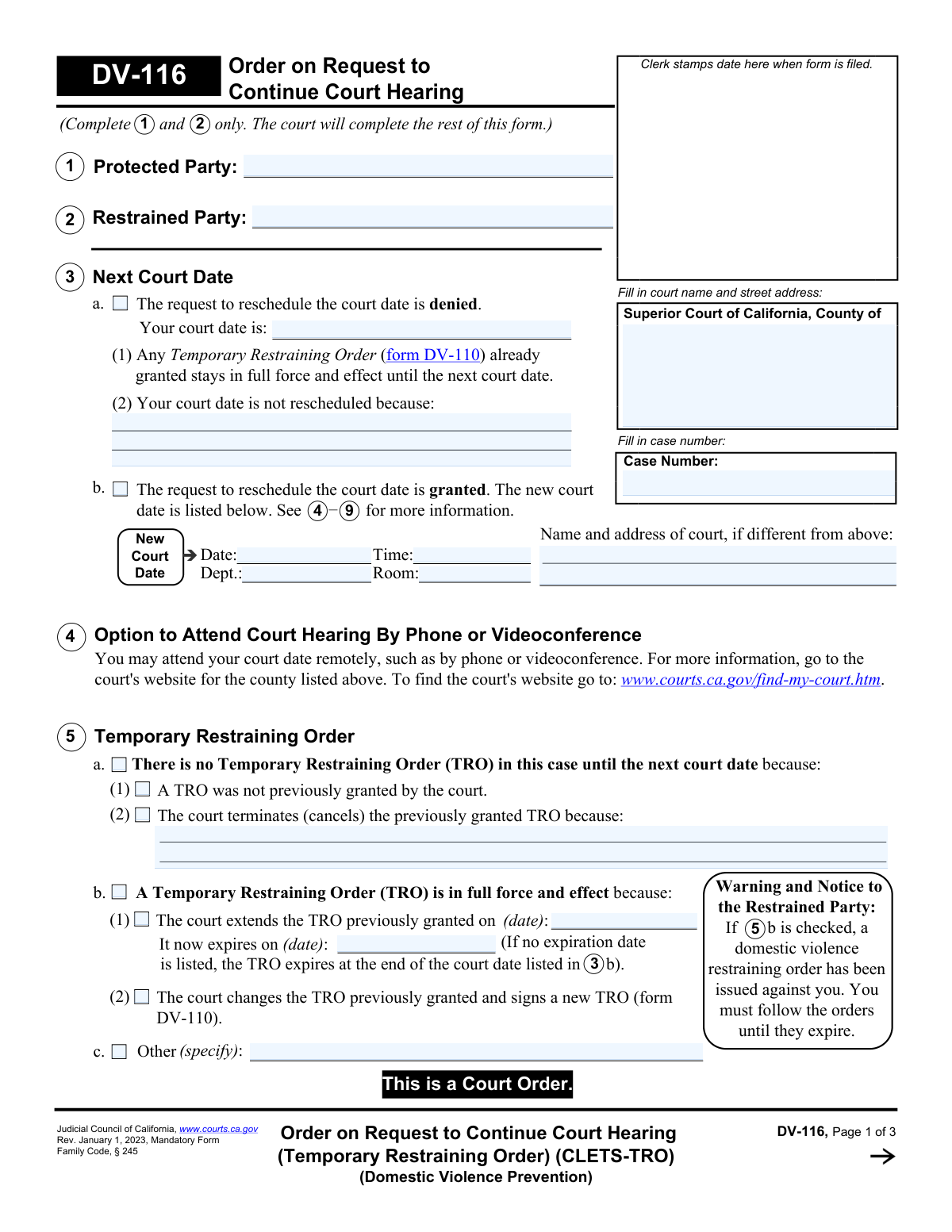
Yes! You can use AI to fill out Form DV-116, Order on Request to Continue Court Hearing (Temporary Restraining Order) (CLETS-TRO) (Domestic Violence Prevention)
Form DV-116, Order on Request to Continue Court Hearing, is a crucial legal document issued by the California Superior Court in domestic violence prevention cases. It officially records a judge's decision on whether to postpone a court hearing, sets a new date if the request is granted, and clarifies the status of any Temporary Restraining Order (TRO) until the next hearing. This order ensures all parties are formally notified of the court's decision and the current legal protections in place. Today, this form can be filled out quickly and accurately using AI-powered services like Instafill.ai, which can also convert non-fillable PDF versions into interactive fillable forms.
DV-116 is part of the
CLETS forms, court forms, domestic violence forms, restraining order forms and UK court forms categories on Instafill.
Our AI automatically handles information lookup, data retrieval, formatting, and form filling.
It takes less than a minute to fill out DV-116 using our AI form filling.
Securely upload your data. Information is encrypted in transit and deleted immediately after the form is filled out.
Form specifications
| Form name: | Form DV-116, Order on Request to Continue Court Hearing (Temporary Restraining Order) (CLETS-TRO) (Domestic Violence Prevention) |
| Number of fields: | 70 |
| Number of pages: | 3 |
| Language: | English |
More forms in CLETS forms
Instafill Demo: How to fill out PDF forms in seconds with AI
How to Fill Out DV-116 Online for Free in 2026
Are you looking to fill out a DV-116 form online quickly and accurately? Instafill.ai offers the #1 AI-powered PDF filling software of 2026, allowing you to complete your DV-116 form in just 37 seconds or less.
Follow these steps to fill out your DV-116 form online using Instafill.ai:
- 1 Navigate to Instafill.ai and upload your PDF or select Form DV-116 from the template library.
- 2 Provide the court and case information, including the Superior Court name, address, and the specific case number.
- 3 Enter the full legal names of the Protected Party and the Restrained Party in the designated fields.
- 4 Follow the AI prompts to indicate the court's decision: whether the request to continue the hearing is granted or denied, and fill in the new court date, time, and department if applicable.
- 5 Specify the status of the Temporary Restraining Order (TRO), indicating if it is extended, terminated, or modified as per the court's ruling.
- 6 Detail the court's orders for serving the document, specifying who must serve whom and by what date and method.
- 7 Review all the information entered for accuracy before the form is finalized for the judge's signature and filing by the court clerk.
Our AI-powered system ensures each field is filled out correctly, reducing errors and saving you time.
Why Choose Instafill.ai for Your Fillable DV-116 Form?
Speed
Complete your DV-116 in as little as 37 seconds.
Up-to-Date
Always use the latest 2026 DV-116 form version.
Cost-effective
No need to hire expensive lawyers.
Accuracy
Our AI performs 10 compliance checks to ensure your form is error-free.
Security
Your personal information is protected with bank-level encryption.
Frequently Asked Questions About Form DV-116
Form DV-116 is the court's official order that either grants or denies a request to reschedule (continue) a court hearing for a domestic violence restraining order. It is the judge's final decision on the request, not the request itself.
You only need to fill in your name, the other party's name, and the case number in sections 1 and 2. The judge and court clerk will complete the rest of the form to issue the official order.
The judge will decide and mark the status in Section 5. The TRO may be extended until the new hearing date, it could be modified, or in some cases, it could be terminated (cancelled).
Look at Section 7, 'Serving (Giving) Order to Other Party,' for specific instructions from the court. You may be required to have the other person formally served with a copy of this order by a specific deadline.
If the request is denied, as marked in Section 3a, your original court hearing date and time have not changed. You must be prepared to proceed with the hearing on that original date.
If the request to reschedule was granted, the new court date, time, and department number will be clearly listed in Section 3b of the form.
Not necessarily. Section 4 states that you may be able to attend the hearing remotely by phone or video; you should check your court's website for specific instructions.
This means that if the court orders you to have this order served, the local sheriff or marshal will serve the documents for free. You must bring a copy of all the required papers to their office.
This form is a court order informing you of the judge's decision about rescheduling a hearing in a domestic violence case you are involved in. Read it carefully to see if the date has changed and what the status of the TRO is.
Form DV-115 is the form you fill out to *request* that a hearing be rescheduled. Form DV-116 is the judge's *order* showing their decision on that request.
Yes, services like Instafill.ai can help you accurately fill in your information for sections 1 and 2. Since the court completes the rest, AI helps ensure your initial details are correct and saves you time.
You can upload the DV-116 form to Instafill.ai, and its AI will help you accurately populate your name and case number. After you complete your part, you can download or print the form for filing with the court.
You can upload the non-fillable PDF to a service like Instafill.ai. It uses AI to convert flat, non-interactive PDFs into fillable forms that you can easily complete online.
Compliance DV-116
Validation Checks by Instafill.ai
1
Mutually Exclusive Hearing Outcome
This validation ensures that only one of the two primary outcomes in Section 3 is selected: either '3a. The request to reschedule... is denied' or '3b. The request to reschedule... is granted.' Selecting both would create a logical contradiction in the court order. If this validation fails, the form is considered invalid because it contains conflicting directives about the court date.
2
Conditional New Hearing Details
This check verifies that if '3b. The request to reschedule... is granted' is selected, then the 'New Court Date', 'Time', and 'Dept.' fields are all filled out. These details are essential for the parties to know when and where to appear for the rescheduled hearing. Failure to provide this information would render the order to continue the hearing incomplete and unenforceable.
3
New Hearing Date is in the Future
This validation confirms that the 'New Court Date' entered in Section 3b is a date in the future. Scheduling a court hearing for a past date is a logical impossibility and would cause significant confusion. This check prevents clerical errors and ensures the order is legally sound and actionable.
4
Mutually Exclusive TRO Status
This check ensures that in Section 5, only one of the two main checkboxes, '5a. There is no Temporary Restraining Order (TRO)' or '5b. A Temporary Restraining Order (TRO) is in full force and effect', is selected. The TRO cannot simultaneously be both non-existent and in effect. An error here would create ambiguity about the restrained party's legal obligations and the protected party's safety.
5
Conditional TRO Termination Reason
This validation ensures that if checkbox '5a(2) The court terminates (cancels) the previously granted TRO' is selected, the corresponding text field explaining the reason for termination is not empty. The legal basis for terminating a protective order must be documented. An omission would make the order incomplete and potentially subject to legal challenge.
6
TRO Extension Date Sequence
This check validates that if '5b(1)' is selected, the 'TRO expiration date' is on or after the date the TRO was extended. An expiration date that precedes the extension date is a logical and chronological error. This ensures the order defines a clear and valid period of protection for the protected party.
7
Conditional Reschedule Reason
This validation verifies that if the hearing is rescheduled (Section 3b is checked), then at least one of the reason checkboxes in Section 6 ('6a', '6b', or '6c') must be selected. The court record must state the justification for continuing the hearing. Failing to provide a reason makes the order procedurally incomplete.
8
Exclusive Requester Selection in Service Section
This check ensures that in Section 7, only one of the three possible requesters ('a. Protected party', 'b. Restrained party', or 'c. Court') is selected. The identity of the requesting party determines the subsequent service obligations. Selecting more than one would create ambiguity and confusion regarding who must serve whom.
9
Conditional Service Deadline for Personal Service
This validation confirms that if service is required (e.g., '7a(2)' or '7b(2)' is checked), the corresponding date field for the service deadline is filled out. A service requirement without a deadline is vague and difficult to enforce. This check ensures the order provides a clear and mandatory timeline for notifying the other party.
10
Logical Service Deadline
This check ensures that any service deadline date entered in Section 7 is prior to the 'New Court Date' specified in Section 3b. Service must be completed before the hearing to provide the served party with adequate notice and time to prepare. A service date after the hearing date would defeat the purpose of notice and violate due process.
11
Case Number Consistency Across Pages
This validation verifies that the 'Case Number' field is present on all pages of the form and that the value is identical on each page. The case number is the primary identifier linking all documents in a legal proceeding. Inconsistent or missing numbers could lead to the order being misfiled or not properly associated with the correct case file.
12
Attachment Count Requirement
This check ensures that if the 'Attached pages' box in Section 10 is checked, the 'Number of pages attached' field contains a positive integer. This count is crucial for the court clerk and all parties to verify that the filing is complete and no pages are missing. An incorrect or missing count can lead to an incomplete record.
13
Attachment Consistency for New TRO
This validation performs a logical cross-check between Section 5 and Section 10. If '5b(2) The court changes the TRO... and signs a new TRO (form DV-110)' is checked, this validation ensures that the 'DV-110' checkbox is also checked in the attachments section. This confirms that the referenced new order is actually included with the filing, preventing an incomplete and confusing order.
14
Party Name Completeness
This check verifies that the full names of both the 'Protected Party' (Section 1) and 'Restrained Party' (Section 2) are provided. These names are fundamental to the order, identifying who is protected and who is restrained. Omitting this information would render the order legally meaningless and unenforceable.
15
Judge's Signature Date Validation
This validation ensures the 'Judge's Signature Date' is a valid, plausible date and is not in the future. The date of the judge's signature is the date the order becomes legally effective. This check prevents data entry errors and ensures the order's timeline is accurate for enforcement purposes, especially for entry into the CLETS system.
Common Mistakes in Completing DV-116
Users often mistype the case number or omit parts of it, such as letters, leading zeros, or hyphens. This happens due to simple data entry error or referencing an incorrect document. An incorrect case number can lead to the document being rejected by the court clerk, misfiled in the wrong case, or causing significant delays in processing the order, which is critical for CLETS entry and enforcement.
Filers may enter a party's common nickname or an incomplete version of their legal name in sections 1 and 2. This is a critical error because restraining orders are enforced based on full legal names. An incorrect name can make the order unenforceable and difficult for law enforcement to verify, potentially putting the protected party at risk.
The form explicitly states that parties should only complete items 1 and 2, with the court completing the rest. However, pro se litigants often misunderstand and attempt to fill out the entire form, guessing what the judge will order. This leads to automatic rejection by the clerk, creates unnecessary work, and can be viewed unfavorably by the court.
A common mistake is checking boxes that are mutually exclusive, such as checking both box 3.a ('The request...is denied') and 3.b ('The request...is granted'). This creates a legally ambiguous and invalid order. Such contradictions render the form unusable and require it to be returned for correction, delaying the finalization of the court's decision.
Users frequently check a box but fail to provide the necessary corresponding details. For example, checking box 6.a(2) ('Other (explain)') without writing an explanation, or checking box 7.a(2) without filling in the service deadline date. This makes the order incomplete and unenforceable, forcing the clerk to reject it until the missing information is provided.
In section 5.b(1), users must enter the date the TRO was previously granted and the new expiration date. It is easy to transpose these dates or enter the hearing date by mistake. This error creates critical ambiguity about when the order is in effect, which can lead to a dangerous lapse in protection or incorrect enforcement by law enforcement.
Section 7 is complex, and users often make errors selecting who must serve whom, by what method, and by what date. For instance, requiring personal service when the party was present in court and service was waived. Improper service can nullify the order, as the other party can claim they were not properly notified, leading to further delays and hearings.
The case number is required at the top of all three pages, but people often make typos or forget to fill it in on pages 2 and 3. If the pages of the order were to become separated, they could not be re-associated with the correct case file. This jeopardizes the integrity of the court record and the order itself.
In Section 10, filers may state that a certain number of pages are attached but provide a different number, or check a box for an attached form (e.g., DV-110) but forget to include it. This makes the order incomplete and its full terms unknown. If a modified TRO is referenced but not attached, the new protections are not documented and cannot be enforced.
This form is an 'Order,' meaning it documents the court's decisions, not a party's requests. A mistake occurs when a person fills it out as if they are making a request, rather than preparing a proposed order that reflects a ruling already made. This fundamental misunderstanding of the document's purpose results in an incorrectly filled-out form that will be rejected. AI-powered tools like Instafill.ai can help by guiding users through the correct fields and validating data, and can also convert non-fillable PDFs into fillable versions to reduce manual errors.
Saved over 80 hours a year
“I was never sure if my IRS forms like W-9 were filled correctly. Now, I can complete the forms accurately without any external help.”
Kevin Martin Green
Your data stays secure with advanced protection from Instafill and our subprocessors

Robust compliance program
Transparent business model
You’re not the product. You always know where your data is and what it is processed for.
ISO 27001, HIPAA, and GDPR
Our subprocesses adhere to multiple compliance standards, including but not limited to ISO 27001, HIPAA, and GDPR.
Security & privacy by design
We consider security and privacy from the initial design phase of any new service or functionality. It’s not an afterthought, it’s built-in, including support for two-factor authentication (2FA) to further protect your account.
Fill out DV-116 with Instafill.ai
Worried about filling PDFs wrong? Instafill securely fills form-dv-116-order-on-request-to-continue-court-hearing-temporary-restraining-order-clets-tro-domestic-violence forms, ensuring each field is accurate.