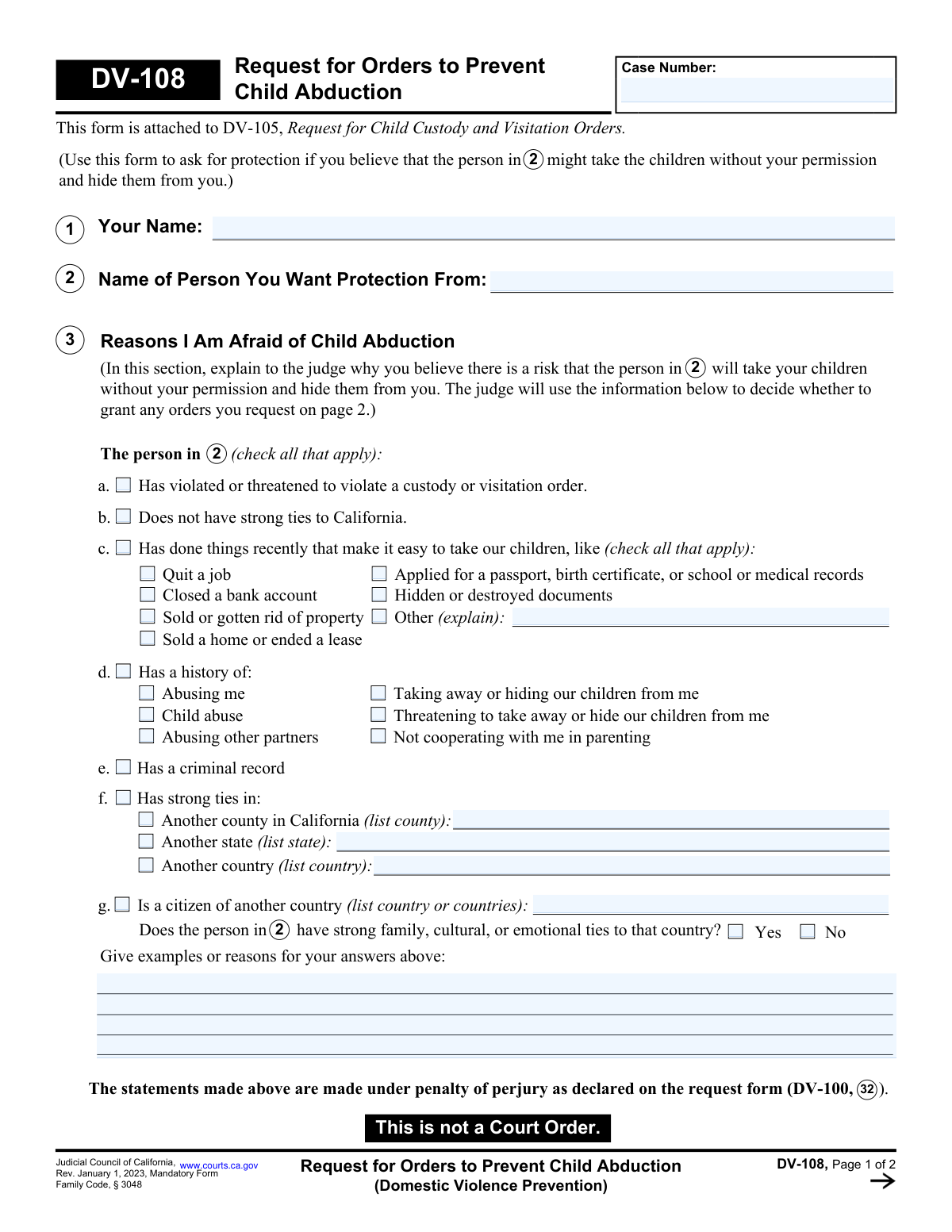
Yes! You can use AI to fill out Form DV-108, Request for Orders to Prevent Child Abduction (Domestic Violence Prevention)

Form DV-108, Request for Orders to Prevent Child Abduction, is a legal document used in California family court. It is filed by a parent who fears the other parent or guardian might unlawfully take and hide their children, particularly in the context of domestic violence. This form allows the requesting party to detail their fears and ask a judge to issue specific preventative orders, such as passport surrender or travel restrictions. Today, this form can be filled out quickly and accurately using AI-powered services like Instafill.ai, which can also convert non-fillable PDF versions into interactive fillable forms.
DV-108 is part of the domestic violence forms category on Instafill.
Our AI automatically handles information lookup, data retrieval, formatting, and form filling.
It takes less than a minute to fill out DV-108 using our AI form filling.
Securely upload your data. Information is encrypted in transit and deleted immediately after the form is filled out.

Form specifications

Form name: Form DV-108, Request for Orders to Prevent Child Abduction (Domestic Violence Prevention)
Number of fields: 61
Number of pages: 2
Language: English
main-image

Instafill Demo: How to fill out PDF forms in seconds with AI

How to Fill Out DV-108 Online for Free in 2026

Are you looking to fill out a DV-108 form online quickly and accurately? Instafill.ai offers the #1 AI-powered PDF filling software of 2026, allowing you to complete your DV-108 form in just 37 seconds or less.
Follow these steps to fill out your DV-108 form online using Instafill.ai:
  1. 1 Navigate to Instafill.ai and upload or select the Form DV-108.
  2. 2 Enter your case number and the full names of yourself and the person you are seeking protection from.
  3. 3 In Section 3, check all boxes that apply to explain why you fear child abduction, detailing the other person's history, lack of ties to California, and recent suspicious actions.
  4. 4 Provide specific examples and detailed reasons in the text box to support your claims and justify your fears to the judge.
  5. 5 On page 2, select the specific court orders you are requesting to prevent abduction, such as passport restrictions, travel plan requirements, or posting a bond.
  6. 6 Carefully review all the information you have provided on the form for accuracy and completeness.
  7. 7 Download, print, and file the completed DV-108 form with the court, attached to your DV-105, Request for Child Custody and Visitation Orders.

Our AI-powered system ensures each field is filled out correctly, reducing errors and saving you time.

Why Choose Instafill.ai for Your Fillable DV-108 Form?

Speed

Complete your DV-108 in as little as 37 seconds.

Up-to-Date

Always use the latest 2026 DV-108 form version.

Cost-effective

No need to hire expensive lawyers.

Accuracy

Our AI performs 10 compliance checks to ensure your form is error-free.

Security

Your personal information is protected with bank-level encryption.

Frequently Asked Questions About Form DV-108

Form DV-108 is used to ask a California court for specific orders to prevent someone from taking your children without your permission. It is filed as part of a domestic violence prevention case when you fear the other person may abduct or hide the children.

You should fill out this form if you are also filing for child custody and visitation orders (Form DV-105) and you have a genuine fear that the other person in your case might take your children and hide them from you.

No, this form is a request, not a court order. A judge must review your request and sign a separate court order to make your requested protections legally enforceable.

In Section 3, you must check boxes indicating risk factors, such as the other person's history of abuse, threats, or recent actions like quitting a job or applying for a passport. You must also write a detailed explanation with specific examples to support your fears.

This asks the judge to require the other person to deposit a sum of money with the court. If they violate the order and take the children, that money can be used to help you pay for legal fees and costs to find and return your children.

You should check the box in Section 3g, list the country, and explain if they have strong ties there. On page 2, you can then ask the judge for specific orders, like requiring them to notify the foreign embassy of the court order or to surrender passports.

This form must be attached to Form DV-105, Request for Child Custody and Visitation Orders. You will file the entire packet with the court clerk according to your local court's rules for domestic violence restraining orders.

A judge will review your request along with your other domestic violence paperwork. The judge will decide whether there is enough evidence of an abduction risk to grant the protective orders you asked for, either on a temporary or long-term basis.

While physical proof like emails or documents is helpful, it is not always required. Your sworn statement on the form is considered evidence, so be as detailed and honest as possible when explaining your reasons for fearing an abduction.

Yes, services like Instafill.ai use AI to help you accurately auto-fill form fields based on your information. This can save you time and help prevent common errors when completing the form.

To fill out Form DV-108 online, you can use a service like Instafill.ai. Simply upload the form, and the platform will make it an interactive, fillable document that you can complete on your computer, then save or print.

If you have a non-fillable or 'flat' PDF, you can use a tool like Instafill.ai. It can convert the document into an interactive, fillable form so you can easily type in your information.

Common requests include ordering the other person not to move with the children without permission, to surrender the children's passports, and to provide a detailed travel itinerary before any approved trips.

Section 3 is where you provide the evidence and reasons why you fear an abduction. Page 2 is where you choose the specific legal actions, or 'orders,' you want the judge to take to prevent that abduction from happening.

Compliance DV-108
Validation Checks by Instafill.ai

1
Case Number Completeness
This check ensures the 'Case Number' field is filled out on both page 1 and page 2 of the form. This is critical for ensuring the document is correctly filed and associated with the existing court case. If the number is missing or inconsistent, the form may be rejected by the court clerk, causing delays.
2
Party Identification Requirement
Validates that both 'Your Name' (Section 1) and 'Name of Person You Want Protection From' (Section 2) are completed. These fields are essential for identifying the parties involved in the request. A failure to provide both names would make the legal document ambiguous and unenforceable.
3
Justification for Fear Requirement
This check verifies that the filer has selected at least one checkbox in Section 3 ('Reasons I Am Afraid of Child Abduction'). The form's purpose is to explain the risk of abduction to a judge, so providing at least one reason is mandatory. If no reasons are selected, the request has no legal basis and cannot be processed.
4
Conditional Requirement for Section 3c 'Other' Explanation
Ensures that if the 'Other (explain)' checkbox is checked in Section 3c, the corresponding text field is not empty. This prevents users from indicating 'Other' reasons without providing the necessary details for the judge to consider. An empty explanation for a checked 'Other' box would trigger a validation error prompting the user to provide details.
5
Conditional Requirement for Section 3f Location Details
This validation checks that if any of the checkboxes in Section 3f ('Another county', 'Another state', 'Another country') are selected, the corresponding text field for the location name is filled. It is not enough to state that the person has ties elsewhere; the specific location must be identified. The system will flag an error if a location type is checked but the name is missing.
6
Conditional Requirement for Section 3g Citizenship Details
Verifies that if the checkbox for Section 3g ('Is a citizen of another country') is checked, then the country name text field is filled and one of the 'Yes' or 'No' options regarding strong ties is selected. These details are crucial for assessing abduction risk related to foreign citizenship. A failure to provide this complete information would result in an incomplete and less persuasive request.
7
Narrative Support Requirement
This check ensures the 'Give examples or reasons for your answers above' text area is not empty if any risk factor in Section 3 has been checked. The checkboxes indicate risks, but the narrative provides the specific evidence and context the judge needs to make a decision. An empty narrative field would prompt the user to add supporting details before submission.
8
At Least One Order Requested
Validates that the user has checked at least one box in Sections 4 through 10 on page 2. The entire purpose of the DV-108 form is to request specific orders from the judge. Submitting the form without requesting any orders would be pointless and is considered a logical error.
9
Conditional Requirement for Passport Order Details
If the checkbox for Section 5 ('Turn In and Do Not Apply for Passports...') is checked, this validation ensures the fields for 'documents to turn in', 'by (date)', and 'to (name of person)' are all completed. A vague order is unenforceable, so all details are required to make the request clear and actionable. Missing information will trigger an error.
10
Date Field Format and Logic
This check validates that all date fields on the form (e.g., in Section 5 and Section 8) are entered in a valid format (e.g., MM/DD/YYYY) and are not in the past. Requesting a deadline that has already passed is a logical error. This ensures the requested orders are practical and can be complied with in the future.
11
Conditional Requirement for Travel Plan Details
Ensures that if the main checkbox for Section 6 ('Provide Travel Plan and Documents') is checked, at least one of the sub-item checkboxes (e.g., 'Children's travel schedule') is also selected. This prevents a user from requesting a travel plan in general without specifying what information must be provided. The validation would fail if the main box is checked but no specific requirements are selected.
12
Conditional Requirement for Embassy Notification
Verifies that if the checkbox for Section 8 ('Notify Foreign Embassy or Consulate...') is checked, both the 'name of embassy or consulate' and the 'by (date)' fields are filled out. For the order to be effective, the court needs to know which specific embassy to notify and the deadline for doing so. The request is incomplete without this information.
13
Bond Amount Format and Value
This validation checks that if the 'Post a Bond' checkbox in Section 10 is checked, the associated amount field contains a valid, positive numeric value. The bond amount cannot be a negative number or text. This ensures the request for a financial bond is clear and specifies a valid monetary figure for the judge to consider.

Common Mistakes in Completing DV-108

Entering an Incorrect or Missing Case Number

The case number is the unique identifier that links this request to your existing court case. People often enter it incorrectly, omit leading zeros or letters, or forget it entirely. An incorrect case number can lead to significant processing delays or the court rejecting the document, as it cannot be filed with the correct case. Always double-check the case number against other official court documents before submitting. AI-powered tools like Instafill.ai can help by saving and accurately pre-filling the case number across all related forms.

Using Incomplete or Informal Names

In sections 1 and 2, filers sometimes use nicknames, initials, or incomplete names instead of the full legal names of themselves and the other party. Court orders must be legally precise to be enforceable. Using an informal name can create ambiguity and potential challenges when trying to enforce the order with law enforcement or other agencies. Always use the full legal name as it appears on government-issued identification or previous court filings.

Checking Risk Factors Without Providing Explanations

A frequent error in Section 3 is checking multiple boxes indicating risk factors (e.g., 'Quit a job,' 'Has a criminal record') without providing any supporting details in the narrative section. A judge needs more than a checklist; they need a story supported by facts. Without a detailed explanation, these checked boxes have little persuasive weight and may be disregarded. You must explain the context and why each checked item makes you fear an abduction.

Providing Vague or Emotional Instead of Factual Details

In the 'Give examples or reasons' section, it is a mistake to write purely emotional statements ('I'm terrified he'll take them') or vague accusations ('He is unstable'). A judge's decision must be based on evidence. A stronger request provides specific, factual details: dates of threats, quotes of what was said, names of witnesses, and descriptions of specific actions taken by the other person. A clear, chronological account of events is far more compelling than general statements.

Requesting Orders Without Specifying Required Details

On page 2, filers often check a box to request an order but then fail to fill in the mandatory details. For example, in Section 5, they ask for passports to be turned in but don't specify a deadline or who should hold them. In Section 10, they request a bond but leave the dollar amount blank. These omissions make the request incomplete and, if granted, the resulting order would be vague and unenforceable.

Mismatching Checkboxes and Corresponding Text Fields

The form contains several items, like 3c(vi) 'Other (explain),' where a text field is dependent on a checkbox. A common data entry error is to write an explanation in the text field without checking the corresponding box, or vice-versa. This creates confusion and may lead the court clerk or judge to overlook the information entirely. Using a tool like Instafill.ai can help prevent this by validating that if one field is filled, its corresponding checkbox is also marked.

Not Requesting Passport Surrender for International Risks

When the facts indicate a risk of international abduction (e.g., the other parent has foreign citizenship or strong ties abroad), the single most critical mistake is failing to request passport surrender in Section 5. This is one of the most effective tools for preventing a child from being taken out of the country. Overlooking this request, or not knowing to ask for it, can have irreversible consequences if the child is removed from the U.S.

Providing Incomplete Foreign Citizenship Details

In Section 3g, it is not enough to simply state that the other person is a citizen of another country. A common mistake is failing to answer the follow-up question: 'Does the person in [2] have strong family, cultural, or emotional ties to that country?'. This specific detail is crucial for the judge to assess the actual flight risk to that nation, as citizenship alone may not be a strong indicator without personal ties.

Failing to Connect Actions to Abduction Risk

A filer might list several facts, such as 'quit a job' and 'has family in another country,' but fail to explicitly state in the narrative how these facts connect to create a credible risk of abduction. The form should tell a clear story. You must connect the dots for the judge by explaining, for example, 'I believe they quit their job to liquidate their assets and flee to [Country], where their family can help them hide with our children.' This transforms a list of facts into a compelling argument.

Submitting a Non-Fillable PDF Without Proper Tools

This form is often found online as a flat, non-fillable PDF, leading to messy, handwritten submissions that can be difficult to read and may be seen as less professional. People may also struggle to format their answers correctly within the limited space. This can be avoided by using a service like Instafill.ai, which can convert any non-fillable court form into an interactive, fillable version, ensuring the final document is clean, legible, and correctly formatted.
Saved over 80 hours a year

“I was never sure if my IRS forms like W-9 were filled correctly. Now, I can complete the forms accurately without any external help.”

Kevin Martin Green

Your data stays secure with advanced protection from Instafill and our subprocessors

Robust compliance program

Transparent business model

You’re not the product. You always know where your data is and what it is processed for.

ISO 27001, HIPAA, and GDPR

Our subprocesses adhere to multiple compliance standards, including but not limited to ISO 27001, HIPAA, and GDPR.

Security & privacy by design

We consider security and privacy from the initial design phase of any new service or functionality. It’s not an afterthought, it’s built-in, including support for two-factor authentication (2FA) to further protect your account.

Fill out DV-108 with Instafill.ai

Worried about filling PDFs wrong? Instafill securely fills form-dv-108-request-for-orders-to-prevent-child-abduction-domestic-violence-prevention forms, ensuring each field is accurate.