Yes! You can use AI to fill out Form DV-109, Notice of Court Hearing (Domestic Violence Prevention)
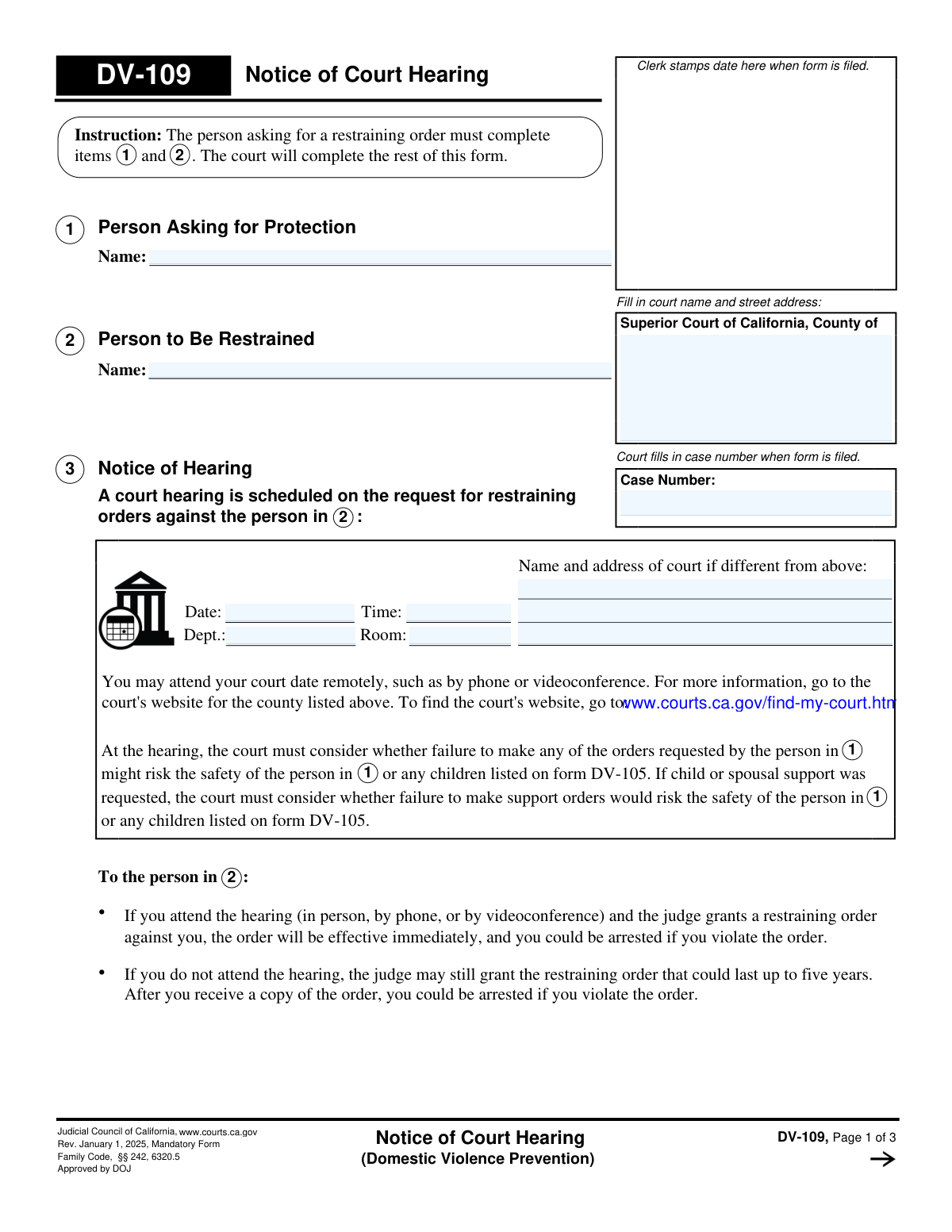
The California Form DV-109, Notice of Court Hearing, is a legal document used to inform an individual that a request for a domestic violence restraining order has been filed against them and to provide the date, time, and location of the court hearing. It also states whether the court has granted or denied any temporary restraining orders pending the hearing. Today, this form can be filled out quickly and accurately using AI-powered services like Instafill.ai, which can also convert non-fillable PDF versions into interactive fillable forms.
DV-109 is part of the
court forms, domestic violence forms and UK court forms categories on Instafill.
Our AI automatically handles information lookup, data retrieval, formatting, and form filling.
It takes less than a minute to fill out DV-109 using our AI form filling.
Securely upload your data. Information is encrypted in transit and deleted immediately after the form is filled out.
Form specifications
| Form name: | Form DV-109, Notice of Court Hearing (Domestic Violence Prevention) |
| Number of fields: | 43 |
| Number of pages: | 3 |
| Language: | English |
Instafill Demo: How to fill out PDF forms in seconds with AI
How to Fill Out DV-109 Online for Free in 2026
Are you looking to fill out a DV-109 form online quickly and accurately? Instafill.ai offers the #1 AI-powered PDF filling software of 2026, allowing you to complete your DV-109 form in just 37 seconds or less.
Follow these steps to fill out your DV-109 form online using Instafill.ai:
- 1 Navigate to Instafill.ai and upload or select the California Form DV-109.
- 2 Use the AI tool to fill in the court name and street address at the top of the form.
- 3 Enter the full name of the person asking for protection in Item 1.
- 4 Enter the full name of the person who is to be restrained in Item 2.
- 5 Review the information you've entered for accuracy. The court will complete the remaining sections, including the hearing details and temporary orders.
- 6 Once the form is filed and completed by the court, use Instafill.ai to save or print the file-stamped copy for your records and for serving the other party.
Our AI-powered system ensures each field is filled out correctly, reducing errors and saving you time.
Why Choose Instafill.ai for Your Fillable DV-109 Form?
Speed
Complete your DV-109 in as little as 37 seconds.
Up-to-Date
Always use the latest 2026 DV-109 form version.
Cost-effective
No need to hire expensive lawyers.
Accuracy
Our AI performs 10 compliance checks to ensure your form is error-free.
Security
Your personal information is protected with bank-level encryption.
Frequently Asked Questions About Form DV-109
Form DV-109, Notice of Court Hearing, is a mandatory court form that officially notifies both parties of the date, time, and location of a hearing for a domestic violence restraining order.
The person asking for protection fills out their name and the name of the person to be restrained (Items 1 and 2). The court clerk and judge will complete the rest of the form, including the hearing details and any temporary orders.
Your court hearing date, time, and department are listed in Item 3, "Notice of Hearing." This section will also indicate if you can attend the hearing remotely by phone or video.
You should carefully review the hearing details in Item 3 and plan to attend if you want the judge to hear your side. You have the option to file a written response using Form DV-120 before the hearing.
Service is the formal legal process of providing court documents to the person to be restrained. Someone 18 or older—who is not you—must personally deliver a copy of this form and others listed in Item 6 to that person, typically at least five days before the hearing.
This means the judge did not grant the orders before the hearing, often because the initial request lacked sufficient detail. You must still attend the scheduled court hearing to present your case and ask for a final restraining order.
You must attend the hearing to request that the judge make the restraining order. If you do not show up, your request will likely be dismissed and any temporary orders will expire.
If you do not attend the hearing, the judge can make a decision without hearing from you. The court may grant a restraining order against you that can last for up to five years.
Item 6 specifies all documents that must be served, which always includes the DV-100 (Request) and a blank DV-120 (Response). If the judge granted temporary orders, the DV-110 (Temporary Restraining Order) must also be included.
Yes, either party can ask the judge to reschedule the hearing for a valid reason. You should read Form DV-115-INFO, 'How to Ask for a New Hearing Date,' for instructions on how to make this request.
Yes, services like Instafill.ai use AI to auto-fill form fields accurately and save time. This can help you complete the sections you are responsible for, such as your name and the other party's name.
You can upload the DV-109 to the Instafill.ai platform. The AI will identify the fillable fields, allowing you to input your information and have it automatically and accurately placed in the correct spots on the form.
If you have a non-fillable PDF, you can use a service like Instafill.ai. It can convert flat, non-interactive PDFs into fillable forms, so you can easily type your information before printing.
Compliance DV-109
Validation Checks by Instafill.ai
1
Case Number Consistency Across Pages
This check verifies that the 'Case Number' entered on page 1, page 2, and page 3 of the form are identical. This is critical for ensuring the document is treated as a single, cohesive legal filing and prevents administrative errors or rejection by the court clerk. If the numbers do not match, the system should flag the discrepancy for correction before submission.
2
Completeness of Party Information
Ensures that the full names for both the 'Person Asking for Protection' (Item 1) and the 'Person to Be Restrained' (Item 2) are provided. These fields are mandatory for the legal validity of the notice, as they clearly identify the parties involved in the proceeding. A failure to provide either name would render the form incomplete and legally unenforceable.
3
Valid and Future Hearing Date
Validates that the 'Date' in the 'Notice of Hearing' section (Item 3) is a valid calendar date and is set for a future date. This is essential because the purpose of the form is to notify parties of an upcoming hearing, so the date cannot be in the past. An invalid or past date would cause confusion and could invalidate the notice, requiring the hearing to be rescheduled.
4
Exclusive TRO Decision Selection
Verifies that in Item 4a, for 'Temporary Restraining Orders', exactly one of the three options ('All granted', 'All denied', or 'Partly granted') is selected. These options are mutually exclusive, and selecting more than one or none at all creates ambiguity about the court's initial ruling. An error here would require clarification from the judicial officer before the form could be processed.
5
Conditional Requirement for Denial Reasons
This check ensures that if 'All denied' (4a(2)) or 'Partly granted and partly denied' (4a(3)) is selected, then at least one reason for denial is checked in section 4b. The Family Code requires the court to state its reasons for denying a temporary order. If this validation fails, the form is incomplete and does not comply with statutory requirements.
6
Specificity for 'Other Reasons for Denial'
If the checkbox for 'Other reasons for denial' (4b(3)) is selected, this validation confirms that the accompanying text field is not empty. The purpose of this option is to allow for specific, case-relevant explanations not covered by the standard reasons. An empty field would defeat this purpose and leave the denial reason unspecified, making the order unclear.
7
Logical Service of Granted TRO (DV-110)
This validation checks for logical consistency between the TRO decision and the documents to be served. If 'All granted' (4a(1)) or 'Partly granted' (4a(3)) is checked, the form DV-110 ('Temporary Restraining Order') must also be checked for service in Item 6. Failing to include the granted order in the service packet means the restrained person would not be properly notified of the orders against them.
8
Logical Service of Confidentiality Order (DV-165)
Ensures that if the box in Item 5a ('A request to keep minor's information confidential was...granted') is checked, then the corresponding box in Item 6e for serving forms DV-170 and DV-165 is also checked. This is crucial for ensuring all parties are properly notified of the confidentiality order and the legal penalties for its violation. Failure to serve these forms would undermine the court's confidentiality ruling.
9
Positive Integer for Service Days
Validates that the number of days specified for service in Item 6 is a positive integer (e.g., 5 or another number). This ensures there is a clear, legally defined deadline for serving the documents before the hearing. An invalid or missing number would create ambiguity about service requirements, potentially leading to a due process challenge.
10
Chronological Integrity of Dates
This check verifies the logical sequence of dates on the form: the 'Judge's Signature Date' must be on or before the 'Clerk's Certificate Date', and both dates must be on or before the scheduled 'Hearing Date'. This sequence reflects the proper legal and administrative workflow. An illogical sequence suggests a data entry error that could raise questions about the document's authenticity and timeline.
11
Completeness of Hearing Location Details
Verifies that the primary 'Court name and street address' field is filled out, and that the hearing 'Dept.' and 'Room' fields in Item 3 are also populated. This information is essential for all parties to know where to appear for the hearing. Incomplete location details could result in parties going to the wrong place, missing the hearing, and negative legal consequences.
12
Specificity for 'Other' Service Documents
If the 'Other (specify)' checkbox in Item 6f is checked, this validation confirms that the corresponding text field is not empty and describes the additional documents. This ensures that the person performing service knows exactly which documents to include in the service packet. An empty field would make the instruction incomplete and could result in improper service.
Common Mistakes in Completing DV-109
Users often enter nicknames, partial names, or incorrect spellings for themselves (Item 1) or the person to be restrained (Item 2). This happens due to haste or not knowing the person's full legal name. An incorrect name for the restrained person can make the order unenforceable and cause significant delays in serving the legal documents, potentially jeopardizing the petitioner's safety. Always use the full legal name as it appears on official documents; for the restrained person, include any known aliases to aid in identification and service.
Anxious or overly helpful applicants often attempt to fill out the entire form, including sections clearly marked for the court or clerk, such as the hearing date (Item 3), temporary order decisions (Item 4), and the Clerk's Certificate. This creates confusion for court staff, who may have to return the form or manually correct it, delaying the filing and the scheduling of a hearing. Only fill out the sections explicitly designated for you (Items 1 and 2 on this form) and leave all other fields blank for the court to complete.
Petitioners sometimes write an incorrect court name or a generic address in the header section, especially if they are unfamiliar with the court system. This can lead to the form being filed in the wrong jurisdiction, causing the case to be rejected and requiring the petitioner to start the process over. To avoid this, use the court's official website or the link provided on the form (www.courts.ca.gov/find-my-court.htm) to verify the exact name and street address of the correct Superior Court for the county where you are filing.
The instructions in Item 6 are critical but often misunderstood, leading to improper service of process. Petitioners may miss the deadline for service (e.g., at least five days before the hearing) or forget to include all required documents, such as the blank DV-120 Response form. Improper service is a common reason for hearings to be postponed, as the court cannot proceed if the respondent has not been legally notified, thus delaying the issuance of a long-term protective order.
In a misguided attempt to expedite the process or due to a misunderstanding of legal rules, the person asking for protection sometimes tries to serve the documents on the respondent themselves. Item 6 explicitly states that service must be performed by someone age 18 or older who is *not* the petitioner or anyone else protected by the order. Personal service by the petitioner is legally invalid, will require the hearing to be rescheduled, and can dangerously escalate the conflict with the restrained person.
Users may misread the date, time, department, or room number for the hearing listed in Item 3, causing them to miss their court date entirely. Furthermore, with the option for remote appearances, users may not understand how to find the correct information on the court's website, leading to a failure to appear. Missing the hearing will result in the automatic dismissal of the request and the expiration of any temporary orders. Always double-check the hearing details and visit the court's website well in advance to understand the procedure for remote attendance.
When a judge denies some or all temporary orders, the reasons are checked in Item 4b (e.g., 'facts do not show reasonable proof of abuse'). Petitioners may feel discouraged and fail to read or understand these reasons. This is a critical mistake, as this section provides direct feedback on what was missing from the initial request (form DV-100), giving the petitioner a chance to gather more evidence or prepare better testimony for the main hearing. Understanding the denial reason is essential for strengthening the case.
Many court forms are only available as non-fillable PDFs, forcing users to print and complete them by hand. This often results in illegible handwriting, which can cause clerks to misenter names, addresses, or other critical information, leading to processing errors and delays. To prevent this, it is crucial to write clearly in block letters. Alternatively, AI-powered tools like Instafill.ai can convert non-fillable PDFs into fillable versions, ensuring all entries are typed, legible, and professional.
A petitioner might mistakenly believe that because a Temporary Restraining Order (TRO) was granted, they do not need to attend the final hearing listed in Item 3. The instructions on page 3 clearly state the petitioner *must* attend the hearing to request a long-term order. Failure to appear will result in the case being dismissed and the temporary orders expiring, leaving the petitioner without protection.
Judicial Council forms are updated periodically, as noted by the 'Rev. January 1, 2025' date on this form. Users who download forms from unofficial sources or reuse old files may submit an outdated version. Courts can reject obsolete forms, forcing the petitioner to refile with the correct version and causing unnecessary delays. Always download the latest version of any form directly from the official court website (e.g., www.courts.ca.gov/forms) to ensure compliance.
Saved over 80 hours a year
“I was never sure if my IRS forms like W-9 were filled correctly. Now, I can complete the forms accurately without any external help.”
Kevin Martin Green
Your data stays secure with advanced protection from Instafill and our subprocessors

Robust compliance program
Transparent business model
You’re not the product. You always know where your data is and what it is processed for.
ISO 27001, HIPAA, and GDPR
Our subprocesses adhere to multiple compliance standards, including but not limited to ISO 27001, HIPAA, and GDPR.
Security & privacy by design
We consider security and privacy from the initial design phase of any new service or functionality. It’s not an afterthought, it’s built-in, including support for two-factor authentication (2FA) to further protect your account.
Fill out DV-109 with Instafill.ai
Worried about filling PDFs wrong? Instafill securely fills form-dv-109-notice-of-court-hearing-domestic-violence-prevention forms, ensuring each field is accurate.