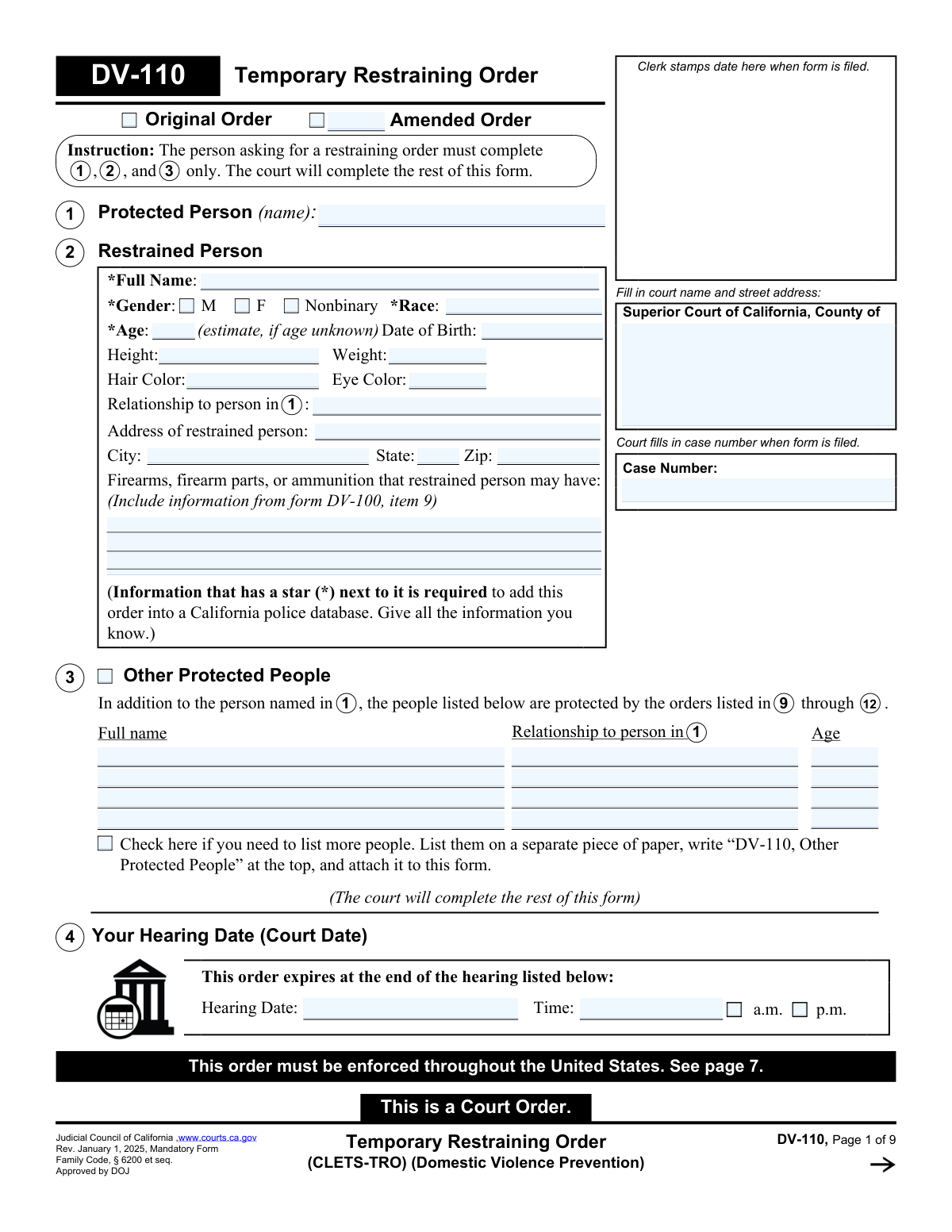
Yes! You can use AI to fill out Judicial Council of California Form DV-110, Temporary Restraining Order (CLETS-TRO) (Domestic Violence Prevention)

Form DV-110, the Temporary Restraining Order, is a court order issued by a California judge to provide immediate protection against domestic violence, harassment, or threats. It establishes temporary rules that the restrained person must follow, such as staying away, not making contact, and surrendering firearms, until a full court hearing can be held. This order is a critical legal tool for ensuring the immediate safety of individuals at risk. Today, this form can be filled out quickly and accurately using AI-powered services like Instafill.ai, which can also convert non-fillable PDF versions into interactive fillable forms.
Our AI automatically handles information lookup, data retrieval, formatting, and form filling.
It takes less than a minute to fill out DV-110 using our AI form filling.
Securely upload your data. Information is encrypted in transit and deleted immediately after the form is filled out.

Form specifications

Form name: Judicial Council of California Form DV-110, Temporary Restraining Order (CLETS-TRO) (Domestic Violence Prevention)
Number of fields: 197
Number of pages: 9
Language: English
Categories: CLETS forms, California judicial forms, domestic violence forms, Judicial Council forms, restraining order forms
main-image

Instafill Demo: How to fill out PDF forms in seconds with AI

How to Fill Out DV-110 Online for Free in 2026

Are you looking to fill out a DV-110 form online quickly and accurately? Instafill.ai offers the #1 AI-powered PDF filling software of 2026, allowing you to complete your DV-110 form in just 37 seconds or less.
Follow these steps to fill out your DV-110 form online using Instafill.ai:
  1. 1 Navigate to Instafill.ai and upload the DV-110 form or select it from the platform's library of official documents.
  2. 2 Provide the required information for the 'Protected Person' in Section 1, including your full name.
  3. 3 In Section 2, enter all known details about the 'Restrained Person,' such as their name, physical description, and address, as this information is vital for law enforcement.
  4. 4 If other people, like children or family members, also need protection, list their full names, relationship to you, and ages in Section 3.
  5. 5 Use the AI-powered tool to carefully review all the information you have entered in Sections 1, 2, and 3 to ensure accuracy and completeness.
  6. 6 Once the review is complete, securely download or print the completed portions of the DV-110 form, which is now ready for filing with the appropriate Superior Court of California.

Our AI-powered system ensures each field is filled out correctly, reducing errors and saving you time.

Why Choose Instafill.ai for Your Fillable DV-110 Form?

Speed

Complete your DV-110 in as little as 37 seconds.

Up-to-Date

Always use the latest 2026 DV-110 form version.

Cost-effective

No need to hire expensive lawyers.

Accuracy

Our AI performs 10 compliance checks to ensure your form is error-free.

Security

Your personal information is protected with bank-level encryption.

Frequently Asked Questions About Form DV-110

This is a court order signed by a judge that provides immediate, short-term protection from domestic violence. It is temporary and typically lasts until the court hearing date listed on the form, where a judge will decide on a long-term order.

The person requesting protection (the 'Protected Person') only needs to complete sections 1, 2, and 3. The court clerk and judge will complete the rest of the form after reviewing the request.

This information is required to enter the restraining order into the California Law Enforcement Telecommunications System (CLETS). Providing these details helps law enforcement accurately identify the restrained person and enforce the order.

You can list other people who also need protection in section 3 of the form. If you run out of space, you can attach a separate sheet of paper titled 'DV-110, Other Protected People' with their information.

A 'No-Contact Order' (item 11) prohibits any form of communication, such as calls, texts, or social media messages. A 'Stay-Away Order' (item 12) requires the restrained person to keep a specific physical distance from you and places like your home, work, or school.

Within 24 hours of receiving this order, the restrained person must sell, store with a licensed dealer, or turn in all firearms, firearm parts, and ammunition to law enforcement. They must then file a receipt with the court within 48 hours as proof of compliance.

The order must be formally delivered ('served') to the restrained person, and it becomes effective immediately. Both parties must then attend the court hearing listed on the form to determine if a long-term order should be issued.

This order is temporary and is only valid until the court hearing date specified in section 4. At the hearing, the judge will decide whether to grant a permanent restraining order, which can last for several years.

The order remains in effect and must be enforced, regardless of whether the protected person consents to contact. If the restrained person violates the order, you should call the police, as it is a criminal offense.

No, according to section 23, there is no fee for the sheriff or marshal to serve a domestic violence restraining order. You will need to complete and provide them with form SER-001, 'Request for Sheriff to Serve Court Papers'.

Yes, services like Instafill.ai use AI to help you accurately auto-fill form fields, which can save time and reduce errors. This is especially helpful for entering the required personal details in sections 1, 2, and 3.

You can use a service like Instafill.ai to complete the form on your computer. Simply upload the DV-110 PDF, and the platform will guide you through filling out the necessary sections before you print it for filing with the court.

If you have a non-fillable or 'flat' PDF, you can upload it to a platform like Instafill.ai. The service can convert it into an interactive, fillable form that you can easily complete online.

Compliance DV-110
Validation Checks by Instafill.ai

1
Protected Person Name Required
This validation ensures that the full name of the 'Protected Person' in Section 1 is provided. This field is fundamentally required as it identifies the individual seeking protection under the order. If this field is left blank, the form is invalid because it is impossible to determine for whom the order is being issued, and the submission must be rejected.
2
Restrained Person CLETS Data Completeness
This check verifies that all fields marked with a star (*) in Section 2 (Full Name, Gender, Age, Race) for the 'Restrained Person' are completed. This information is required by law to enter the order into the California Law Enforcement Telecommunications System (CLETS), making it visible and enforceable by police statewide. If this data is missing, the order cannot be entered into the police database, severely limiting its real-world effectiveness and officer safety.
3
Restrained Person Age and DOB Consistency
This validation checks if both the 'Age' and 'Date of Birth' are provided for the restrained person in Section 2, they must be logically consistent. The age calculated from the date of birth should match the age entered in the age field. This prevents data entry errors and ensures the identifying information is accurate for law enforcement purposes. A mismatch should trigger a warning to review and correct the information.
4
Exclusive Order Type Selection
This validation ensures that either the 'Original Order' or 'Amended Order' checkbox is selected at the top of the form, but not both. A single filing cannot be both the initial order and a modification at the same time. This check prevents a logical contradiction and ensures the document is processed correctly by the court clerk according to its intended purpose.
5
Future Hearing Date Validation
This check ensures the 'Hearing Date' entered in Section 4 is a valid date that occurs in the future. A Temporary Restraining Order is, by definition, temporary and expires at the hearing. An invalid date or a date in the past would make the order's expiration term nonsensical and legally problematic. The system should reject any date that is not in the future.
6
Case Number Consistency Across Pages
This validation verifies that the 'Case Number' entered on page 1 is identical to the 'Case Number' entered in the header of all subsequent pages. Maintaining a consistent case number is crucial for document integrity and ensuring all pages are correctly associated with the same legal case file. A mismatch could lead to filing errors, lost pages, and legal challenges to the order's completeness.
7
Conditional Grant Details Required
This check applies to multiple sections (e.g., 10, 11, 12, 13, 16). It verifies that if a checkbox for 'Granted as follows' is selected, the corresponding detail fields for that order are filled out. For example, if a Stay-Away Order is granted, the distance and location must be specified. This ensures that granted orders are specific, unambiguous, and enforceable, rather than vague and ineffective.
8
Stay-Away Distance Format and Value
This validation confirms that the distance specified in the Stay-Away Order (Section 12a) is a positive numerical value. The distance in yards is a critical term of the order that must be clear for both the restrained person and law enforcement. The system should reject non-numeric text, zero, or negative values to prevent ambiguity and ensure the order is legally sound and enforceable.
9
Move-Out Order Address Completeness
This check validates that if the 'Order to Move Out' in Section 13 is granted, a full and specific street address is provided. The order is completely unenforceable without a clearly identified location from which the restrained person must move. This check prevents the issuance of a vague order and ensures law enforcement can act upon it if necessary.
10
Complete Information for Other Protected People
This validation verifies that for each person listed in Section 3 'Other Protected People', the full name, relationship to the primary protected person, and age are all provided. Incomplete entries can result in these individuals not being legally protected by the order. This check ensures all individuals intended for protection are clearly identified for the court and for enforcement purposes.
11
Attached Pages Count Logic
This check validates the logic in Section 24 regarding attachments. If the 'Number of pages attached' is a number greater than zero, at least one of the attachment form checkboxes (e.g., DV-140, Other) must be selected. Conversely, if an attachment checkbox is selected, the page count must be greater than zero. This ensures the record of attachments is internally consistent and accurately reflects the documents being filed.
12
Debt Payment Amount and Date Validation
This validation ensures that for each debt listed in Section 21, the 'Amount' is a valid numerical currency value and the 'Due date' is a valid, properly formatted date. These financial obligations must be clear and unambiguous to be enforceable. The system should reject non-numeric amounts or invalid dates to prevent confusion and potential non-compliance.
13
Firearms Compliance Date Logic
This check verifies that any date entered in the 'Proof of compliance received by the court' column in Section 6 is a valid date that is on or before the current date. It is logically impossible for the court to have received proof on a future date. This validation ensures the integrity and accuracy of the court record regarding the restrained person's compliance with critical firearms relinquishment orders.
14
Restrained Person's Relationship Required
This validation ensures the 'Relationship to person in 1' field in Section 2 is filled out. This information is a critical legal element, as it helps the court establish jurisdiction under the Domestic Violence Prevention Act, which applies to specific relationship types (e.g., spouse, cohabitant, dating relationship). An empty field may halt proceedings until the relationship is clarified, as it is a foundational component of the case.

Common Mistakes in Completing DV-110

Incomplete or Inaccurate Restrained Person Identifiers

Users often provide partial names, incorrect dates of birth, or vague physical descriptions in Section 2. This happens due to stress or not having all the information, but the form notes that starred (*) items are critical for law enforcement databases (CLETS). Inaccurate or missing data can make it impossible for police to identify the correct individual, rendering the restraining order unenforceable and putting the protected person at risk. To avoid this, gather as much accurate information as possible before filling out the form, and use 'unknown' only if an estimate isn't possible.

Filling Out Court-Only Sections

The form explicitly instructs the user to complete only sections 1, 2, and 3. However, filers in a hurry or under stress may overlook this and attempt to fill out sections 4 through 24, which are reserved for the judge. This common error can lead to the court clerk rejecting the form, causing critical delays in getting the temporary order issued. Always read instructions carefully and only complete the sections designated for you.

Forgetting to List All Children and Household Members Needing Protection

In Section 3, users sometimes forget to list all individuals who need protection, especially minor children living in the home. This oversight means those individuals are not legally covered by the no-contact and stay-away provisions of the order, leaving them vulnerable. It is crucial to list the full name, relationship, and age of every person, including children, who should be protected. If more space is needed, use an attachment as instructed on the form.

Providing Vague or Incomplete Firearm Information

When describing firearms the restrained person may have (Section 2), users might provide vague information like 'a handgun' without any other details. This information is critical for the safety of law enforcement when they serve the order and for ensuring all weapons are relinquished as required by law. Be as specific as possible, including any known details from form DV-100, such as type, make, model, or location, to ensure the order is effective.

Using Nicknames Instead of Full Legal Names

For both the protected person (Section 1) and the restrained person (Section 2), users may write a common nickname instead of the full legal name. Legal documents require precise identification for them to be valid and enforceable. Using a nickname can cause the order to be rejected or create significant challenges for law enforcement trying to verify and enforce it. Always use the complete legal name as it would appear on a driver's license or other official ID.

Submitting an Illegible or Messy Form

This form is often filled out by hand under duress, leading to illegible handwriting. If the court clerk or law enforcement cannot read the names, addresses, or other critical details, the form may be rejected, or worse, entered into the system with errors. This can delay the order or lead to mistaken identity. To prevent this, print clearly in block letters. If the form is a non-fillable PDF, tools like Instafill.ai can convert it into a fillable version, ensuring all entries are typed and perfectly legible.

Providing an Outdated or Incomplete Address for the Restrained Person

A user might list an old address for the restrained person or omit the apartment number in Section 2. This address is essential for law enforcement to legally serve the order on the restrained person, which is a required step for the order to become fully enforceable. An incorrect address will cause significant delays in service, leaving the protected person in a dangerous limbo. Double-check the address for accuracy and completeness before submitting.

Failing to Use an Attachment for Additional Protected People

The form provides limited space in Section 3 for 'Other Protected People.' When a user needs to list more individuals than the form allows, they sometimes try to squeeze them in or simply omit them. The form instructs users to attach a separate page for this purpose. Failing to do so means those additional people will not be included in the court order and will not receive its legal protections. Always follow the instructions to attach a properly labeled separate sheet if needed.

Misunderstanding the 'Required for Police Database' Fields

The form marks several fields in Section 2 with a star (*), noting they are 'required to add this order into a California police database.' Users may not grasp the importance of these fields (Full Name, Gender, Age/DOB, Race) and provide estimates when exact information is obtainable. Without this core data, the order cannot be properly entered into CLETS, meaning an officer during an incident may not see the active restraining order. It's vital to provide the most accurate information known for these specific fields to ensure officer and victim safety. AI-powered tools like Instafill.ai can help by flagging these mandatory fields to ensure they aren't missed.

Incorrectly Filling the 'Relationship to Protected Person' Field

In both Section 2 and Section 3, the filer must state the relationship between the parties (e.g., 'spouse,' 'child,' 'roommate'). People sometimes write a narrative or leave it too vague, which is a problem as the type of relationship is a legal prerequisite for a Domestic Violence Restraining Order (DVRO). An improper or unclear relationship may not meet the statutory requirements, potentially leading a judge to deny the order. Be concise and use legally recognized relationship terms as listed on the initial DV-100 request form.
Saved over 80 hours a year

“I was never sure if my IRS forms like W-9 were filled correctly. Now, I can complete the forms accurately without any external help.”

Kevin Martin Green

Your data stays secure with advanced protection from Instafill and our subprocessors

Robust compliance program

Transparent business model

You’re not the product. You always know where your data is and what it is processed for.

ISO 27001, HIPAA, and GDPR

Our subprocesses adhere to multiple compliance standards, including but not limited to ISO 27001, HIPAA, and GDPR.

Security & privacy by design

We consider security and privacy from the initial design phase of any new service or functionality. It’s not an afterthought, it’s built-in, including support for two-factor authentication (2FA) to further protect your account.

Fill out DV-110 with Instafill.ai

Worried about filling PDFs wrong? Instafill securely fills judicial-council-of-california-form-dv-110-temporary-restraining-order-clets-tro-domestic-violence-prevention forms, ensuring each field is accurate.