
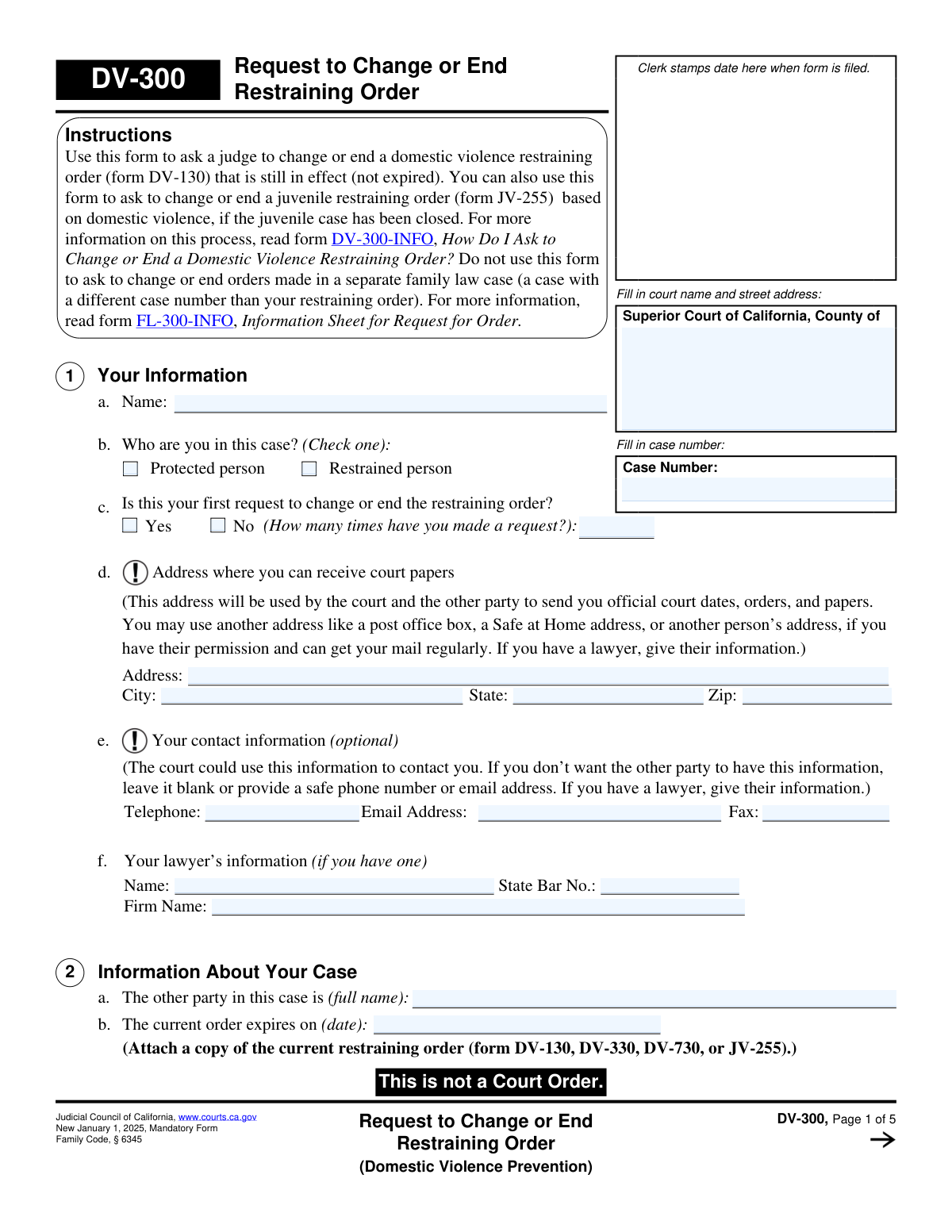
Yes! You can use AI to fill out Form DV-300, Request to Change or End Restraining Order (Domestic Violence Prevention)
Don't type 86 fields by hand. Tell our AI about yourself, or upload a document you already have, and it fills every field in seconds. You check it, then download, print or sign.
The AI does the filling. You just check it.
No typing into boxes, nothing to install.
What this form asks for
The AI fills all of it, from your answers or your documents.
The AI checks your answers before you download
14 checks built for this form, so a wrong date or a missing answer is caught before anyone else sees it.
This check verifies that the 'Case Number' field (CaseNumber_ft) on page 1 is not empty. The case number is the primary identifier for the legal proceeding, and its absence would make it impossible for the court clerk to file the document correctly. A failed validation would prevent submission until the case number is entered.
Validates that exactly one box is checked in section 1b, identifying the filer as either the 'Protected person' or the 'Restrained person'. This status is fundamental to the request and determines the filer's legal standing. Selecting neither or both options creates ambiguity and would cause the form to be rejected.
If the user checks 'No' for 'Is this your first request to change or end the restraining order?' (item 1c), this validation ensures the subsequent field asking 'How many times have you made a request?' contains a positive integer. This information provides important context for the judge regarding the case history. An empty or non-numeric value would result in an incomplete and potentially misleading submission.
This check ensures the 'current order expires on' date (ExpirationDate_dt) in section 2b is a valid date that has not yet passed. The form is explicitly for orders that are 'still in effect (not expired)'. Submitting a request for an already expired order is procedurally incorrect and would be rejected by the court.
Verifies that in section 3, the user selects either 'end all the orders' (3a) or 'change or end some of the orders' (3b), but not both. These are mutually exclusive actions, and selecting both would make the filer's intent unclear. The system should enforce a choice of one or the other to ensure the request is unambiguous.
If the user checks box 3b to 'change or end some of the orders,' this validation confirms that the description field in 3b(1) is filled out. The court must know the specific changes being requested to make a ruling. A failure to provide this detail renders the request incomplete and meaningless.
And 8 more checks
- Conditional Child Custody Form Logic
- Conditional Add/Remove People Justification
- People Table Row Completeness
- Numeric Age Validation
- Reason for Request Completeness
- Attached Current Order Form Check
- Signature Date Validity
- Case Number Consistency Across Pages
Let AI fill out your DV-300
No typing. Every field filled in seconds, checked, ready to sign.
How to Fill Out DV-300 Online for Free in 2026
What the AI walks you through.
- Navigate to Instafill.ai and upload or select the Form DV-300.
- Provide your personal information in Section 1, including your name, contact details, and your role in the case (protected or restrained person).
- Enter the case number and details about the other party and the current restraining order in Section 2.
- In Section 3, specify whether you are asking to end the entire order or change specific parts. Clearly describe the changes you are requesting.
- Use Section 4 to provide a detailed explanation and reasons for your request to change or end the restraining order.
- Review all the information auto-filled by the AI for accuracy, then electronically sign and date the form in Section 8.
- Download the completed DV-300 and follow the 'Your Next Steps' instructions on the form for filing it with the court and serving the other party.
Common Mistakes in Completing DV-300
The ones the AI is built to catch.
Incorrect or Missing Case Number
Failure to Attach the Current Restraining Order
Using a Confidential Address for Service
Providing a Weak or Unclear Reason for the Request
Omitting Required Child Custody Attachment (DV-305)
Missing Signature or Date
Improper Service of Court Documents
Submitting a Handwritten, Illegible Form
Missing Financial Forms for Support Changes
Confusing 'End All Orders' with 'Change Some Orders'
Improperly Requesting Immediate Orders
Frequently Asked Questions About DV-300
Is it really free for 7 days?
Can I fill other forms too?
How do I cancel?
How does the AI fill out DV-300?
What happens to my information?
How complex is DV-300 to fill out?
What is Form DV-300 used for?
Who can file Form DV-300?
What other documents do I need to submit with this form?
What if I want to change the child custody or visitation orders?
Where and when do I file this form?
How do I notify the other person about my request?
What should I write in Section 4, 'Reason for Request'?
Can I get the order changed immediately without a hearing?
What's the difference between this form and a family law form like FL-300?
What happens if my restraining order is about to expire?
Can an AI tool help me fill out Form DV-300?
How can I use Instafill.ai to complete this form online?
The PDF version of the form I have is not fillable. What can I do?
Can I ask the court to make the other person pay for my lawyer?
Get your DV-300 filled out by AI
$0 today. Cancel before Nov 1 and you pay nothing.
Other forms like this one
California court forms: Judicial Council of California Form SC-105, Request for Court Order and Answer (Small Claims), Judicial Council of California Form SC-120, Defendant’s Claim and ORDER to Go to Small Claims Court (Small Claims), Judicial Council of California Form SER-001, Request for Sheriff to Serve Court Papers, Judicial Council of California Form SER-001, Request for Sheriff to Serve Court Papers, Affidavit for Collection of Personal Property California Probate Code Section 13100, Form POS-040, Proof of Service—Civil, Declaration of Facts of Death (California Superior Court), declaration-of-marriage-for-court-proceeding-california-family-law, ADOPT-200, Adoption Request, ADOPT-200, Stepparent Adoption Request, ADOPT-210, Adoption Agreement, ADOPT-310, Contact After Adoption Agreement, Judicial Council of California Form ADOPT-200, Adoption Request, Form ADR-107, Mediation Attendance Sheet, Form ADR-110, Order Appointing Referee, Form ADR-109, Stipulation or Motion for Order Appointing Referee, Form ADR-102, Request for Trial De Novo After Judicial Arbitration, Form ADR-108, Referee's Report (Code Civ. Proc., §§ 638, 639), Form ADR-106, Petition to Confirm, Correct, or Vacate Contractual Arbitration Award, Form ADR-104, Rejection of Award and Request for Trial After Attorney-Client Fee Arbitration
restraining order forms: Form DV-100, Request for Domestic Violence Restraining Order, DV-100, Request for Domestic Violence Restraining Order (Domestic Violence Prevention), Judicial Council of California Form DV-110, Temporary Restraining Order (CLETS-TRO) (Domestic Violence Prevention), Form DV-116, Order on Request to Continue Court Hearing (Temporary Restraining Order) (CLETS-TRO) (Domestic Violence Prevention), Form DV-130, Restraining Order After Hearing (Order of Protection) (Domestic Violence Prevention), Form CH-110, Temporary Restraining Order (CLETS-TCH) (Civil Harassment Prevention), Form CH-120, Response to Request for Civil Harassment Restraining Orders, Form CH-130, Civil Harassment Restraining Order After Hearing (CLETS-CHO), Order on Request to Modify/Terminate Civil Harassment Restraining Order (Civil Harassment Prevention), Form CH-620, Response to Request to Modify/Terminate Civil Harassment Restraining Order (Civil Harassment Prevention), Form CIV-025, Application and Order for Reissuance of Order to Show Cause and Temporary Restraining Order, Form CD-190, Application for Temporary Restraining Order (Claim and Delivery), Order on Request to Continue Hearing (Temporary Restraining Order) (CLETS-TCH) (Civil Harassment Prevention), Form CH-610, Notice of Hearing on Request to Modify/Terminate Civil Harassment Restraining Order (Civil Harassment Prevention), Form CH-700, Request to Renew Restraining Order (Civil Harassment Prevention), Form CH-730, Order Renewing Civil Harassment Restraining Order (CLETS), Form DV-120, Response to Request for Domestic Violence Restraining Order (Domestic Violence Prevention), Form DV-310, Notice of Court Hearing and Temporary Order to Change or End Restraining Order (Domestic Violence Prevention), Form DV-315, Request to Reschedule Hearing to Change or End Restraining Order (Domestic Violence Prevention), Form DV-710, Notice of Hearing to Renew Restraining Order (CLETS-OAH) (Domestic Violence Prevention)
domestic violence forms: Form DV-100, Request for Domestic Violence Restraining Order, Dakota County CDA New Admissions Informal Review Request Form (Housing Choice Voucher Program) and HUD Form 5382, Certification of Domestic Violence, Dating Violence, Sexual Assault, or Stalking, and Alternate Documentation, DV-100, Request for Domestic Violence Restraining Order (Domestic Violence Prevention), Form DV-200, Proof of Personal Service (CLETS) (Domestic Violence Prevention), Judicial Council of California Form DV-110, Temporary Restraining Order (CLETS-TRO) (Domestic Violence Prevention), Form DV-109, Notice of Court Hearing (Domestic Violence Prevention), Form DV-101, Description of Abuse (Domestic Violence Prevention), Form DV-108, Request for Orders to Prevent Child Abduction (Domestic Violence Prevention), Form DV-116, Order on Request to Continue Court Hearing (Temporary Restraining Order) (CLETS-TRO) (Domestic Violence Prevention), Form DV-130, Restraining Order After Hearing (Order of Protection) (Domestic Violence Prevention), Form DV-105, Request for Child Custody and Visitation Orders (Domestic Violence Prevention), Form DV-140, Child Custody and Visitation Order (Domestic Violence Prevention), Form DV-145, Order to Prevent Child Abduction (Domestic Violence Prevention), State of Michigan Form MC 282, Domestic Violence Screening for Referral to Mediation, MC 282a, Domestic Violence Screening, Form CR-161, Criminal Protective Order—Other Than Domestic Violence (CLETS—CPO), Form CR-162, Order to Surrender Firearms, Firearm Parts, and Ammunition in Domestic Violence Case (CLETS—CPO), Form CR-102, Domestic Violence Plea Form With Waiver of Rights—Misdemeanor (Criminal), Form CR-160, Criminal Protective Order—Domestic Violence (CLETS—CPO), Form DV-120, Response to Request for Domestic Violence Restraining Order (Domestic Violence Prevention)
Let AI fill out your DV-300
Your trial starts once a card is added. You pay nothing before Nov 1.
Our AI already knows this form, all 86 fields of it. Skip the typing: tell it about yourself, or upload what you have, and it fills the whole form in seconds.
- AI fills every field on all 5 pages, tables and checkboxes included
- No typing into boxes: answer a few questions, or upload a document you already have, an old copy of this form, a photo of a document
- The AI checks the answers; you review and change anything before you download
- Download the finished PDF, print it, or sign it online
- Encrypted, and never used to train AI
Cancel before Nov 1 and you pay nothing.
A card is needed to start the trial. Cancel in two clicks from your account.
Terms · Privacy