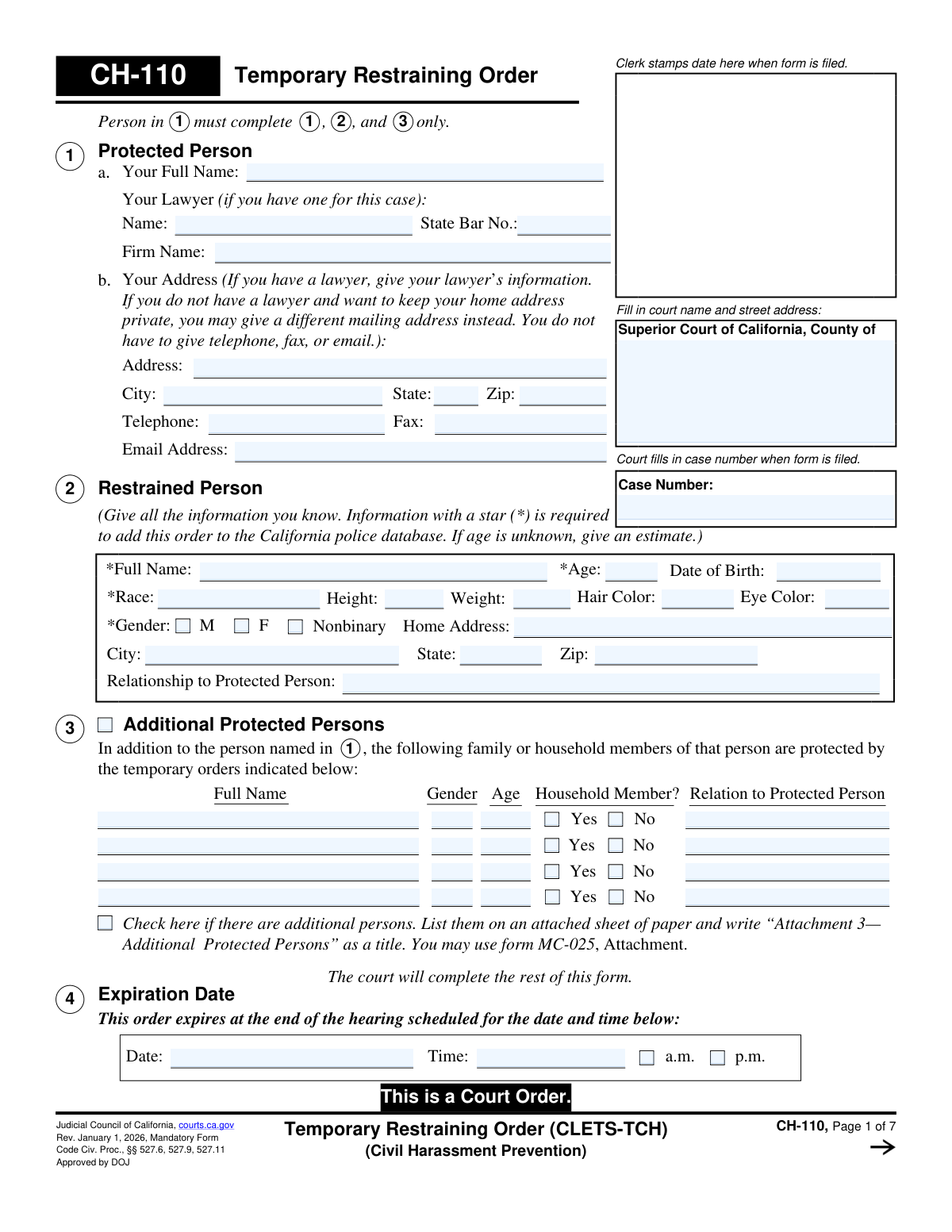
Yes! You can use AI to fill out Form CH-110, Temporary Restraining Order (CLETS-TCH) (Civil Harassment Prevention)

Form CH-110, the Temporary Restraining Order, is a legal document issued by the California Superior Court to provide immediate protection against civil harassment. It details the specific orders a restrained person must follow, such as staying away from and not contacting the protected person, until a formal court hearing. This order is crucial for ensuring the safety and peace of individuals facing stalking, threats, or abuse. Today, this form can be filled out quickly and accurately using AI-powered services like Instafill.ai, which can also convert non-fillable PDF versions into interactive fillable forms.
CH-110 is part of the California court forms, civil court forms and restraining order forms categories on Instafill.
Our AI automatically handles information lookup, data retrieval, formatting, and form filling.
It takes less than a minute to fill out CH-110 using our AI form filling.
Securely upload your data. Information is encrypted in transit and deleted immediately after the form is filled out.

Form specifications

Form name: Form CH-110, Temporary Restraining Order (CLETS-TCH) (Civil Harassment Prevention)
Number of fields: 165
Number of pages: 1
Language: English
main-image

Instafill Demo: How to fill out PDF forms in seconds with AI

How to Fill Out CH-110 Online for Free in 2026

Are you looking to fill out a CH-110 form online quickly and accurately? Instafill.ai offers the #1 AI-powered PDF filling software of 2026, allowing you to complete your CH-110 form in just 37 seconds or less.
Follow these steps to fill out your CH-110 form online using Instafill.ai:
  1. 1 Navigate to Instafill.ai and upload or select the CH-110, Temporary Restraining Order form.
  2. 2 Enter your full name and address as the 'Protected Person' in Section 1. If you have a lawyer, provide their information.
  3. 3 In Section 2, provide all known information about the 'Restrained Person,' including their name, physical description, and address, which is required for police enforcement.
  4. 4 List any additional family or household members who also need protection in Section 3.
  5. 5 Use the AI assistant to review the entered information for completeness and accuracy, ensuring all required fields for the petitioner are filled.
  6. 6 Download or print the completed sections of the form. Note that the petitioner only fills out sections 1, 2, and 3; the court completes the remainder.
  7. 7 File the completed form with the clerk at the appropriate Superior Court to initiate the legal process.

Our AI-powered system ensures each field is filled out correctly, reducing errors and saving you time.

Why Choose Instafill.ai for Your Fillable CH-110 Form?

Speed

Complete your CH-110 in as little as 37 seconds.

Up-to-Date

Always use the latest 2026 CH-110 form version.

Cost-effective

No need to hire expensive lawyers.

Accuracy

Our AI performs 10 compliance checks to ensure your form is error-free.

Security

Your personal information is protected with bank-level encryption.

Frequently Asked Questions About Form CH-110

This form is used by a California court to order a person to stop harassing, intimidating, or abusing another person. It outlines temporary orders, such as no-contact and stay-away rules, that are in effect until a court hearing.

The person seeking protection, referred to as the 'Protected Person' in Section 1, is responsible for filling out the initial sections of this form. The court will complete the remaining sections detailing the specific orders.

As the person requesting the order, you only need to complete Sections 1, 2, and 3. The court clerk and judge will fill out the rest of the form, from Section 4 onwards.

You must provide all the information you know, but details marked with a star (*) like full name, race, and gender are required to add the order to the California police database (CLETS). Providing an accurate date of birth and physical description is also very helpful for law enforcement.

Yes, in Section 1b, you may provide a different mailing address (like a P.O. Box or your lawyer's address) instead of your home address to keep it private. You are not required to list your phone number or email.

You can list other family or household members who also need protection in Section 3, 'Additional Protected Persons'. If you need to list more people than the form allows, you can attach a separate sheet.

The temporary order is short-term and only lasts until the court hearing. The expiration date and time of the order will be specified by the court in Section 4 of the form.

After you file the form, a judge will review it and decide whether to grant the temporary orders. The form will then be served to the restrained person, and a court hearing will be scheduled to determine if a long-term restraining order should be issued.

If the court grants this order (Section 7), the restrained person is prohibited from owning, possessing, or buying any firearms, firearm parts, or ammunition. They must turn in, sell, or store any they currently have and provide proof to the court.

Yes, AI-powered services like Instafill.ai can help you accurately auto-fill your information in Sections 1, 2, and 3. This can save you time and help reduce errors.

You can use a service like Instafill.ai to upload the form and fill it out digitally. The platform allows you to type your information directly into the required fields (Sections 1-3) before printing for submission.

If you have a non-fillable or 'flat' PDF, you can use a tool like Instafill.ai. It can convert the PDF into an interactive, fillable form that you can easily complete on your computer.

The restrained person must obey all orders checked by the court immediately. They should read the form carefully, especially the warnings, and can file a response (Form CH-120) and attend the scheduled court hearing.

Compliance CH-110
Validation Checks by Instafill.ai

1
Restrained Person CLETS Data Completeness
This check verifies that the 'Full Name', 'Race', and 'Gender' fields for the Restrained Person in Section 2 are all filled. These fields are marked with a star, indicating they are required for entry into the California police database (CLETS). Failure to provide this information prevents law enforcement from effectively identifying the restrained person and enforcing the order, so the form submission must be rejected until these fields are complete.
2
Restrained Person Age and Date of Birth Consistency
This validation checks the logical consistency between the 'Date of Birth' (RestrainedDOB) and 'Age' (RestrainedAge_no) fields in Section 2. If both fields are provided, the system calculates the age from the date of birth and verifies it matches the entered age, allowing for a one-year tolerance. This check prevents data entry errors and ensures the identifying information is accurate for law enforcement. A mismatch would trigger a warning to review and correct the data.
3
Protected Person Full Name Requirement
Ensures that the 'Your Full Name' field for the Protected Person in Section 1 (ProtectedFullName) is not empty. This is the primary identifier for the individual seeking protection under the court order. Without this information, the order is legally meaningless and cannot be enforced, so the form cannot be processed if this fundamental field is left blank.
4
State Bar Number Format
Verifies that the 'State Bar No.' in Section 1 (ProtectedLawyerBarNo), if provided, follows the correct format for a California State Bar number, which is typically a sequence of digits. This ensures that the lawyer's credentials can be accurately verified by the court. An incorrectly formatted number could delay proceedings or cause confusion, prompting a correction request.
5
Stay-Away Order Grant Conditions
This check ensures that if the 'Stay-Away Order' in Section 6 is marked as 'Granted as Follows', the 'stay at least yards away' distance (StayawayYards_no) is filled with a positive number and at least one location checkbox is selected. An order that is granted but lacks a specific distance or location is ambiguous and unenforceable. This validation prevents the creation of a legally deficient order.
6
Conditional 'Other (specify)' Field Requirement
This validation applies to multiple sections, such as 5a(4) and 6a(9). It ensures that if an 'Other (specify)' checkbox is selected, the corresponding text field is not left empty. This prevents incomplete specifications that would make the order's terms unclear and difficult to enforce. An empty 'Other' field would render that specific provision of the order void, so the user must provide the required details.
7
Expiration Date and Time Validity
Validates that the 'Expiration Date' and 'Time' in Section 4 are in the correct format (e.g., MM/DD/YYYY, HH:MM) and represent a future point in time relative to the filing date. A temporary restraining order is by definition time-limited and must have a clear end date for the hearing. An invalid or past date would make the order defective and legally invalid.
8
Additional Protected Persons Row Completeness
For each row in Section 3 'Additional Protected Persons', this check ensures that if a 'Full Name' is entered, the corresponding 'Gender', 'Age', 'Household Member?', and 'Relation to Protected Person' fields are also completed. This guarantees that all necessary information is captured for every individual being added to the protection order. Incomplete rows would lead to ambiguity and potential failure to protect these individuals.
9
CLETS Law Enforcement Agency Information
Verifies that if checkbox 13c is selected, indicating a specific law enforcement agency must enter the order into CARPOS, the 'Name of Law Enforcement Agency' and 'Address' fields are completed. This information is vital for the operational workflow of getting the restraining order into the statewide system for enforcement. Missing this data would halt the notification process and delay the order's enforceability by police.
10
Case Number Consistency Across Pages
This check confirms that the 'Case Number' entered at the top of each page is identical throughout the entire document. Maintaining consistency is crucial for document integrity and proper filing, ensuring all pages are correctly associated with the same legal case. A mismatch could lead to pages being misfiled or the document being rejected by the court clerk.
11
Household Member Selection Exclusivity
In the 'Additional Protected Persons' table (Section 3), this validation ensures that for each person listed, either 'Yes' or 'No' is selected for the 'Household Member?' question, but not both. This prevents contradictory data entry for a simple binary choice. Such an error, while small, indicates a data capture problem and must be corrected to maintain a clean and accurate record.
12
Animal Protection Order Specificity
In Section 11, if 'Granted as Follows' is selected for 'Possession and Protection of Animals', this check ensures that the details are specified. If possession is granted (11a), the animal description must be filled. If a stay-away order is granted (11b), the distance in yards must be specified. This prevents an ambiguous and unenforceable order regarding the protection of animals.
13
Restrained Person Date of Birth Format
Ensures the 'Date of Birth' for the Restrained Person in Section 2 is entered in a valid MM/DD/YYYY format and is a plausible date (i.e., not in the future). Accurate date of birth is a key identifier for law enforcement and the court system. An invalid format would cause data rejection, while an illogical date could lead to misidentification.
14
Attached Pages Count Validity
Checks that the 'Number of pages attached' field in Section 15 contains a non-negative integer. This field is important for the court clerk to verify that the filing is complete and all attachments are present. An incorrect count could lead to an incomplete case file, so this validation ensures the record is accurate from the start.

Common Mistakes in Completing CH-110

Disclosing a Confidential Home Address

In Section 1, filers often list their actual home address out of habit, forgetting that the restrained person will receive a copy of this form. This can compromise the filer's safety. To avoid this, you must use a different, safe mailing address (like a P.O. Box) or your lawyer's address if you have one, as the form explicitly permits.

Providing Incomplete Information for the Restrained Person

Filers frequently leave fields in Section 2 blank because they don't know the exact details. However, information marked with a star (*)—Full Name, Gender, and Race—is mandatory for entering the order into the California police database (CLETS). Missing this data can make the order unenforceable by law enforcement, defeating its purpose. It is crucial to provide at least an estimate for age if the date of birth is unknown.

Using Vague Physical Descriptors

When describing the restrained person in Section 2, people often use generic terms like 'average' for height/weight or 'brown' for hair/eye color. These descriptions are too vague for law enforcement to reliably identify the individual. Be as specific as possible (e.g., 'approx. 6'1"', '200 lbs', 'dark brown', 'hazel') to ensure the order can be enforced effectively.

Failing to List All Household Members Needing Protection

A person filing for a restraining order is often under immense stress and may focus only on their own protection, forgetting to list children or other family members in their household in Section 3. This is a critical oversight, as anyone not listed is not legally protected by the stay-away and personal conduct orders. Always take the time to include every household member who is also at risk.

Completing Sections Reserved for the Court

The form clearly states that the filer should only complete Sections 1, 2, and 3, and that 'The court will complete the rest of this form.' However, filers sometimes attempt to check boxes or fill in details in sections like 5 (Personal Conduct Orders) or 6 (Stay-Away Order). This can cause confusion, require correction, and delay the issuance of the temporary order.

Submitting an Illegible Handwritten Form

Many people find a non-fillable PDF version of the form and fill it out by hand. Due to the stressful circumstances, handwriting can be rushed and illegible, leading to critical data entry errors by the court clerk for names, addresses, or dates. This can invalidate the order or make it impossible to serve. Using a tool like Instafill.ai can convert a flat PDF into a fillable one, ensuring all entries are typed and perfectly legible.

Improperly Attaching Additional Information

If more than four additional people need protection, Section 3 instructs the filer to list them on an attached sheet. A common error is to use a blank piece of paper without the proper title ('Attachment 3—Additional Protected Persons') or to forget the attachment altogether. This can result in the additional names being missed by the court, leaving those individuals unprotected.

Confusing Lawyer and Personal Information

Section 1 asks for the protected person's information and their lawyer's information separately. A frequent mistake is mixing these up, such as putting the lawyer's name in the 'Your Full Name' field or providing personal contact details when the form directs you to use the lawyer's. This can cause significant confusion and delays in communication from the court. AI-powered tools like Instafill.ai can help prevent this by guiding the user to enter the correct information in the appropriate fields.

Providing an Ambiguous Relationship Description

In Section 2, the 'Relationship to Protected Person' field requires a factual description for legal context. People sometimes enter emotional or vague terms like 'stalker' or 'problem person' instead of a clear, objective relationship like 'neighbor,' 'former co-worker,' or 'ex-friend.' A precise description helps the judge understand the nature of the relationship and the basis for the civil harassment claim.
Saved over 80 hours a year

“I was never sure if my IRS forms like W-9 were filled correctly. Now, I can complete the forms accurately without any external help.”

Kevin Martin Green

Your data stays secure with advanced protection from Instafill and our subprocessors

Robust compliance program

Transparent business model

You’re not the product. You always know where your data is and what it is processed for.

ISO 27001, HIPAA, and GDPR

Our subprocesses adhere to multiple compliance standards, including but not limited to ISO 27001, HIPAA, and GDPR.

Security & privacy by design

We consider security and privacy from the initial design phase of any new service or functionality. It’s not an afterthought, it’s built-in, including support for two-factor authentication (2FA) to further protect your account.

Fill out CH-110 with Instafill.ai

Worried about filling PDFs wrong? Instafill securely fills form-ch-110-temporary-restraining-order-clets-tch-civil-harassment-prevention forms, ensuring each field is accurate.

Related forms by category

California court forms Judicial Council of California Form SC-105, Request for Court Order and Answer (Small Claims), Judicial Council of California Form SC-120, Defendant’s Claim and ORDER to Go to Small Claims Court (Small Claims), Judicial Council of California Form SER-001, Request for Sheriff to Serve Court Papers, Judicial Council of California Form SER-001, Request for Sheriff to Serve Court Papers, Affidavit for Collection of Personal Property California Probate Code Section 13100, Form POS-040, Proof of Service—Civil, Declaration of Facts of Death (California Superior Court), Declaration of Marriage for Court Proceeding (California Family Law), ADOPT-200, Adoption Request, ADOPT-200, Stepparent Adoption Request, ADOPT-210, Adoption Agreement, ADOPT-310, Contact After Adoption Agreement, Judicial Council of California Form ADOPT-200, Adoption Request, Form ADR-107, Mediation Attendance Sheet, Form ADR-110, Order Appointing Referee, Form ADR-109, Stipulation or Motion for Order Appointing Referee, Form ADR-102, Request for Trial De Novo After Judicial Arbitration, Form ADR-108, Referee's Report (Code Civ. Proc., §§ 638, 639), Form ADR-106, Petition to Confirm, Correct, or Vacate Contractual Arbitration Award, Form ADR-104, Rejection of Award and Request for Trial After Attorney-Client Fee Arbitration · + 30 more →
civil court forms Petition for Leave to Proceed In Forma Pauperis (Court of Common Pleas of Lehigh County, Pennsylvania, Civil Division), Designation of Record on Appeal (Civil) (Maricopa County Justice Courts, Arizona) (Form APP 8150-702), Certificate of Service (Civil Court Claim), Pfändungs- und Überweisungsbeschluss (Garnishment and Transfer Order) – German Civil Enforcement Court Form, AOPC 308A, Civil Complaint, Form MC 03, Answer, Civil, Form POS-040, Proof of Service—Civil, ONTARIO Form 8: Application (General), Form ATJ 601.9, Application for Waiver of Court Fees (Civil), Nevada Justice / Municipal Civil Court Cover Sheet, Form MC 01, Summons, Form MC 10, Judgment, Civil, Form MC 99, Motion and Affidavit to Set Aside Default (Civil), Form MC 281a, Civil Mediator Application, Ex Parte Motion and Order to Renew Civil Judgment, AO 88B, Subpoena to Produce Documents, Information, or Objects or to Permit Inspection of Premises in a Civil Action, Form APP-031A, Application for Extension of Time to File Brief (Civil Case), Civil Appeal Case Information Statement, Form APP-014, Appellant's Proposed Statement on Appeal (Unlimited Civil Case), Form APP-015, Respondent's Proposed Corrections to/Additions to Appellant's Proposed Settled Statement (Unlimited Civil Case) · + 3 more →
restraining order forms Form DV-100, Request for Domestic Violence Restraining Order, DV-100, Request for Domestic Violence Restraining Order (Domestic Violence Prevention), Judicial Council of California Form DV-110, Temporary Restraining Order (CLETS-TRO) (Domestic Violence Prevention), Form DV-116, Order on Request to Continue Court Hearing (Temporary Restraining Order) (CLETS-TRO) (Domestic Violence Prevention), Form DV-130, Restraining Order After Hearing (Order of Protection) (Domestic Violence Prevention), form-ch-120-response-to-request-for-civil-harassment-restraining-orders