Yes! You can use AI to fill out AOPC 308A, Civil Complaint

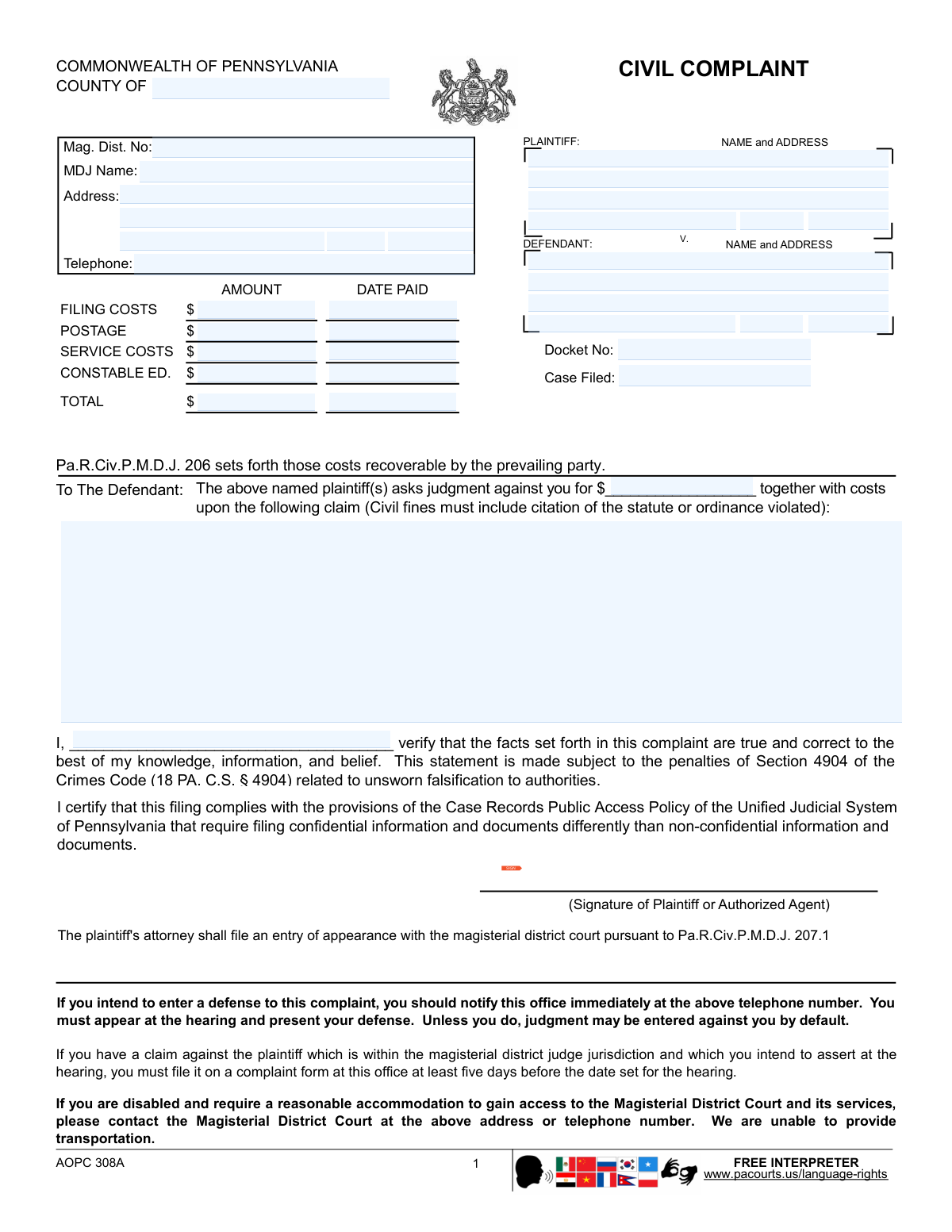
Form AOPC 308A is the official Civil Complaint form for the Commonwealth of Pennsylvania, used by a plaintiff to begin a legal action against a defendant in a Magisterial District Court. It outlines the plaintiff's claim, the amount of damages sought, and provides essential information about both parties to the court. Today, this form can be filled out quickly and accurately using AI-powered services like Instafill.ai, which can also convert non-fillable PDF versions into interactive fillable forms.
Our AI automatically handles information lookup, data retrieval, formatting, and form filling.
It takes less than a minute to fill out AOPC 308A using our AI form filling.
Securely upload your data. Information is encrypted in transit and deleted immediately after the form is filled out.

Form specifications

Form name: AOPC 308A, Civil Complaint
Number of pages: 1
Language: English
main-image

Instafill Demo: How to fill out PDF forms in seconds with AI

How to Fill Out AOPC 308A Online for Free in 2026

Are you looking to fill out a AOPC 308A form online quickly and accurately? Instafill.ai offers the #1 AI-powered PDF filling software of 2026, allowing you to complete your AOPC 308A form in just 37 seconds or less.
Follow these steps to fill out your AOPC 308A form online using Instafill.ai:
  1. 1 Navigate to Instafill.ai and upload or select the Pennsylvania Civil Complaint form (AOPC 308A).
  2. 2 Provide the court details, including the county, Magisterial District number, and the judge's name and address.
  3. 3 Enter the full name and address for both the plaintiff (the person filing) and the defendant (the person being sued).
  4. 4 Clearly state the claim against the defendant, including the monetary amount being sought and the factual basis for the complaint.
  5. 5 Complete the verification section by affirming that the information provided is true and correct to the best of your knowledge.
  6. 6 Review all entered information for accuracy, then e-sign and date the complaint in the designated signature fields.
  7. 7 Download the completed AOPC 308A to file with the appropriate Magisterial District Court.

Our AI-powered system ensures each field is filled out correctly, reducing errors and saving you time.

Why Choose Instafill.ai for Your Fillable AOPC 308A Form?

Speed

Complete your AOPC 308A in as little as 37 seconds.

Up-to-Date

Always use the latest 2026 AOPC 308A form version.

Cost-effective

No need to hire expensive lawyers.

Accuracy

Our AI performs 10 compliance checks to ensure your form is error-free.

Security

Your personal information is protected with bank-level encryption.

Frequently Asked Questions About Form AOPC 308A

This form is used to initiate a civil lawsuit in a Pennsylvania Magisterial District Court. The plaintiff (the person filing) uses it to state their claim against a defendant and request a monetary judgment.

The plaintiff is the person or business starting the lawsuit and seeking money or other relief. The defendant is the person or business being sued.

You will need the full legal names and current addresses for both yourself (plaintiff) and the party you are suing (defendant). You also need the specific details of your claim and the total dollar amount you are seeking.

In the space provided, clearly and concisely explain the facts of your case, including what the defendant did or did not do and why you are owed money. If your claim is based on a specific statute or ordinance, you must include its citation.

You must file the form at the Magisterial District Court office that has jurisdiction over your case. This is typically determined by where the defendant lives or where the incident in question occurred.

If you intend to defend against the claim, you must notify the Magisterial District Court office immediately and appear at the scheduled hearing. If you do not appear, a default judgment may be entered against you.

If you have a counterclaim against the plaintiff, you must file it on a separate complaint form at the same court office. This must be done at least five days before the scheduled hearing date.

By signing the verification, you are swearing under penalty of law that the facts stated in the complaint are true and correct to the best of your knowledge. Providing false information can result in criminal penalties.

The Docket Number is a unique identifier assigned by the court to your case upon filing. The court clerk will provide this number, which you must use to reference your case in all future communications.

You should contact the Magisterial District Court at the address or phone number listed on the form to request a reasonable accommodation. Note that the court is unable to provide transportation.

Yes, services like Instafill.ai use AI to help you accurately auto-fill form fields, which can save time and reduce errors. This ensures all required information is entered correctly before you file.

Simply upload the Civil Complaint PDF to the Instafill.ai platform. The AI will identify all the form fields, allowing you to provide your information and have the form filled out automatically and accurately.

You can use a service like Instafill.ai, which is capable of converting flat, non-fillable PDFs into interactive, fillable forms. This allows you to easily type your information directly into the correct fields online.

These are court-mandated fees for initiating a lawsuit, including filing costs, postage for mailing documents, and service costs for officially delivering the complaint to the defendant. The court will inform you of the exact amounts you need to pay.

Compliance AOPC 308A
Validation Checks by Instafill.ai

1
Ensures Plaintiff Name is Provided
This check verifies that the 'Plaintiff Name' field is not empty. The plaintiff is the party initiating the lawsuit, and their full legal name is a fundamental requirement for a valid legal complaint. If this field is left blank, the complaint cannot be processed as the filing party is unknown.
2
Ensures Defendant Name is Provided
This check confirms that the 'Defendant — Full Name' field contains a value. Properly identifying the defendant is crucial for legal service of process and for the court to establish jurisdiction over the party being sued. A complaint without a named defendant is legally deficient and cannot proceed.
3
Validates Claim Amount is a Positive Number
This validation ensures the 'Claim / Judgment Amount' is a valid, positive monetary value. A civil complaint must specify a quantifiable amount of damages being sought from the defendant. A non-numeric, zero, or negative value would be illogical and would cause the filing to be rejected for failing to state a proper claim for relief.
4
Verifies Claim Description is Not Empty
This check ensures that the 'Claim Description / Basis for Relief' field contains text explaining the reason for the lawsuit. Due process requires that the defendant be informed of the specific allegations against them. An empty description fails to state a claim, which would lead to the complaint being dismissed or rejected by the court.
5
Confirms Verification Name Matches Plaintiff Name
This validation compares the 'Plaintiff's Name (Verification)' field with the main 'Plaintiff Name' field to ensure they are identical. The person verifying the facts of the complaint must be the plaintiff or their authorized agent, and this check confirms that identity. A mismatch could raise questions about the authenticity of the verification and may require correction.
6
Verifies Sum of Costs Equals Total Amount
This logical check calculates the sum of 'Filing Costs', 'Postage', 'Service Costs', and 'Constable Ed.' amounts and compares it to the 'Fifth Row - Total Amount' field. This ensures mathematical accuracy on the form, which is critical for financial accounting and determining the final judgment. A discrepancy would flag the form for manual review and correction.
7
Ensures All Dates are in a Valid Format
This rule validates that all date fields, including 'Case Filed' and all 'Date Paid' fields, are entered in a recognized date format (e.g., MM/DD/YYYY). Inconsistent or invalid date formats can lead to data entry errors and confusion in the official court record. The system should reject or flag any non-date entries to maintain data integrity.
8
Prevents Future Case Filed Date
This check ensures the 'Case Filed Date' is not set to a date in the future. A legal case cannot be officially filed on a day that has not yet occurred. This validation prevents simple clerical errors and ensures the integrity of the court's timeline and records.
9
Validates ZIP Code Format for All Addresses
This validation ensures that all ZIP code fields (for the MDJ office, Plaintiff, and Defendant) contain either a 5-digit or 9-digit (ZIP+4) numeric code. Correct ZIP codes are essential for the successful delivery of legal notices and correspondence by mail. An invalid format would flag the address for review to prevent service failures.
10
Ensures County of Filing is Specified
This check verifies that the 'County' field is filled out, as this determines the proper legal venue and jurisdiction of the court. Filing a complaint in the wrong county can lead to the case being dismissed or transferred, causing significant delays. This is a mandatory field for the complaint to be legally sound.
11
Validates MDJ/Court Telephone Number Format
This check ensures the 'MDJ/Court Telephone' number follows a standard US phone number format (e.g., (XXX) XXX-XXXX or XXXXXXXXXX). A valid phone number is essential for all parties to be able to contact the court. An incorrectly formatted number could prevent communication and delay proceedings.
12
Ensures All Cost Amounts are Valid Monetary Values
This check verifies that all cost-related amount fields ('Filing Costs', 'Postage', 'Service Costs', 'Constable Ed.') are entered as non-negative numeric values. These fields are used for financial calculations and cannot contain text or negative numbers. This validation maintains the financial integrity of the document and prevents calculation errors.
13
Requires Plaintiff and Defendant Address Completeness
This validation ensures that the street address, city, state, and ZIP code fields are all filled out for both the plaintiff and the defendant. Complete and accurate addresses are legally required for proper service of process and for sending official court notices. Missing address components can halt the case before it begins.
14
Validates State Field Abbreviation
This check ensures that the 'State' fields for the MDJ, Plaintiff, and Defendant addresses use a valid two-letter postal abbreviation. Using standardized state codes is crucial for address verification systems and ensuring mail is delivered correctly. An invalid entry could lead to returned mail and failures in serving legal documents.

Common Mistakes in Completing AOPC 308A

Filing in the Wrong Court District

Filers often do not know the correct Magisterial District Number (Mag. Dist. No.) or address and may guess or leave it blank. This mistake can cause the complaint to be filed in the wrong venue, leading to dismissal and forcing the plaintiff to start over. To avoid this, use the Pennsylvania court system's official website to look up the correct magisterial district court based on where the defendant lives or where the incident occurred.

Providing an Incomplete or Inaccurate Defendant Address

A critical error is entering a wrong or incomplete address for the defendant, such as omitting an apartment number or using an old address. This prevents successful 'service of process,' meaning the defendant won't be legally notified of the lawsuit and the case cannot proceed. Always verify the defendant's current, complete physical address; AI-powered tools like Instafill.ai can help validate addresses to ensure they are correct and properly formatted.

Writing a Vague or Insufficient Claim Description

Plaintiffs often write overly brief or emotional descriptions, such as 'He owes me money,' without providing the necessary facts, dates, and circumstances that form the basis of the lawsuit. A judge may dismiss a case if the complaint fails to state a clear and legally recognized claim. Be specific and objective, outlining exactly what happened, when it happened, and why you are entitled to the judgment you seek.

Forgetting to Sign or Verify the Complaint

The filer may forget to physically sign the complaint or print their name in the verification section, which affirms the facts are true under penalty of perjury. An unsigned or unverified complaint is not legally valid and will be rejected by the court clerk, halting the entire filing process. Always double-check that you have printed your name on the verification line and signed in the designated signature box before submitting.

Omitting Statute Citations for Civil Fines

The form explicitly states that claims involving civil fines must include a citation of the statute or ordinance that was violated. Filers frequently overlook this requirement and only provide a narrative description of the violation. This omission can result in the claim being deemed legally insufficient, leading to dismissal or delays while the complaint is amended.

Entering an Inconsistent or Ambiguous Judgment Amount

The monetary amount requested in the sentence 'plaintiff(s) asks judgment against you for $____' must be a specific number that is supported by the claim description. People sometimes write vague terms like 'damages' or enter an amount that doesn't match the calculations detailed in their claim. This ambiguity can confuse the court and may require clarification, delaying the proceedings.

Misspelling the Legal Names of Parties

Incorrectly spelling the full legal name of the plaintiff or defendant is a frequent data entry error that can create significant legal problems. A judgment against 'Jon Smith' may not be enforceable against 'John Smyth,' causing issues with collection or correctly identifying the parties in the court record. Carefully check the spelling of all names against official documents or records.

Submitting a Form with Illegible Handwriting

When filling out a paper copy, messy handwriting can make critical information like names, addresses, and claim details impossible for the court to read. This can lead to the form being rejected outright or cause critical data entry errors in the court's system, potentially derailing the case. If the form is a non-fillable PDF, tools like Instafill.ai can convert it into a fillable version to ensure all text is typed, clear, and legible.

Using a P.O. Box for the Defendant's Service Address

While a P.O. Box is a valid mailing address, it is often insufficient for the legal 'service of process,' which typically requires personal delivery by a sheriff or constable. Listing only a P.O. Box for the defendant can make service impossible, preventing the case from moving forward until a valid physical address is provided. Always research and provide the defendant's actual street address where they can be legally served.

Confusing Plaintiff and Defendant Information

In the stress of filling out legal paperwork, individuals sometimes accidentally switch the information for the plaintiff (the person filing the complaint) and the defendant (the person being sued). This fundamental error will cause the complaint to be filed incorrectly, naming the wrong parties in the wrong roles. Carefully review the form to ensure your name and address are in the 'PLAINTIFF' section and the other party's information is in the 'DEFENDANT' section.
Saved over 80 hours a year

“I was never sure if my IRS forms like W-9 were filled correctly. Now, I can complete the forms accurately without any external help.”

Kevin Martin Green

Your data stays secure with advanced protection from Instafill and our subprocessors

Robust compliance program

Transparent business model

You’re not the product. You always know where your data is and what it is processed for.

ISO 27001, HIPAA, and GDPR

Our subprocesses adhere to multiple compliance standards, including but not limited to ISO 27001, HIPAA, and GDPR.

Security & privacy by design

We consider security and privacy from the initial design phase of any new service or functionality. It’s not an afterthought, it’s built-in, including support for two-factor authentication (2FA) to further protect your account.

Fill out AOPC 308A with Instafill.ai

Worried about filling PDFs wrong? Instafill securely fills aopc-308a-civil-complaint forms, ensuring each field is accurate.