
Yes! You can use AI to fill out Form DE-111, Petition for Probate
Don't type 177 fields by hand. Tell our AI about yourself, or upload a document you already have, and it fills every field in seconds. You check it, then download, print or sign.
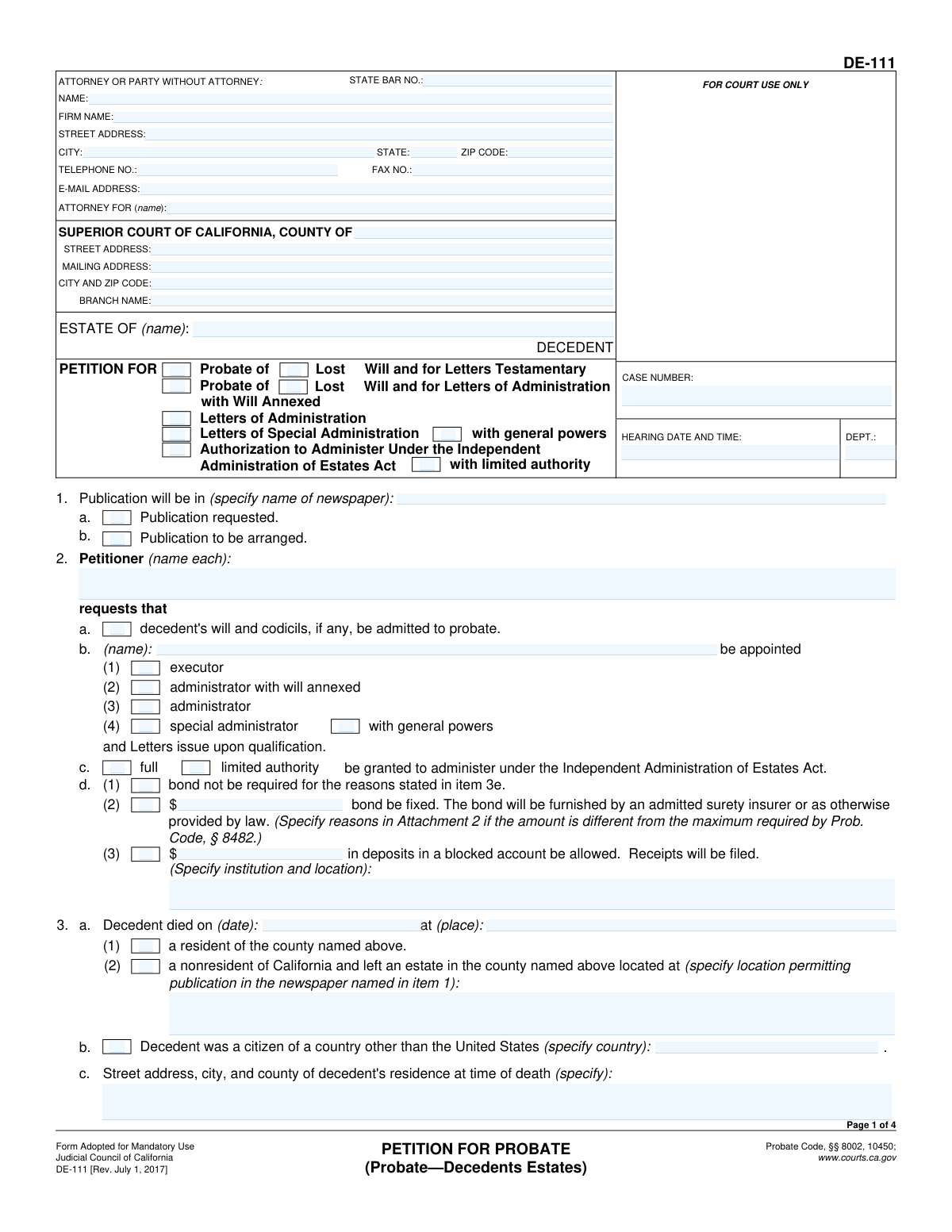
The AI does the filling. You just check it.
No typing into boxes, nothing to install.
What this form asks for
The AI fills all of it, from your answers or your documents.
The AI checks your answers before you download
15 checks built for this form, so a wrong date or a missing answer is caught before anyone else sees it.
Ensures that all details related to the Superior Court of California are accurately filled in, including the county, branch name, city and zip code, street address, and mailing address. Verifies that the information is complete and matches the official records. Confirms that the court details are legible and correctly formatted. Validates that no fields related to the court details are left blank or contain incorrect information.
Confirms that the name, state bar number, firm name, address, telephone number, fax number, and email address of the attorney or party without an attorney are provided. Ensures that the decedent's name is also included in this section. Verifies that all contact information is current and accurately entered. Checks that the details are complete and formatted correctly to avoid any processing delays.
Ensures that the case number is entered if it is known. Validates that the case number follows the correct format as per court requirements. Confirms that the field is not left blank if the case number is available. Checks for any discrepancies in the case number that might lead to processing errors.
Validates that the appropriate boxes indicating the type of petition being filed are checked. Ensures that at least one box is selected to specify the petition type. Confirms that the selection is clear and unambiguous. Checks that the selection aligns with the other information provided in the form.
Checks that the decedent's name, date of death, place of death, and residence details are provided, including residency status in the county or California. Ensures that all fields related to the decedent are accurately and completely filled out. Verifies that the date of death is in the correct format and logically consistent. Confirms that the residence details are clear and support the petition's requirements.
Ensures that the form accurately identifies the type of personal representative being appointed by verifying the correct boxes are checked. Confirms that all necessary details related to the appointment are fully provided to avoid any discrepancies. Validates the completeness of the information to ensure the probate process proceeds without delays. Checks for any missing or incorrect information that could impact the appointment of the personal representative.
And 9 more checks
- Confirms that details about the decedent's will and codicils, including dates and self-proving status, are provided if applicable.
- Ensures that bond information is indicated, including whether it is required, waived, or needs to be fixed, with reasons provided if the bond amount differs from the maximum required.
- Validates that the character and estimated value of the property of the estate, including personal property, real property, and any encumbrances, are accurately completed.
- Checks that the appropriate boxes indicating who survived the decedent are checked, with names, relationships, ages, and addresses provided.
- Confirms whether administration under the Independent Administration of Estates Act is requested.
- Ensures all petitioners have signed the form, with the petition verified by one of them, and includes the date and printed names alongside signatures.
- Verifies that any attachments exceeding the space provided are noted with the number of pages attached.
- Validates that all entered information is reviewed for accuracy and completeness before submission.
- Confirms the use of the current version of the form and consultation of the Probate Code for specific requirements.
Let AI fill out your DE-111
No typing. Every field filled in seconds, checked, ready to sign.
How to Fill Out DE-111 Online for Free in 2026
What the AI walks you through.
- Visit instafill.ai site and select DE-111
- Enter decedent's personal information
- Specify type of letters requested
- Detail estate's character and value
- List heirs and beneficiaries
- Sign and date the form electronically
- Check for accuracy and submit form
Common Mistakes in Completing DE-111
The ones the AI is built to catch.
Incorrect or incomplete court information
Missing attorney or party without attorney details
Case number not provided or incorrect
Incorrect petition type checked
Incomplete decedent information
Missing or incorrect personal representative details
Will and codicils details incomplete
Bond information not specified correctly
Incomplete property of the estate details
Survivors information missing or incorrect
Independent Administration of Estates Act not indicated
Signatures missing or not verified
Attachments not noted or incomplete
Form not reviewed for accuracy before submission
Using an outdated version of the form
Frequently Asked Questions About DE-111
Is it really free for 7 days?
Can I fill other forms too?
How do I cancel?
How does the AI fill out DE-111?
What happens to my information?
How complex is DE-111 to fill out?
What is Form DE-111 used for?
Who can file a Petition for Probate (Form DE-111)?
What information is required to complete Form DE-111?
How do I determine if the decedent's will is self-proving?
What are the requirements for appointing an executor or administrator?
How is the bond requirement determined for a personal representative?
What is the Independent Administration of Estates Act and how does it apply to Form DE-111?
How do I handle a lost will in the Petition for Probate?
What are the steps to request publication in a newspaper for probate?
How do I list the decedent's heirs and beneficiaries on Form DE-111?
What is the difference between Letters of Administration and Letters Testamentary?
How do I calculate the estimated value of the decedent's estate for Form DE-111?
What attachments are required when filing Form DE-111?
How do I nominate a personal representative in the Petition for Probate?
What are the grounds for requesting a special administrator?
How do I indicate that the decedent was a nonresident of California on Form DE-111?
What are the consequences of not waiving bond for a personal representative?
How do I verify the Petition for Probate?
What is the process for filing Form DE-111 with the Superior Court of California?
Where can I find more information about Probate Code sections referenced in Form DE-111?
Get your DE-111 filled out by AI
$0 today. Cancel before Nov 1 and you pay nothing.
Other forms like this one
probate forms: Judicial Council of California Form DE-111, Petition for Probate (Probate—Decedents Estates), Form P3 (Rule 25-3(2)) — Affidavit of Applicant for Grant of Probate or Grant of Administration with Will Annexed (Short Form) (Supreme Court of British Columbia), Form DE-160/GC-040, Inventory and Appraisal (Declaration of Representative/Guardian/Conservator or Small Estate Claimant and Declaration of Probate Referee), Affidavit for Collection of Personal Property California Probate Code Section 13100, Petition for Letters of Administration (New York Surrogate's Court), Transfer on Death Letter of Authorization, Form GC-111, Petition for Appointment of Temporary Conservator (Probate—Guardianships and Conservatorships), Form GC-310, Petition for Appointment of Probate Conservator, Form GC-335, Confidential Capacity Assessment and Declaration—Probate Conservatorship, Form GC-335A, Everyday Activities Attachment to Confidential Capacity Assessment and Declaration—Probate Conservatorship, Form GC-314, Confidential Conservator Screening Form (Probate—Guardianships and Conservatorships), Form GC-320, Citation for Conservatorship (Probate—Guardianships and Conservatorships), Form GC-341, NOTICE OF CONSERVATEE'S RIGHTS (Probate—Guardianships and Conservatorships), Form GC-140, Order Appointing Temporary Guardian (Probate—Guardianships and Conservatorships), Form GC-220, Petition for Special Immigrant Juvenile Findings (Probate—Guardianships and Conservatorships), Probate Case Cover Sheet – Certificate of Grounds for Assignment to District, Form GC-210(CA), Child Information Attachment to Probate Guardianship Petition
California state forms: Judicial Council of California Form DE-111, Petition for Probate (Probate—Decedents Estates), DS 1891, Applicant/Vendor Disclosure Statement (State of California Department of Developmental Services), Judicial Council of California Form DE-120, Notice of Hearing—Decedent's Estate or Trust, Judicial Council of California Form DE-120, Notice of Hearing—Decedent's Estate or Trust, Murrieta Police Department Citizen Complaint Form (California Penal Code § 148.6 Advisory Statement), California Department of Social Services, Sworn Statement, State of California Department of Transportation California Civil Rights Laws Certification, State of California Department of Transportation Darfur Contracting Act Certification, Form DOT ADM-0077, State of California Department of Transportation, Contract Requirements, State of California Department of Transportation Subcontractor List, State of California Department of Transportation, Certified DVBE Summary, Bidder Declaration GSPD-05-105, State of California Level of Care Rate Determination Protocol Matrix, State of California Accessible Form, State of California Form SOC 321, Request for Order and Consent - Paramedical Services, State of California Darfur Contracting Act Certification, State of California Department of Veterans Affairs COMMERCIALLY USEFUL FUNCTION (CUF) CERTIFICATION FORM, Form ADR-100, Statement of Agreement or Nonagreement, Civil Appeal Case Information Statement, Form APP-014, Appellant's Proposed Statement on Appeal (Unlimited Civil Case)
Judicial Council forms: Judicial Council of California Form FL-300, Request for Order, Judicial Council of California Form FL-150, Income and Expense Declaration, Judicial Council of California Form SC-104, Proof of Service (Small Claims), Judicial Council of California Form SC-105, Request for Court Order and Answer (Small Claims), Judicial Council of California Form DE-111, Petition for Probate (Probate—Decedents Estates), Judicial Council of California Form SC-104, Proof of Service (Small Claims), Judicial Council of California Form SC-108, Request to Correct or Cancel Judgment and Answer (Small Claims), Judicial Council of California Form SC-120, Defendant’s Claim and ORDER to Go to Small Claims Court (Small Claims), Civil Case Cover Sheet (Judicial Council of California Form CM-010), Civil Case Cover Sheet (Judicial Council of California Form CM-010), Judicial Council of California Form TR-205, Request for Trial by Written Declaration (Trial by Written Declaration—Traffic), Judicial Council of California Form DE-120, Notice of Hearing—Decedent's Estate or Trust, Inventory and Appraisal Attachment (Judicial Council of California Form DE-161, GC-041), CLETS-001, Confidential Information for Law Enforcement (Judicial Council of California), Judicial Council of California Form SER-001, Request for Sheriff to Serve Court Papers, Judicial Council of California Form UD-105, Answer—Unlawful Detainer, CLETS-001, Confidential Information for Law Enforcement (Judicial Council of California), Judicial Council of California Form ADOPT-210, Adoption Agreement, Judicial Council of California Form DE-120, Notice of Hearing—Decedent's Estate or Trust, Inventory and Appraisal (Judicial Council of California) (Form DE-160/GC-040)
estate forms: Form 593, Real Estate Withholding, Form 1099-S, Proceeds From Real Estate Transactions, Inland Residential Real Estate Services LLC Application for Lease (Form 4301, Rev. 11/14), New licence application – Form 1–1 (IND), Application for an individual’s licence (Real estate agent, property auctioneer, resident letting agent, motor dealer, chattel auctioneer, field agent), Judicial Council of California Form DE-111, Petition for Probate (Probate—Decedents Estates), Texas Real Estate Commission (TREC) One to Four Family Residential Contract (Resale) (TREC No. 20-18), City of Harvey Real Estate Transfer Declaration & Application (with Certificate for Exemption), Judicial Council of California Form DE-120, Notice of Hearing—Decedent's Estate or Trust, Form DE-160/GC-040, Inventory and Appraisal (Declaration of Representative/Guardian/Conservator or Small Estate Claimant and Declaration of Probate Referee), Judicial Council of California Form DE-120, Notice of Hearing—Decedent's Estate or Trust, Fidelity Change of Account Ownership — Mutual Fund Only Accounts (Changing to a Trust, Estate, Guardian, or Conservator Account), Fidelity Change of Account Registration — Changing to a Trust, Estate, Guardian, or Conservator Brokerage Account, Valuing Your Estate Worksheet (from Vanguard's 'Understanding the basics of estate planning' guide), Alaska Residential Real Estate Purchase Agreement, Merrill Edge Self-Directed Trust and Estate Cash Management Account (CMA Account) Account Application Booklet and Agreements, Affidavit for Collection of Personal Property California Probate Code Section 13100, Oklahoma Real Estate Commission Tenancy Guidelines (01-01-2026), Oklahoma Real Estate Commission Residential Property Condition Disclosure Exemption Form (RPCD EXEMPTION FORM), Oklahoma Real Estate Commission Residential Lease, Oklahoma Real Estate Commission Tenant Flood Notice (01-01-2026)
California judicial forms: Judicial Council of California Form FL-300, Request for Order, Judicial Council of California Form FL-150, Income and Expense Declaration, Judicial Council of California Form SC-104, Proof of Service (Small Claims), Judicial Council of California Form SC-105, Request for Court Order and Answer (Small Claims), Judicial Council of California Form DE-111, Petition for Probate (Probate—Decedents Estates), Judicial Council of California Form SC-104, Proof of Service (Small Claims), Judicial Council of California Form SC-108, Request to Correct or Cancel Judgment and Answer (Small Claims), Judicial Council of California Form SC-120, Defendant’s Claim and ORDER to Go to Small Claims Court (Small Claims), Civil Case Cover Sheet (Judicial Council of California Form CM-010), Civil Case Cover Sheet (Judicial Council of California Form CM-010), Judicial Council of California Form TR-205, Request for Trial by Written Declaration (Trial by Written Declaration—Traffic), Judicial Council of California Form DE-120, Notice of Hearing—Decedent's Estate or Trust, Inventory and Appraisal Attachment (Judicial Council of California Form DE-161, GC-041), CLETS-001, Confidential Information for Law Enforcement (Judicial Council of California), Judicial Council of California Form SER-001, Request for Sheriff to Serve Court Papers, Judicial Council of California Form UD-105, Answer—Unlawful Detainer, CLETS-001, Confidential Information for Law Enforcement (Judicial Council of California), Judicial Council of California Form ADOPT-210, Adoption Agreement, Judicial Council of California Form DE-120, Notice of Hearing—Decedent's Estate or Trust, Inventory and Appraisal (Judicial Council of California) (Form DE-160/GC-040)
California probate forms: Judicial Council of California Form DE-111, Petition for Probate (Probate—Decedents Estates), Affidavit for Collection of Personal Property California Probate Code Section 13100, Form DE-142/DE-111(A-3e), Waiver of Bond by Heir or Beneficiary (Probate—Decedents Estates), Form DE-140, Order for Probate, Form DE-150, Letters (Probate), Form DE-154/GC-035, Request for Special Notice (Probate), Form DE-157, Notice of Administration to Creditors, Form DE-120(P), Proof of Personal Service of Notice of Hearing—Decedent's Estate or Trust, Form DE-131, Proof of Subscribing Witness (Probate), Form DE-172, Creditor's Claim (Probate), Form DE-174, Allowance or Rejection of Creditor's Claim, Form DE-221, Spousal or Domestic Partner Property Petition (Probate—Decedents Estates), Form DE-270 / GC-070, Ex Parte Petition for Authority to Sell Securities and Order, Form DE-315, Order Determining Succession to Primary Residence, Form DE-351/GC-101, Order Appointing Guardian Ad Litem—Probate, Form DE-115/GC-015, Notice of Hearing on Petition to Determine Claim to Property, Attachment to Notice of Hearing Proof of Service by Mail (Probate—Decedents' Estates and Guardianships and Conservatorships), Attachment to Notice of Hearing Proof of Personal Service (Probate—Decedents' Estates and Guardianships and Conservatorships), Form DE-125, Summons (Probate), Form DE-147, Duties and Liabilities of Personal Representative
PA state forms: Form 1095-A, Health Insurance Marketplace Statement, Form W-2, Wage and Tax Statement, Form 593, Real Estate Withholding, Form 8938, Statement of Specified Foreign Financial Assets, Form CMS-2567, Statement of Deficiencies, Form 1098, Mortgage Interest Statement, Form 1098-T, Tuition Statement, Form 1099-S, Proceeds From Real Estate Transactions, Form 1098-E, Student Loan Interest Statement, Form DS-3053, Statement of Consent, Form DS-86, Statement of Non-Receipt of a U.S. Passport, Form DS-86, Statement of Non-Receipt of a U.S. Passport, Form 108, Statement of Intention, Form 107, Statement of Financial Affairs, Form 121, Statement About Your SSNs, Form 122A-1, Chapter 7 Statement of Current Monthly Income, Center for Infertility & Reproductive Surgery – New Patient Questionnaire and Patient/Guarantor Statement (Brigham and Women’s Hospital, Department of Obstetrics and Gynecology), Adult Travel Document Application for Stateless and Protected Persons in Canada (16 years of age or over) (PPTC 190), Form W-8IMY (Rev. October 2021), Certificate of Foreign Intermediary, Foreign Flow-Through Entity, or Certain U.S. Branches for United States Tax Withholding and Reporting, Form W-2, Wage and Tax Statement (2025)
NJ state forms: Form 1095-A, Health Insurance Marketplace Statement, Form W-2, Wage and Tax Statement, Form 593, Real Estate Withholding, Form 8938, Statement of Specified Foreign Financial Assets, Form CMS-2567, Statement of Deficiencies, Form 1098, Mortgage Interest Statement, Form 1098-T, Tuition Statement, Form 1099-S, Proceeds From Real Estate Transactions, Form 1098-E, Student Loan Interest Statement, Form DS-3053, Statement of Consent, Form DS-86, Statement of Non-Receipt of a U.S. Passport, Form DS-86, Statement of Non-Receipt of a U.S. Passport, Form 108, Statement of Intention, Form 107, Statement of Financial Affairs, Form 121, Statement About Your SSNs, Form 122A-1, Chapter 7 Statement of Current Monthly Income, Center for Infertility & Reproductive Surgery – New Patient Questionnaire and Patient/Guarantor Statement (Brigham and Women’s Hospital, Department of Obstetrics and Gynecology), Adult Travel Document Application for Stateless and Protected Persons in Canada (16 years of age or over) (PPTC 190), Form W-8IMY (Rev. October 2021), Certificate of Foreign Intermediary, Foreign Flow-Through Entity, or Certain U.S. Branches for United States Tax Withholding and Reporting, Form W-2, Wage and Tax Statement (2025)
state ID forms: Application for Renewal or Duplicate of Alabama Driver License or ID card, Form 1095-A, Health Insurance Marketplace Statement, Form W-2, Wage and Tax Statement, Form 593, Real Estate Withholding, Form 8938, Statement of Specified Foreign Financial Assets, Form CMS-2567, Statement of Deficiencies, Form 1098, Mortgage Interest Statement, Form 1098-T, Tuition Statement, Form 1099-S, Proceeds From Real Estate Transactions, Form 1098-E, Student Loan Interest Statement, Form DS-3053, Statement of Consent, Form DS-86, Statement of Non-Receipt of a U.S. Passport, Form 108, Statement of Intention, Form 107, Statement of Financial Affairs, Form 121, Statement About Your SSNs, Form 122A-1, Chapter 7 Statement of Current Monthly Income, Center for Infertility & Reproductive Surgery – New Patient Questionnaire and Patient/Guarantor Statement (Brigham and Women’s Hospital, Department of Obstetrics and Gynecology), Adult Travel Document Application for Stateless and Protected Persons in Canada (16 years of age or over) (PPTC 190), Form W-8IMY (Rev. October 2021), Certificate of Foreign Intermediary, Foreign Flow-Through Entity, or Certain U.S. Branches for United States Tax Withholding and Reporting, Form W-2, Wage and Tax Statement (2025)
Let AI fill out your DE-111
Your trial starts once a card is added. You pay nothing before Nov 1.
Our AI already knows this form, all 177 fields of it. Skip the typing: tell it about yourself, or upload what you have, and it fills the whole form in seconds.
- AI fills every field on all 4 pages, checkboxes included
- No typing into boxes: answer a few questions, or upload a document you already have, an old copy of this form, a photo of a document
- The AI checks the answers; you review and change anything before you download
- Download the finished PDF, print it, or sign it online
- Encrypted, and never used to train AI
Cancel before Nov 1 and you pay nothing.
A card is needed to start the trial. Cancel in two clicks from your account.
Terms · Privacy