
Yes! You can use AI to fill out Judicial Council of California Form SC-104, Proof of Service (Small Claims)
Don't type 60 fields by hand. Tell our AI about yourself, or upload a document you already have, and it fills every field in seconds. You check it, then download, print or sign.
The AI does the filling. You just check it.
No typing into boxes, nothing to install.
What this form asks for
The AI fills all of it, from your answers or your documents.
The AI checks your answers before you download
16 checks built for this form, so a wrong date or a missing answer is caught before anyone else sees it.
Validates that the Superior Court county name is provided and that the court street address field is not left blank. This is important because the proof of service must be tied to the correct court location for filing and case tracking. If missing or incomplete, the submission should be rejected or flagged because the court cannot reliably associate the proof with the proper venue.
Checks that both the Case Number and Case Name fields are present and non-empty, and that the case number matches an expected pattern (e.g., alphanumeric with dashes as used by the county). These identifiers are essential to link the proof of service to the correct small claims matter. If validation fails, the form should be returned for correction because mis-association can invalidate filing or cause service to be credited to the wrong case.
Ensures Hearing Date is a valid calendar date, Time is in a valid time format (with a.m./p.m. if required), and Department is provided when applicable. This matters because the form instructions require filing at least 5 days before the hearing, and the court uses these fields to confirm timeliness. If invalid or missing, the system should flag the submission as incomplete and potentially noncompliant with filing deadlines.
Validates that the form is completed for exactly one served party type: either item 1(a) (person’s name) or item 1(b) (business/entity name plus authorized person and job title). This prevents ambiguity about who was served and whether service was directed to an authorized recipient. If both are filled or both are blank, the submission should be rejected because the served party cannot be determined.
When serving a business or public entity, checks that Business/Agency Name, Person Authorized for Service, and Job Title are all provided and not placeholders (e.g., 'N/A'). This is important because service on an entity is only valid if delivered to an appropriate authorized individual. If missing, the system should flag the service as potentially invalid and require correction before filing.
Ensures at least one document in section 3 is selected (SC-100, SC-120, Order for Examination forms, or 'Other' with specification). Proof of service must identify exactly what papers were delivered to establish notice and due process. If none are selected, the submission should be rejected because it does not prove what was served.
And 10 more checks
- Other Document Specification Required When 'Other' is Checked
- Service Method Exclusivity (Personal vs. Substituted)
- Personal Service Details Completeness and Format
- Substituted Service Recipient Category and Recipient Identification
- Substituted Service Mailing Step Completeness and Chronology
- SC-104A Attachment Requirement for Third-Party Mailing
- Address Validation Rules (No U.S. P.O. Box Where Prohibited)
- Server Eligibility Attestation and Case-Party Exclusion
- Server Information Completeness and Contact Format
- Registered Process Server Fields Conditional Requirement
Let AI fill out your SC-104
No typing. Every field filled in seconds, checked, ready to sign.
How to Fill Out SC-104 Online for Free in 2026
What the AI walks you through.
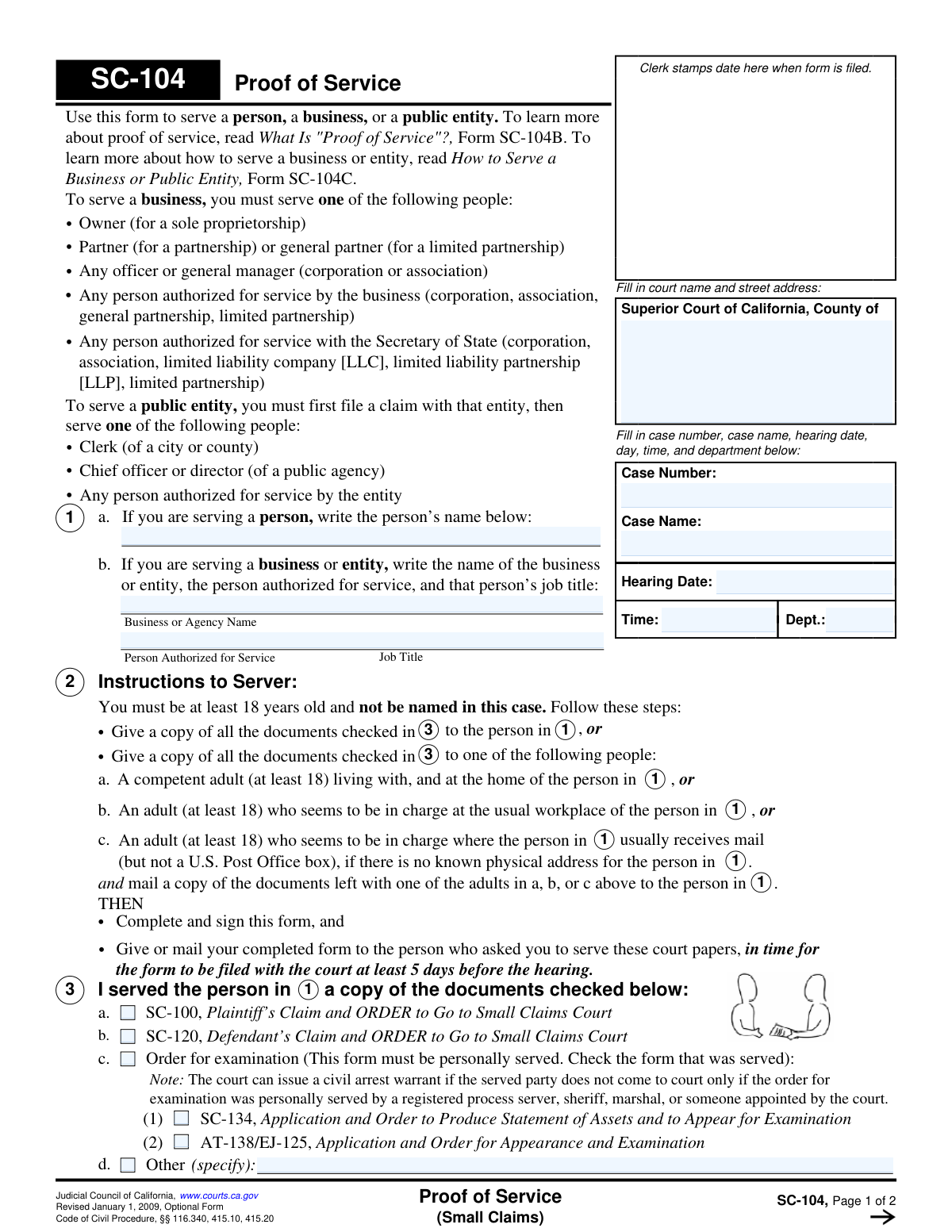
- Enter the court information and case details (county, case number, case name, hearing date/time/department).
- Identify who was served: either the individual’s name or the business/public entity name plus the authorized person for service and their job title.
- Select and list the exact documents served (e.g., SC-100, SC-120, order for examination forms, and/or other specified documents).
- Choose the service method and complete the appropriate section: Personal Service (date/time/address) or Substituted Service (who received the papers, date/time/address, and the name/description of the recipient).
- If substituted service was used, complete the mailing details (date mailed, city/state mailed from, and how the envelope was deposited/mailed; attach SC-104A if someone else mailed it).
- Complete the server’s information (name, phone, address, service fee, and process server registration details if applicable).
- Sign and date the declaration under penalty of perjury, then return the completed form to the requesting party so it can be filed with the court at least 5 days before the hearing.
Common Mistakes in Completing SC-104
The ones the AI is built to catch.
Leaving court and case header fields blank or inconsistent
Listing the wrong person/business in Item 1
Serving a business without naming an authorized recipient and title
Using substituted service incorrectly (wrong recipient or wrong location)
Forgetting the required follow-up mailing after substituted service
Checking the wrong documents served (or not specifying “Other”)
Attempting substituted service for documents that require personal service
Incomplete or inaccurate date/time/address details for service
Not identifying the substituted-service recipient (name/description) clearly
Server eligibility errors (party to the case, under 18, or missing server info)
Missing signature, printed name, or perjury declaration date
Not meeting the filing deadline (proof of service filed too late)
Frequently Asked Questions About SC-104
Is it really free for 7 days?
Can I fill other forms too?
How do I cancel?
How does the AI fill out SC-104?
What happens to my information?
How complex is SC-104 to fill out?
What is Form SC-104 (Proof of Service—Small Claims) used for?
Who should fill out and sign Form SC-104?
When does the Proof of Service need to be filed with the court?
What information do I need to fill in at the top of the form?
How do I complete item 1 if I’m serving an individual person?
How do I complete item 1 if I’m serving a business or public entity?
Who can be served on behalf of a business?
Are there special rules for serving a public entity (like a city or county)?
What documents do I list in item 3?
What is the difference between Personal Service and Substituted Service on this form?
If I use Substituted Service, do I have to mail a copy too?
Can I use a U.S. Post Office box for substituted service?
What details must the server include about when and where service happened?
What is the “Order for examination” note about personal service and arrest warrants?
What is Form SC-104A and when do I attach it?
Get your SC-104 filled out by AI
$0 today. Cancel before Nov 1 and you pay nothing.
Other forms like this one
Judicial Council forms: Judicial Council of California Form FL-300, Request for Order, Judicial Council of California Form FL-150, Income and Expense Declaration, Judicial Council of California Form SC-105, Request for Court Order and Answer (Small Claims), Judicial Council of California Form DE-111, Petition for Probate (Probate—Decedents Estates), Judicial Council of California Form SC-104, Proof of Service (Small Claims), Judicial Council of California Form SC-108, Request to Correct or Cancel Judgment and Answer (Small Claims), Judicial Council of California Form SC-120, Defendant’s Claim and ORDER to Go to Small Claims Court (Small Claims), Civil Case Cover Sheet (Judicial Council of California Form CM-010), Civil Case Cover Sheet (Judicial Council of California Form CM-010), Judicial Council of California Form TR-205, Request for Trial by Written Declaration (Trial by Written Declaration—Traffic), Judicial Council of California Form DE-120, Notice of Hearing—Decedent's Estate or Trust, Inventory and Appraisal Attachment (Judicial Council of California Form DE-161, GC-041), CLETS-001, Confidential Information for Law Enforcement (Judicial Council of California), Judicial Council of California Form SER-001, Request for Sheriff to Serve Court Papers, Judicial Council of California Form UD-105, Answer—Unlawful Detainer, CLETS-001, Confidential Information for Law Enforcement (Judicial Council of California), Judicial Council of California Form ADOPT-210, Adoption Agreement, Judicial Council of California Form DE-120, Notice of Hearing—Decedent's Estate or Trust, Inventory and Appraisal (Judicial Council of California) (Form DE-160/GC-040), Judicial Council of California Form JUD-100, Judgment
California judicial forms: Judicial Council of California Form FL-300, Request for Order, Judicial Council of California Form FL-150, Income and Expense Declaration, Judicial Council of California Form SC-105, Request for Court Order and Answer (Small Claims), Judicial Council of California Form DE-111, Petition for Probate (Probate—Decedents Estates), Judicial Council of California Form SC-104, Proof of Service (Small Claims), Judicial Council of California Form SC-108, Request to Correct or Cancel Judgment and Answer (Small Claims), Judicial Council of California Form SC-120, Defendant’s Claim and ORDER to Go to Small Claims Court (Small Claims), Civil Case Cover Sheet (Judicial Council of California Form CM-010), Civil Case Cover Sheet (Judicial Council of California Form CM-010), Judicial Council of California Form TR-205, Request for Trial by Written Declaration (Trial by Written Declaration—Traffic), Judicial Council of California Form DE-120, Notice of Hearing—Decedent's Estate or Trust, Inventory and Appraisal Attachment (Judicial Council of California Form DE-161, GC-041), CLETS-001, Confidential Information for Law Enforcement (Judicial Council of California), Judicial Council of California Form SER-001, Request for Sheriff to Serve Court Papers, Judicial Council of California Form UD-105, Answer—Unlawful Detainer, CLETS-001, Confidential Information for Law Enforcement (Judicial Council of California), Judicial Council of California Form ADOPT-210, Adoption Agreement, Judicial Council of California Form DE-120, Notice of Hearing—Decedent's Estate or Trust, Inventory and Appraisal (Judicial Council of California) (Form DE-160/GC-040), Judicial Council of California Form JUD-100, Judgment
small claims forms: Form SC-100, Plaintiff's Claim and ORDER to Go to Small Claims Court, SC-108, Request to Correct or Cancel Judgment and Answer (Small Claims), Judicial Council of California Form SC-105, Request for Court Order and Answer (Small Claims), SC-120, Defendant’s Claim and ORDER to Go to Small Claims Court (Small Claims), Judicial Council of California Form SC-104, Proof of Service (Small Claims), Judicial Council of California Form SC-108, Request to Correct or Cancel Judgment and Answer (Small Claims), SC-105, Request for Court Order and Answer (Small Claims), Judicial Council of California Form SC-120, Defendant’s Claim and ORDER to Go to Small Claims Court (Small Claims), Form SC-100, Plaintiff’s Claim and ORDER to Go to Small Claims Court, Form N161, Appellant’s notice (All appeals except small claims track appeals and appeals to the Family Division of the High Court), Plaintiff's Claim and ORDER to Go to Small Claims Court (SC-100), Form N161, Appellant's Notice (All appeals except small claims track appeals and appeals to the Family Division of the High Court), Form SC-100A, Other Plaintiffs or Defendants (Attachment to Plaintiff's Claim and ORDER to Go to Small Claims Court), Form A, Claim Form, European Small Claims Procedure, Form EJ-001, Abstract of Judgment—Civil and Small Claims, Form SC-109, Authorization to Appear (Small Claims), Form SC-112A, Proof of Service by Mail (Small Claims), Form SC-114, Request to Amend Party Name Before Hearing (Small Claims), Form SC-132, Attorney-Client Fee Dispute (Attachment to Notice of Entry of Judgment), Form SC-152, Order on Request to Postpone Trial (Small Claims)
VA claim forms: Form OWCP-915, Claim for Medical Reimbursement, Form 8862, Information To Claim Certain Credits, Form CA-7, Claim for Compensation, Form CA-5, Claim for Compensation, Form SC-100, Plaintiff's Claim and ORDER to Go to Small Claims Court, Form 20-0995, Decision Review Request: Supplemental Claim, Form 104, List of Creditors 20 Largest Unsecured Claims, Form 941-X (Rev. April 2023), Adjusted Employer’s QUARTERLY Federal Tax Return or Claim for Refund, Immigration and Refugee Board of Canada (IRB) – Refugee Protection Division (RPD) Basis of Claim Form (for persons claiming refugee protection in Canada) (RPD.02.01), SC-108, Request to Correct or Cancel Judgment and Answer (Small Claims), Judicial Council of California Form SC-105, Request for Court Order and Answer (Small Claims), SC-120, Defendant’s Claim and ORDER to Go to Small Claims Court (Small Claims), Judicial Council of California Form SC-104, Proof of Service (Small Claims), Continental American Insurance Company (CAIC) / Aflac Group Critical Illness Claim Form (with Attending Physician’s Statement, HIPAA Authorization to Obtain Information, and Electronic Funds Transaction Authorization), Judicial Council of California Form SC-108, Request to Correct or Cancel Judgment and Answer (Small Claims), SC-105, Request for Court Order and Answer (Small Claims), Judicial Council of California Form SC-120, Defendant’s Claim and ORDER to Go to Small Claims Court (Small Claims), Small Claim and Notice of Small Claim (ORS 46.425) (OJD Official) (Jan 2026), VA Form 21-4138, Statement in Support of Claim, Form SSA-795, Statement of Claimant or Other Person
proof of service forms: Form POS-040, Proof of Service—Civil, Judicial Council of California Form SC-104, Proof of Service (Small Claims), Form DV-200, Proof of Personal Service (CLETS) (Domestic Violence Prevention), Illinois Circuit Court Eviction Summons and Proof of Service of Eviction Summons & Eviction Complaint (Form E-S 3507.3), proof-of-electronic-service-appellate, Form APP-009, Proof of Service (Appellate Division), Form APP-109, Proof of Service (Appellate Division), Form GC-020(P), PROOF OF PERSONAL SERVICE OF NOTICE OF HEARING— GUARDIANSHIP OR CONSERVATORSHIP, Form APP-109E, Proof of Electronic Service (Appellate Division), Proof of Personal Service of Notice of Initial Appearance—CARE Act Proceedings, Form CARE-116, Proof of Personal Service of Notice of Hearing—CARE Act Proceedings, Form CR-106, Proof of Service — Criminal Record Clearing, CARE-107, Proof of Personal Service of Notice of Order for CARE Act Report, Form CIV-120, Notice of Entry of Dismissal and Proof of Service, Form DAL-012, Proof of Service—Disability Access Litigation, Form DE-120(P), Proof of Personal Service of Notice of Hearing—Decedent's Estate or Trust, Form EA-200, Proof of Personal Service (Elder or Dependent Adult Abuse Prevention), Form EA-260, Proof of Service of Order After Hearing by Mail (Elder or Dependent Adult Abuse Prevention), Form FL-115, Proof of Service of Summons (Family Law—Uniform Parentage—Custody and Support), Form CR-401, Proof of Service for Petition/Application Under Health and Safety Code Section 11361.8—Adult Crimes
Let AI fill out your SC-104
Your trial starts once a card is added. You pay nothing before Nov 1.
Our AI already knows this form, all 60 fields of it. Skip the typing: tell it about yourself, or upload what you have, and it fills the whole form in seconds.
- AI fills every field on both pages, checkboxes included
- No typing into boxes: answer a few questions, or upload a document you already have, an old copy of this form, a photo of a document
- The AI checks the answers; you review and change anything before you download
- Download the finished PDF, print it, or sign it online
- Encrypted, and never used to train AI
Cancel before Nov 1 and you pay nothing.
A card is needed to start the trial. Cancel in two clicks from your account.
Terms · Privacy