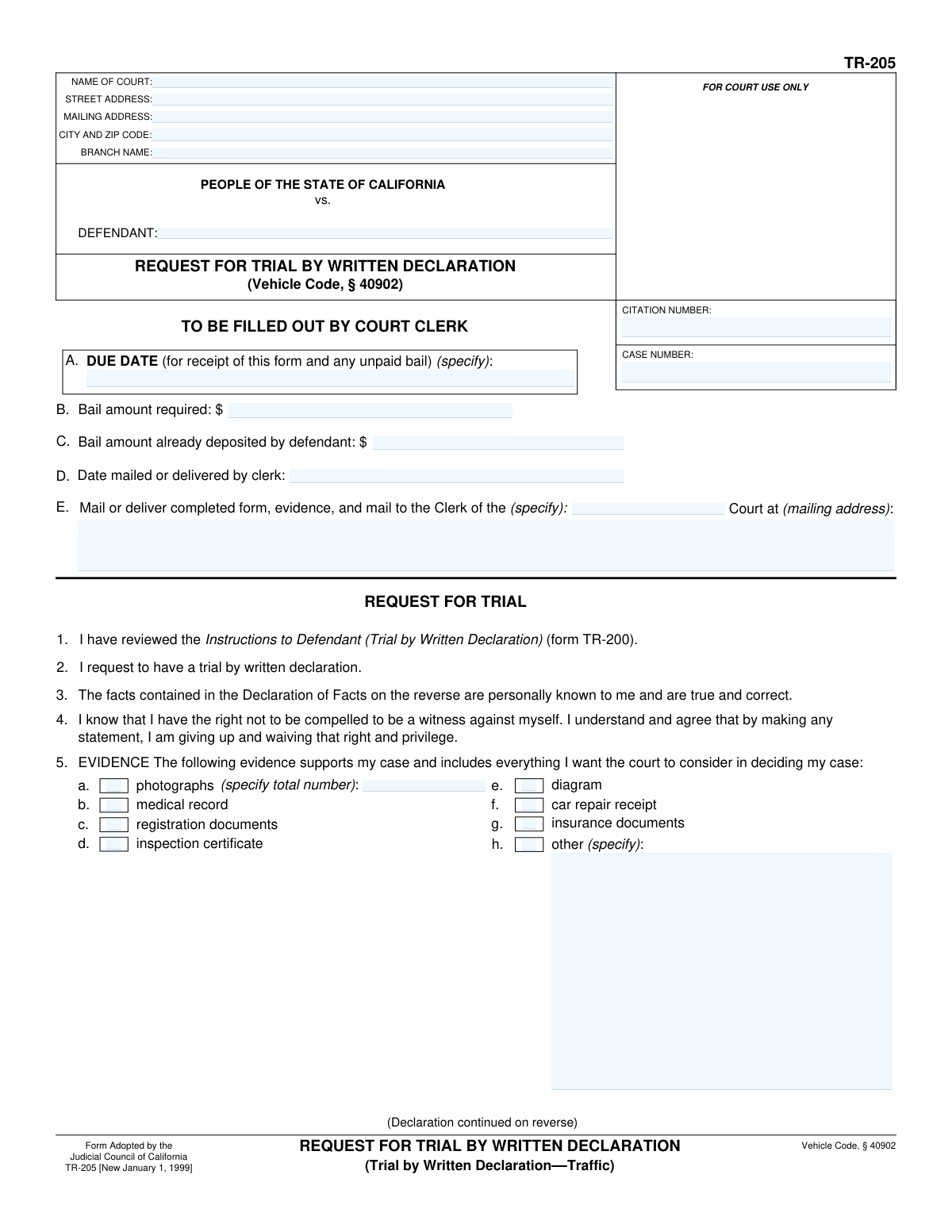
Yes! You can use AI to fill out Judicial Council of California Form TR-205, Request for Trial by Written Declaration (Trial by Written Declaration—Traffic)
Form TR-205 is the official California court form used to request a traffic trial by written declaration under Vehicle Code § 40902. It allows a defendant to present their version of events and supporting evidence in writing for the court to review and decide the citation. The form includes a declaration under penalty of perjury and requires the defendant to list and explain all evidence they want considered. It is important because it is the formal mechanism to elect a written trial process and to ensure the court receives the defendantâs statement and exhibits by the deadline (often along with required bail).
Our AI automatically handles information lookup, data retrieval, formatting, and form filling.
It takes less than a minute to fill out TR-205 using our AI form filling.
Securely upload your data. Information is encrypted in transit and deleted immediately after the form is filled out.
Form specifications
| Form name: | Judicial Council of California Form TR-205, Request for Trial by Written Declaration (Trial by Written Declaration—Traffic) |
| Number of pages: | 2 |
| Language: | English |
| Categories: | court forms |
Instafill Demo: filling out a legal form in seconds
How to Fill Out TR-205 Online for Free in 2026
Are you looking to fill out a TR-205 form online quickly and accurately? Instafill.ai offers the #1 AI-powered PDF filling software of 2026, allowing you to complete your TR-205 form in just 37 seconds or less.
Follow these steps to fill out your TR-205 form online using Instafill.ai:
- 1 Enter the case identifiers from your citation/court notice (citation number, case number, court name, and court address/branch if required).
- 2 Review the referenced instructions (Form TR-200) and confirm you are requesting a trial by written declaration for the traffic citation.
- 3 Complete the defendant information section (your name and current mailing address) exactly as it appears on court records or update it as needed.
- 4 In the evidence section, check all evidence types you are submitting (e.g., photos, registration, diagrams) and specify counts/details; prepare clear copies/scans of each exhibit.
- 5 Write the Declaration/Statement of Facts explaining what happened, addressing the alleged violation, and describing how each piece of evidence supports your position; add additional pages if needed.
- 6 List the number of pages attached, then sign and date the declaration under penalty of perjury (type/print your name and provide your signature).
- 7 Submit the completed TR-205 and all attachments to the court clerk by the due date, and include any required bail amount (or confirm bail already deposited) as indicated by the court.
Our AI-powered system ensures each field is filled out correctly, reducing errors and saving you time.
Why Choose Instafill.ai for Your Fillable TR-205 Form?
Speed
Complete your TR-205 in as little as 37 seconds.
Up-to-Date
Always use the latest 2026 TR-205 form version.
Cost-effective
No need to hire expensive lawyers.
Accuracy
Our AI performs 10 compliance checks to ensure your form is error-free.
Security
Your personal information is protected with bank-level encryption.
Frequently Asked Questions About Form TR-205
Form TR-205 is used to request a Trial by Written Declaration for a California traffic citation under Vehicle Code section 40902. It lets you present your case in writing instead of appearing in court.
This form is generally for defendants who received a traffic citation and want the court to decide the case based on written statements and evidence. The court clerk section of the form will indicate the due date and bail requirements for your case.
Yes. TR-205 asks you to confirm that you reviewed the âInstructions to Defendant (Trial by Written Declaration)â on form TR-200 before requesting a written trial.
You must provide identifying case information (like citation number and case number if available), your declaration of facts, your current mailing address, the number of pages attached, and your signature under penalty of perjury. Some top sections are completed by the court clerk.
The clerk completes the due date for receipt, bail amount required, bail already deposited, the date the form was mailed or delivered, and where to mail or deliver the completed packet. These items appear in the âTO BE FILLED OUT BY COURT CLERKâ section.
The due date is the deadline for the court to receive your TR-205 and any unpaid bail. If the court does not receive everything by that date, your request may be rejected or you may lose the option to proceed by written declaration.
Often, yesâTR-205 includes a section for âBail amount requiredâ and âBail amount already deposited.â The clerkâs instructions will indicate whether you must include unpaid bail with your submission.
Mail or deliver the completed form, evidence, and any required bail to the court clerk at the address listed in item E of the clerk section. Use the specific court and mailing address provided there.
The form lists common evidence types such as photographs, medical records, registration documents, inspection certificates, diagrams, car repair receipts, and insurance documents. You can also include âotherâ evidence, but you should specify what it is.
Check each type of evidence you are submitting and specify the total number of photographs if you include photos. Make sure the evidence you send matches what you checked, and explain each item in your Declaration of Facts.
Describe what happened in your own words and explain how each piece of evidence supports your position. Type or print clearly, and attach additional pages if you need more space.
Yes. The form allows additional pages, and you must list the âNumber of pages attachedâ in item 7 so the court knows your submission is complete.
Yes, you must sign and date the form and type or print your name. âUnder penalty of perjuryâ means you are declaring the statements are true and correct, and false statements can have legal consequences.
TR-205 states you have the right not to be compelled to be a witness against yourself, and that by making statements in the declaration you are waiving that right for what you submit. In other words, your written statement is your testimony for the court to consider.
Provide your current mailing address in the Declaration of Facts section. The court may use it to send notices or the decision, so it should be accurate and up to date.
Compliance TR-205
Validation Checks by Instafill.ai
1
Validates presence and format of Citation Number
Checks that the Citation Number field is provided and matches the court/agencyâs expected citation format (commonly alphanumeric with a defined length and no illegal characters). This is critical to correctly associate the request with the underlying traffic citation. If missing or malformed, the submission should be rejected or routed to manual review because the court may be unable to locate the case.
2
Validates presence and format of Case Number (if assigned)
Verifies that the Case Number is present when the court has already assigned one and that it conforms to the courtâs case numbering pattern (e.g., specific prefixes, separators, and length). This prevents misfiling into the wrong case docket. If the case number is required by the workflow and is absent/invalid, the system should block submission or request correction.
3
Ensures Court identification fields are complete (Name/Branch/Addresses)
Confirms that the Name of Court and the mailing address destination (court mailing address, city, ZIP, and branch name if applicable) are completed. These fields determine where the clerk should receive and process the written declaration package. If incomplete, the request may be misrouted or not processed by the correct branch, so the system should flag the submission for correction.
4
Validates Defendant name is present and consistent across pages
Checks that the Defendant name is provided on the first page and that the 'PEOPLE v. DEFENDANT (Name)' and '(Name)' fields on page two match (allowing minor formatting differences like middle initials). Consistency is important to ensure the declaration is attributed to the correct person and to reduce identity ambiguity. If names differ materially, the submission should be held for manual review or require the user to correct the mismatch.
5
Validates current mailing address completeness and deliverability
Ensures the defendantâs current mailing address is present and includes required components (street, city, state if collected, and ZIP code with valid 5-digit or ZIP+4 format). The court uses this address for notices and the decision, so an incomplete or invalid address can prevent service. If validation fails, the system should require correction before acceptance.
6
Validates Due Date field is a valid date and not in the past (clerk section)
When the Due Date is entered (for receipt of the form and any unpaid bail), verifies it is a valid calendar date and, at time of entry, is not earlier than the current date. This prevents impossible deadlines and supports accurate compliance tracking. If the date is invalid or in the past, the system should reject the entry or prompt for correction.
7
Validates Bail amount required is a valid currency amount (clerk section)
Checks that the bail amount required is numeric, non-negative, and conforms to currency rules (e.g., max two decimal places, reasonable upper bound). Accurate bail is essential because trial by written declaration typically requires bail to be posted unless otherwise allowed. If invalid, the system should block processing because it can lead to incorrect payment demands or accounting errors.
8
Validates Bail amount already deposited does not exceed required bail (clerk section)
Ensures the 'bail amount already deposited' is numeric and less than or equal to the 'bail amount required' (unless the court explicitly allows overpayment handling). This logical check prevents negative balances and reconciliation issues. If the deposited amount exceeds required bail, the system should flag for manual review or require correction to avoid accounting discrepancies.
9
Validates clerk mailing/delivery date is a valid date and logically consistent
Verifies that 'Date mailed or delivered by clerk' is a valid date and is not after the due date (if both are present), and not unreasonably far in the future. This supports auditability and ensures the timeline of notices is coherent. If inconsistent, the system should flag the record for correction because it can affect timeliness determinations.
10
Confirms required defendant acknowledgments (Items 1–4) are affirmed
Checks that the defendant has affirmatively indicated agreement/acknowledgment for items 1 through 4 (reviewed instructions, requests trial by written declaration, truthfulness of facts, and waiver/understanding of self-incrimination rights). These statements are foundational to the validity of the request and the declaration process. If any are not affirmed, the system should treat the request as incomplete and prevent submission.
11
Validates Evidence selection details and dependencies (Item 5)
If 'photographs' is selected, requires a total number to be provided and validates it as a positive integer within a reasonable limit. If 'other' is selected, requires a non-empty description of what the evidence is. If dependencies are not met, the system should prompt for the missing details because the court needs a clear inventory of evidence to consider.
12
Validates Declaration of Facts (Statement of Facts) is present and sufficiently complete
Ensures the Statement of Facts field is not blank and meets a minimum content threshold (e.g., minimum character count) to avoid submissions that provide no factual basis. The declaration is the core of the written trial request and must explain what happened and how evidence supports the case. If too short or empty, the system should reject or require the defendant to add substantive facts.
13
Cross-checks Evidence selections against narrative references
Performs a consistency check that when evidence items are checked (e.g., medical record, diagram, repair receipt), the Statement of Facts includes at least a brief reference or explanation of those items (keyword/section prompts or structured references if available). This helps ensure the court can understand relevance and reduces the chance evidence is submitted without context. If evidence is selected but not explained, the system should warn the user and require confirmation or additional explanation.
14
Validates Number of pages attached is a non-negative integer and consistent with attachments
Checks that 'Number of pages attached' is provided when additional pages are included and that it is a whole number (0 or greater). If the system supports file uploads, it should reconcile the stated number with the actual number of attached pages/documents. If mismatched, the system should flag the submission because missing pages can omit critical facts or evidence.
15
Validates perjury declaration execution: date, printed name, and signature present
Ensures the declaration is properly executed by requiring a valid date, a typed/printed name, and a signature (wet signature for paper, or compliant e-signature if electronic filing is allowed). This is essential for enforceability under penalty of perjury and for confirming authorship. If any element is missing or the date is invalid, the system should not accept the declaration as legally complete.
Common Mistakes in Completing TR-205
People often donât have the paperwork in front of them and guess, omit, or copy the wrong citation/case number. This can cause the clerk to be unable to match the request to the correct file, delaying processing or resulting in the request being rejected as incomplete. Always copy the citation number exactly as it appears on the ticket and the case number exactly as it appears on the court notice (if one has been assigned). If you are unsure, contact the court before submitting.
A common error is sending the form to the wrong courthouse location or leaving the branch name and mailing address fields incomplete. This can lead to misdelivery, late receipt, and missing the due date for the written declaration and bail. Use the address provided by the clerk in section E (or on the courtâs notice) and confirm the correct branch handling traffic matters for your case. If you hand-deliver, deliver to the same branch listed for the case.
Many defendants assume the form is timely if it is postmarked by the due date, but the form states a due date for receipt by the court. If the court receives it late, the request may be denied and the case may proceed as a failure to comply, potentially leading to additional penalties. Mail early, use trackable delivery, and keep proof of delivery. If time is short, consider in-person filing or an approved expedited service.
People frequently submit the request without paying the unpaid bail, or they assume a prior payment automatically covers the required amount without confirming the balance. The court may not process the trial by written declaration request until the required bail is deposited, which can cause missed deadlines or default outcomes. Verify the bail amount required (item B) and how much you have already deposited (item C), and include payment for any remaining balance. Confirm acceptable payment methods with the court.
Applicants often check evidence boxes but forget to specify the total number of photographs or fail to describe what âotherâ evidence is. This creates confusion about what the court should expect and can result in evidence being overlooked or treated as incomplete. If you check photographs, write the total number and label them (e.g., Photo 1, Photo 2). For âother,â clearly identify the item (e.g., âdashcam video stills,â âwitness letter,â âGPS logâ) and include it with the submission.
A very common mistake is referencing documents (registration, insurance, repair receipts, diagrams) but forgetting to include copies, or attaching them without labels that tie them to the declaration. The judge may decide the case without considering missing or unclear exhibits, weakening your defense. Attach copies of every item you list in item 5 and label each exhibit (e.g., âExhibit AâRegistration,â âExhibit BâPhoto 1â). In your statement, explicitly refer to each exhibit and explain what it proves.
People often provide a short narrative that doesnât address the elements of the violation, doesnât explain what happened in a clear timeline, or focuses on frustration rather than facts. This reduces credibility and may fail to create reasonable doubt or establish a legal defense. Use a clear, chronological account: date/time/location, traffic conditions, what you did, what the officer alleged, and why that allegation is incorrect or incomplete. Tie each key point to the evidence you attached and avoid speculation or emotional arguments.
The form instructs âType or print only,â but many people submit hard-to-read handwriting or omit the current mailing address on page two. Illegible or missing contact information can prevent the court from sending notices and can cause delays or missed outcomes (e.g., decision mailed to the wrong address). Print legibly or type the declaration, and ensure your current mailing address is complete and up to date. If you moved recently, use the address where you reliably receive mail.
Defendants frequently attach extra pages of narrative or exhibits but leave âNumber of pages attachedâ blank or provide an incorrect count. This can lead to pages being separated, not scanned, or not reviewed because the court cannot confirm the submission is complete. Count every additional page beyond the form itself, including continuation pages and any written statements. Number your pages (e.g., âPage 1 of 4â) and keep a complete copy for your records.
A common fatal error is submitting the declaration without signing, dating, or printing the name where required under penalty of perjury. An unsigned or undated declaration may be treated as invalid, meaning the court may disregard your statement entirely. Before submitting, confirm the Date field is filled in, your name is typed/printed, and your signature is present in the signature line. Use the same name format consistently as it appears on the citation and court records.
Some people inadvertently admit key facts (e.g., speed, lane change, device use) while trying to explain circumstances, not realizing the form warns that making statements waives the right not to be a witness against oneself. Such admissions can make it easier for the court to find the violation proven. Stick to accurate, necessary facts and avoid volunteering admissions that establish the elements of the offense unless you are asserting a specific legal justification. If unsure, focus on objective observations and evidence rather than conclusory admissions.
Saved over 80 hours a year
âI was never sure if my IRS forms like W-9 were filled correctly. Now, I can complete the forms accurately without any external help.â
Kevin Martin Green
Your data stays secure with advanced protection from Instafill and our subprocessors

Robust compliance program
Transparent business model
Youâre not the product. You always know where your data is and what it is processed for.
ISO 27001, HIPAA, and GDPR
Our subprocesses adhere to multiple compliance standards, including but not limited to ISO 27001, HIPAA, and GDPR.
Security & privacy by design
We consider security and privacy from the initial design phase of any new service or functionality. Itâs not an afterthought, itâs built-in, including support for two-factor authentication (2FA) to further protect your account.
Fill out TR-205 with Instafill.ai
Worried about filling PDFs wrong? Instafill securely fills judicial-council-of-california-form-tr-205-request forms, ensuring each field is accurate.