Yes! You can use AI to fill out Judicial Council of California Form UD-105, Answer—Unlawful Detainer

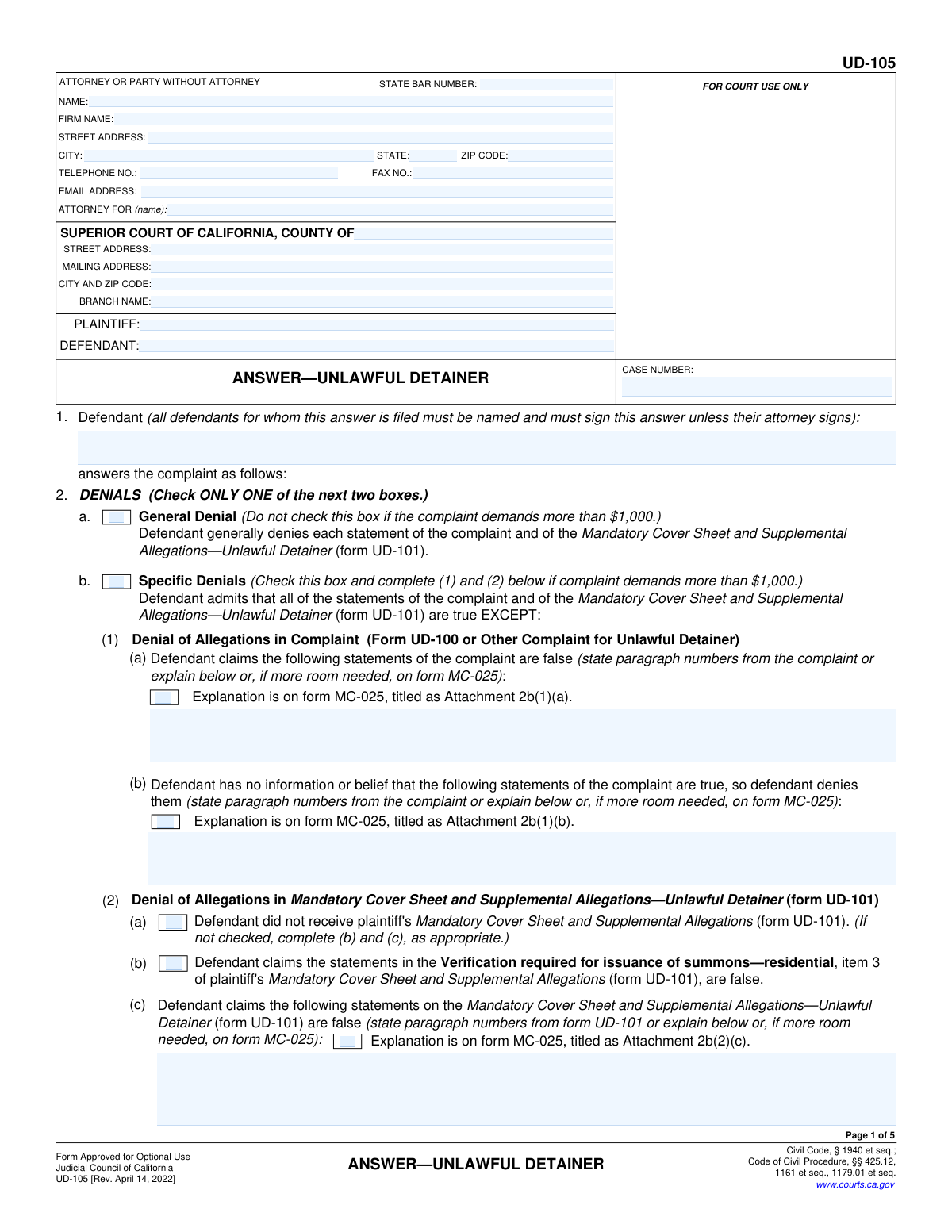
Form UD-105 (Answer—Unlawful Detainer) is the official California Judicial Council pleading a tenant/defendant files to respond to an unlawful detainer complaint. It allows the defendant to choose a general or specific denial, assert legally recognized defenses (including habitability, retaliation, discrimination, rent control, Tenant Protection Act, and certain COVID-19 and CARES Act-related defenses), and request outcomes such as dismissal, costs, attorney’s fees, or repair/rent reduction orders. Filing a complete and accurate Answer is important because it preserves defenses and formally contests the eviction in court. Today, this form can be filled out quickly and accurately using AI-powered services like Instafill.ai, which can also convert non-fillable PDF versions into interactive fillable forms.
Our AI automatically handles information lookup, data retrieval, formatting, and form filling.
It takes less than a minute to fill out UD-105 using our AI form filling.
Securely upload your data. Information is encrypted in transit and deleted immediately after the form is filled out.

Form specifications

Form name: Judicial Council of California Form UD-105, Answer—Unlawful Detainer
Number of pages: 5
Language: English
Categories: Judicial Council forms, California judicial forms, unlawful detainer forms
main-image

Instafill Demo: filling out a legal form in seconds

How to Fill Out UD-105 Online for Free in 2026

Are you looking to fill out a UD-105 form online quickly and accurately? Instafill.ai offers the #1 AI-powered PDF filling software of 2026, allowing you to complete your UD-105 form in just 37 seconds or less.
Follow these steps to fill out your UD-105 form online using Instafill.ai:
  1. 1 Go to Instafill.ai and upload the UD-105 PDF (or search/select “UD-105 Answer—Unlawful Detainer” from the form library).
  2. 2 Enter the case caption details: court county/branch and address information, case number, and the plaintiff and defendant names exactly as shown on the complaint.
  3. 3 Provide attorney/party contact information (or indicate you are self-represented), including address, phone, and email for service.
  4. 4 Complete Item 2 (Denials) by selecting either General Denial (if allowed) or Specific Denials, and use Instafill.ai to draft/insert the paragraph-based explanations and add MC-025 attachments when more space is needed.
  5. 5 Complete Item 3 (Defenses and Objections) by checking all applicable defenses and using Instafill.ai to generate concise supporting facts for Item 3w and any required attachments (MC-025).
  6. 6 Complete Items 4–6 (Other statements, requests, and number of pages attached), then complete the Unlawful Detainer Assistant section (Item 7) if applicable.
  7. 7 Review for consistency, then e-sign/prepare signatures and verification, download the finalized form and attachments, and file/serve according to the court’s unlawful detainer procedures and deadlines.

Our AI-powered system ensures each field is filled out correctly, reducing errors and saving you time.

Why Choose Instafill.ai for Your Fillable UD-105 Form?

Speed

Complete your UD-105 in as little as 37 seconds.

Up-to-Date

Always use the latest 2026 UD-105 form version.

Cost-effective

No need to hire expensive lawyers.

Accuracy

Our AI performs 10 compliance checks to ensure your form is error-free.

Security

Your personal information is protected with bank-level encryption.

Frequently Asked Questions About Form UD-105

UD-105 is the defendant’s written response to an unlawful detainer (eviction) complaint in California. It tells the court whether you deny the allegations and what defenses or objections you are raising.

Any defendant named in the unlawful detainer complaint who wants to respond should file an Answer using UD-105 (unless using another permitted response). Every defendant for whom the Answer is filed must be listed in item 1 and must sign (unless an attorney signs for them).

Check only one box. Use General Denial only if the complaint does not demand more than $1,000; if it demands more than $1,000, you generally must use Specific Denials and complete the required subparts identifying what you dispute.

Copy the case number, plaintiff name, and defendant name exactly as they appear on the Summons/Complaint you were served. Include any letters, dashes, spaces, and leading zeros in the case number.

Use form MC-025 (Attachment) and title it exactly as the UD-105 indicates (for example, “Attachment 2b(1)(a)” or “Attachment 3w”). Then check the corresponding box on UD-105 that says the explanation is on MC-025.

List the paragraph numbers from the complaint (and from UD-101, if applicable) that you claim are false or that you cannot confirm are true. If you did not receive the plaintiff’s UD-101, you can check the box stating you did not receive it; otherwise, complete the parts that apply and explain your denials.

Yes. The form instructs that for each defense/objection box you check, you must briefly state supporting facts in item 3w (page 4) or on MC-025 if you need more room.

Defenses 3a, 3b, and 3c are labeled “(Nonpayment of rent only)” and should be used only when the eviction is based on alleged nonpayment. Other defenses may apply to different types of eviction cases depending on your situation.

Some defenses require specific proof—for example, the domestic violence/abuse-related defense (item 3j) requires a qualifying restraining/protective order or police report (not more than 180 days old) or a signed statement from a qualified third party. For other defenses, you may want documents like notices, rent receipts, repair requests, photos, or communications, depending on what you claim.

Item 4 lets you add key facts the court should know, such as whether you already moved out and the date, or whether you believe the claimed fair rental value is excessive. If you need more space, you can explain on MC-025 and reference it as the form instructs.

You can request that the plaintiff take nothing, and you may request costs and (if applicable) attorney fees. If habitability is an issue in a nonpayment case, you can also request repairs and a rent reduction until conditions are corrected, and you can list other requests in item 5e (or on MC-025).

Yes—item 7 says it must be completed in all cases. If you paid an unlawful detainer assistant for help, you must check “did” and provide the assistant’s registration details; otherwise check “did not.”

Yes. Each defendant for whom the Answer is filed must sign (unless an attorney signs), and the Verification section must be signed by the defendant(s) declaring under penalty of perjury that the Answer is true and correct.

Yes—AI form-filling services like Instafill.ai can help auto-fill form fields from your information and documents, reducing manual typing and missed fields. You should still review everything carefully before signing because you are responsible for what is filed with the court.

You can upload the UD-105 PDF to Instafill.ai, provide your case details (and any supporting documents), and let the AI map your information into the correct fields for review and download. If your copy is a flat/non-fillable PDF, Instafill.ai can convert it into an interactive fillable form so you can complete it and export a clean, typed version.

Compliance UD-105
Validation Checks by Instafill.ai

1
Case Number present and matches allowed court case-number pattern
Validate that the Case Number field is not blank and contains only characters typically allowed in California court case numbers (letters, numbers, spaces, dashes, and leading zeros). This is critical for correct filing, routing, and matching the answer to the correct unlawful detainer case. If the value is missing or contains disallowed characters, the submission should be rejected or flagged for manual review because it may not be accepted by the court or may be misfiled.
2
Party names (Plaintiff/Defendant) are complete and consistent across header and Item 1
Ensure Plaintiff and Defendant names in the case caption are provided and that the defendant(s) listed in Item 1 (Defendant(s) answering) are also present and not contradictory to the caption defendant. This prevents ambiguity about who is answering and ensures the answer is properly attributed to the correct parties. If Item 1 is blank or lists names that do not match/relate to the caption defendants, the system should require correction or route to review.
3
Attorney vs. self-represented fields completeness and dependency enforcement
If a State Bar Number is provided (or an attorney name is indicated), require attorney-related fields to be coherent: attorney name, firm (if applicable), and “Attorney for” should be completed and “Attorney for” should not be blank. If the filer is a party without an attorney, allow State Bar Number and “Attorney for” to be blank but require the party name and mailing address/phone. If these dependencies are violated, the submission should fail validation because service and representation status will be unclear.
4
State Bar Number format validation (if provided)
Validate that the State Bar Number contains only digits and is within a reasonable length range used by the California State Bar (commonly 4–6 digits, but allow configurable range). This reduces data-entry errors and helps downstream integrations or lookups. If the format is invalid, the system should prompt for correction or flag the record for review rather than silently accepting a malformed identifier.
5
Contact information format checks (phone, fax, email) with required minimums
Validate telephone and fax numbers (if provided) for valid North American numbering format (10 digits, allowing punctuation like parentheses/dashes) and validate email address syntax (single @, valid domain, no spaces). At least one reliable contact method should be present for the filer (typically telephone; email if used for service). If formats are invalid or required contact is missing, the submission should be blocked because notices and communications may fail.
6
Mailing address completeness and ZIP code format validation
Require Street Address, City, State, and ZIP Code for the attorney/party section, and validate ZIP as 5 digits or ZIP+4 (##### or #####-####). This is important for service, correspondence, and court records accuracy. If any required address component is missing or ZIP is malformed, the system should fail validation and request correction.
7
Denials selection is mutually exclusive (General vs. Specific)
Enforce that exactly one of the two denial options is selected: General Denial (2a) or Specific Denials (2b). The form instructions explicitly require checking only one, and selecting both (or neither) creates an invalid pleading posture. If the rule is violated, the submission should be rejected and the user must choose one option.
8
General Denial eligibility check against complaint amount (if amount captured)
If the system captures or can infer the complaint’s demanded amount, validate that General Denial is not selected when the complaint demands more than $1,000 (per the form instruction). This prevents filing an answer that is procedurally improper. If General Denial is selected while the amount exceeds $1,000, the system should block submission or require switching to Specific Denials.
9
Specific Denials require at least one substantive denial entry or attachment reference
When Specific Denials (2b) is selected, require that at least one of the denial explanation areas is completed: (1)(a) text, (1)(b) text, (2)(c) text, (2)(d) text, or the corresponding MC-025 attachment checkbox/reference is provided. This ensures the answer actually identifies what is being denied, as required by the form. If Specific Denials is selected but no denial content/attachment is provided, the submission should fail validation as incomplete.
10
UD-101 denial logic: “Did not receive UD-101” vs. (b)/(c)/(d) completion consistency
If the box “Defendant did not receive plaintiff’s UD-101” is checked, the system should not require (b)/(c)/(d) denial details for UD-101 statements, because the form indicates those are completed as appropriate when not checked. If it is not checked, then at least one of (b), (c), or (d) should be selected/provided when the filer is asserting UD-101-related denials. If the user’s selections contradict this logic, the submission should be flagged for correction to avoid inconsistent statements.
11
Defense selections require supporting facts in Item 3w or MC-025
For any defense/objection checkbox selected in Item 3 (a–v), require that Item 3w contains supporting facts or that the MC-025 attachment indicator for 3w is present and the attachment page count supports it. The form explicitly requires brief facts for each checked defense, and missing facts can render the defense insufficient or invite a motion to strike. If defenses are checked without facts/attachment, the system should block submission or require completion.
12
Defense c date required and must be a valid date
If Defense 3(c) (rent offered before notice expired) is checked, require the “On (date)” field to be completed and validate it as a real calendar date (MM/DD/YYYY or other configured court-accepted format). This date is essential to the defense’s factual basis and timeline. If missing or invalid, the submission should fail validation because the defense is incomplete.
13
Local ordinance defense (3g) requires ordinance identification details
If Defense 3(g) is checked, require entry of the city/county, ordinance title, and date of passage (or a clear narrative that includes these elements), and require supporting facts in 3w/MC-025. This specificity is necessary to evaluate applicability and to provide adequate notice to the plaintiff and court. If the ordinance details are missing, the system should reject or flag the submission as insufficiently specified.
14
Other statements/requests text required when “Other” is selected (Items 4c and 5e)
If “Other” is selected in Item 4(c) or Item 5(e), require the corresponding free-text specification or an MC-025 attachment reference, and ensure the text is not just a placeholder (e.g., 'see attached' without an attachment count). This prevents blank “Other” selections that provide no actionable information. If “Other” is checked without content/attachment, the submission should fail validation.
15
Vacated premises date validation (Item 4a) and logical consistency
If the defendant indicates they vacated the premises (Item 4a), require a valid date and ensure it is not in the future relative to the submission/verification date. This date can affect possession issues and potential mootness, so it must be credible. If the date is invalid or future-dated, the system should prompt for correction or flag for review.
16
Unlawful Detainer Assistant section completeness and expiration date validity
Require that exactly one of “did” or “did not” is selected for whether an unlawful detainer assistant provided compensated help. If “did” is selected, require assistant name, phone, address, county of registration, registration number, and an expiration date that is a valid date and not expired as of the signing date (or at least not obviously invalid). If these fields are missing or the expiration date is invalid/expired, the submission should be rejected or flagged because the disclosure is statutorily required.
17
Signature and verification completeness for all answering defendants
Validate that each defendant named in Item 1 has a corresponding signature and printed name line completed, unless an attorney signature is provided on behalf of all defendants. Also require at least one verification signature with a verification date, and validate the verification date as a real date (not future-dated). If signatures/dates are missing or do not cover all listed defendants, the submission should fail validation because the answer may be procedurally defective.
18
Number of pages attached is numeric and matches attachment indicators
Validate that “Number of pages attached” is a non-negative integer and is consistent with whether any MC-025 attachments are referenced (e.g., Attachment 2b(1)(a), 3w, 4b, 5e). This helps ensure the filing packet is complete and that referenced attachments are actually included. If attachments are referenced but the page count is zero/blank (or vice versa), the system should flag the submission for missing documents or incorrect counts.

Common Mistakes in Completing UD-105

Using the wrong case number format (missing letters/dashes/leading zeros)

People often copy the case number from the wrong document, omit leading zeros, or drop suffix letters and dashes because they seem “optional.” A mismatched case number can cause the clerk to reject the filing or misfile it under a different case, delaying your response. Always copy the case number exactly as it appears on the summons/complaint (including spaces, dashes, and letters). AI-powered tools like Instafill.ai can help by preserving exact formatting and validating that the case number field isn’t altered.

Not naming and signing for every defendant who is answering (Item 1 + signatures)

A very common error is listing only one defendant in Item 1 even though multiple defendants were named in the complaint, or having only one person sign when multiple defendants are filing a joint answer. The form explicitly requires that all defendants for whom the answer is filed must be named and must sign (unless an attorney signs), and missing names/signatures can lead to an incomplete answer for some defendants and potential default risk. Double-check the complaint caption and ensure every answering defendant is listed in Item 1 and signs in the signature/verification sections. Instafill.ai can prompt for all named defendants and flag missing signature lines before you finalize.

Checking both ‘General Denial’ and ‘Specific Denials’ (or checking the wrong one)

Item 2 requires checking ONLY ONE box, but filers often check both to “cover all bases,” or they choose General Denial even when the complaint demands more than $1,000. This can make the answer internally inconsistent and may result in rejection or weaken the response because required specific denial details are missing. Confirm the amount demanded in the complaint: if it’s more than $1,000, use Specific Denials and complete the required subparts; otherwise, General Denial may be appropriate. Instafill.ai can enforce the “only one” rule and guide the selection based on the complaint amount you enter.

Selecting ‘Specific Denials’ but leaving required sub-items blank (2b(1) and 2b(2))

When people check Specific Denials, they often forget to complete the follow-up sections identifying what is denied in the complaint (UD-100) and in UD-101, or they provide vague statements without paragraph references. The consequence is an incomplete or unclear denial that may not properly put allegations in dispute and can create procedural problems. Avoid this by listing paragraph numbers from the complaint/UD-101 and clearly stating whether you deny as false or deny for lack of information, using MC-025 if needed. Instafill.ai can remind you which sub-items become mandatory once Specific Denials is selected and can format paragraph references consistently.

Referencing MC-025 attachments incorrectly (wrong attachment title or missing pages)

This form repeatedly instructs you to use MC-025 and to title attachments precisely (e.g., “Attachment 2b(1)(a),” “Attachment 3w”), but many filers either forget to attach MC-025, use the wrong title, or don’t match the attachment to the checkbox they selected. Courts can treat the answer as unsupported or incomplete if the referenced attachment isn’t actually included or is mislabeled. Always attach MC-025 when you check an “Explanation is on MC-025” box, and label each attachment exactly as the form specifies. Instafill.ai can generate properly titled attachments and help ensure the referenced pages are actually included in the final packet.

Checking defenses without providing supporting facts in Item 3w

A frequent mistake is checking multiple defenses in Item 3 (habitability, retaliation, rent control, TPA, COVID-related defenses, etc.) but leaving Item 3w blank or writing only conclusions like “landlord is retaliating.” The form requires brief facts for each checked defense, and missing facts can make defenses ineffective and easier for the plaintiff to challenge. For every box you check, add short, specific facts (dates, notices received, payments offered, conditions, communications) in 3w or on MC-025. Instafill.ai can prompt you to enter at least one fact per selected defense and keep the narrative organized by defense letter.

Using ‘Nonpayment of rent only’ defenses in the wrong type of case

Defenses 3a–3c are explicitly limited to nonpayment-of-rent cases, but people often check them in holdover, breach-of-lease, nuisance, or no-fault termination cases because the issues feel relevant. Checking inapplicable defenses can confuse the court and distract from stronger, relevant defenses, and it may signal that the answer was not carefully prepared. Verify the basis for eviction stated in the complaint and notice (e.g., 3-day pay or quit vs. 3-day perform or quit vs. 30/60-day notice) before selecting these defenses. Instafill.ai can help by asking what type of notice/complaint you received and warning when a defense is typically limited to nonpayment cases.

Leaving required dates blank (rent offer date, vacate date, verification date)

Several sections require dates (e.g., Defense 3c rent-offer date, Item 4a vacate date, and the Verification date), and people commonly skip them or write approximate timeframes. Missing or unclear dates can undermine credibility and make it harder to evaluate defenses tied to statutory deadlines and notice periods. Use exact dates whenever possible and cross-check them against notices, receipts, texts/emails, and court papers. Instafill.ai can standardize date formatting and flag missing date fields that become required based on boxes you checked.

Misunderstanding UD-101-related denials (not indicating receipt vs. denying specific statements)

In Item 2b(2), filers often check “did not receive UD-101” even when they did receive it, or they fail to complete (b) and (c)/(d) when they do not check the “did not receive” box. This creates logical gaps: the form instructs that if you did receive UD-101, you must address whether the verification statements are false and identify which UD-101 paragraphs are denied. Carefully choose only what is true: check non-receipt only if you truly did not get UD-101, otherwise complete the applicable denial sections with paragraph references. Instafill.ai can guide the conditional logic so the UD-101 section is completed consistently.

Forgetting to complete the Unlawful Detainer Assistant section (Item 7) in all cases

Item 7 must be completed in all cases, but many people leave it blank because they assume it applies only if they used an assistant. An unanswered Item 7 can lead to a rejected filing or a request to correct and refile, costing time in a fast-moving unlawful detainer timeline. Always check either “did not” or “did,” and if “did,” fill in the assistant’s registration details completely. Instafill.ai can ensure this mandatory section is never left unanswered and can format the assistant information consistently if applicable.

Missing or improper verification (wrong signer, missing signature, or incomplete perjury declaration)

People often sign the answer but forget the verification signatures/dates, or an attorney signs the defendant verification even though the form says to use a different verification if verified by an attorney or for an entity. An unverified or improperly verified answer can be treated as defective and may require correction, risking delays or procedural disadvantages. Ensure each defendant who is verifying signs and dates the verification section, and use the correct verification form if an attorney or a corporation/partnership is verifying. Instafill.ai can flag missing verification signatures/dates and help ensure the correct verification approach is used for the filer type.
Saved over 80 hours a year

“I was never sure if my IRS forms like W-9 were filled correctly. Now, I can complete the forms accurately without any external help.”

Kevin Martin Green

Your data stays secure with advanced protection from Instafill and our subprocessors

Robust compliance program

Transparent business model

You’re not the product. You always know where your data is and what it is processed for.

ISO 27001, HIPAA, and GDPR

Our subprocesses adhere to multiple compliance standards, including but not limited to ISO 27001, HIPAA, and GDPR.

Security & privacy by design

We consider security and privacy from the initial design phase of any new service or functionality. It’s not an afterthought, it’s built-in, including support for two-factor authentication (2FA) to further protect your account.

Fill out UD-105 with Instafill.ai

Worried about filling PDFs wrong? Instafill securely fills judicial-council-of-california-form-ud-105-answerunlawful-detainer forms, ensuring each field is accurate.



