Yes! You can use AI to fill out Standard Possession Order
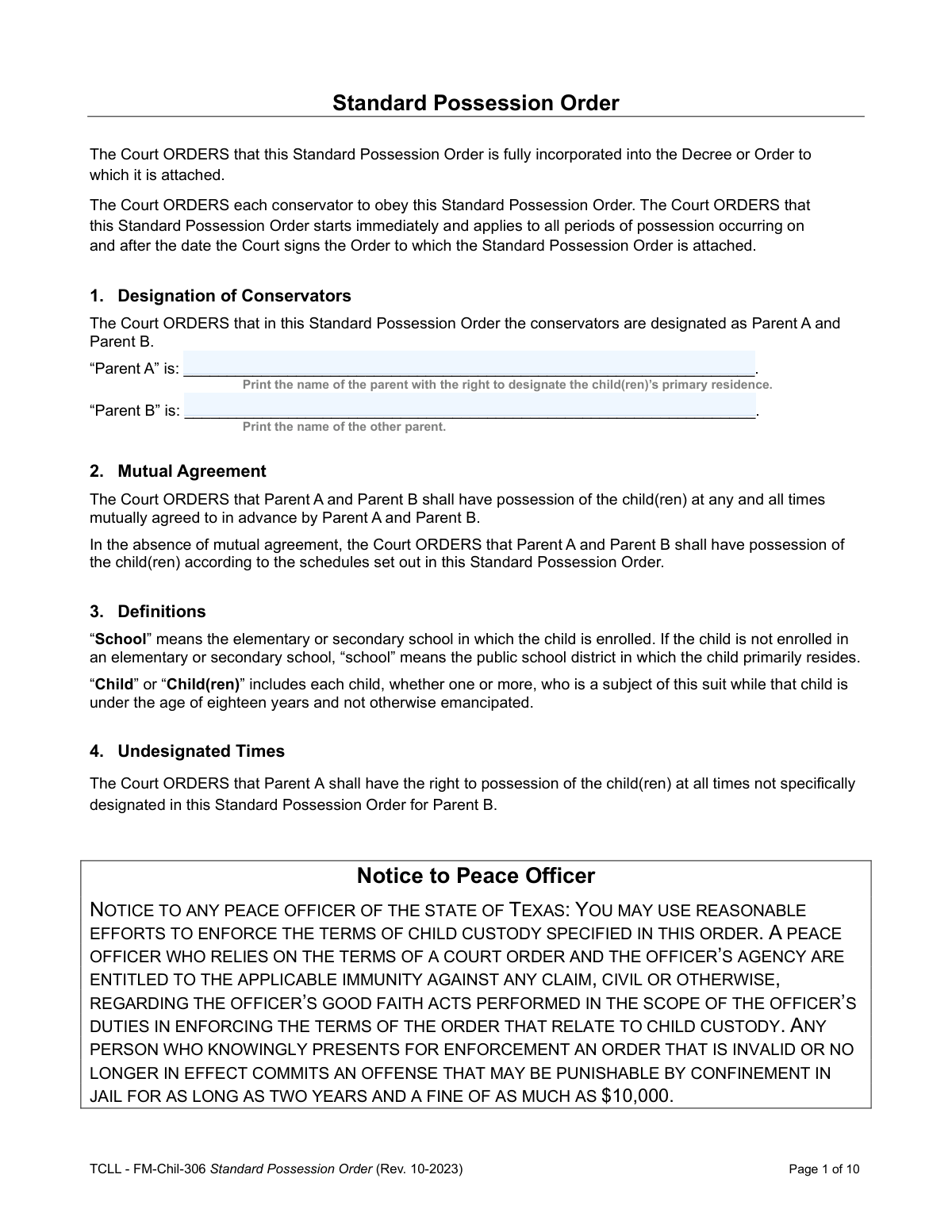
The Standard Possession Order is a legal form used in Texas family court cases to establish a clear and enforceable schedule for when each parent has physical possession of their child or children. It details specific arrangements for weekends, holidays, and summer vacations, with different schedules (Expanded, Standard, Long-Distance) based on the geographical distance between the parents' homes. This order aims to provide consistency and predictability for both the parents and the children involved. Today, this form can be filled out quickly and accurately using AI-powered services like Instafill.ai, which can also convert non-fillable PDF versions into interactive fillable forms.
TCLL - FM-Chil-306 is part of the
child custody forms category on Instafill.
Our AI automatically handles information lookup, data retrieval, formatting, and form filling.
It takes less than a minute to fill out TCLL - FM-Chil-306 using our AI form filling.
Securely upload your data. Information is encrypted in transit and deleted immediately after the form is filled out.
Form specifications
| Form name: | Standard Possession Order |
| Number of fields: | 73 |
| Number of pages: | 1 |
| Language: | English |
Instafill Demo: How to fill out PDF forms in seconds with AI
How to Fill Out TCLL - FM-Chil-306 Online for Free in 2026
Are you looking to fill out a TCLL - FM-CHIL-306 form online quickly and accurately? Instafill.ai offers the #1 AI-powered PDF filling software of 2026, allowing you to complete your TCLL - FM-CHIL-306 form in just 37 seconds or less.
Follow these steps to fill out your TCLL - FM-CHIL-306 form online using Instafill.ai:
- 1 Navigate to Instafill.ai and upload or select the Standard Possession Order form.
- 2 Use the AI assistant to identify and enter the full names for 'Parent A' (the parent designating the child's primary residence) and 'Parent B'.
- 3 Follow the prompts to select which possession schedule applies based on the distance between the parents' residences (e.g., Expanded for 50 miles or less, Standard for 51-100 miles, Long-Distance for over 100 miles).
- 4 Review the specific sections for the selected schedule and check the appropriate boxes for possession start and end times for weekends, holidays (like Thanksgiving and Christmas), and vacations as determined by the court.
- 5 Complete the 'General Terms and Conditions' section by specifying the locations for exchanging the child(ren) at the start and end of possession periods.
- 6 Carefully review all the information and selections for accuracy, ensuring they reflect the court's order, before saving or printing the completed document.
Our AI-powered system ensures each field is filled out correctly, reducing errors and saving you time.
Why Choose Instafill.ai for Your Fillable TCLL - FM-Chil-306 Form?
Speed
Complete your TCLL - FM-Chil-306 in as little as 37 seconds.
Up-to-Date
Always use the latest 2026 TCLL - FM-Chil-306 form version.
Cost-effective
No need to hire expensive lawyers.
Accuracy
Our AI performs 10 compliance checks to ensure your form is error-free.
Security
Your personal information is protected with bank-level encryption.
Frequently Asked Questions About Form TCLL - FM-Chil-306
This is a legal court order that establishes a detailed, enforceable schedule for when each parent has possession of their child(ren). It is incorporated into a final decree or order in Texas custody cases to provide a clear and predictable plan.
'Parent A' is the parent with the legal right to designate the child's primary residence. 'Parent B' is the other parent, for whom the specific possession times (weekends, holidays, etc.) are outlined in the order.
The schedule is determined by the distance between Parent B's home and the child's primary residence. The court selects the Expanded (50 miles or less), Standard (100 miles or less), or Long-Distance (over 100 miles) schedule based on this mileage.
The Expanded schedule generally provides Parent B with more time, often starting possession when school is dismissed on Friday and ending when school resumes. The Standard schedule typically has more fixed times, such as 6 p.m. Friday to 6 p.m. Sunday.
Yes, the order explicitly states that parents can have possession of the child at any and all times they mutually agree to in advance. The detailed schedule in the order is the default plan to be followed in the absence of a mutual agreement.
Parent B is entitled to an extended summer possession period, typically 30 or 42 days. To choose the specific dates, Parent B must give Parent A written notice by April 1st; otherwise, a default period specified in the order will apply.
The specific holiday schedules detailed in the order always supersede the regular weekend possession schedule. The form outlines which parent has the child for these holidays in alternating odd and even-numbered years.
The order requires you to give notice to the other parent on each occasion that you will be unable to exercise your right of possession for any specified period.
Generally, Parent B is responsible for picking up the child at the beginning of their possession period and returning the child at the end. The specific locations for pickup and drop-off (e.g., school, a parent's residence) are designated in the order.
This section informs law enforcement that the document is a valid court order. It gives them the authority to use reasonable efforts to enforce the child custody terms specified within it.
Yes, services like Instafill.ai use AI to help you accurately auto-fill form fields with your information. This can save time and help you prepare a draft of the order for review by your attorney.
You can use a service like Instafill.ai to easily complete the form online. Simply upload the document, and its AI will identify all the fields for you to fill in your browser, check boxes, and add names.
If you have a non-fillable or 'flat' PDF, you can upload it to Instafill.ai. The service's AI technology can convert it into an interactive, fillable form that you can complete and save online.
Compliance TCLL - FM-Chil-306
Validation Checks by Instafill.ai
1
Ensures Parent A's Name is Provided
This validation checks that the text field for 'Parent A' in Section 1 is not empty. This field identifies the parent with the right to designate the child's primary residence, which is fundamental to the entire order. Failure to provide this name makes the order legally deficient and unenforceable.
2
Ensures Parent B's Name is Provided
This validation checks that the text field for 'Parent B' in Section 1 is not empty. This field identifies the other parent subject to the possession schedule. Without this name, the rights and responsibilities of the parties cannot be established, rendering the order invalid.
3
Validates Exclusive Selection for Expanded Schedule Applicability
This validation ensures that exactly one box is checked in Section 5(a), either 'Yes' or 'No,' regarding the applicability of the Expanded Possession Schedule. Selecting both or neither creates ambiguity about which possession rules apply. The form submission should be rejected until a single, clear choice is made.
4
Requires Reason for Declining Expanded Schedule
This check verifies that if the 'No' box is checked in Section 5(a), one of the subsequent reason boxes must also be checked. This is a legal requirement to document why the expanded schedule is not being used. An incomplete selection would leave the court's reasoning undocumented and the order potentially invalid.
5
Ensures 'Other' Reason for Declining Expanded Schedule is Specified
If the 'other' checkbox is selected as the reason for the Expanded Possession Schedule not applying in Section 5(a), this validation ensures the corresponding text field is not empty. This is crucial for providing a clear and specific justification for the court's decision. A blank field would make the reason for the deviation from the standard unclear and contestable.
6
Validates Logical Consistency Between Expanded and Standard Schedule Selections
This check ensures the selection in Section 5(b) is consistent with the selection in Section 5(a). If 5(a) is 'Yes' (Expanded applies for <=50 miles), then 5(b) must select the option for 51-100 miles. If 5(a) is 'No', then 5(b) must select the option for 100 miles or less. This prevents contradictory distance rules from being applied in the same order.
7
Ensures All Required Selections in Standard Possession Schedule are Made
This validation verifies that if the Standard Possession Schedule (Section 7) is applicable, a selection has been made for every group of checkboxes within that section. This includes start/end times for weekends, holidays, Thursdays, Father's Day, and Mother's Day. Missing a selection creates an incomplete and ambiguous schedule, leading to future disputes.
8
Validates Exclusive Selection for Standard Weekend Start Time
This check ensures that for the Standard Possession Schedule (Section 7a), exactly one option is selected for the weekend start time ('6 p.m.' or 'the time school is regularly dismissed'). Choosing both or neither would make it impossible to determine when Parent B's possession legally begins. The form must be rejected until a single choice is made.
9
Validates Long-Distance Weekend Possession Selection
This check ensures that in the Long-Distance Possession Schedule (Section 8a), the user does not select options for the 1st/3rd/5th weekend schedule (e.g., start/end times) if they have also checked the 'Alternative Weekend Possession' box. These two options are mutually exclusive. The validation prevents the creation of a conflicting order with two different weekend schedules.
10
Requires Specification for 'Following Location' at Start of Possession
This check verifies that in Section 9(a), if the checkbox for 'the following location' is selected for the exchange of children, the corresponding text field must contain a specific address or location. A checked box with a blank field creates uncertainty about where the exchange should occur. This validation prevents ambiguity and potential conflict during exchanges.
11
Validates Exclusive Selection for End of Possession Exchange Location
This check ensures that exactly one option is selected in the first part of Section 9(b) for where Parent B surrenders the child ('Parent B’s residence,' 'Parent A’s residence,' or 'The following location'). Selecting multiple options or none would create a direct conflict in the order's instructions. The system should enforce a single, unambiguous choice.
12
Requires Specification for 'Following Location' at End of Possession
This validation ensures that in Section 9(b), if the checkbox for 'The following location' is selected for the return of the children, the associated text field must be filled with a specific address. This is critical for defining where Parent B's possession period ends. An empty field would make this part of the order unenforceable and lead to disputes.
13
Ensures Contingent Exchange Location is Selected
This validation checks that one of the two options ('Parent B’s residence' or 'the location designated above') is selected under the contingency clause in Section 9(b). This clause applies if Parent A moves out of the county, and failing to make a selection leaves a critical logistical detail unresolved for a foreseeable event. This prevents future ambiguity if the parents' living situation changes.
14
Validates Exclusive Selection for Mother's Day Options (Standard Schedule)
This check ensures that for the Standard Possession Schedule (Section 7j), exactly one option is selected for the Mother's Day possession start time and exactly one option is selected for the end time. Selecting multiple or no options for either the start or end time creates an ambiguous and conflicting schedule for a specific holiday. The form must enforce a single, clear selection for both to be valid.
Common Mistakes in Completing TCLL - FM-Chil-306
Users often fail to read the fine print and mistakenly reverse the names for 'Parent A' (the parent designating the child's residence) and 'Parent B'. This critical error happens when rushing and can invalidate the entire possession schedule, as all rights and timelines are assigned based on these roles. To avoid this, carefully read the description under each name field before entering the information, ensuring the correct parent is assigned to each role.
Section 5 requires a series of dependent checkbox selections to determine which possession schedule applies based on distance. A common mistake is selecting conflicting options, such as checking 'No' for the Expanded Schedule but then failing to select the correct corresponding option for the Standard Schedule. This creates an ambiguous and unenforceable order, leading to future legal disputes. Carefully follow the instructions for each checkbox, as your choice in one part dictates the required choice in another.
Throughout the Standard and Long-Distance schedules, the form requires a choice between times like '6 p.m.' and 'the time school is regularly dismissed'. People often overlook these checkboxes, assuming a default will apply. Leaving these selections blank creates ambiguity that fuels future conflict over pickup and drop-off times. To prevent this, ensure every single checkbox group has a selection made to create a clear and enforceable order.
In Section 9, if child exchanges do not occur at school, a location must be specified by checking a box for a parent's residence or writing in a specific location. A frequent error is checking 'the following location' but leaving the line blank, or skipping the section entirely. This omission leads to arguments, confusion, and potential police involvement over where exchanges should happen. Always designate a clear, specific, and unambiguous location for all exchanges.
The form repeatedly offers choices between possession starting at 'the time school is regularly dismissed' versus a fixed time like '6 p.m.'. Users often fail to consider the logistical implications, such as responsibility for after-school activities or transportation. This misunderstanding leads to chronic disagreements about pickup times and parental duties. Before selecting, parents should discuss and agree on a choice that best fits the child's schedule and their own.
The Thanksgiving and Christmas schedules alternate between parents based on 'odd-numbered years' and 'even-numbered years'. It is very common for users to get confused and assign the wrong years to the wrong parent, effectively reversing the standard holiday rotation. This error guarantees major conflicts during holidays and may require returning to court to fix. Carefully double-check that the odd/even year assignments for each parent match the intended schedule.
As a legal document, all entries must be clear and legible, but users often submit forms with unreadable handwriting, especially for names in Section 1 and custom locations in Section 9. Illegible information can make the order difficult or impossible to enforce. To avoid this, print all information clearly in block letters. AI-powered tools like Instafill.ai can convert this non-fillable PDF into a fillable version, allowing you to type directly into the fields for perfect legibility.
When selecting an 'other' option, such as in Section 5(a) to explain why the Expanded Schedule is not in the child's best interest, users frequently check the box but fail to provide a written explanation. An empty blank next to a checked 'other' box makes the selection invalid and can be disregarded by the court. If you select an 'other' option, you must provide a clear, concise, and complete explanation in the space provided.
The Long-Distance schedule (Section 8) offers an 'Alternative Weekend Possession' option that must be elected either on the form or within 90 days. Users often misunderstand this time-sensitive requirement, either missing the checkbox or failing to provide notice later. This mistake can result in losing the right to a more flexible schedule, forcing the non-primary parent into a rigid possession schedule that is impractical for long-distance travel.
In the Standard and Long-Distance schedules, the Mother's Day and Father's Day sections have their own specific checkboxes for start and end times. These are often overlooked, especially when they differ from the standard weekend selections. Missing these selections creates ambiguity around two of the most emotionally significant holidays, leading to conflict. Ensure you review and complete the specific time selections for these holidays.
Saved over 80 hours a year
“I was never sure if my IRS forms like W-9 were filled correctly. Now, I can complete the forms accurately without any external help.”
Kevin Martin Green
Your data stays secure with advanced protection from Instafill and our subprocessors

Robust compliance program
Transparent business model
You’re not the product. You always know where your data is and what it is processed for.
ISO 27001, HIPAA, and GDPR
Our subprocesses adhere to multiple compliance standards, including but not limited to ISO 27001, HIPAA, and GDPR.
Security & privacy by design
We consider security and privacy from the initial design phase of any new service or functionality. It’s not an afterthought, it’s built-in, including support for two-factor authentication (2FA) to further protect your account.
Fill out TCLL - FM-Chil-306 with Instafill.ai
Worried about filling PDFs wrong? Instafill securely fills standard-possession-order forms, ensuring each field is accurate.