
Yes! You can use AI to fill out Florida Supreme Court Approved Family Law Form 12.995(a), Parenting Plan
Don't type 317 fields by hand. Tell our AI about yourself, or upload a document you already have, and it fills every field in seconds. You check it, then download, print or sign.
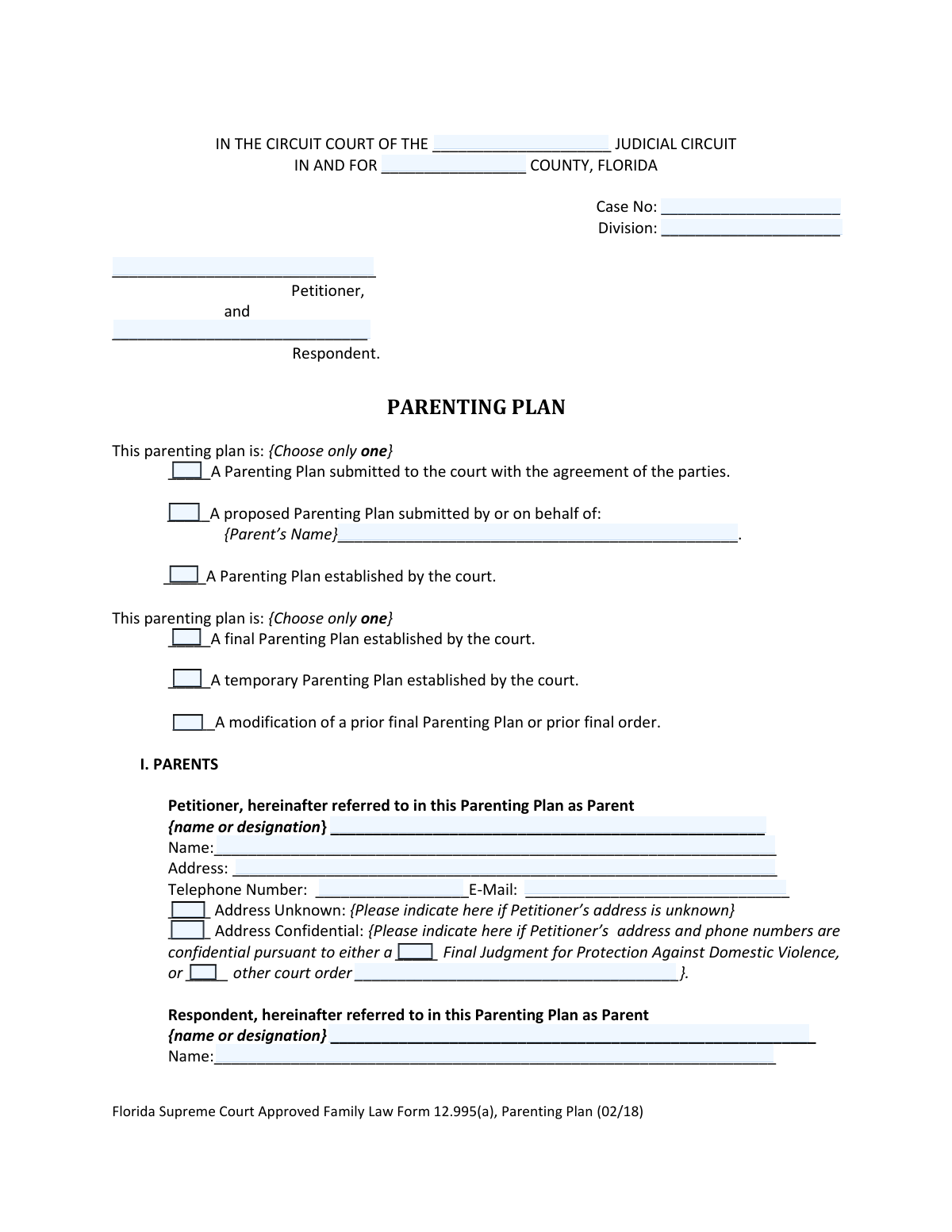
The AI does the filling. You just check it.
No typing into boxes, nothing to install.
What this form asks for
The AI fills all of it, from your answers or your documents.
The AI checks your answers before you download
12 checks built for this form, so a wrong date or a missing answer is caught before anyone else sees it.
This check validates that the sum of the overnights entered for each parent in Section VII.6 equals exactly 365. This is a critical logical check to ensure the entire calendar year is accounted for in the time-sharing schedule, which directly impacts child support calculations and legal compliance. If the total does not equal 365, the form cannot be finalized, and the user will be prompted to correct the time-sharing schedule.
This validation ensures that when cost-sharing percentages are entered for extra-curricular activities (IV.3.d) or transportation (VIII.3.b), the sum of the percentages for both parents equals 100%. This prevents financial ambiguity and future disputes by ensuring the full financial responsibility is clearly allocated. An error will be flagged if the sum is not 100%, requiring the user to adjust the values.
If the option 'Shared Parental Responsibility with Decision Making Authority' (IV.1.b) is selected, this check verifies that a parent designation is provided for each subsequent category (Education, Health care, etc.). This is crucial to make the clause legally effective and prevent a stalemate if parents later disagree. The submission will be blocked if the primary option is checked but the specific authority assignments are left blank.
This check ensures that in Section IV.1, exactly one of the three parental responsibility options (Shared, Shared with Authority, or Sole) is selected. The legal framework for decision-making is foundational to the plan, and selecting zero or multiple options would create an unenforceable and contradictory document. The system will require the user to select one and only one option before proceeding.
For any given holiday in the schedule grid (VII.2.c), this validation ensures that a single parent cannot be assigned the holiday for both 'Even Years' and 'Odd Years'. It also prevents the same year type (e.g., 'Even Years') from being assigned to both parents for the same holiday. This logic guarantees a clear, conflict-free holiday schedule that functions correctly in perpetuity.
This check confirms that the 'Date of Birth' entered for each child in Section II is a valid calendar date and is a date in the past. This ensures fundamental data integrity and confirms the plan is for an existing minor child. The system will reject any future dates or improperly formatted dates, prompting the user for correction.
And 6 more checks
- Parent Designation Consistency Check
- Confidential Information Justification
- Majority Time Designation vs. Overnight Count
- Non-Lawyer Information Completeness
- Time-Sharing Period Completeness
- Valid Case Number Format
Let AI fill out your Form 12.995(a)
No typing. Every field filled in seconds, checked, ready to sign.
How to Fill Out Form 12.995(a) Online for Free in 2026
What the AI walks you through.
- Navigate to Instafill.ai and upload or select the Florida Parenting Plan, Form 12.995(a).
- Use the AI assistant to input case details, including court information, and the personal information for both parents and all minor children.
- Specify the type of parental responsibility (shared or sole) and designate authority for major decisions regarding education, healthcare, and other activities.
- Outline the complete time-sharing schedule, including regular weekdays/weekends, holidays, and school breaks, ensuring the total overnights for each parent equals 365.
- Define the logistics for transportation, communication methods between parents and with the child, child care arrangements, and travel permissions.
- Review the entire completed plan for accuracy, make any necessary edits, and then securely e-sign the document.
- Download the finalized Parenting Plan, have it notarized if required, and file it with the appropriate Florida circuit court as part of your family law case.
Common Mistakes in Completing Form 12.995(a)
The ones the AI is built to catch.
Incomplete or Conflicting Holiday Schedule
Incorrect Overnight Calculation
Using Vague or Unenforceable Language
Ignoring 'Choose Only One' Instructions
Forgetting Notarization and Proper Signatures
Ambiguous 'Right of First Refusal' Clause
Inconsistent Parent Designations
Incorrect Case Header Information
Failing to Specify Decision-Making Authority
Neglecting to Define Transportation and Exchange Logistics
Submitting a Non-Fillable PDF without Conversion
Frequently Asked Questions About Form 12.995(a)
Is it really free for 7 days?
Can I fill other forms too?
How do I cancel?
How does the AI fill out Form 12.995(a)?
What happens to my information?
How complex is Form 12.995(a) to fill out?
What is the purpose of the Florida Parenting Plan form, 12.995(a)?
Do I have to fill out a Parenting Plan if my child's other parent and I agree on everything?
What happens if we cannot agree on a Parenting Plan?
What is the difference between 'Shared Parental Responsibility' and 'Sole Parental Responsibility'?
What key information must be included in the Parenting Plan?
How do I submit the completed Parenting Plan?
How do we calculate the number of overnights for the child support calculation?
What is the purpose of the 'Designation for Other Legal Purposes' section?
How do we make changes to the Parenting Plan after it has been approved by the court?
Can I use an AI tool to help me fill out this form?
How can I fill out the Florida Parenting Plan online?
The PDF of the Parenting Plan I downloaded is not fillable. What can I do?
What if my case involves supervised visits or one parent relocating?
Do both parents need to sign the Parenting Plan?
Get your Form 12.995(a) filled out by AI
$0 today. Cancel before Oct 30 and you pay nothing.
Other forms like this one
family law forms: Form 12.902(b), Family Law Financial Affidavit (Short Form), Florida Supreme Court Approved Family Law Form 12.901(b)(3), Petition for Dissolution of Marriage with No Dependent or Minor Child(ren) or Property (02/18), Form FL-170, Declaration for Default or Uncontested Dissolution or Legal Separation (Family Law), Form FL-100, Petition—Marriage/Domestic Partnership (Family Law), declaration-of-marriage-for-court-proceeding-california-family-law, Florida Supreme Court Approved Family Law Form 12.902(d), Uniform Child Custody Jurisdiction and Enforcement Act (UCCJEA) Affidavit, Florida Family Law Rules of Procedure Form 12.910(a), Summons: Personal Service on an Individual, Florida Supreme Court Approved Family Law Form 12.941(a), Petition for Enforcement of Out-of-State Custody Decree and for Order to Pick Up Minor Child(ren), Florida Supreme Court Approved Family Law Form 12.970(a), Petition for Temporary Custody by Extended Family, Form FL-110, Summons (Family Law), Form FL-120, Response—Marriage/Domestic Partnership (Family Law), ADOPT-200, Adoption Request, ADOPT-200, Stepparent Adoption Request, ADOPT-210, Adoption Agreement, ADOPT-310, Contact After Adoption Agreement, Adoption Assistance Program Nonrecurring Adoption Expense Agreement and Claim, Adoption Request (Stepparent), Adoption and Safe Families Act (ASFA) Survey, Florida Family Law Rules of Procedure Form 12.900(b), Notice of and Consent to Limited Appearance, Florida Family Law Rules of Procedure Form 12.900(d), Termination of Limited Appearance
family court forms: Form 12.995(c), Safety-Focused Parenting Plan, Florida Supreme Court Approved Family Law Form 12.901(b)(3), Petition for Dissolution of Marriage with No Dependent or Minor Child(ren) or Property (02/18), Form N161, Appellant’s notice (All appeals except small claims track appeals and appeals to the Family Division of the High Court), Form N161, Appellant's Notice (All appeals except small claims track appeals and appeals to the Family Division of the High Court), declaration-of-marriage-for-court-proceeding-california-family-law, Florida Supreme Court Approved Family Law Form 12.902(d), Uniform Child Custody Jurisdiction and Enforcement Act (UCCJEA) Affidavit, Florida Supreme Court Approved Family Law Form 12.941(a), Petition for Enforcement of Out-of-State Custody Decree and for Order to Pick Up Minor Child(ren), Florida Supreme Court Approved Family Law Form 12.970(a), Petition for Temporary Custody by Extended Family, Adoption Request (Stepparent), Florida Family Law Rules of Procedure Form 12.900(b), Notice of and Consent to Limited Appearance, Florida Family Law Rules of Procedure Form 12.900(d), Termination of Limited Appearance, Florida Family Law Rules of Procedure Form 12.900(e), Acknowledgment of Assistance by Attorney, Florida Family Law Rules of Procedure Form 12.900(g), Agreement Limiting Representation, Florida Family Law Rules of Procedure Form 12.900(h), Notice of Related Cases, Florida Family Law Rules of Procedure Form 12.901(a), Joint Petition for Simplified Dissolution of Marriage, Form 12.902(b), Family Law Financial Affidavit (Short Form), Florida Family Law Rules of Procedure Form 12.902(c), Family Law Financial Affidavit (Long Form), Florida Family Law Rules of Procedure Form 12.902(e), Child Support Guidelines Worksheet, Florida Supreme Court Approved Family Law Form 12.902(f)(1), Marital Settlement Agreement for Dissolution of Marriage with Dependent or Minor Child(ren), Florida Supreme Court Approved Family Law Form 12.902(f)(2), Marital Settlement Agreement for Dissolution of Marriage with Property but No Dependent or Minor Child(ren)
parenting plan forms: Form 12.995(c), Safety-Focused Parenting Plan, FL Parentage 331, Petition for a Parenting Plan and/or Child Support, Florida Supreme Court Approved Family Law Form 12.904(a)(2), Petition for Support and Parenting Plan Unconnected with Dissolution of Marriage with Dependent or Minor Child(ren), Florida Supreme Court Approved Family Law Form 12.905(a), Supplemental Petition to Modify Parental Responsibility, Visitation or Parenting Plan / Time-Sharing Schedule and Other Relief
florida court forms: Form 12.995(c), Safety-Focused Parenting Plan, Florida Supreme Court Approved Family Law Form 12.901(b)(3), Petition for Dissolution of Marriage with No Dependent or Minor Child(ren) or Property (02/18), Florida Supreme Court Approved Family Law Form 12.902(d), Uniform Child Custody Jurisdiction and Enforcement Act (UCCJEA) Affidavit, Florida Supreme Court Approved Family Law Form 12.941(a), Petition for Enforcement of Out-of-State Custody Decree and for Order to Pick Up Minor Child(ren), Florida Supreme Court Approved Family Law Form 12.970(a), Petition for Temporary Custody by Extended Family, Florida Family Law Rules of Procedure Form 12.900(b), Notice of and Consent to Limited Appearance, Florida Family Law Rules of Procedure Form 12.900(d), Termination of Limited Appearance, Florida Family Law Rules of Procedure Form 12.900(e), Acknowledgment of Assistance by Attorney, Florida Family Law Rules of Procedure Form 12.900(a), Disclosure from Nonlawyer, Florida Family Law Rules of Procedure Form 12.910(a), Summons: Personal Service on an Individual, Form 12.902(b), Family Law Financial Affidavit (Short Form), Florida Supreme Court Approved Family Law Form 12.902(f)(1), Marital Settlement Agreement for Dissolution of Marriage with Dependent or Minor Child(ren), Florida Supreme Court Approved Family Law Form 12.903(c)(1), Answer to Petition and Counterpetition for Dissolution of Marriage with Dependent or Minor Child(ren), Florida Supreme Court Approved Family Law Form 12.902(l), Affidavit of Income for Child Support, Florida Supreme Court Approved Family Law Form 12.903(b), Answer to Petition for Dissolution of Marriage, Florida Supreme Court Approved Family Law Form 12.902(i), Affidavit of Corroborating Witness, Florida Supreme Court Approved Family Law Form 12.902(f)(2), Marital Settlement Agreement for Dissolution of Marriage with Property but No Dependent or Minor Child(ren), Florida Family Law Rules of Procedure Form 12.902(c), Family Law Financial Affidavit (Long Form), Florida Family Law Rules of Procedure Form 12.902(e), Child Support Guidelines Worksheet, Florida Family Law Rules of Procedure Form 12.900(h), Notice of Related Cases
child custody forms: Form 12.995(c), Safety-Focused Parenting Plan, Form FL-341(E), Child Custody and Visitation (Parenting Time) Application Attachment, Florida Supreme Court Approved Family Law Form 12.902(d), Uniform Child Custody Jurisdiction and Enforcement Act (UCCJEA) Affidavit, Florida Supreme Court Approved Family Law Form 12.941(a), Petition for Enforcement of Out-of-State Custody Decree and for Order to Pick Up Minor Child(ren), Form DV-105, Request for Child Custody and Visitation Orders (Domestic Violence Prevention), Form DV-140, Child Custody and Visitation Order (Domestic Violence Prevention), Form FL-105/GC-120, Declaration Under Uniform Child Custody Jurisdiction and Enforcement Act (UCCJEA), form-fl-105gc-120-declaration-under-uniform-child-custody-jurisdiction-and-enforcement-act-uccjea-1, Uniform Child Custody Jurisdiction Enforcement Act Affidavit, Florida Supreme Court Approved Family Law Form 12.905(a), Supplemental Petition to Modify Parental Responsibility, Visitation or Parenting Plan / Time-Sharing Schedule and Other Relief, Form DV-305, Request to Change Child Custody and Visitation Orders (Domestic Violence Prevention), Form ICWA-030, Notice of Child Custody Proceeding for Indian Child (Indian Child Welfare Act), Form FL-260, Petition for Custody and Support of Minor Children, Form FL-270, Response to Petition for Custody and Support of Minor Children, Affidavit Regarding Minor Children (Superior Court of Arizona in Maricopa County), Joint Legal Decision-Making Education Order, Sole Legal Decision-Making Education Order, Exhibit: Out-of-State Party Declaration (Form FM-OSP-302), Standard Possession Order, Counter-Petition to Modify the Parent-Child Relationship
Let AI fill out your Form 12.995(a)
Your trial starts once a card is added. You pay nothing before Oct 30.
Our AI already knows this form, all 317 fields of it. Skip the typing: tell it about yourself, or upload what you have, and it fills the whole form in seconds.
- AI fills every field on all 18 pages, tables and checkboxes included
- No typing into boxes: answer a few questions, or upload a document you already have, an old copy of this form, a photo of a document
- The AI checks the answers; you review and change anything before you download
- Download the finished PDF, print it, or sign it online
- Encrypted, and never used to train AI
Cancel before Oct 30 and you pay nothing.
A card is needed to start the trial. Cancel in two clicks from your account.
Terms · Privacy