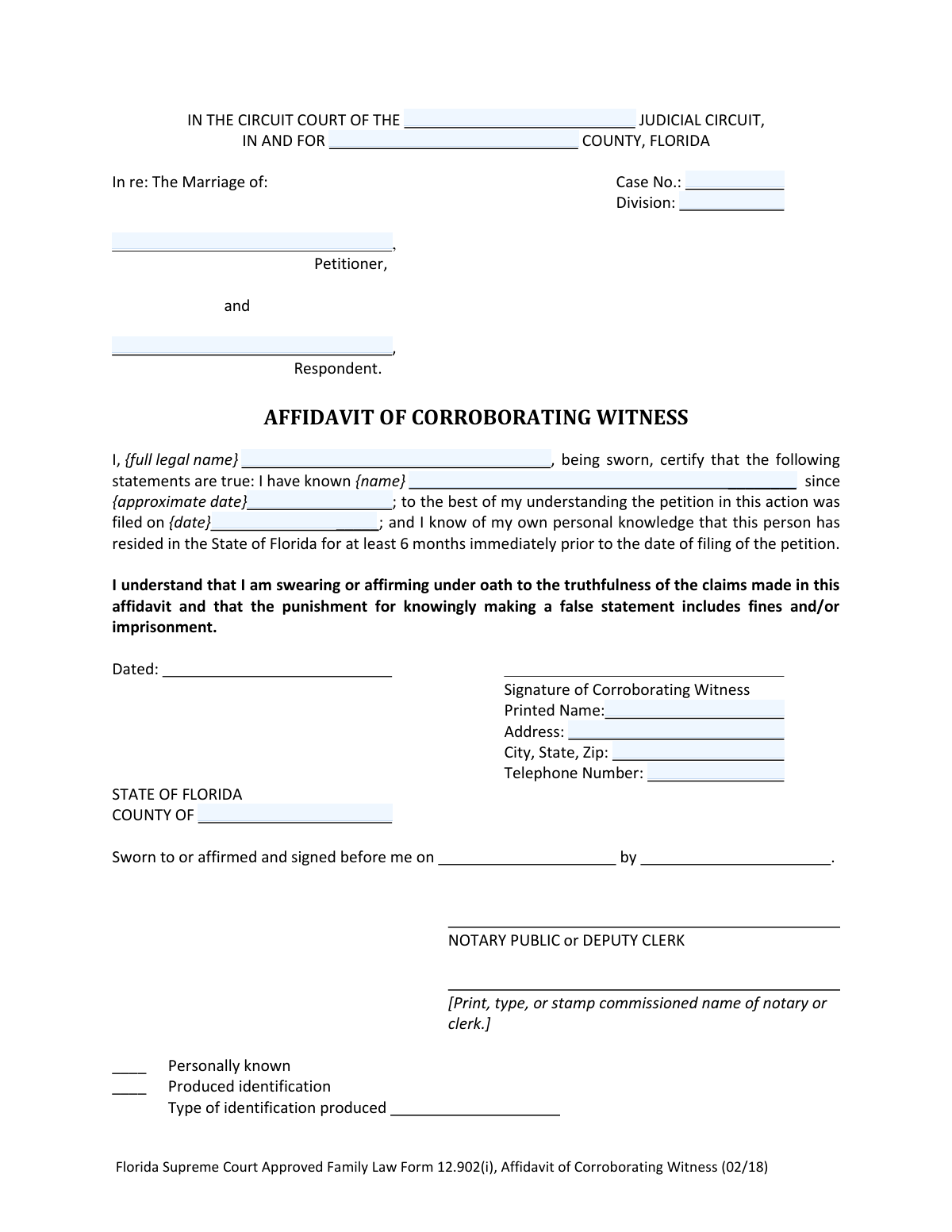
Yes! You can use AI to fill out Florida Supreme Court Approved Family Law Form 12.902(i), Affidavit of Corroborating Witness

Florida Form 12.902(i) is a sworn legal statement used to corroborate the residency requirement in a dissolution of marriage case. To get a divorce in Florida, one party must have lived in the state for at least six months, and this form allows a third-party witness to attest to that fact under oath. Today, this form can be filled out quickly and accurately using AI-powered services like Instafill.ai, which can also convert non-fillable PDF versions into interactive fillable forms.
Form 12.902(i) is part of the family court forms, family law forms and divorce forms categories on Instafill.
Our AI automatically handles information lookup, data retrieval, formatting, and form filling.
It takes less than a minute to fill out Form 12.902(i) using our AI form filling.
Securely upload your data. Information is encrypted in transit and deleted immediately after the form is filled out.

Form specifications

Form name: Florida Supreme Court Approved Family Law Form 12.902(i), Affidavit of Corroborating Witness
Number of fields: 25
Number of pages: 1
Language: English
main-image

Instafill Demo: How to fill out PDF forms in seconds with AI

How to Fill Out Form 12.902(i) Online for Free in 2026

Are you looking to fill out a FORM 12.902(I) form online quickly and accurately? Instafill.ai offers the #1 AI-powered PDF filling software of 2026, allowing you to complete your FORM 12.902(I) form in just 37 seconds or less.
Follow these steps to fill out your FORM 12.902(I) form online using Instafill.ai:
  1. 1 Navigate to Instafill.ai and upload or select the Florida Form 12.902(i), Affidavit of Corroborating Witness.
  2. 2 Use the AI assistant to provide the court case information, including the judicial circuit, county, case number, and the names of the petitioner and respondent.
  3. 3 Enter the full legal name and contact information of the corroborating witness who is signing the affidavit.
  4. 4 Input the name of the party whose residency is being confirmed, the date the witness has known them, and the date the divorce petition was filed.
  5. 5 If a nonlawyer assisted in preparing the form, provide their required details in the designated section.
  6. 6 Review all entered information for accuracy, then download the completed affidavit.
  7. 7 Print the form, and have the witness sign it in the presence of a notary public or deputy clerk before filing with the court.

Our AI-powered system ensures each field is filled out correctly, reducing errors and saving you time.

Why Choose Instafill.ai for Your Fillable Form 12.902(i) Form?

Speed

Complete your Form 12.902(i) in as little as 37 seconds.

Up-to-Date

Always use the latest 2026 Form 12.902(i) form version.

Cost-effective

No need to hire expensive lawyers.

Accuracy

Our AI performs 10 compliance checks to ensure your form is error-free.

Security

Your personal information is protected with bank-level encryption.

Frequently Asked Questions About Form Form 12.902(i)

This form is used in a Florida divorce case to prove that at least one spouse has lived in the state for a minimum of six months before the divorce was filed. It is signed by a third-party witness who can confirm this residency requirement.

A 'corroborating witness' must complete and sign this form. This must be someone other than the spouses involved in the divorce who has personal knowledge of the party's residency in Florida.

No, this form is one of several options. You can also prove residency with a valid Florida driver’s license, Florida identification card, or voter’s registration card, provided it was issued at least six months before the divorce petition was filed.

Your witness can be any adult, such as a friend, neighbor, or coworker, who is not your spouse. The key requirement is that they have direct, personal knowledge that you have lived in Florida for the necessary six-month period.

Yes, this is a sworn affidavit, so the witness must sign it in the physical presence of a notary public or a deputy clerk. The official will then complete their section to certify the signature.

You must file the original, notarized form with the clerk of the circuit court where your divorce case is filed. You also need to provide a copy to the other party in the case and keep a copy for your own records.

This refers to the official date that the initial Petition for Dissolution of Marriage was filed with the clerk of court. This date is typically stamped on the first page of the petition documents.

While e-filing is common, self-represented litigants in Florida are not required to e-file and may submit the physical paper form to the clerk's office. If you do choose to e-file, you must follow the court's specific rules and procedures.

If you have a flat, non-fillable PDF, you can use a service like Instafill.ai. It can convert the document into an interactive form, allowing you to easily type your information into the correct fields before printing.

Yes, services like Instafill.ai use AI to help you accurately auto-fill form fields, which saves time and reduces the risk of errors. The AI can identify fields for case numbers, names, and dates to streamline the process.

Simply upload the form to the Instafill.ai platform, and its AI will make the document fillable. You can then type in the required information, download the completed form, and print it for the witness to sign in front of a notary.

If you received help filling out this form from someone who is not an attorney (like a paralegal or document preparer), that person must fill in their name, address, and phone number in this section. This is a required disclosure under Florida law.

After filing the original with the court, you must serve a copy on the other party. This can be done by mailing it, e-mailing it, or delivering it by hand to your spouse or their attorney.

Compliance Form 12.902(i)
Validation Checks by Instafill.ai

1
Required Case Identification Fields
Verifies that the 'Judicial Circuit', 'County', 'Case No.', 'Petitioner', and 'Respondent' fields are all filled. These fields are critical for correctly identifying the legal case to which this affidavit pertains. Missing information will result in the clerk rejecting the document for being improperly filed.
2
Known Person Matches a Party
Ensures the name of the person the witness has known, '{name}', matches either the 'Petitioner' or 'Respondent' name in the case caption. This affidavit's purpose is to corroborate the residency of a party to the case. If the name does not match either party, the affidavit is irrelevant and legally ineffective for this proceeding.
3
Petition Filing Date Validation
Validates that the 'petition in this action was filed on {date}' is a valid, non-future date in a recognized format (e.g., MM/DD/YYYY). This date is the legal anchor for the six-month residency requirement. An invalid, future, or improperly formatted date would render the affidavit logically flawed and subject to rejection.
4
Residency Period Corroboration Logic
Checks that the '{approximate date}' the witness has known the party is at least six months prior to the 'petition... was filed on {date}'. This is the core purpose of the affidavit, as it proves the witness's capacity to testify to the required residency period. If the duration is less than six months, the affidavit fails to meet the statutory requirement for corroborating residency.
5
Witness Name Consistency
Ensures the '{full legal name}' of the witness in the affidavit body is identical to the 'Printed Name' in the signature block. This consistency is crucial for verifying the identity of the affiant (the corroborating witness). A mismatch could invalidate the affidavit or raise questions about its authenticity during legal review.
6
Witness Contact Information Completeness
Verifies that the witness's 'Printed Name', 'Address', 'City, State, Zip', and 'Telephone Number' are all provided. This information is required to identify and potentially contact the witness for verification or further testimony. Incomplete information may lead to the affidavit being questioned or rejected by the court.
7
Notarization Section Completeness
Checks that the 'COUNTY OF' where the form was notarized is filled, the date of notarization is present, and the method of identification ('Personally known' or 'Produced identification') is checked. An incomplete notary block invalidates the sworn statement under penalty of perjury. This makes the entire affidavit legally ineffective and unusable in court.
8
Notary Identification Specificity
If the 'Produced identification' checkbox is marked in the notary section, this validation ensures the 'Type of identification produced' field is not empty. This rule provides a clear record of how the notary verified the affiant's identity, a critical component of a valid notarization. Leaving the type blank creates an incomplete and potentially challengeable record.
9
Signature and Notarization Date Consistency
Confirms the date in the notary block ('Sworn to or affirmed and signed before me on...') is the same as or after the 'Dated' field next to the witness's signature. A notary cannot legally attest to a signature that has not yet occurred. This chronological check ensures the logical and legal integrity of the notarization process.
10
Telephone Number Format
Ensures the 'Telephone Number' for the corroborating witness is in a valid format (e.g., (xxx) xxx-xxxx or xxx-xxx-xxxx). A valid phone number is necessary for the court or opposing party to contact the witness if needed. An improperly formatted number can hinder communication and cause delays in the legal process.
11
Conditional Nonlawyer Information Validation
If any field in the 'IF A NONLAWYER HELPED YOU' section is filled, this check ensures all fields in that section are completed. Florida rules require full disclosure of nonlawyer assistance, including name, business, full address, and phone number. Incomplete information violates procedural rules and can lead to scrutiny of the document's preparation.
12
Nonlawyer 'Prepared For' Selection
If the nonlawyer assistance section is used, this validation ensures that one and only one of the checkboxes ('Affiant', 'Petitioner', or 'Respondent') is selected. This selection clarifies on whose behalf the nonlawyer provided assistance. Failure to make a clear, single selection makes the disclosure incomplete and non-compliant with court rules.

Common Mistakes in Completing Form 12.902(i)

Signing the Affidavit Without a Notary Present

Witnesses often sign the form at home before taking it to a notary, misunderstanding the process. An affidavit must be signed in the physical presence of the notary public or deputy clerk, who must witness the act of signing. A pre-signed document cannot be properly notarized, rendering the affidavit invalid and causing the court to reject it, which delays the divorce proceedings.

Entering an Incorrect Petition Filing Date

The witness may guess or not know the exact date the Petition for Dissolution of Marriage was filed with the court. This date is the critical reference point for the six-month residency requirement, and an incorrect date makes the entire sworn statement legally unsound. To avoid this, the witness must obtain the exact filing date from the petitioner or the court record before completing the form.

Misunderstanding the Six-Month Residency Period

A witness might confirm the party has lived in Florida for six months, but not for the specific period 'immediately prior to the date of filing of the petition.' This mistake happens when the witness bases their knowledge on the current date, not the legally relevant timeframe. This error can jeopardize the court's jurisdiction over the case, potentially leading to dismissal.

Incomplete or Incorrect Case Caption Information

People frequently miscopy the Judicial Circuit, County, Case Number, or Division from the main divorce filings. Any error in this top section can lead to the affidavit being misfiled by the clerk's office or not being associated with the correct case. To prevent this, carefully copy all information exactly as it appears on the Petition for Dissolution of Marriage.

Mismatching Names of Parties and Witness

The witness might misspell their own name, or more critically, the name of the party whose residency they are corroborating. The name entered in the phrase 'I have known {name}' must exactly match the Petitioner or Respondent's name in the case caption. Discrepancies create ambiguity and can lead a judge to question the validity of the affidavit.

Submitting a Form with an Incomplete Notary Section

After the witness signs, the notary may forget to check a box indicating how identity was verified ('Personally known' or 'Produced identification') or fail to stamp their commission details clearly. The filer is responsible for ensuring the notary's section is fully and correctly completed before leaving the notary's presence. An incomplete notarization invalidates the affidavit.

Using an Ineligible Corroborating Witness

The form is sometimes filled out by a person who lacks direct, personal knowledge of the party's residency for the required six-month period. For example, a friend who lives out of state and only communicates online is not a suitable witness. This can be challenged by the other party or the court, requiring a new, valid affidavit and causing delays.

Forgetting to Serve a Copy on the Other Party

Filers often assume that filing the original document with the court clerk is the only step required. However, the instructions mandate that a copy of the completed affidavit must be sent to the other party in the case. Failure to provide this 'service' is a procedural error that can delay hearings or lead to motions from the opposing side.

Illegible Handwriting and Unprofessional Formatting

Court forms are often filled out by hand with messy or illegible writing, especially since many are distributed as non-fillable PDFs. This can cause the clerk to misinterpret names, dates, or case numbers, leading to filing errors or rejection of the document. Using a tool like Instafill.ai can convert flat PDFs into fillable forms and populate them with clear, typed text to prevent such issues.

Omitting the Nonlawyer Preparer's Information

If a nonlawyer (like a paralegal) assists in filling out the form, they are legally required to complete the section at the bottom with their name, business, and contact information. People often overlook this section, either because they don't realize it's required or the preparer forgets. This omission can have legal consequences for the preparer and may cause the court to scrutinize the document more closely.
Saved over 80 hours a year

“I was never sure if my IRS forms like W-9 were filled correctly. Now, I can complete the forms accurately without any external help.”

Kevin Martin Green

Your data stays secure with advanced protection from Instafill and our subprocessors

Robust compliance program

Transparent business model

You’re not the product. You always know where your data is and what it is processed for.

ISO 27001, HIPAA, and GDPR

Our subprocesses adhere to multiple compliance standards, including but not limited to ISO 27001, HIPAA, and GDPR.

Security & privacy by design

We consider security and privacy from the initial design phase of any new service or functionality. It’s not an afterthought, it’s built-in, including support for two-factor authentication (2FA) to further protect your account.

Fill out Form 12.902(i) with Instafill.ai

Worried about filling PDFs wrong? Instafill securely fills florida-supreme-court-approved-family-law-form-12902i-affidavit-of-corroborating-witness forms, ensuring each field is accurate.

Related forms by category

family court forms Form 12.995(c), Safety-Focused Parenting Plan, Florida Supreme Court Approved Family Law Form 12.901(b)(3), Petition for Dissolution of Marriage with No Dependent or Minor Child(ren) or Property (02/18), Form N161, Appellant’s notice (All appeals except small claims track appeals and appeals to the Family Division of the High Court), Form N161, Appellant's Notice (All appeals except small claims track appeals and appeals to the Family Division of the High Court), Florida Supreme Court Approved Family Law Form 12.915, Designation of Current Mailing and E-mail Address, Declaration of Marriage for Court Proceeding (California Family Law), Florida Supreme Court Approved Family Law Form 12.902(d), Uniform Child Custody Jurisdiction and Enforcement Act (UCCJEA) Affidavit, Florida Supreme Court Approved Family Law Form 12.941(a), Petition for Enforcement of Out-of-State Custody Decree and for Order to Pick Up Minor Child(ren), Florida Supreme Court Approved Family Law Form 12.970(a), Petition for Temporary Custody by Extended Family, Adoption Request (Stepparent), florida-family-law-rules-of-procedure-form-12900b-notice-of-and-consent-to-limited-appearance, florida-family-law-rules-of-procedure-form-12900d-termination-of-limited-appearance, florida-family-law-rules-of-procedure-form-12900e-acknowledgment-of-assistance-by-attorney, florida-family-law-rules-of-procedure-form-12900g-agreement-limiting-representation, florida-family-law-rules-of-procedure-form-12900h-notice-of-related-cases, florida-family-law-rules-of-procedure-form-12901a-joint-petition-for-simplified-dissolution-of-marriage, Form 12.902(b), Family Law Financial Affidavit (Short Form), florida-family-law-rules-of-procedure-form-12902c-family-law-financial-affidavit-long-form, florida-family-law-rules-of-procedure-form-12902e-child-support-guidelines-worksheet, florida-supreme-court-approved-family-law-form-12902f1-marital-settlement-agreement-for-dissolution-of-marriage-with · + 19 more →
family law forms Form 12.902(b), Family Law Financial Affidavit (Short Form), Florida Supreme Court Approved Family Law Form 12.901(b)(3), Petition for Dissolution of Marriage with No Dependent or Minor Child(ren) or Property (02/18), Form FL-170, Declaration for Default or Uncontested Dissolution or Legal Separation (Family Law), Form FL-100, Petition—Marriage/Domestic Partnership (Family Law), Florida Supreme Court Approved Family Law Form 12.915, Designation of Current Mailing and E-mail Address, Declaration of Marriage for Court Proceeding (California Family Law), Florida Supreme Court Approved Family Law Form 12.902(d), Uniform Child Custody Jurisdiction and Enforcement Act (UCCJEA) Affidavit, Florida Family Law Rules of Procedure Form 12.910(a), Summons: Personal Service on an Individual, Florida Supreme Court Approved Family Law Form 12.941(a), Petition for Enforcement of Out-of-State Custody Decree and for Order to Pick Up Minor Child(ren), Florida Supreme Court Approved Family Law Form 12.970(a), Petition for Temporary Custody by Extended Family, Form FL-110, Summons (Family Law), Form FL-120, Response—Marriage/Domestic Partnership (Family Law), ADOPT-200, Adoption Request, ADOPT-200, Stepparent Adoption Request, ADOPT-210, Adoption Agreement, ADOPT-310, Contact After Adoption Agreement, Adoption Assistance Program Nonrecurring Adoption Expense Agreement and Claim, Adoption Request (Stepparent), Adoption and Safe Families Act (ASFA) Survey, florida-family-law-rules-of-procedure-form-12900b-notice-of-and-consent-to-limited-appearance · + 26 more →
divorce forms Form 12.995(c), Safety-Focused Parenting Plan, Florida Supreme Court Approved Family Law Form 12.901(b)(3), Petition for Dissolution of Marriage with No Dependent or Minor Child(ren) or Property (02/18), Florida Supreme Court Approved Family Law Form 12.915, Designation of Current Mailing and E-mail Address, Florida Supreme Court Approved Family Law Form 12.902(d), Uniform Child Custody Jurisdiction and Enforcement Act (UCCJEA) Affidavit, Florida Supreme Court Approved Family Law Form 12.941(a), Petition for Enforcement of Out-of-State Custody Decree and for Order to Pick Up Minor Child(ren), Florida Supreme Court Approved Family Law Form 12.970(a), Petition for Temporary Custody by Extended Family, florida-family-law-rules-of-procedure-form-12900b-notice-of-and-consent-to-limited-appearance, florida-family-law-rules-of-procedure-form-12900d-termination-of-limited-appearance, florida-family-law-rules-of-procedure-form-12900e-acknowledgment-of-assistance-by-attorney, florida-family-law-rules-of-procedure-form-12900a-disclosure-from-nonlawyer, Florida Family Law Rules of Procedure Form 12.910(a), Summons: Personal Service on an Individual, Form 12.902(b), Family Law Financial Affidavit (Short Form), florida-supreme-court-approved-family-law-form-12902f1-marital-settlement-agreement-for-dissolution-of-marriage-with, florida-supreme-court-approved-family-law-form-12903c1-answer-to-petition-and-counterpetition-for-dissolution-of, florida-supreme-court-approved-family-law-form-12902l-affidavit-of-income-for-child-support, florida-supreme-court-approved-family-law-form-12903b-answer-to-petition-for-dissolution-of-marriage, florida-supreme-court-approved-family-law-form-12902f2-marital-settlement-agreement-for-dissolution-of-marriage-with, florida-family-law-rules-of-procedure-form-12902c-family-law-financial-affidavit-long-form, florida-family-law-rules-of-procedure-form-12902e-child-support-guidelines-worksheet, florida-family-law-rules-of-procedure-form-12900h-notice-of-related-cases · + 20 more →