
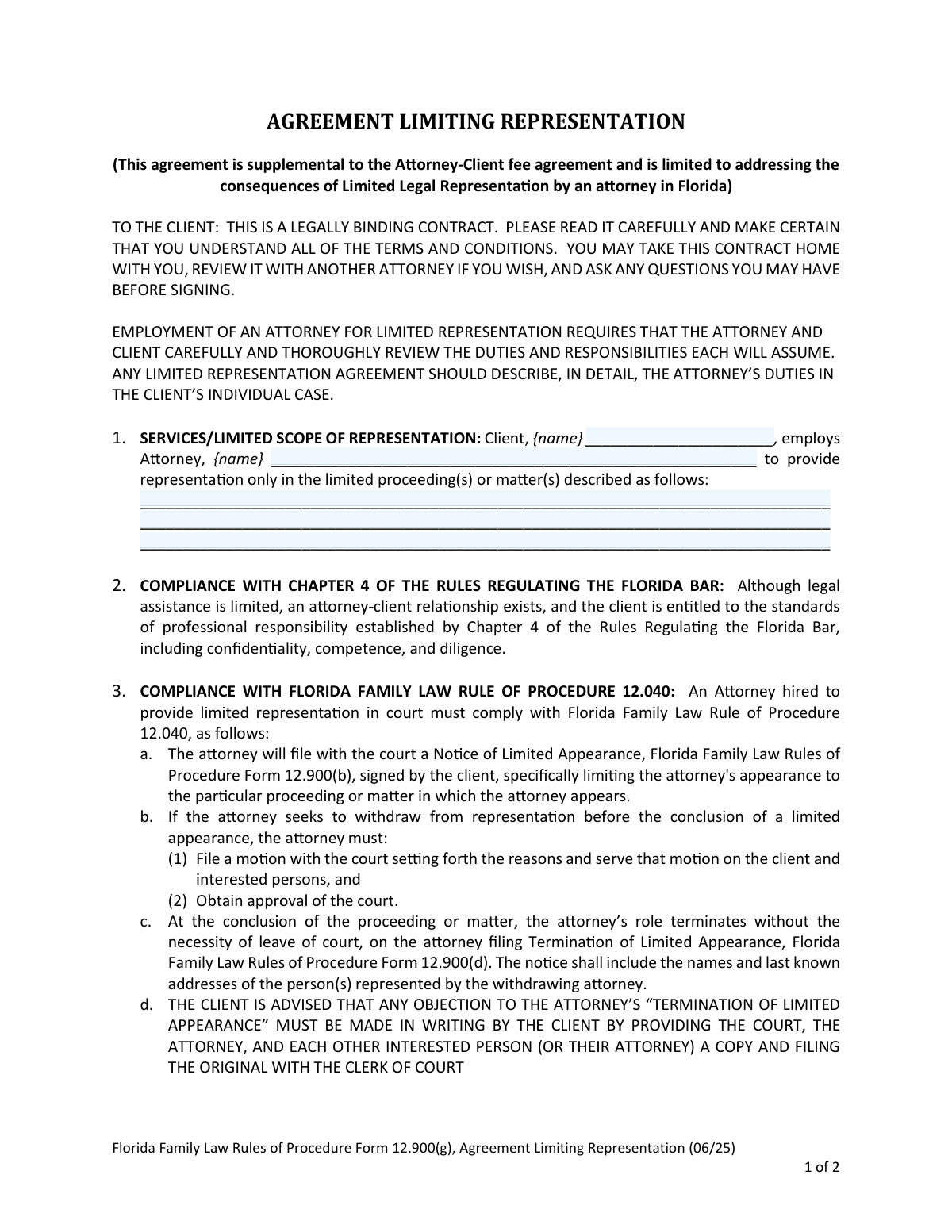
Yes! You can use AI to fill out Florida Family Law Rules of Procedure Form 12.900(g), Agreement Limiting Representation
Don't type 21 fields by hand. Tell our AI about yourself, or upload a document you already have, and it fills every field in seconds. You check it, then download, print or sign.
The AI does the filling. You just check it.
No typing into boxes, nothing to install.
What this form asks for
The AI fills all of it, from your answers or your documents.
The AI checks your answers before you download
12 checks built for this form, so a wrong date or a missing answer is caught before anyone else sees it.
This check verifies that the text area describing the limited proceedings or matters is not empty. This section is the core of the agreement, defining the exact services the attorney will provide. An empty or vague description could lead to disputes and renders the agreement meaningless, so submission should be blocked if this field is blank.
This validation compares the attorney's name entered in Section 1 with the name provided in the attorney's signature block. Consistency is crucial for legal clarity and to ensure there is no ambiguity about which attorney is party to the agreement. A mismatch could invalidate the contract or cause confusion and should trigger a warning.
This check ensures the client's name in the introductory paragraph (Section 1) is identical to the name in the client's signature block. This confirms the identity of the client throughout the document, which is essential for the agreement's legal validity. Discrepancies could lead to challenges regarding who is bound by the contract.
This check ensures the 'Florida Bar Number' field contains only numeric characters and fits the expected length for a valid bar number. An incorrect or invalid bar number could mean the person is not a licensed attorney in Florida, which would void the agreement. The system should flag any non-numeric or improperly formatted entries.
This validation confirms that the date field next to the attorney's signature is completed and is a valid date. The date establishes when the attorney agreed to the terms, which is critical for determining the contract's effective date. An undated signature can create legal ambiguity about when the representation officially began.
This check ensures the client has provided a valid date next to their signature. This date marks the client's formal acceptance of the agreement's terms and conditions. Without a date, it becomes difficult to prove when the agreement was finalized, potentially impacting its enforceability.
And 6 more checks
- Ensures Signature Dates are Not in the Future
- Ensures Attorney Contact Information is Complete
- Validates Telephone Number Format
- Validates Email Address Format
- Validates ZIP Code Format
- Confirms Final Client Acknowledgment
Let AI fill out your Form 12.900(g)
No typing. Every field filled in seconds, checked, ready to sign.
How to Fill Out Form 12.900(g) Online for Free in 2026
What the AI walks you through.
- Navigate to Instafill.ai and upload or select the Florida Form 12.900(g), Agreement Limiting Representation.
- Use the AI assistant to identify the fields for the client's name and the attorney's name.
- In Section 1, clearly and specifically describe the limited proceedings or matters for which the attorney is being employed.
- Enter the complete contact information for both the attorney and the client, including names, addresses, phone numbers, and email addresses. The attorney must also provide their Florida Bar Number.
- Carefully review all entered information to ensure the scope of representation is accurately detailed and all personal details are correct.
- The attorney and client must both sign and date the agreement in the designated sections to make it legally binding.
- Download the completed agreement for both parties' records. Note that this form is not filed with the clerk of the court.
Common Mistakes in Completing Form 12.900(g)
The ones the AI is built to catch.
Ambiguous Description of Limited Services
Using Incorrect or Incomplete Legal Names
Missing the Client's Acknowledgment Signature
Entering Incorrect Contact Information
Omitting or Using Inconsistent Dates
Incorrect or Missing Attorney Bar Number
Mistaking the Form for a Full Retainer Agreement
Improperly Filing the Agreement with the Court
Relying on Verbal Modifications to the Scope
Leaving the Scope of Representation Section Blank
Frequently Asked Questions About Form 12.900(g)
Is it really free for 7 days?
Can I fill other forms too?
How do I cancel?
How does the AI fill out Form 12.900(g)?
What happens to my information?
How complex is Form 12.900(g) to fill out?
What is the purpose of the Agreement Limiting Representation form?
Who needs to sign this form?
Should I file this agreement with the court?
What information is required to complete this form?
What happens if I need my attorney to do more work than we originally agreed on?
Is this form the same as a fee agreement?
What happens when the attorney completes the limited work?
What is a 'Notice of Limited Appearance'?
Are my rights as a client different under a limited representation agreement?
Can I use an AI tool to help me fill out this form?
How can I fill out this form online if I only have a PDF copy?
What should I do if my PDF of the form is not fillable?
Does signing this agreement prevent me from hiring the attorney for my full case later?
Get your Form 12.900(g) filled out by AI
$0 today. Cancel before Oct 31 and you pay nothing.
Other forms like this one
family law forms: Form 12.902(b), Family Law Financial Affidavit (Short Form), Florida Supreme Court Approved Family Law Form 12.901(b)(3), Petition for Dissolution of Marriage with No Dependent or Minor Child(ren) or Property (02/18), Form FL-170, Declaration for Default or Uncontested Dissolution or Legal Separation (Family Law), Form FL-100, Petition—Marriage/Domestic Partnership (Family Law), declaration-of-marriage-for-court-proceeding-california-family-law, Florida Supreme Court Approved Family Law Form 12.902(d), Uniform Child Custody Jurisdiction and Enforcement Act (UCCJEA) Affidavit, Florida Family Law Rules of Procedure Form 12.910(a), Summons: Personal Service on an Individual, Florida Supreme Court Approved Family Law Form 12.941(a), Petition for Enforcement of Out-of-State Custody Decree and for Order to Pick Up Minor Child(ren), Florida Supreme Court Approved Family Law Form 12.970(a), Petition for Temporary Custody by Extended Family, Form FL-110, Summons (Family Law), Form FL-120, Response—Marriage/Domestic Partnership (Family Law), ADOPT-200, Adoption Request, ADOPT-200, Stepparent Adoption Request, ADOPT-210, Adoption Agreement, ADOPT-310, Contact After Adoption Agreement, Adoption Assistance Program Nonrecurring Adoption Expense Agreement and Claim, Adoption Request (Stepparent), Adoption and Safe Families Act (ASFA) Survey, Florida Family Law Rules of Procedure Form 12.900(b), Notice of and Consent to Limited Appearance, Florida Family Law Rules of Procedure Form 12.900(d), Termination of Limited Appearance
family court forms: Form 12.995(c), Safety-Focused Parenting Plan, Florida Supreme Court Approved Family Law Form 12.901(b)(3), Petition for Dissolution of Marriage with No Dependent or Minor Child(ren) or Property (02/18), Form N161, Appellant’s notice (All appeals except small claims track appeals and appeals to the Family Division of the High Court), Form N161, Appellant's Notice (All appeals except small claims track appeals and appeals to the Family Division of the High Court), declaration-of-marriage-for-court-proceeding-california-family-law, Florida Supreme Court Approved Family Law Form 12.902(d), Uniform Child Custody Jurisdiction and Enforcement Act (UCCJEA) Affidavit, Florida Supreme Court Approved Family Law Form 12.941(a), Petition for Enforcement of Out-of-State Custody Decree and for Order to Pick Up Minor Child(ren), Florida Supreme Court Approved Family Law Form 12.970(a), Petition for Temporary Custody by Extended Family, Adoption Request (Stepparent), Florida Family Law Rules of Procedure Form 12.900(b), Notice of and Consent to Limited Appearance, Florida Family Law Rules of Procedure Form 12.900(d), Termination of Limited Appearance, Florida Family Law Rules of Procedure Form 12.900(e), Acknowledgment of Assistance by Attorney, Florida Family Law Rules of Procedure Form 12.900(h), Notice of Related Cases, Florida Family Law Rules of Procedure Form 12.901(a), Joint Petition for Simplified Dissolution of Marriage, Form 12.902(b), Family Law Financial Affidavit (Short Form), Florida Family Law Rules of Procedure Form 12.902(c), Family Law Financial Affidavit (Long Form), Florida Family Law Rules of Procedure Form 12.902(e), Child Support Guidelines Worksheet, Florida Supreme Court Approved Family Law Form 12.902(f)(1), Marital Settlement Agreement for Dissolution of Marriage with Dependent or Minor Child(ren), Florida Supreme Court Approved Family Law Form 12.902(f)(2), Marital Settlement Agreement for Dissolution of Marriage with Property but No Dependent or Minor Child(ren), Florida Supreme Court Approved Family Law Form 12.902(i), Affidavit of Corroborating Witness
florida court forms: Form 12.995(c), Safety-Focused Parenting Plan, Florida Supreme Court Approved Family Law Form 12.901(b)(3), Petition for Dissolution of Marriage with No Dependent or Minor Child(ren) or Property (02/18), Florida Supreme Court Approved Family Law Form 12.902(d), Uniform Child Custody Jurisdiction and Enforcement Act (UCCJEA) Affidavit, Florida Supreme Court Approved Family Law Form 12.941(a), Petition for Enforcement of Out-of-State Custody Decree and for Order to Pick Up Minor Child(ren), Florida Supreme Court Approved Family Law Form 12.970(a), Petition for Temporary Custody by Extended Family, Florida Family Law Rules of Procedure Form 12.900(b), Notice of and Consent to Limited Appearance, Florida Family Law Rules of Procedure Form 12.900(d), Termination of Limited Appearance, Florida Family Law Rules of Procedure Form 12.900(e), Acknowledgment of Assistance by Attorney, Florida Family Law Rules of Procedure Form 12.900(a), Disclosure from Nonlawyer, Florida Family Law Rules of Procedure Form 12.910(a), Summons: Personal Service on an Individual, Form 12.902(b), Family Law Financial Affidavit (Short Form), Florida Supreme Court Approved Family Law Form 12.902(f)(1), Marital Settlement Agreement for Dissolution of Marriage with Dependent or Minor Child(ren), Florida Supreme Court Approved Family Law Form 12.903(c)(1), Answer to Petition and Counterpetition for Dissolution of Marriage with Dependent or Minor Child(ren), Florida Supreme Court Approved Family Law Form 12.902(l), Affidavit of Income for Child Support, Florida Supreme Court Approved Family Law Form 12.903(b), Answer to Petition for Dissolution of Marriage, Florida Supreme Court Approved Family Law Form 12.902(i), Affidavit of Corroborating Witness, Florida Supreme Court Approved Family Law Form 12.902(f)(2), Marital Settlement Agreement for Dissolution of Marriage with Property but No Dependent or Minor Child(ren), Florida Family Law Rules of Procedure Form 12.902(c), Family Law Financial Affidavit (Long Form), Florida Family Law Rules of Procedure Form 12.902(e), Child Support Guidelines Worksheet, Florida Family Law Rules of Procedure Form 12.900(h), Notice of Related Cases
Let AI fill out your Form 12.900(g)
Your trial starts once a card is added. You pay nothing before Oct 31.
Our AI already knows this form, all 21 fields of it. Skip the typing: tell it about yourself, or upload what you have, and it fills the whole form in seconds.
- AI fills every field on all 3 pages, checkboxes included
- No typing into boxes: answer a few questions, or upload a document you already have, an old copy of this form, a photo of a document
- The AI checks the answers; you review and change anything before you download
- Download the finished PDF, print it, or sign it online
- Encrypted, and never used to train AI
Cancel before Oct 31 and you pay nothing.
A card is needed to start the trial. Cancel in two clicks from your account.
Terms · Privacy