Yes! You can use AI to fill out Uniform Child Custody Jurisdiction Enforcement Act Affidavit
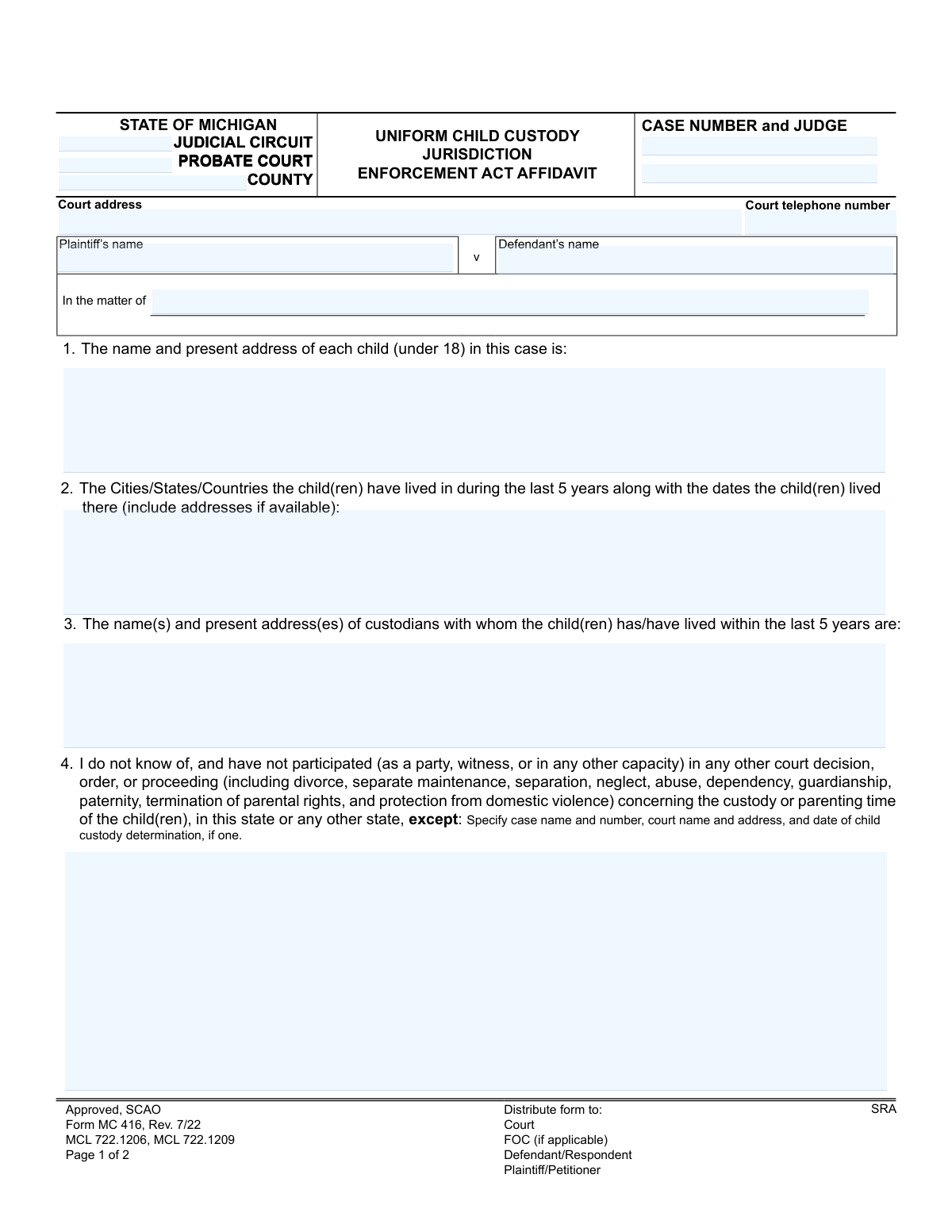
Form MC 416, the Uniform Child Custody Jurisdiction Enforcement Act (UCCJEA) Affidavit, is a sworn legal statement used in Michigan courts for cases involving child custody. It provides the court with essential information about a child's residential history over the last five years and any other custody-related legal proceedings in any state. This helps the court determine if it has the proper jurisdiction to make decisions about the child. Today, this form can be filled out quickly and accurately using AI-powered services like Instafill.ai, which can also convert non-fillable PDF versions into interactive fillable forms.
Our AI automatically handles information lookup, data retrieval, formatting, and form filling.
It takes less than a minute to fill out MC 416 using our AI form filling.
Securely upload your data. Information is encrypted in transit and deleted immediately after the form is filled out.
Form specifications
| Form name: | Uniform Child Custody Jurisdiction Enforcement Act Affidavit |
| Number of fields: | 34 |
| Number of pages: | 1 |
| Language: | English |
More forms in Child custody forms
Instafill Demo: How to fill out PDF forms in seconds with AI
How to Fill Out MC 416 Online for Free in 2026
Are you looking to fill out a MC 416 form online quickly and accurately? Instafill.ai offers the #1 AI-powered PDF filling software of 2026, allowing you to complete your MC 416 form in just 37 seconds or less.
Follow these steps to fill out your MC 416 form online using Instafill.ai:
- 1 Navigate to Instafill.ai and upload or select the Michigan Uniform Child Custody Jurisdiction Enforcement Act Affidavit (Form MC 416).
- 2 Use the AI assistant to automatically populate the case information, including the court, county, case number, and party names.
- 3 Provide the required details for each child, such as their name, present address, and a five-year history of where they have lived.
- 4 List the names and current addresses of all custodians the child has lived with during the past five years.
- 5 Disclose any past or pending court cases concerning the child's custody in any state, or affirm that you have no knowledge of such proceedings.
- 6 Carefully review all the information entered by the AI for completeness and accuracy.
- 7 Sign the affidavit before a notary public, have it notarized, and file it with the appropriate court as required.
Our AI-powered system ensures each field is filled out correctly, reducing errors and saving you time.
Why Choose Instafill.ai for Your Fillable MC 416 Form?
Speed
Complete your MC 416 in as little as 37 seconds.
Up-to-Date
Always use the latest 2026 MC 416 form version.
Cost-effective
No need to hire expensive lawyers.
Accuracy
Our AI performs 10 compliance checks to ensure your form is error-free.
Security
Your personal information is protected with bank-level encryption.
Frequently Asked Questions About Form MC 416
This form provides the court with information about a child's residential history for the past five years. It helps the court determine if it has the legal authority, or jurisdiction, to make or change custody and parenting time orders for that child.
Any party involved in a Michigan court case concerning child custody must complete and file this affidavit. This includes cases for divorce, separate maintenance, paternity, or guardianship where a child under 18 is involved.
The 'home state' is the state where the child lived with a parent for at least six consecutive months immediately before the court case began. The form provides a more detailed legal definition at the bottom of the second page.
If you believe disclosing your or your child's address would put your health or safety at risk, you can check the box in Section 8. You should discuss your safety concerns with the court clerk or an attorney to understand how to protect your information.
You must disclose any other court proceedings, past or present, concerning the child's custody. This includes cases for divorce, neglect, abuse, guardianship, paternity, or domestic violence protection orders in any state.
You should provide the most accurate and complete information you have. If you cannot recall a specific street address, provide the city, state, and the dates the child lived there to the best of your ability.
Yes, your signature on the affidavit must be sworn to and signed in the presence of a notary public or a deputy court clerk. Do not sign the form beforehand.
The original, notarized form must be filed with the court handling your custody case. You should also provide copies to the other party (plaintiff/defendant) and the Friend of the Court (FOC), if one is involved in your case.
Failing to file this affidavit can delay your case, and providing false information is a serious offense as you are swearing to its truthfulness. You have a continuing duty to inform the court of any new information that could affect the case.
Yes, services like Instafill.ai use AI to accurately auto-fill form fields, which can save you time and help prevent errors. These tools can extract information from your records and place it in the correct fields on the form.
You can use a service like Instafill.ai to complete the form digitally. Simply upload the PDF, and the platform will make it an interactive, fillable form that you can complete on your computer or mobile device.
If you have a non-fillable or 'flat' PDF, you can upload it to a platform like Instafill.ai. The service's technology can convert the static document into an interactive, fillable form for you to complete online.
Section 4 asks about any past court decisions or orders regarding the child's custody. Section 5 asks about any other proceedings that are currently pending or ongoing that could affect the current case.
Compliance MC 416
Validation Checks by Instafill.ai
1
Mandatory Home State Declaration
This check ensures that the 'home state' field in Section 7 is not empty. The determination of the child's home state is the primary purpose of the UCCJEA affidavit, as it establishes which court has jurisdiction over the custody proceedings. Failure to provide this information will result in the form being rejected as it is fundamentally incomplete and fails to meet its legal objective.
2
Logical Consistency of Home State
This validation cross-references the declared 'home state' in Section 7 with the residency history provided in Section 2. The check verifies that the child has lived in the declared home state for at least six consecutive months immediately before the proceeding, as per the UCCJEA definition. If the residency history does not support the home state claim, the form may be flagged for review or rejected for being legally inconsistent.
3
Completeness of Child's 5-Year Residence History
This check validates that for every location listed in Section 2, a corresponding set of dates is also provided. This history is critical evidence for establishing the child's home state and jurisdiction. An incomplete history with missing dates makes it impossible for the court to verify jurisdictional claims, leading to a request for more information or rejection of the affidavit.
4
Conditional Requirement for Prior Proceedings Details
This validation rule applies to Section 4. If the affiant does not check the box indicating they have no knowledge of other proceedings, then the fields for 'case name and number,' 'court name and address,' and 'date of child custody determination' become mandatory. This ensures that the court is fully informed of any relevant legal history that could impact the current case. An omission here would render the exception meaningless and require correction.
5
Mandatory Explanation for Temporary Action
This check ensures that if the checkbox in Section 5 for 'Temporary action by this court is necessary' is selected, the associated explanation is not empty. Requesting emergency temporary action is a significant legal step that requires justification. Failure to provide a detailed explanation will result in the request being denied or the form being returned for completion.
6
Completeness of Child Information
This validation ensures that for each child listed in Section 1, both a full name and a complete present address are provided. The court must be able to positively identify every child who is a subject of the proceeding. Missing names or addresses make the affidavit ambiguous and legally insufficient, preventing the case from moving forward.
7
Valid Notarization and Commission Dates
This check verifies two date-related conditions in the notary section: the 'Date sworn' must be a valid date on or before the submission date, and the notary's 'Commission expires on' date must be after the 'Date sworn'. This is crucial for establishing that the affidavit was properly sworn before a notary with a valid, active commission. An expired commission or invalid date invalidates the notarization and the legal standing of the document.
8
Affiant Information and Signature Completeness
This validation confirms that the 'Name of affiant', 'Address of affiant', and 'Signature of affiant' fields are all filled. The affidavit is a sworn statement, and the identity and attestation of the person making the statement are paramount. An anonymous or unsigned affidavit has no legal weight and will be immediately rejected by the court.
9
Case Number Format and Presence
This check ensures the 'Case Number' field is filled and, if possible, matches the expected format for the specified court. The case number is the primary identifier that links this affidavit to the correct legal proceeding in the court's records. An incorrect or missing case number can lead to filing errors, delays, or the document being misplaced.
10
Completeness of Custodian Information
This validation rule applies to Section 3, ensuring that for every custodian listed, both a name and a present address are provided. These individuals may have legal rights or be required to receive notice of the proceedings. Incomplete information hinders the court's ability to ensure all interested parties are properly notified, which can lead to future legal challenges.
11
Conditional Requirement for Other Custody Claimants
This check validates Section 6. If the affiant indicates knowledge of other persons claiming custody rights, the fields for the name(s) and address(es) of those persons become mandatory. The court must be aware of all potential parties to a custody dispute to ensure due process. Failure to provide these details when indicated will cause the form to be returned for completion.
12
Conditional Requirement for Pending Proceedings Details
This rule applies to Section 5. If the affiant indicates knowledge of a pending proceeding, the fields for 'case name and number,' 'court name and address,' and 'nature of the proceeding' must be filled. This prevents conflicting orders from different courts and ensures judicial efficiency. Omitting these details after indicating their existence would make the affidavit incomplete and require clarification.
Common Mistakes in Completing MC 416
This form requires identifying the child's 'home state' based on a specific legal definition, which is where the child has lived for six consecutive months immediately before the case. Many people mistakenly list the state where they currently reside, even if they've been there for less than six months. This error can lead to the court determining it lacks jurisdiction, causing significant delays or dismissal of the case.
Section 2 requires a detailed account of every place the child has lived for the past five years, including dates. People often struggle to recall this information accurately, leading to gaps, vague entries like 'sometime in 2021,' or incorrect dates. An incomplete or inaccurate history can undermine the affidavit's purpose and cause the court to demand more information, delaying the proceedings.
Sections 4 and 5 ask about any other court cases concerning the child, including divorce, protection orders, or paternity cases. Filers may forget about older cases, not realize a certain proceeding is relevant, or misread the complex legal phrasing. Omitting a required case is a serious error that can be considered perjury and may result in sanctions or negatively impact the filer's credibility with the court.
This is a sworn affidavit, meaning it must be signed in the physical or virtual presence of a notary public who verifies the signer's identity. A common mistake is to fill out and sign the form at home and then take it to be notarized, which invalidates the signature. A court clerk will reject an improperly notarized form, requiring the entire process to be repeated.
The top of the form requires specific details like the Case Number, Judge, and Judicial Circuit. People often leave these fields blank, assuming the court clerk will fill them in or because they don't have the information handy. Without this data, the document cannot be correctly filed and associated with the proper case, leading to it being rejected or lost in the system.
Section 8 provides a crucial option to protect a party's or child's address if its disclosure would put their health, safety, or liberty at risk, which is vital in cases involving domestic violence. Filers under stress may overlook this checkbox and list their current address in Section 1, inadvertently making it a public record and revealing their location to an abuser. It is critical to carefully consider this option before providing any address information.
Section 3 asks for the names and *present* addresses of all persons with whom the child has lived in the last five years. A frequent error is to list the address where the custodian lived at the time, rather than their current, up-to-date address. This prevents the court from being able to properly notify all relevant parties, leading to an incomplete form and procedural delays.
The form requires the full legal names of the plaintiff, defendant, and all children involved. People often use informal names, nicknames, or initials out of habit. This can create ambiguity and cause mismatches with official records like birth certificates and other court filings, forcing the court to request clarification and delaying the case. To avoid this, always use the complete legal name as it appears on official documents.
By signing, the affiant acknowledges a 'continuing duty to advise this court' of any new custody proceedings that may arise. Many filers overlook this statement or don't understand its ongoing legal obligation. If a new custody-related case is started in another state after this form is filed, failing to promptly inform the current court is a violation of this duty and can have serious negative consequences on the case.
Saved over 80 hours a year
“I was never sure if my IRS forms like W-9 were filled correctly. Now, I can complete the forms accurately without any external help.”
Kevin Martin Green
Your data stays secure with advanced protection from Instafill and our subprocessors

Robust compliance program
Transparent business model
You’re not the product. You always know where your data is and what it is processed for.
ISO 27001, HIPAA, and GDPR
Our subprocesses adhere to multiple compliance standards, including but not limited to ISO 27001, HIPAA, and GDPR.
Security & privacy by design
We consider security and privacy from the initial design phase of any new service or functionality. It’s not an afterthought, it’s built-in, including support for two-factor authentication (2FA) to further protect your account.
Fill out MC 416 with Instafill.ai
Worried about filling PDFs wrong? Instafill securely fills uniform-child-custody-jurisdiction-enforcement-act-affidavit forms, ensuring each field is accurate.