Yes! You can use AI to fill out Form MC 14, Garnishee Disclosure

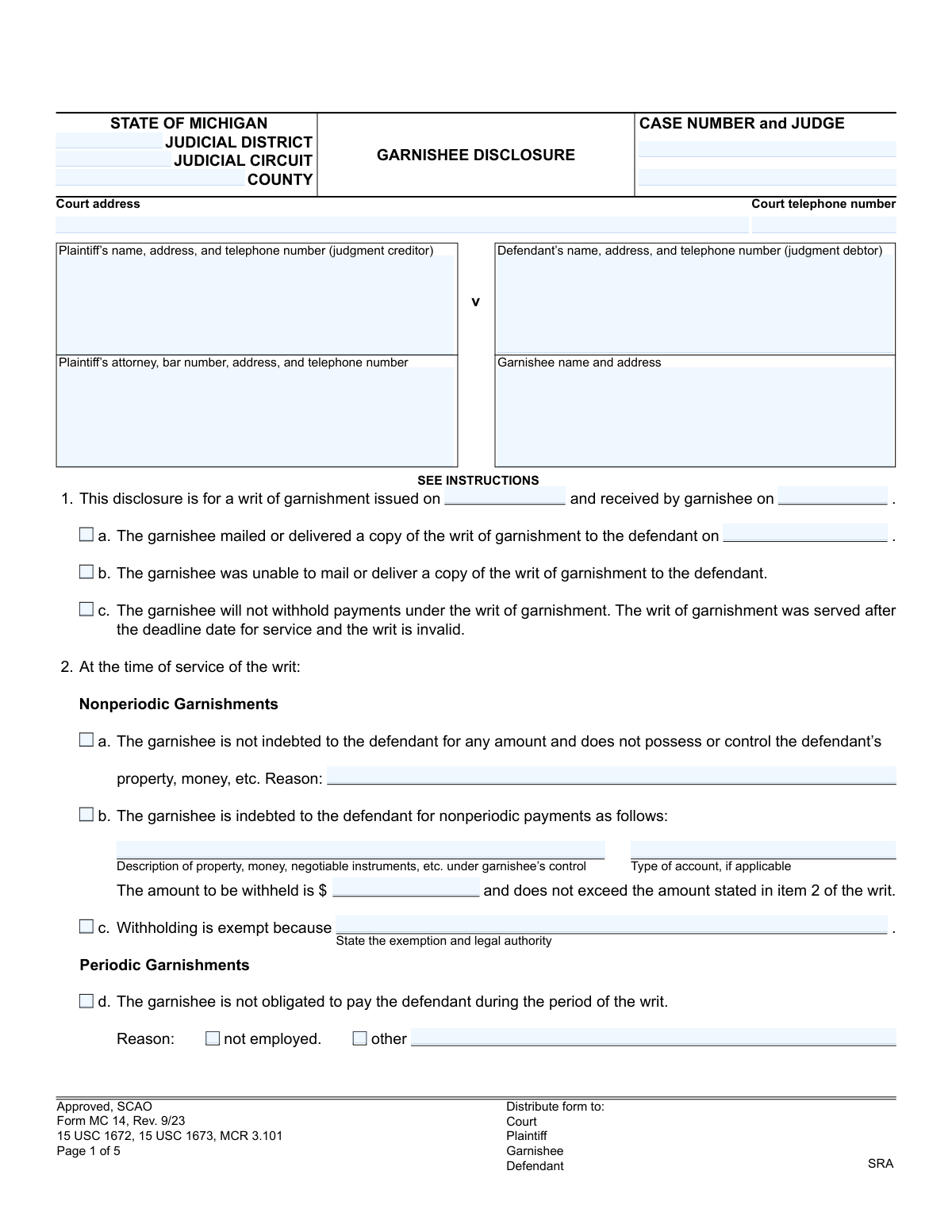
Form MC 14, Garnishee Disclosure, is a mandatory legal document in Michigan filed by a third party (the garnishee) who holds assets or owes money to a judgment debtor. It serves as a formal response to a court's writ of garnishment, detailing the nature and amount of any property, money, or periodic payments (like wages) owed to the debtor. Completing this disclosure accurately is crucial for legal compliance and avoiding potential penalties. Today, this form can be filled out quickly and accurately using AI-powered services like Instafill.ai, which can also convert non-fillable PDF versions into interactive fillable forms.
MC 14 is part of the Michigan court forms category on Instafill.
Our AI automatically handles information lookup, data retrieval, formatting, and form filling.
It takes less than a minute to fill out MC 14 using our AI form filling.
Securely upload your data. Information is encrypted in transit and deleted immediately after the form is filled out.

Form specifications

Form name: Form MC 14, Garnishee Disclosure
Number of fields: 81
Number of pages: 1
Language: English
main-image

Instafill Demo: How to fill out PDF forms in seconds with AI

How to Fill Out MC 14 Online for Free in 2026

Are you looking to fill out a MC 14 form online quickly and accurately? Instafill.ai offers the #1 AI-powered PDF filling software of 2026, allowing you to complete your MC 14 form in just 37 seconds or less.
Follow these steps to fill out your MC 14 form online using Instafill.ai:
  1. 1 Navigate to Instafill.ai and upload the MC 14 Garnishee Disclosure form or select it from the template library.
  2. 2 Use the AI assistant to accurately fill in the case details, including the court, case number, judge, and information for the plaintiff, defendant, and garnishee.
  3. 3 Indicate the dates the writ of garnishment was issued and received, and confirm whether a copy was successfully delivered to the defendant.
  4. 4 Disclose your financial relationship with the defendant by specifying whether you are indebted for nonperiodic payments (like a bank account) or obligated for periodic payments (like wages).
  5. 5 If making periodic payments, detail the payment frequency, calculate the legally permissible withholding amount, and state if any higher-priority writs are already in effect.
  6. 6 Review all entered information for accuracy, then electronically sign and date the disclosure and the certificate of mailing sections.
  7. 7 Download the completed form and follow the instructions to distribute copies to the court, the plaintiff, and the defendant within the legal deadline.

Our AI-powered system ensures each field is filled out correctly, reducing errors and saving you time.

Why Choose Instafill.ai for Your Fillable MC 14 Form?

Speed

Complete your MC 14 in as little as 37 seconds.

Up-to-Date

Always use the latest 2026 MC 14 form version.

Cost-effective

No need to hire expensive lawyers.

Accuracy

Our AI performs 10 compliance checks to ensure your form is error-free.

Security

Your personal information is protected with bank-level encryption.

Frequently Asked Questions About Form MC 14

This form is used by a garnishee (a person or business, like an employer or bank, that owes money to the defendant) to respond to a court-ordered Writ of Garnishment. It discloses whether you hold any of the defendant's money or property and how much will be withheld to pay a judgment.

You must still complete and return the form within 14 days. On page 1, check box 2d, 'The garnishee is not obligated to pay the defendant,' and check the 'not employed' box to explain why.

You must complete and mail or deliver the Garnishee Disclosure form within 14 days after you were served with the writ of garnishment. Copies must be sent to the court, the plaintiff (or their attorney), and the defendant.

Periodic garnishments apply to regular, recurring payments like wages or rent payments. Nonperiodic garnishments apply to one-time debts or assets like bank accounts or property.

No, do not include your payment with the disclosure form. You must hold the funds for 28 days after being served the writ, and then you can begin sending payments to the plaintiff or court as directed.

Certain orders, like child support or a previously served writ, have higher priority. You must indicate on the form that a 'higher priority writ/order is currently in effect' and continue paying that one first before withholding for this new writ.

No, using the provided calculation sheet is optional. However, you are required to maintain a record of your payment calculations and make it available for review if requested by the plaintiff, defendant, or court.

A writ of garnishment is invalid if it is served more than 182 days after the date it was issued. If the writ is invalid, check box 1c on the form, sign it, and distribute it as required.

The final statement (Form MC 48) is a separate form you must file when the garnishment ends, either because the judgment is fully paid or the defendant is no longer employed by you. It reports the total amount you withheld and paid on the writ.

On page 2, check the box indicating withholding 'will not begin immediately.' Then, check the appropriate box for the reason, such as 'laid off,' 'sick,' or 'on leave.'

Yes, services like Instafill.ai use AI to accurately auto-fill form fields with your information, which can save time and reduce errors. This is especially helpful for repetitive information like case numbers and party details.

You can use a service like Instafill.ai to easily fill out this form online. Simply upload the PDF, and the platform will make it interactive so you can type directly into the fields and save or print your completed document.

If you have a non-fillable or 'flat' PDF, you can use a tool like Instafill.ai to convert it into an interactive, fillable form. This allows you to easily type your information, save, and print the completed disclosure.

Compliance MC 14
Validation Checks by Instafill.ai

1
Writ Received Date After Issue Date
This validation ensures that the 'Writ of Garnishment Received Date' is on or after the 'Writ of Garnishment Issue Date'. A writ cannot be received before it is officially issued by the court. This check prevents logical impossibilities and ensures the timeline of the legal process is correctly documented, which is critical for determining the validity and effective date of the garnishment.
2
Writ of Garnishment 182-Day Service Deadline
Validates that the 'Writ of Garnishment Received Date' is no more than 182 days after the 'Writ of Garnishment Issue Date'. The form instructions state the writ is invalid if not served within this timeframe. If the validation fails, the system should prompt the user to check box 1c ('The garnishee will not withhold payments... writ is invalid') to ensure compliance with legal procedure.
3
Conditional Requirement for Garnishment Delivery Date
Ensures that if checkbox 1a ('The garnishee mailed or delivered a copy...') is selected, the corresponding 'Garnishment Delivered Date' field is populated with a valid date. This is crucial for creating a complete record of the garnishee's actions and proving compliance with the requirement to notify the defendant. An error would indicate an incomplete disclosure.
4
Mutually Exclusive Selections for Writ Handling
Verifies that only one of the checkboxes in section 1 (1a, 1b, or 1c) is selected at a time. These options represent mutually exclusive outcomes: the writ was delivered, could not be delivered, or is invalid. Allowing multiple selections would create a contradictory and legally ambiguous disclosure, so the form must enforce a single choice.
5
Conditional Requirement for Non-Indebtedness Reason
This check requires the 'The Garnishee Is Not Indebted Reason' field to be completed if checkbox 2a ('The garnishee is not indebted...') is selected. Simply stating non-indebtedness is insufficient; a reason must be provided for legal clarity and to inform the plaintiff. Failure to provide a reason results in an incomplete and potentially challengeable disclosure.
6
Conditional Requirement for Exemption Authority
Validates that if checkbox 2c ('Withholding is exempt...') is selected, the 'State the exemption and legal authority' field is filled out. Claiming an exemption requires citing the specific legal basis for it. This check ensures the garnishee provides the necessary justification, preventing unsupported claims and potential legal disputes with the creditor.
7
Conditional Requirement for 'Other' Payment Frequency
Ensures that if the 'Payments are made other' checkbox is selected in section 2e, the corresponding 'Frequency of payment' text field is not empty. This provides essential information to the plaintiff about when to expect funds. An incomplete entry here would leave the payment schedule ambiguous, hindering the garnishment process.
8
Conditional Requirement for 'Nonearnings' Specification
Verifies that if the 'Payments are for nonearnings' checkbox is selected in section 2e, the 'Specify nature of payment' field is completed. This clarifies the source of the garnished funds (e.g., rent payments, land contract payments), which is important for legal and accounting purposes. Without this detail, the disclosure is incomplete and lacks necessary context.
9
Completeness of Higher Priority Writ Information
This check confirms that if the 'A higher priority writ/order is' checkbox is selected, all related fields (Court Name, Case Number, Date Issued, Date Served) are filled. This information is critical for the plaintiff to understand the payment hierarchy and predict when their garnishment will become active. Missing data would prevent the plaintiff from properly tracking the case.
10
Logical Date Order for Higher Priority Writ
Ensures the 'Date Served' for the higher priority writ is on or after its 'Date Issued'. Similar to the primary writ validation, this check prevents logical date errors in the disclosure. Accurate dates are essential for establishing the legal priority of competing garnishment orders.
11
Calculation of Disposable Earnings
On the Garnishee Calculation Sheet, this validation verifies that the 'Disposable earnings' (line 3) is correctly calculated as 'Gross earnings' (line 1) minus 'Total deductions' (line 2g). This is a fundamental calculation for determining the amount available for garnishment. An incorrect value would invalidate all subsequent calculations and could lead to withholding the wrong amount.
12
Calculation of Test I Amount
Verifies that the value in 'Test I for amount available for garnishment' (line 4) is exactly 25% of the 'Disposable earnings' (line 3). This is a federally mandated calculation (per 15 USC 1673) used to determine the garnishment ceiling. An error here would mean the calculation does not comply with federal law, exposing the garnishee to liability.
13
Calculation of Maximum Amount Subject to Garnishment
Ensures that the 'Maximum amount subject to garnishment' (line 6) is correctly determined as the lesser of the values from 'Test I' (line 4) and 'Test II' (line 5b). This is the final step in determining the maximum legally allowable garnishment for the pay period. An incorrect selection would lead to either under-withholding or over-withholding, both of which have legal consequences.
14
Certificate of Mailing Date Validity
Validates that the dates entered in the 'Certificate of Mailing' section are on or after the main 'Disclosure Date' and are not in the future. A person cannot certify that they mailed a document before they have signed it, nor can they certify a future action. This check ensures the integrity and chronological sense of the legal certification process.

Common Mistakes in Completing MC 14

Confusing Critical Dates in Section 1

Garnishees often mix up the date the writ was issued, the date they received it, and the date they delivered it to the defendant. This happens due to the multiple date fields at the start of the form. Incorrect dates can invalidate the disclosure or create disputes over when withholding should have begun, potentially leading to legal liability for the garnishee. To avoid this, carefully reference the original writ for the 'issued on' date and use your mail log or receipt date for the 'received by' date.

Failing to Invalidate an Expired Writ

The instructions state a writ is invalid if not served within 182 days of its issue date, a detail many garnishees overlook. They proceed with withholding when they should be checking box 1c and returning the form. This results in unlawful withholding and unnecessary administrative work. Always calculate the difference between the issue date and the date you received the writ; if it's over 182 days, the writ is invalid.

Incorrectly Calculating Withholding Amounts

The 'Garnishee Calculation Sheet' is complex, leading to frequent errors in determining 'disposable earnings' or the final withholding amount. Garnishees may incorrectly subtract non-mandatory deductions or misapply the 25% rule versus the minimum wage test. This leads to either under-withholding, which angers the creditor, or over-withholding, which is illegal and harms the employee. Using automated payroll systems or AI-powered form fillers like Instafill.ai, which can perform these calculations automatically, helps prevent these costly math errors.

Mishandling Higher Priority Writs

Garnishees often fail to correctly identify and report existing higher-priority orders like child support or federal tax levies, or they list them in the wrong order. This can disrupt the legal priority of payments, placing the garnishee in violation of one or more court orders. It is critical to review all existing garnishments, determine their legal priority, and accurately complete the 'higher priority writ/order' section before beginning withholding for a new, lower-priority writ.

Incomplete or Unsigned Certificate of Mailing

The form has two separate signature sections: one for the disclosure itself and one for the 'Certificate of Mailing.' People frequently sign the first but forget the second, or they fail to enter the dates they mailed the copies. An incomplete certificate fails to provide legal proof that all parties (court, plaintiff, defendant) were properly notified. This can lead to motions and judgments against the garnishee for failure to disclose, so always double-check that both signature blocks and all mailing dates are filled out correctly.

Incorrectly Reporting Employee Status

A common error is checking box 2d ('The garnishee is not obligated to pay') for an employee who is temporarily on leave, sick, or laid off. The correct procedure is to check box 2e and then indicate the reason withholding 'will not begin immediately.' This mistake can cause the writ to be dismissed prematurely, forcing the creditor to start the process over when the employee returns. Garnishees must understand that an employment relationship exists even when pay is temporarily paused.

Submitting Payment with the Disclosure Form

Despite a clear warning in all caps ('DO NOT Include Your Payment With This Disclosure'), some garnishees send a check along with the initial form. This violates the legally mandated 28-day waiting period, which allows the defendant time to file objections. Sending payment early can expose the garnishee to liability if the garnishment is later overturned by the court. Always hold the funds for the required period and await further instruction or the expiration of the 28 days.

Leaving Header Information Incomplete

Garnishees, focused on the financial details, sometimes neglect to fill in the complete case information at the top of the form, such as the Case Number, Judge, and Judicial District. This information is essential for the court clerk to correctly file the document. An improperly filed disclosure is legally the same as no disclosure at all, potentially resulting in a default judgment against the garnishee. AI tools like Instafill.ai can help by auto-populating this data from the original writ, ensuring accuracy and completeness.

Providing Vague Explanations for 'Other' Selections

Throughout the form, there are 'other' checkboxes that require a written explanation (e.g., reason for not being indebted, frequency of payment). A frequent mistake is to check 'other' but provide a vague, one-word answer or leave the explanation blank entirely. This ambiguity forces the court or plaintiff to guess the garnishee's situation, leading to follow-up requests and delays. Always provide a clear and concise explanation whenever you select an 'other' option.

Failing to Serve a Copy to the Defendant

The garnishee has a legal obligation to mail or deliver a copy of the writ to the defendant, yet this step is sometimes forgotten in a busy HR or payroll department. This failure denies the defendant their right to be notified of the garnishment and to file timely objections. Forgetting to check box 1a and document the date of service can lead to legal challenges and demonstrates non-compliance with the court's order. If the form is a non-fillable PDF, a tool like Instafill.ai can convert it to a fillable version, making it easier to complete and manage copies for all parties.
Saved over 80 hours a year

“I was never sure if my IRS forms like W-9 were filled correctly. Now, I can complete the forms accurately without any external help.”

Kevin Martin Green

Your data stays secure with advanced protection from Instafill and our subprocessors

Robust compliance program

Transparent business model

You’re not the product. You always know where your data is and what it is processed for.

ISO 27001, HIPAA, and GDPR

Our subprocesses adhere to multiple compliance standards, including but not limited to ISO 27001, HIPAA, and GDPR.

Security & privacy by design

We consider security and privacy from the initial design phase of any new service or functionality. It’s not an afterthought, it’s built-in, including support for two-factor authentication (2FA) to further protect your account.

Fill out MC 14 with Instafill.ai

Worried about filling PDFs wrong? Instafill securely fills form-mc-14-garnishee-disclosure forms, ensuring each field is accurate.