Yes! You can use AI to fill out Request and Writ for Garnishment (Periodic)

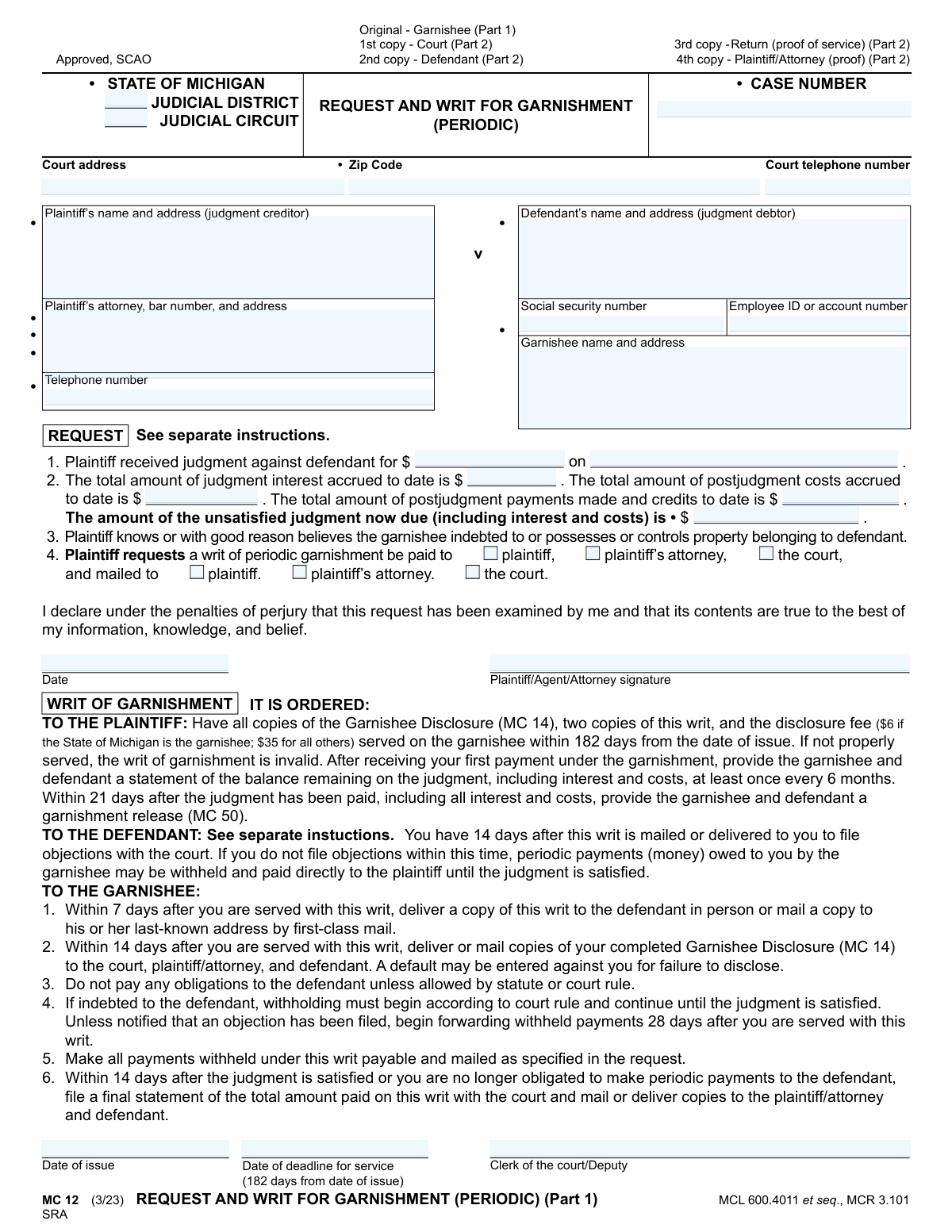
This is a legal document filed in Michigan courts by a judgment creditor to enforce a court judgment by seizing periodic payments, such as wages or rental income, owed to the judgment debtor by a third party (the garnishee). The writ orders the garnishee to withhold a portion of these payments and send them to the creditor until the judgment is fully paid. Today, this form can be filled out quickly and accurately using AI-powered services like Instafill.ai, which can also convert non-fillable PDF versions into interactive fillable forms.
MC 12 is part of the Michigan court forms category on Instafill.
Our AI automatically handles information lookup, data retrieval, formatting, and form filling.
It takes less than a minute to fill out MC 12 using our AI form filling.
Securely upload your data. Information is encrypted in transit and deleted immediately after the form is filled out.

Form specifications

Form name: Request and Writ for Garnishment (Periodic)
Number of fields: 85
Number of pages: 1
Language: English
main-image

Instafill Demo: How to fill out PDF forms in seconds with AI

How to Fill Out MC 12 Online for Free in 2026

Are you looking to fill out a MC 12 form online quickly and accurately? Instafill.ai offers the #1 AI-powered PDF filling software of 2026, allowing you to complete your MC 12 form in just 37 seconds or less.
Follow these steps to fill out your MC 12 form online using Instafill.ai:
  1. 1 Navigate to Instafill.ai and upload or select the Request and Writ for Garnishment (Periodic) form (MC 12).
  2. 2 Provide the court and case information, along with the names and addresses of the plaintiff (creditor), defendant (debtor), and the garnishee (e.g., the debtor's employer).
  3. 3 Enter the financial details of the judgment, including the original amount, date, accrued interest, post-judgment costs, and any payments already made.
  4. 4 Indicate who should receive the garnished payments and where they should be mailed by checking the appropriate boxes in the 'Request' section.
  5. 5 Review all the information populated by the AI for accuracy, ensuring all calculations for the unsatisfied judgment amount are correct.
  6. 6 Electronically sign and date the request section to declare the contents are true to the best of your knowledge.
  7. 7 Download the completed form to be filed with the court and served on the garnishee and defendant as required by court rules.

Our AI-powered system ensures each field is filled out correctly, reducing errors and saving you time.

Why Choose Instafill.ai for Your Fillable MC 12 Form?

Speed

Complete your MC 12 in as little as 37 seconds.

Up-to-Date

Always use the latest 2026 MC 12 form version.

Cost-effective

No need to hire expensive lawyers.

Accuracy

Our AI performs 10 compliance checks to ensure your form is error-free.

Security

Your personal information is protected with bank-level encryption.

Frequently Asked Questions About Form MC 12

This form is used by a creditor (plaintiff) who has won a court judgment to collect an outstanding debt. It legally directs a third party (the garnishee), like an employer, to withhold a portion of the debtor's (defendant's) regular payments and send them to the creditor.

The plaintiff (the person or entity owed money) or their attorney fills out the 'Request' section. The court clerk then signs and issues the 'Writ' portion, which is then served on the garnishee.

The garnishee is the person or entity, such as an employer or financial institution, that has control over the defendant's money or property. This form instructs the garnishee to redirect the defendant's periodic payments to the plaintiff.

You have 14 days after receiving the writ to file an objection with the court. You may object if you believe your income is exempt, the amount is wrong, or the judgment has already been paid.

To calculate this amount, start with the original judgment amount, add any accrued interest and post-judgment costs, and then subtract any payments the defendant has already made.

The plaintiff must arrange for the garnishee to be served with two copies of this writ, a Garnishee Disclosure form (MC 14), and the required disclosure fee ($35 for most, or $6 if the State of Michigan is the garnishee).

Yes, the writ must be served on the garnishee within 182 days from the date it is issued by the court. If it is not served within this timeframe, the writ becomes invalid.

As the garnishee, you must provide a copy to the defendant within 7 days, complete and return the Garnishee Disclosure (MC 14) within 14 days, and begin withholding payments as required by law. You will forward the funds to the plaintiff unless you are notified that an objection has been filed.

Yes, certain types of income are exempt by law, such as Social Security benefits, Supplemental Security Income (SSI), unemployment benefits, and veterans' benefits. A list of examples is provided in the form's instructions.

Within 21 days after the judgment is fully paid, the plaintiff is required to file a garnishment release (MC 50) with the court and provide copies to both the garnishee and the defendant. This officially stops the garnishment.

Yes, services like Instafill.ai use AI to accurately auto-fill form fields with your information, which can save time and reduce errors. This is helpful for ensuring details like case numbers, names, and addresses are entered correctly.

You can use a service like Instafill.ai to upload the PDF of the form. The platform makes the document interactive, allowing you to type your information directly into the fields and then download the completed form.

If you have a non-fillable or 'flat' PDF, you can use a tool like Instafill.ai to convert it into an interactive, fillable form. Simply upload your document, and the service will automatically identify the fields for you to complete online.

The defendant's Social Security Number and/or employee ID number are used by the garnishee, especially an employer, to accurately identify the correct individual. This ensures the garnishment is applied to the right person's wages.

Compliance MC 12
Validation Checks by Instafill.ai

1
Unsatisfied Judgment Calculation
This check verifies that the 'Unsatisfied Judgment Amount Due' is the correct sum of the initial judgment, interest, and costs, minus any payments. The formula is: (Judgment Amount + Judgment Interest + Postjudgment Costs) - Postjudgment Payments. This is critical for ensuring the garnishment is for the correct legal amount. A mismatch could invalidate the writ or lead to legal challenges for over-collection.
2
Service Deadline Calculation
This validation ensures the 'Date of deadline for service' is exactly 182 days after the 'Date of issue'. The form explicitly states this calculation, and it defines the legal window for serving the garnishee. If this date is calculated incorrectly, the plaintiff might miss the deadline, rendering the writ invalid and requiring the process to be restarted.
3
Judgment Date in Past
This check confirms that the 'Judgment Received Date' is a valid date that occurs before the date the request is signed. A garnishment can only be requested for a judgment that has already been granted. This prevents attempts to file for garnishments based on future or non-existent judgments, which would be legally baseless.
4
Defendant SSN Format
Validates that the 'Defendant Social Security Number' field, if provided, follows the standard XXX-XX-XXXX format. Although not always mandatory, a correctly formatted SSN is a key identifier for the garnishee (e.g., an employer) to correctly identify the debtor and apply the garnishment. An improperly formatted number can lead to processing errors or failure to identify the correct individual.
5
Required Party Information
Ensures that the name and address fields for the Plaintiff (judgment creditor), Defendant (judgment debtor), and Garnishee are all complete. These fields are fundamental to the legal process, identifying who is owed money, who owes it, and who controls the funds to be garnished. Missing information would make the writ unenforceable and legally deficient.
6
Payment Payee Selection
This check verifies that at least one checkbox under item 4 ('be paid to') is selected, indicating whether payments should go to the plaintiff, the plaintiff's attorney, or the court. The garnishee needs clear instructions on who to make payments to. Failure to specify a payee would leave the garnishee without direction, halting the payment process.
7
Payment Mailing Recipient Selection
This validation ensures at least one checkbox under item 4 ('and mailed to') is selected, specifying where payment checks should be sent. This is distinct from the payee and provides the physical mailing destination for the funds. Without a mailing recipient, payments cannot be delivered, defeating the purpose of the garnishment.
8
Request Signature and Date Presence
This check confirms that the 'Plaintiff/Agent/Attorney signature' and the corresponding date are both present on the request. The signature and date certify that the information is true under penalty of perjury, making the request legally valid. A missing signature or date would render the request incomplete and cause it to be rejected by the court clerk.
9
Service Date Consistency
Validates that the 'Date and time of service' on the Proof of Service section is on or after the 'Date of issue' and on or before the 'Date of deadline for service'. Service cannot legally occur before the writ is issued or after it has expired. This check ensures the service was performed within the legally mandated timeframe.
10
Proof of Service Method Selection
If the 'I served' checkbox is selected in the Proof of Service section, this check ensures that either the 'personally' or 'by registered or certified mail' checkbox is also selected. This is required to document the specific legal method used to serve the garnishee. Omitting this detail makes the proof of service incomplete and could be challenged.
11
Attorney Bar Number Format
If the 'Plaintiff's attorney' field is filled, this validation checks that the 'bar number' is also provided and follows the expected format for a Michigan attorney (e.g., 'P' followed by numbers). The bar number uniquely identifies the attorney and confirms their authority to act on the plaintiff's behalf. An invalid or missing number could lead to rejection or questions about representation.
12
Case Number Presence
This check ensures the 'Case Number' field is not empty. The case number is the primary identifier that links the garnishment request to the original judgment in the court's records. Without it, the court cannot process the writ, as it's impossible to verify the underlying judgment or file the document in the correct case file.
13
Financial Fields Numeric Format
Verifies that all monetary fields, such as 'Judgment Amount', 'Judgment Interest Amount', and 'Postjudgment Costs', contain only valid numeric characters (digits, decimal point). This ensures that the financial data is machine-readable and can be used in calculations without error. Non-numeric data would cause calculation failures and prevent the form from being processed correctly.
14
Mutually Exclusive Service Status
This validation ensures that the 'I served' and 'I have attempted to serve' checkboxes in the Proof of Service section are mutually exclusive; only one can be selected. A process server either successfully serves the documents or they do not. Selecting both would create a logical contradiction in the legal declaration of service.

Common Mistakes in Completing MC 12

Saved over 80 hours a year

“I was never sure if my IRS forms like W-9 were filled correctly. Now, I can complete the forms accurately without any external help.”

Kevin Martin Green

Your data stays secure with advanced protection from Instafill and our subprocessors

Robust compliance program

Transparent business model

You’re not the product. You always know where your data is and what it is processed for.

ISO 27001, HIPAA, and GDPR

Our subprocesses adhere to multiple compliance standards, including but not limited to ISO 27001, HIPAA, and GDPR.

Security & privacy by design

We consider security and privacy from the initial design phase of any new service or functionality. It’s not an afterthought, it’s built-in, including support for two-factor authentication (2FA) to further protect your account.

Fill out MC 12 with Instafill.ai

Worried about filling PDFs wrong? Instafill securely fills request-and-writ-for-garnishment-periodic forms, ensuring each field is accurate.